Waiver of Lien Agreement by Subcontractor
Overview of this form
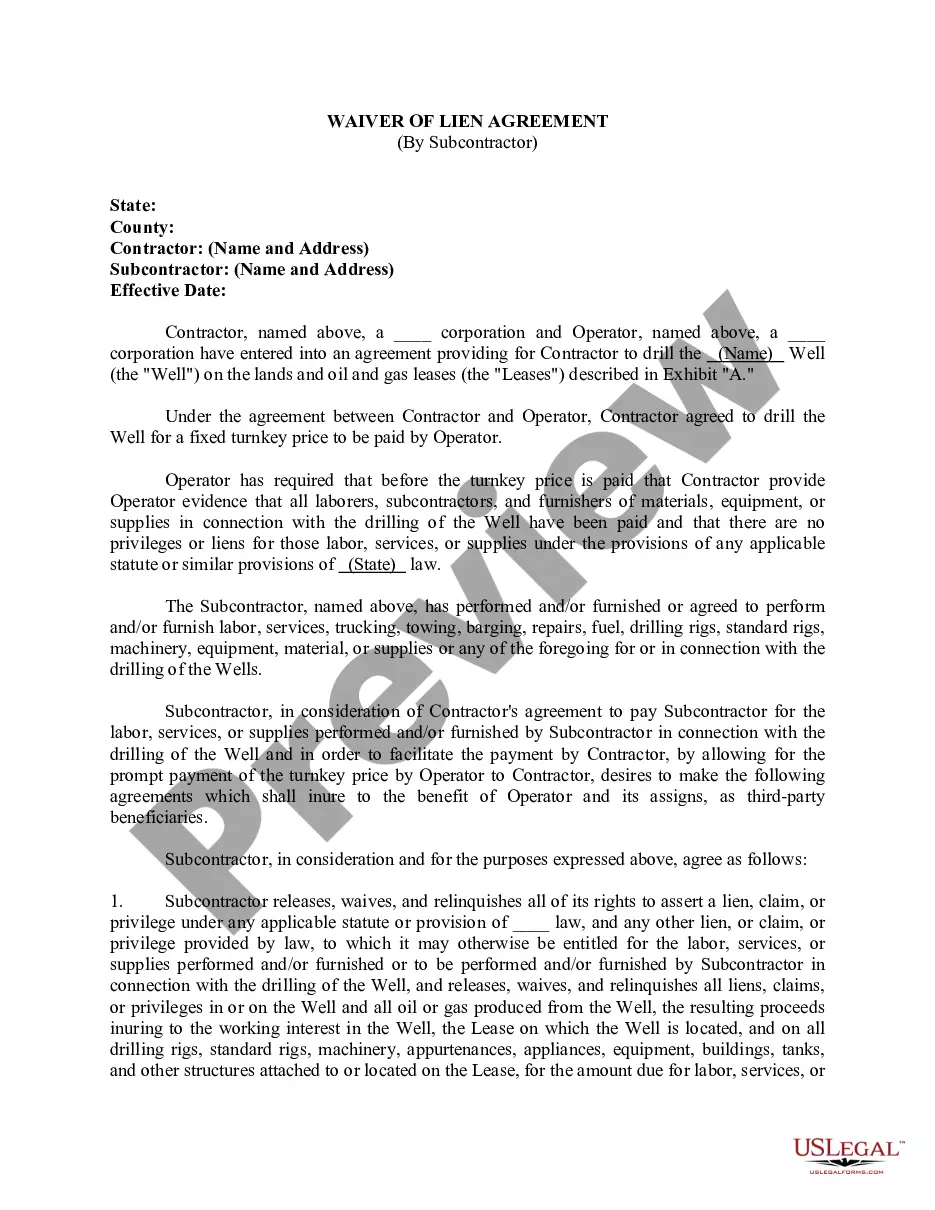
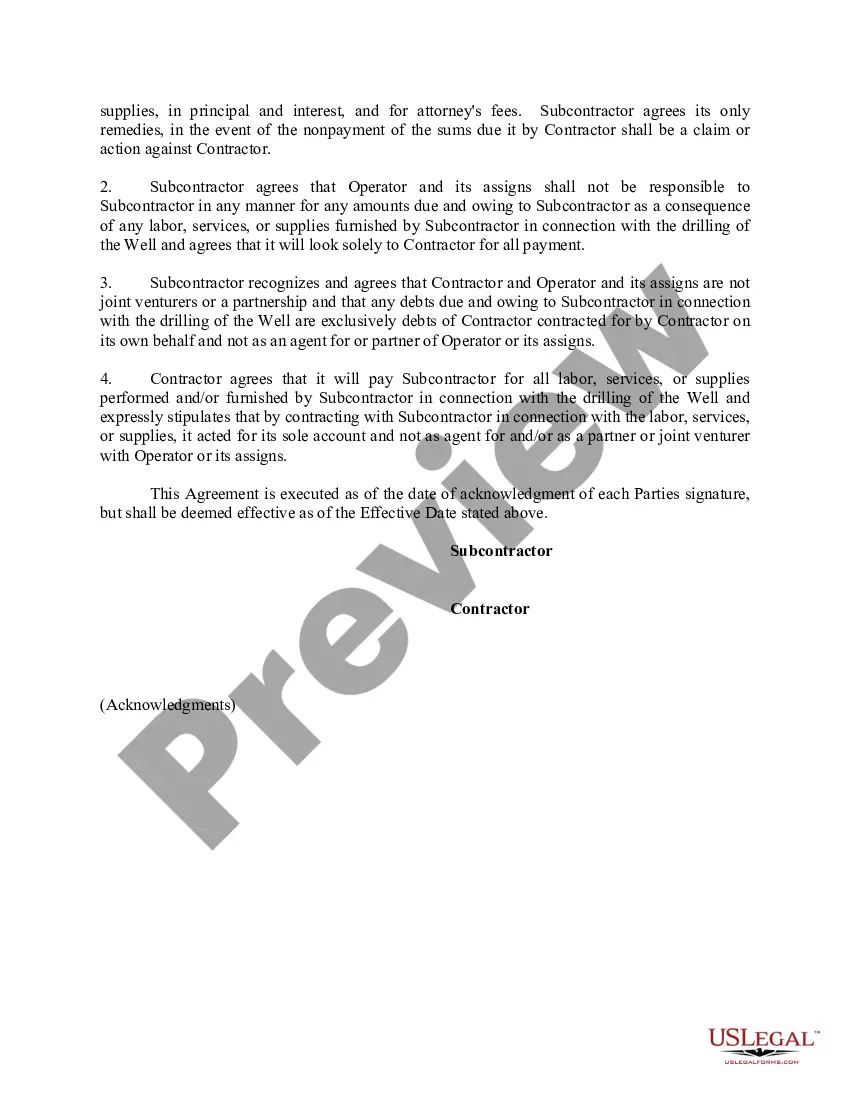
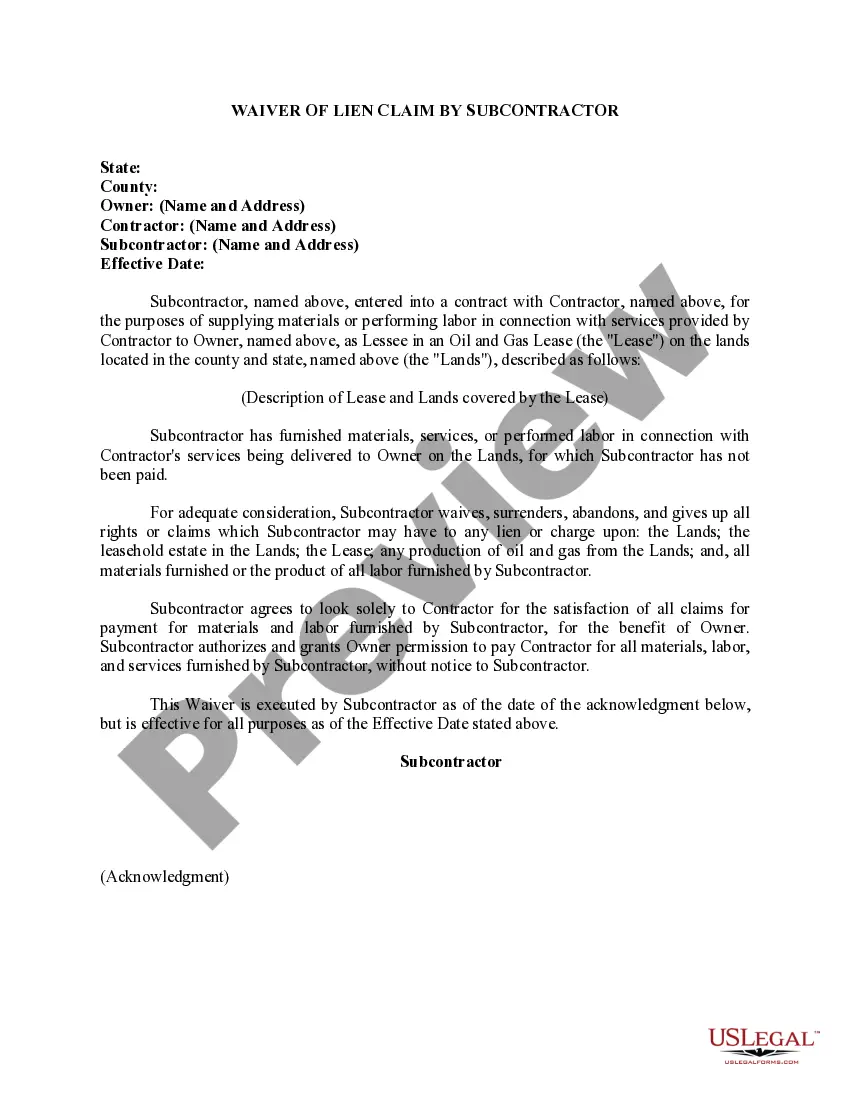
The Waiver of Lien Agreement by Subcontractor is a legal document that allows a subcontractor to waive their right to place a lien on a property or well for unpaid labor, materials, or services related to drilling. This form is essential in the construction and oil drilling industries, where clarity regarding payment and rights is crucial. By using this form, subcontractors agree to release claims against the contractor and the associated operator, facilitating smoother payment processes.
Key components of this form
- Identification of the subcontractor and contractor, including their addresses.
- Effective date of the agreement.
- Clear statement of rights waived by the subcontractor regarding liens and claims.
- Agreement that the subcontractor will seek payment solely from the contractor.
- Provisions regarding the nature of the relationship between the contractor and operator.
When to use this form
This form should be used when a subcontractor has worked on a drilling project and needs to confirm their waiver of lien rights. It is typically required when a contractor seeks to assure an operator that all subcontractors and laborers have been paid to facilitate the payment process for construction or drilling services. This form helps to prevent potential disputes and encumbrances on the property being worked on.
Intended users of this form
- Subcontractors providing labor, services, or materials in oil and gas drilling projects.
- Contractors looking to streamline payment processes with operators.
- Operators requiring assurances that no liens exist from subcontractors.
- Legal professionals assisting clients with drilling agreements.
How to complete this form
- Identify the subcontractor and contractor by entering their names and addresses.
- Specify the effective date of the agreement.
- Clearly outline the labor, services, or materials provided by the subcontractor.
- Include language waiving any future lien rights related to the well or drilling equipment.
- Ensure both parties sign and date the document.
Is notarization required?
In most cases, this form does not require notarization. However, some jurisdictions or signing circumstances might. US Legal Forms offers online notarization powered by Notarize, accessible 24/7 for a quick, remote process.
Get your form ready online
Our built-in tools help you complete, sign, share, and store your documents in one place.
Make edits, fill in missing information, and update formatting in US Legal Forms—just like you would in MS Word.
Download a copy, print it, send it by email, or mail it via USPS—whatever works best for your next step.
Sign and collect signatures with our SignNow integration. Send to multiple recipients, set reminders, and more. Go Premium to unlock E-Sign.
If this form requires notarization, complete it online through a secure video call—no need to meet a notary in person or wait for an appointment.
We protect your documents and personal data by following strict security and privacy standards.

Make edits, fill in missing information, and update formatting in US Legal Forms—just like you would in MS Word.

Download a copy, print it, send it by email, or mail it via USPS—whatever works best for your next step.

Sign and collect signatures with our SignNow integration. Send to multiple recipients, set reminders, and more. Go Premium to unlock E-Sign.

If this form requires notarization, complete it online through a secure video call—no need to meet a notary in person or wait for an appointment.

We protect your documents and personal data by following strict security and privacy standards.
Avoid these common issues
- Failing to complete all required fields, particularly names and addresses.
- Not specifying the effective date of the agreement.
- Omitting signatures or acknowledgement sections from relevant parties.
- Misunderstanding the implications of waiving lien rights.
Why complete this form online
- Easy access to legal templates drafted by licensed attorneys.
- Convenience of completing the form at your own pace.
- Editable document that can be customized to suit specific needs.
- Reliable legal structure ensuring compliance with regulations.
Looking for another form?
Form popularity
FAQ
Legally, an unpaid contractor, subcontractor or supplier can file a lien (sometimes called a mechanic's lien) that could eventually force the sale of your home in place of compensation.Conversely, if the contractor who worked on your project does not pay for materials, a supplier could place a lien on your property.
The simplest way to prevent liens and ensure that subcontractors and suppliers are paid is to pay with joint checks. This is when both parties endorse the check. Compare the contractor's materials or labor bill to the schedule of payments in your contract and the Preliminary Notices.
In fact, the subcontractor doesn't have any contract with the owner neither written nor verbal!However, presuming that the subcontractor on the project has a written contract with someone, they can still file a lien even if they don't have a written agreement with the property owner.
Conditional lien waivers are provided by contractors or suppliers before they've been paid.The form says they will waive their right to lien once they receive the payment, so they can't file a lien after payment has been received.
If a general contractor refuses to pay his subcontractors, they can make a claim against the payment bond. The surety company will pay out the subcontractors for at least part of their money and take the contractor to court.
If a creditor gets a judgment against you, it can then place a lien on your property. The lien gives the creditor an interest in your property so that it can get paid for the debt you owe.And in some cases, the lien gives the creditor the right to force a sale of your property in order to get paid.
A lien is a legal right or claim against a property by a creditor. Liens are commonly placed against property, such as homes and cars, so creditors, such as banks and credit unions, can collect what is owed to them. Liens can also be removed, giving the owner full and clear title to the property.
How Liens Work. A lien provides a creditor with the legal right to seize and sell the collateral property or asset of a borrower who fails to meet the obligations of a loan or contract. The property that is the subject of a lien cannot be sold by the owner without the consent of the lien holder.
The lien agreement form is a security measure taken by the creditor by which an asset owned by the debtor cannot be sold before the creditor is repaid in full.