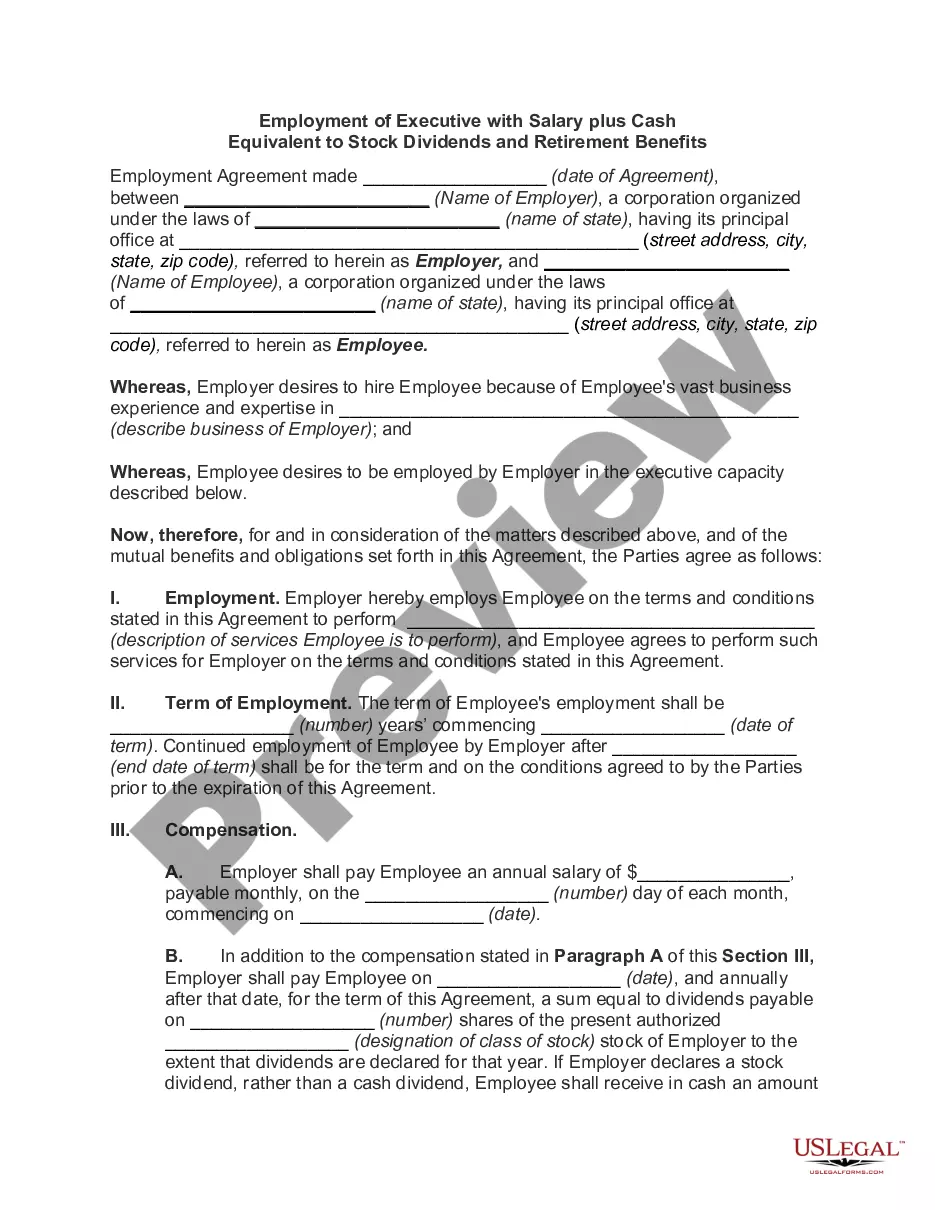
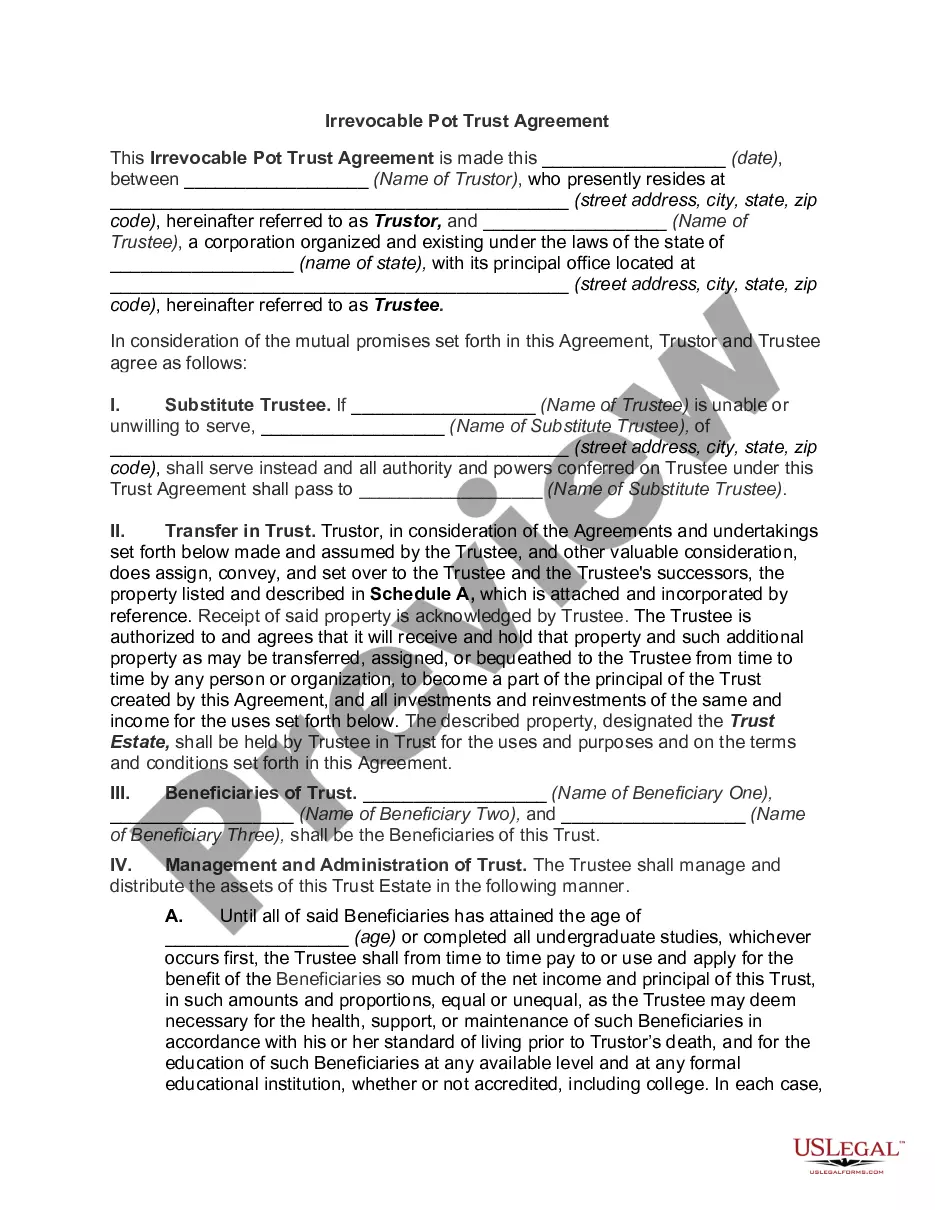
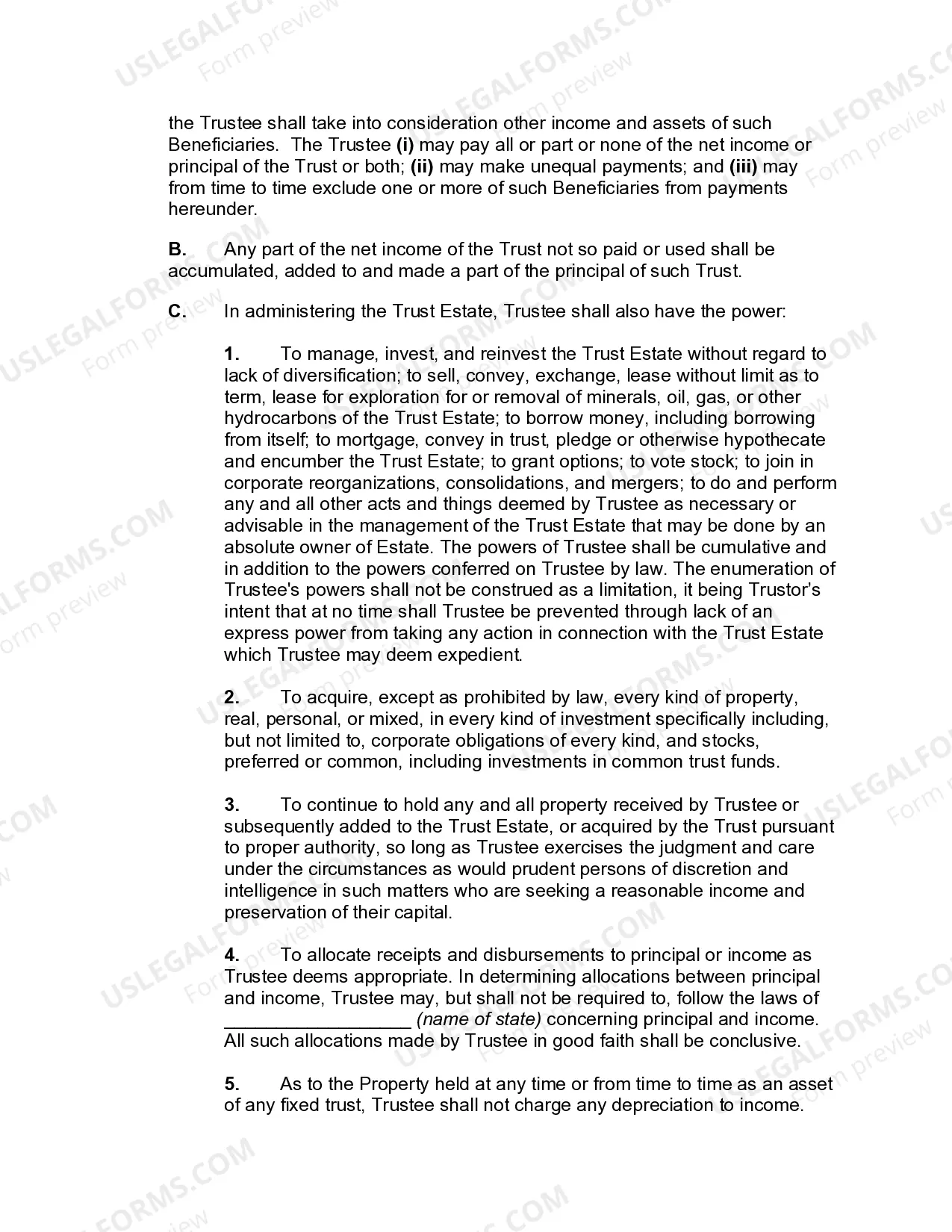
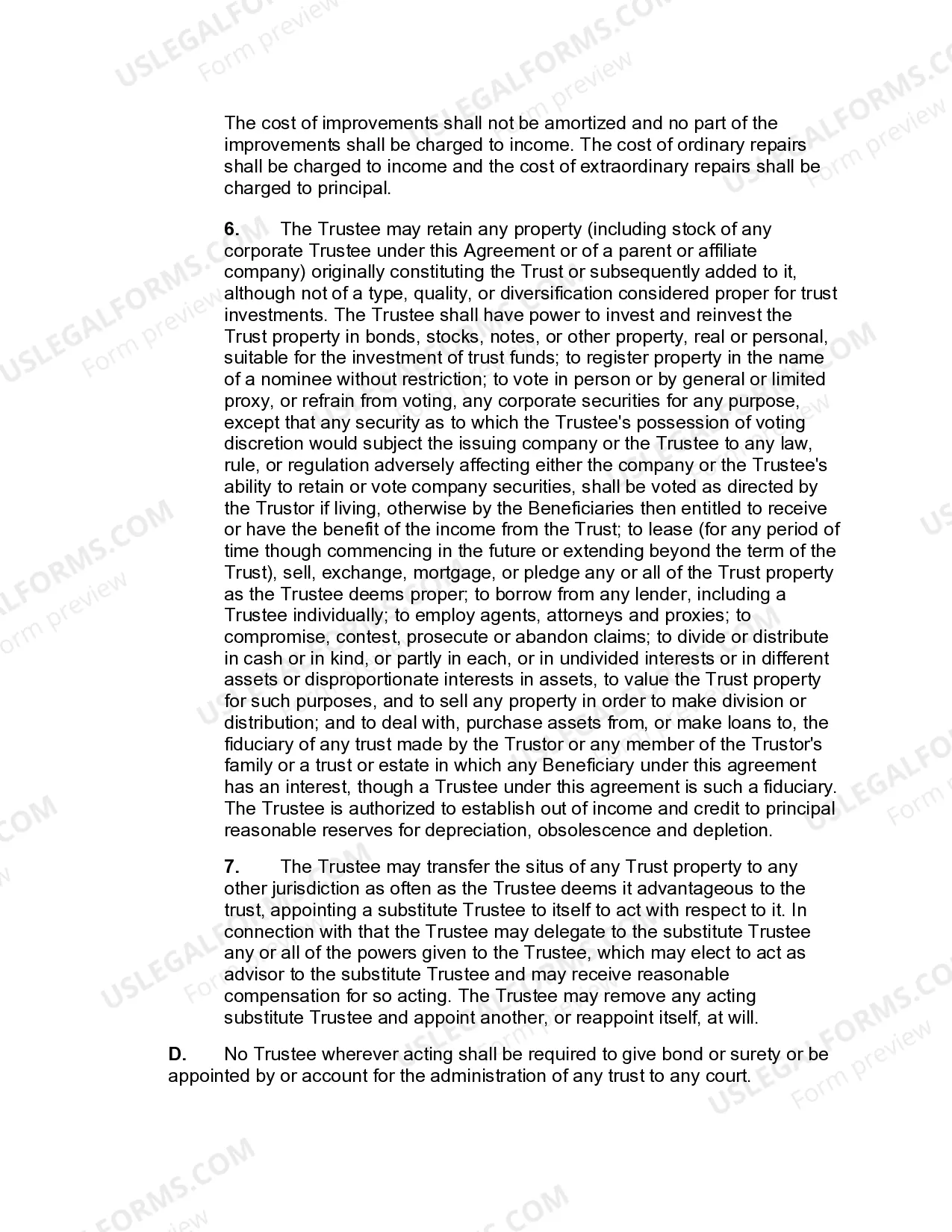
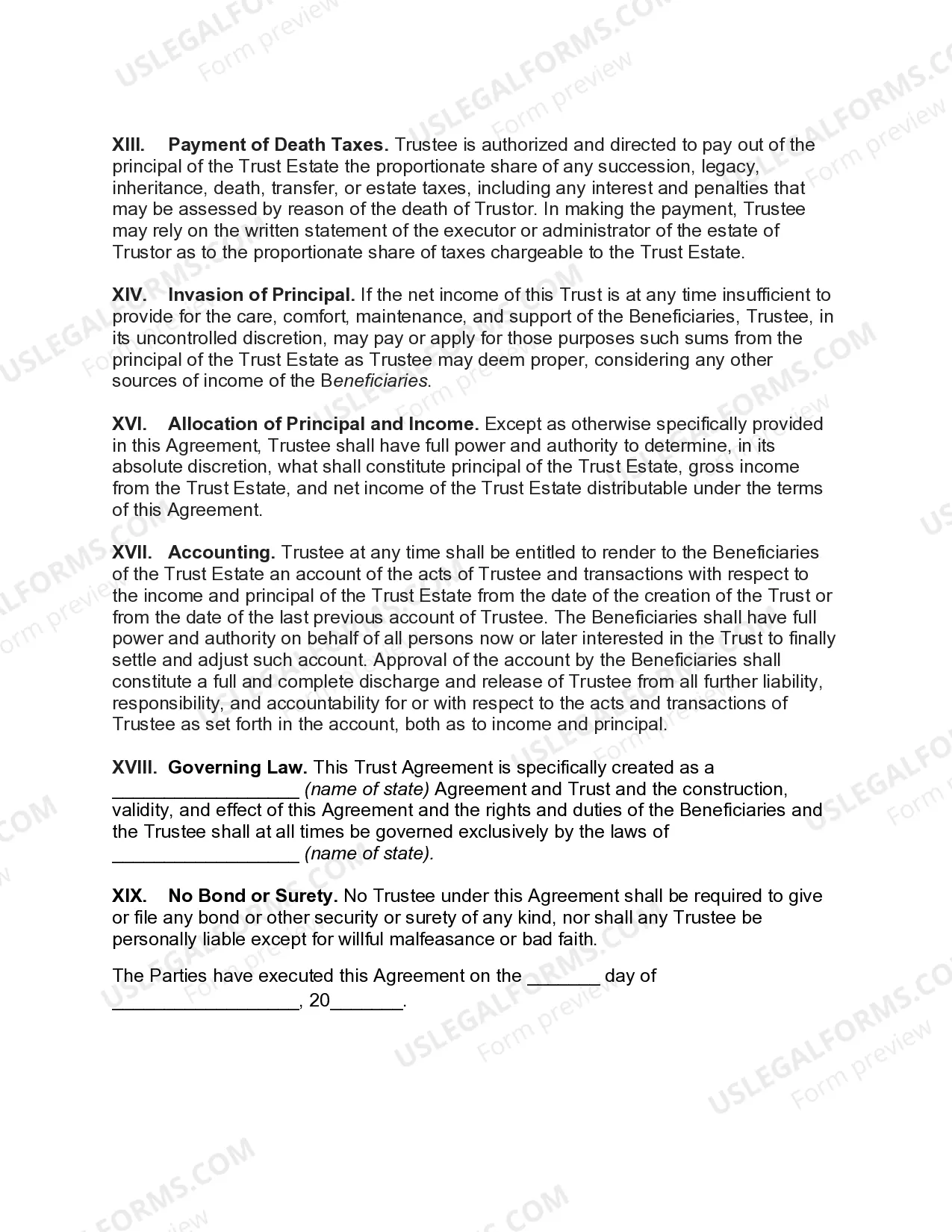
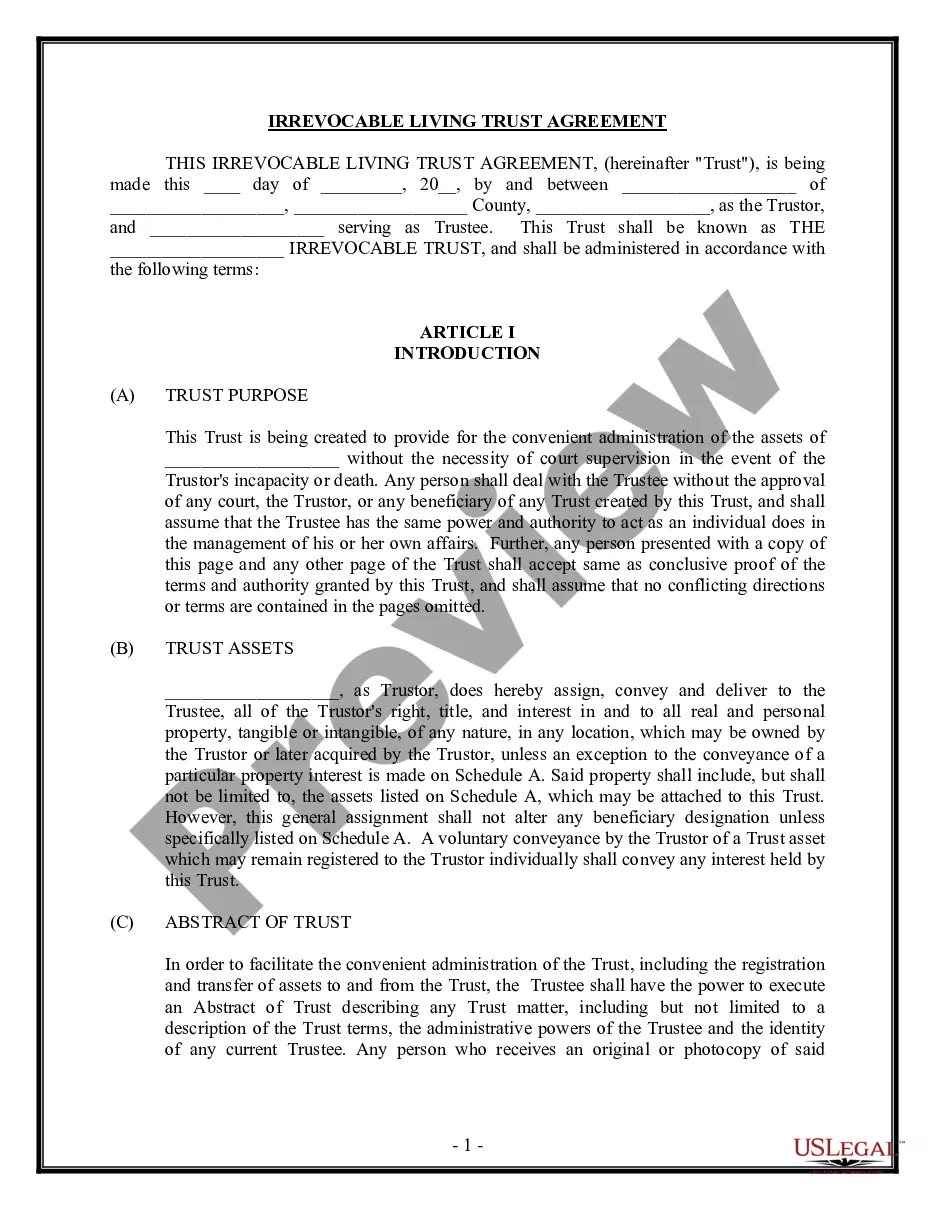
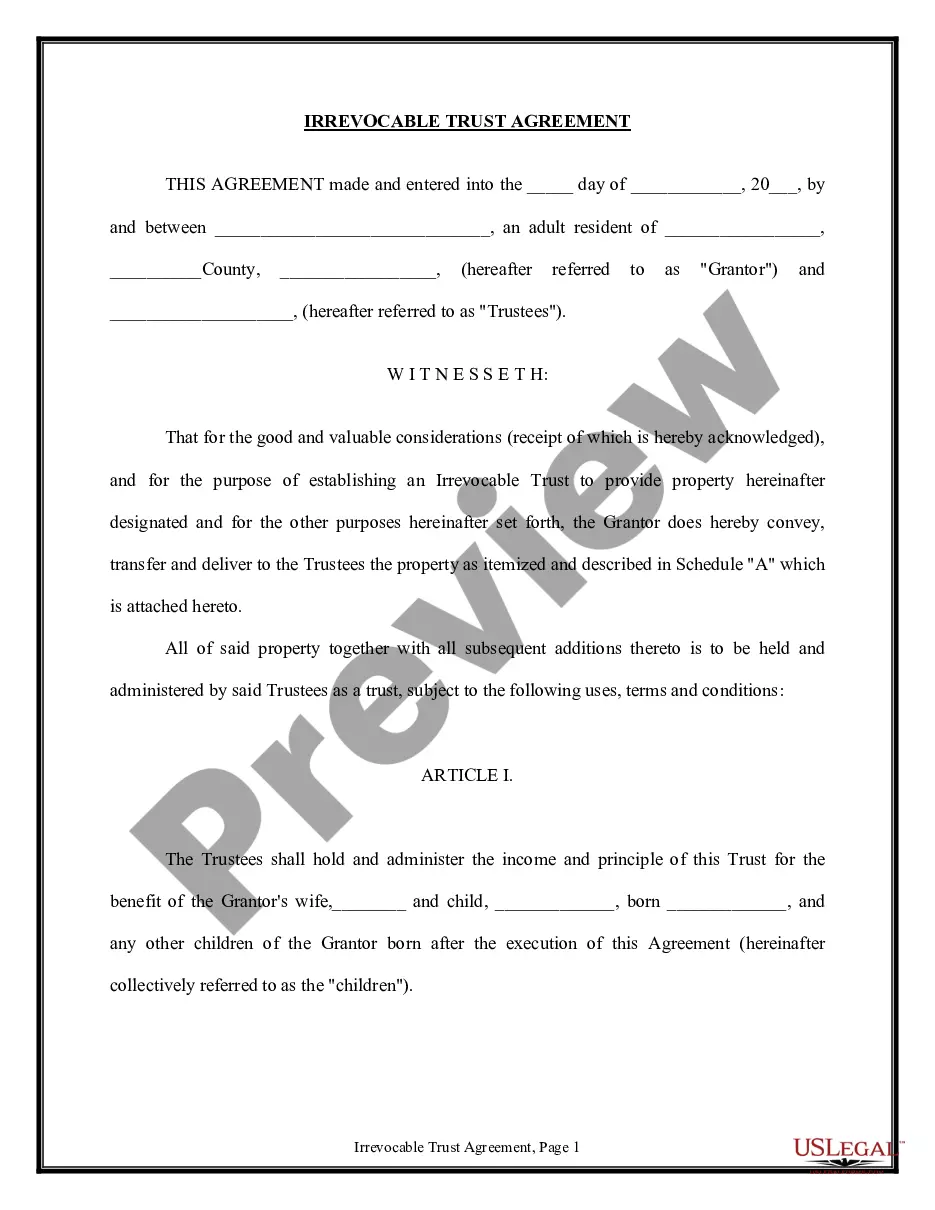
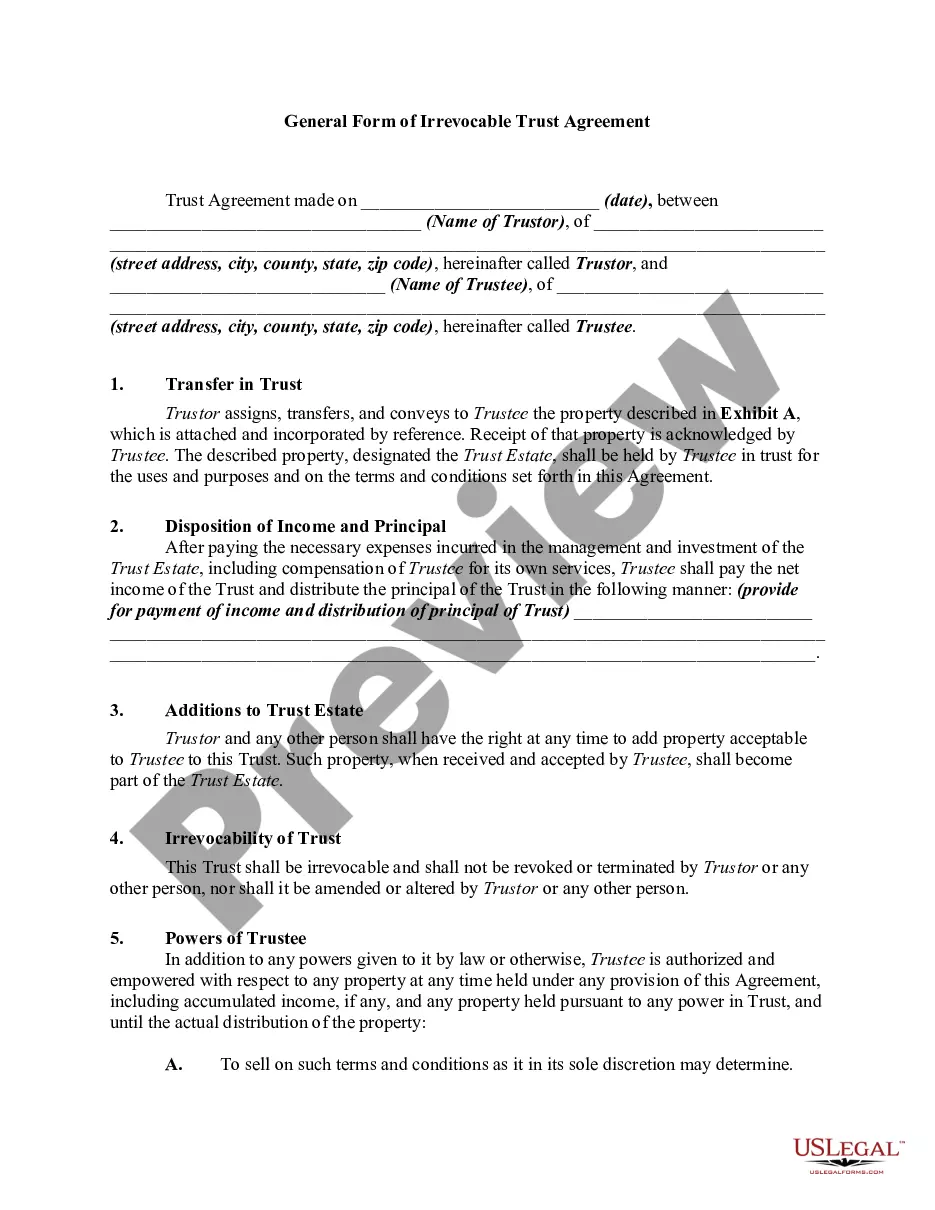
An irrevocable trust is a trust that cannot be modified or terminated without the permission of the beneficiary. In most states, a trust will be deemed irrevocable unless the Trustor specifies otherwise. Once the Trustor has transferred assets into the trust, s/he has no rights of ownership to the assets and the trust. Irrevocable trusts are preferred because it removes all incidents of ownership, thereby effectively removing the trust's assets from the grantor's taxable estate. The Trustor is also relieved of the tax liability on the income generated by the assets. This is the opposite of a "revocable trust", which allows the Trustor to modify the trust.
A Pot Trust is a trust set up for more than one beneficiary, typically children. The purpose of a Pot Trust is to keep the funds in one pot until a later event. For example, at the death of the parents, the assets may be kept in one pot until all the children have graduated from college or reached age 21.
Indiana Irrevocable Pot Trust Agreement
Instant download
Description
Free preview



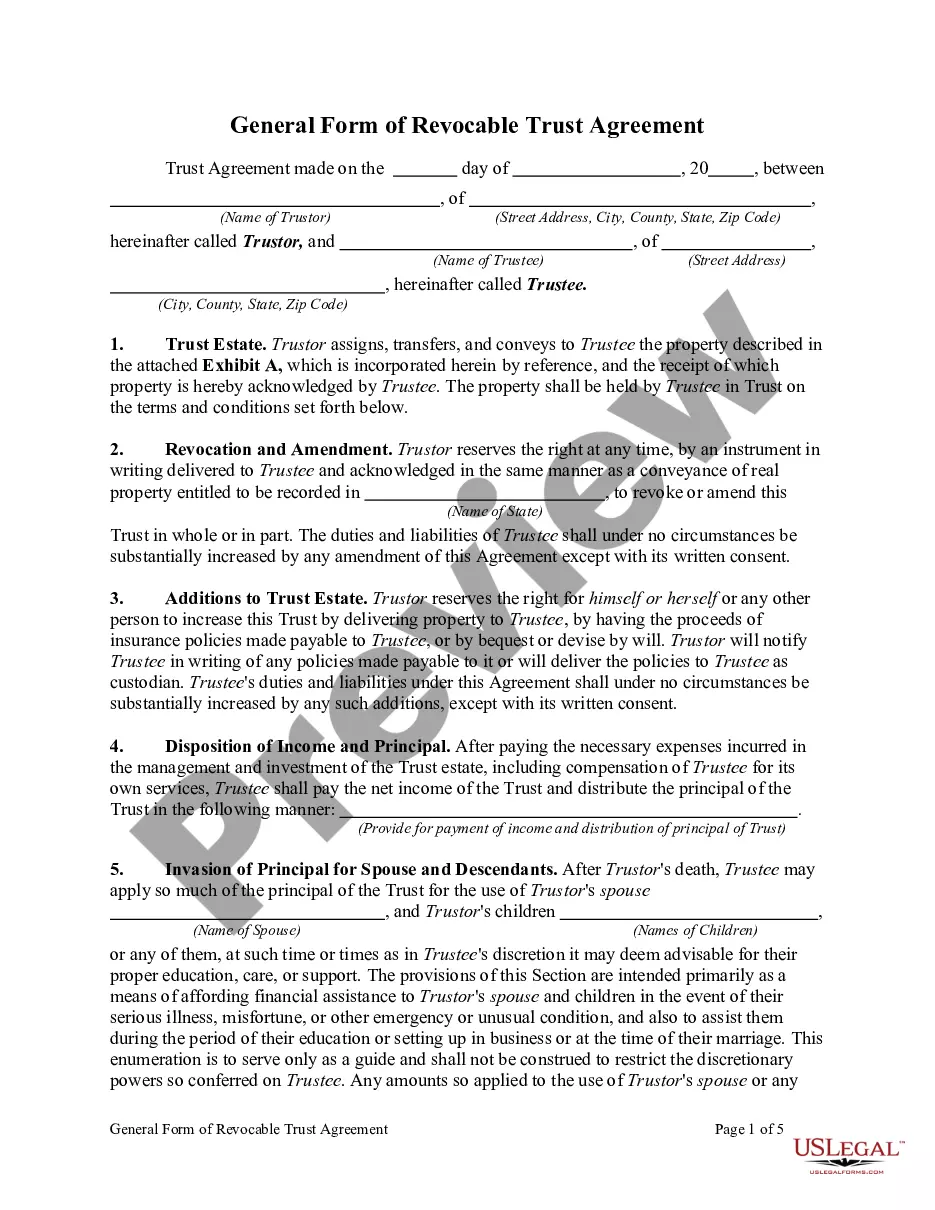
Get your form ready online
Our built-in tools help you complete, sign, share, and store your documents in one place.
Built-in online Word editor
Make edits, fill in missing information, and update formatting in US Legal Forms—just like you would in MS Word.
Export easily
Download a copy, print it, send it by email, or mail it via USPS—whatever works best for your next step.
E-sign your document
Sign and collect signatures with our SignNow integration. Send to multiple recipients, set reminders, and more. Go Premium to unlock E-Sign.
Notarize online 24/7
If this form requires notarization, complete it online through a secure video call—no need to meet a notary in person or wait for an appointment.
Store your document securely
We protect your documents and personal data by following strict security and privacy standards.

Make edits, fill in missing information, and update formatting in US Legal Forms—just like you would in MS Word.

Download a copy, print it, send it by email, or mail it via USPS—whatever works best for your next step.

Sign and collect signatures with our SignNow integration. Send to multiple recipients, set reminders, and more. Go Premium to unlock E-Sign.

If this form requires notarization, complete it online through a secure video call—no need to meet a notary in person or wait for an appointment.

We protect your documents and personal data by following strict security and privacy standards.
Looking for another form?
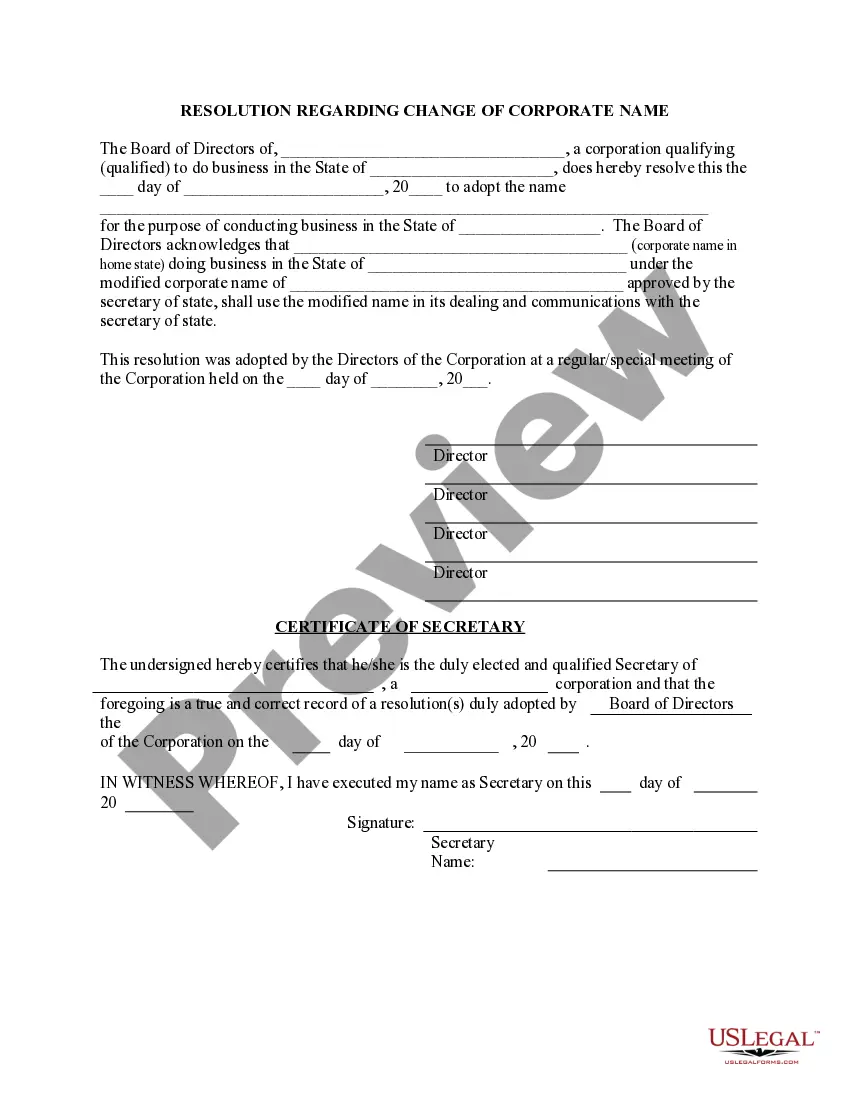


How to fill out Irrevocable Pot Trust Agreement?
US Legal Forms - one of the largest collections of legal documents in the USA - offers a range of legal document templates that you can download or print.
By using the website, you will find thousands of forms for corporate and personal purposes, organized by categories, states, or keywords. You can access the most recent versions of forms such as the Indiana Irrevocable Pot Trust Agreement within moments.
If you possess a membership, Log In to download the Indiana Irrevocable Pot Trust Agreement from the US Legal Forms library. The Download button will appear on every form you view. You can access all previously obtained forms from the My documents tab of your account.
Finalize the transaction by using your credit card or PayPal account.
Choose the format and download the form to your device. Make edits. Complete, modify, print, and sign the downloaded Indiana Irrevocable Pot Trust Agreement.
Every design you add to your account has no expiration date and is yours indefinitely. Therefore, if you wish to download or print another copy, simply navigate to the My documents section and click on the form you need.
Access the Indiana Irrevocable Pot Trust Agreement with US Legal Forms, the most extensive library of legal document templates. Utilize thousands of professional and state-specific templates that meet your corporate or personal needs and requirements.
- Ensure you have selected the correct form for your town/county.
- Click on the Preview button to review the form's content.
- Check the form summary to confirm that you have chosen the appropriate form.
- If the form does not fit your needs, use the Search field at the top of the screen to find one that does.
- When you are satisfied with the form, confirm your selection by clicking the Download now button.
- Then, select the pricing plan you prefer and provide your information to register for the account.
Form popularity
FAQ
If the trust is a revocable living trust, as the name implies, the Settlor may modify or terminate the trust at any time. An irrevocable living trust, however, cannot be modified or revoked by the Settlor at any time nor for any reason once active.
When an irrevocable trust makes a distribution, it deducts the income distributed on its own tax return and issues the beneficiary a tax form called a K-1. This form shows the amount of the beneficiary's distribution that's interest income as opposed to principal.
An irrevocable trust is a very powerful tool for Medicaid Asset Protection, as it allows you to shelter assets from a nursing home after they have been in the trust for five years.
Unless the terms of a trust expressly provide that the trust is irrevocable, the settlor may revoke or amend the trust.
A trust established under this chapter must be an irrevocable trust and may not be revoked or terminated by the authority or any other person, nor may it be amended or altered by the authority or any other person. However, the terms of the trust must provide that the trust terminates when no funds remain in the trust.
The downside to irrevocable trusts is that you can't change them. And you can't act as your own trustee either. Once the trust is set up and the assets are transferred, you no longer have control over them.
Terminating an irrevocable trust and distributing its assets to beneficiaries can result in a levy of gift taxes and income taxes on you as well as the beneficiaries. For this reason, it would be wise to consult a tax or estate attorney before making any amendments to an irrevocable trust, or attempting to revoke it.
Irrevocable trusts are generally set up to minimize estate taxes, access government benefits, and protect assets. This is in contrast to a revocable trust, which allows the grantor to modify the trust, but loses certain benefits such as creditor protection.
As discussed above, irrevocable trusts are not completely irrevocable; they can be modified or dissolved, but the settlor may not do so unilaterally. The most common mechanisms for modifying or dissolving an irrevocable trust are modification by consent and judicial modification.
IRREVOCABLE TRUSTS These trusts are used by people who are exposed to estate taxes. When you convey assets into an irrevocable wealth preservation trust, you are removing the assets from your own name for estate tax purposes. Irrevocable trusts can also be used to protect assets from litigants seeking redress.