Indiana Independent Contractor Agreement Between Licensed Counselor and Therapist and Licensed Counselor and Therapist Practicing as a Solo Practitioner

State:
Multi-State
Control #:
US-02565BG
Format:
Word; 
Rich Text
Instant download

Description

An independent contractor is a person or business who performs services for another person pursuant to an agreement and who is not subject to the other's control, or right to control, the manner and means of performing the services. The exact nature of the independent contractor's relationship with the hiring party is important since an independent contractor pays his/her own Social Security, income taxes without payroll deduction, has no retirement or health plan rights, and often is not entitled to worker's compensation coverage. The traditional tests to determine whether a worker is an employee or independent contractor involve the concept of control. The Internal Revenue Service (IRS) developed 20 factors used to determine whether a worker is an independent contractor under the common law. A "yes" answer to any of these questions would be evidence of an employer-employee relationship.

" Does the principal provide instructions to the worker about when, where, and how he or she is to perform the work?


" Does the principal provide training to the worker?

" Are the services provided by the worker integrated into the principal's business operations?

" Must the services be rendered personally by the worker?

" Does the principal hire, supervise and pay assistants to the worker?

" Is there a continuing relationship between the principal and the worker?

" Does the principal set the work hours and schedule?

" Does the worker devote substantially full time to the business of the principal?

" Is the work performed on the principal's premises?

" Is the worker required to perform the services in an order or sequence set by the principal?

" Is the worker required to submit oral or written reports to the principal?

" Is the worker paid by the hour, week, or month?

" Does the principal have the right to discharge the worker at will?

" Can the worker terminate his or her relationship with the principal any time he or she wishes without incurring liability to the principal?

" Does the principal pay the business or traveling expenses of the worker?

A "yes" answer to any of these questions would be evidence of an independent contractor relationship.


" Does the worker furnish significant tools, materials and equipment?

" Does the worker have a significant investment in facilities?

" Can the worker realize a profit or loss as a result of his or her services?

" Does the worker provide services for more than one firm at a time?

" Does the worker make his or her services available to the general public?
Free preview
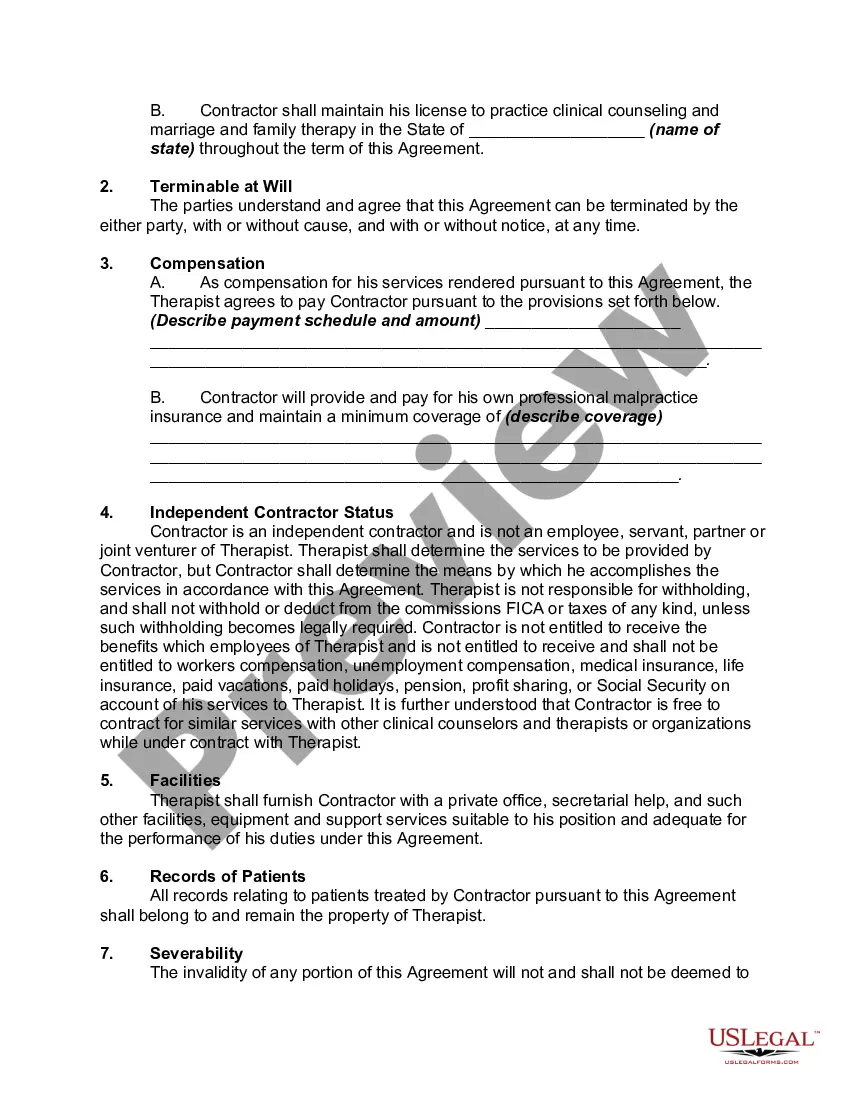
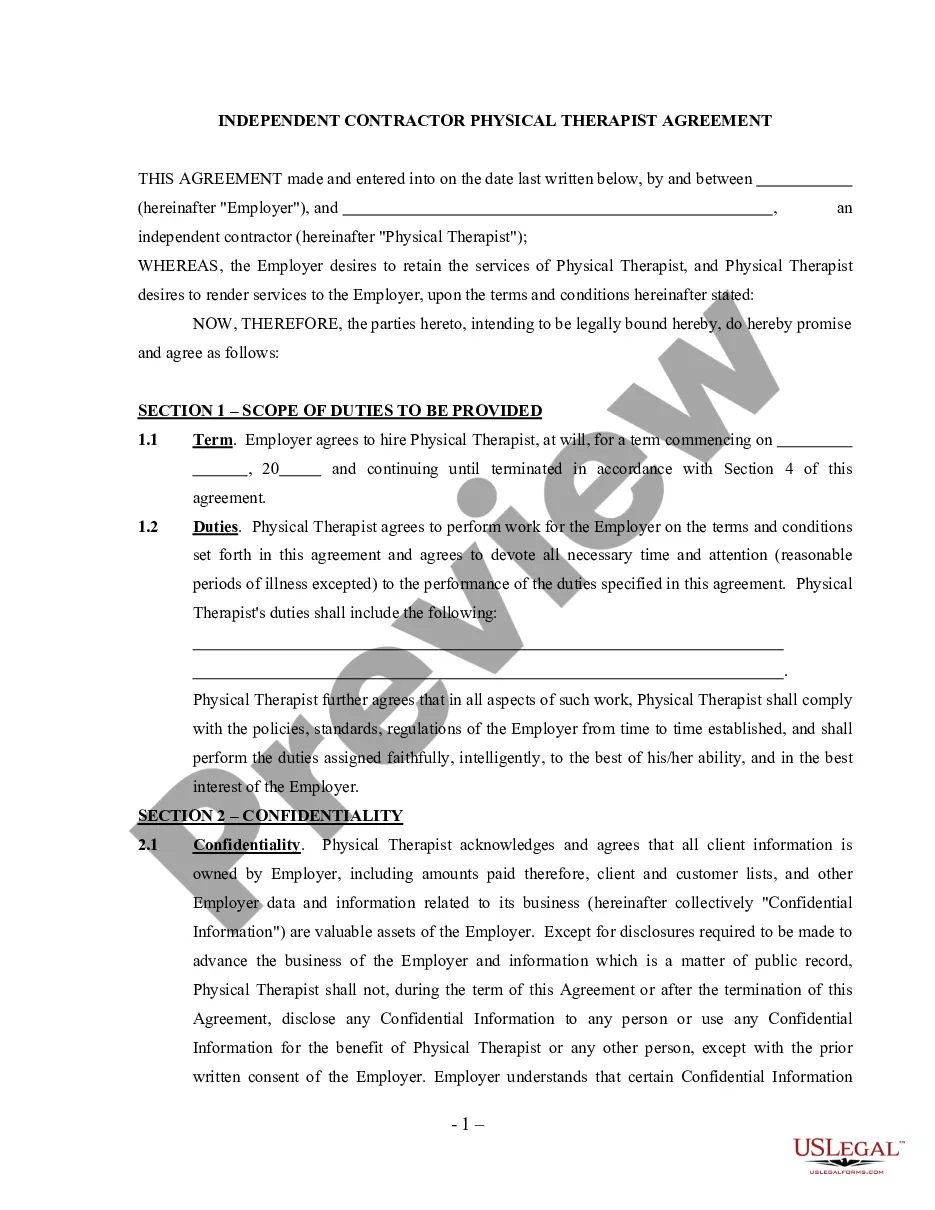
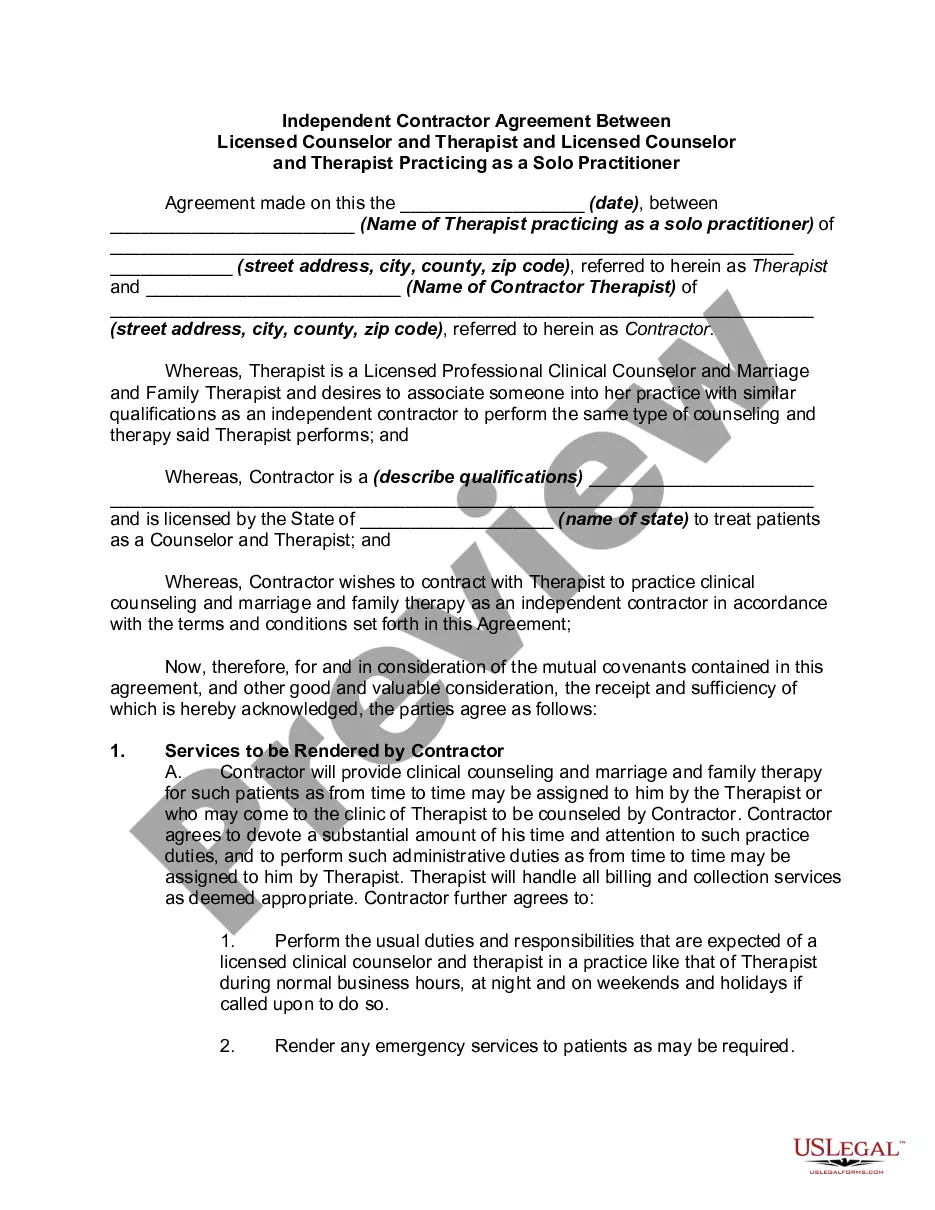
  • Preview Independent Contractor Agreement Between Licensed Counselor and Therapist and Licensed Counselor and Therapist Practicing as a Solo Practitioner
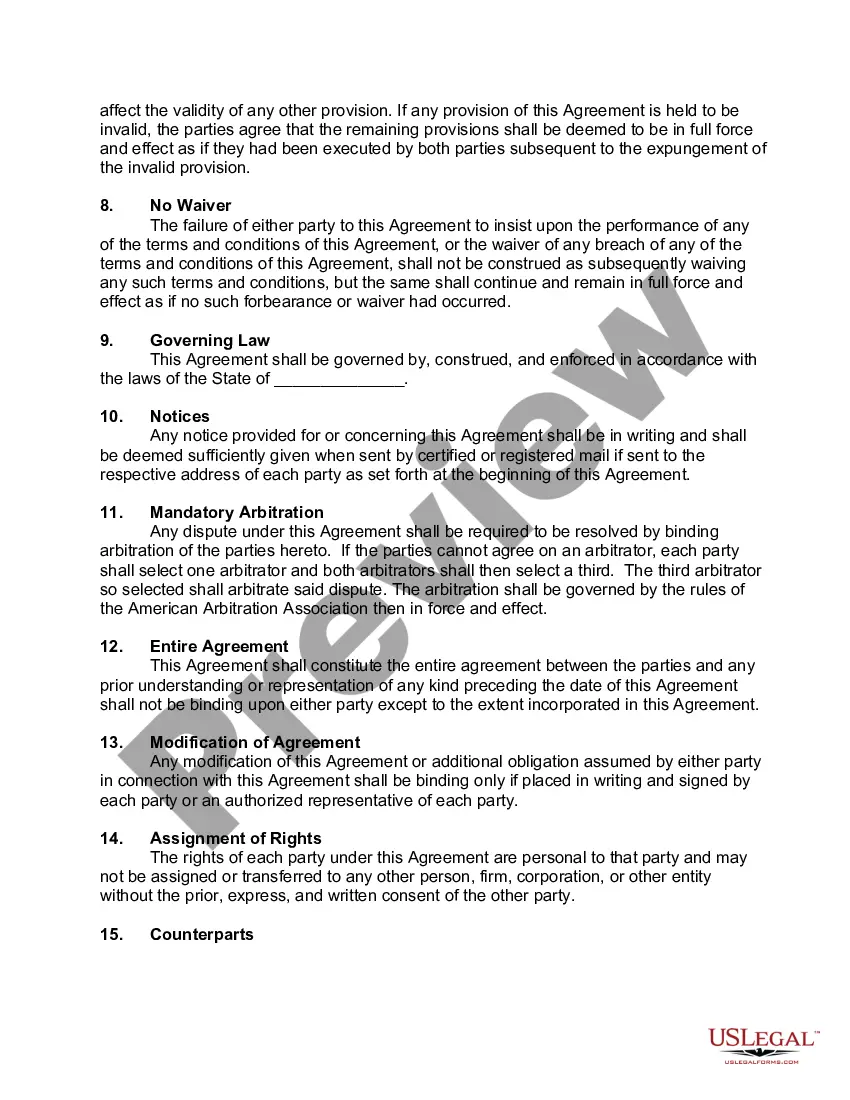
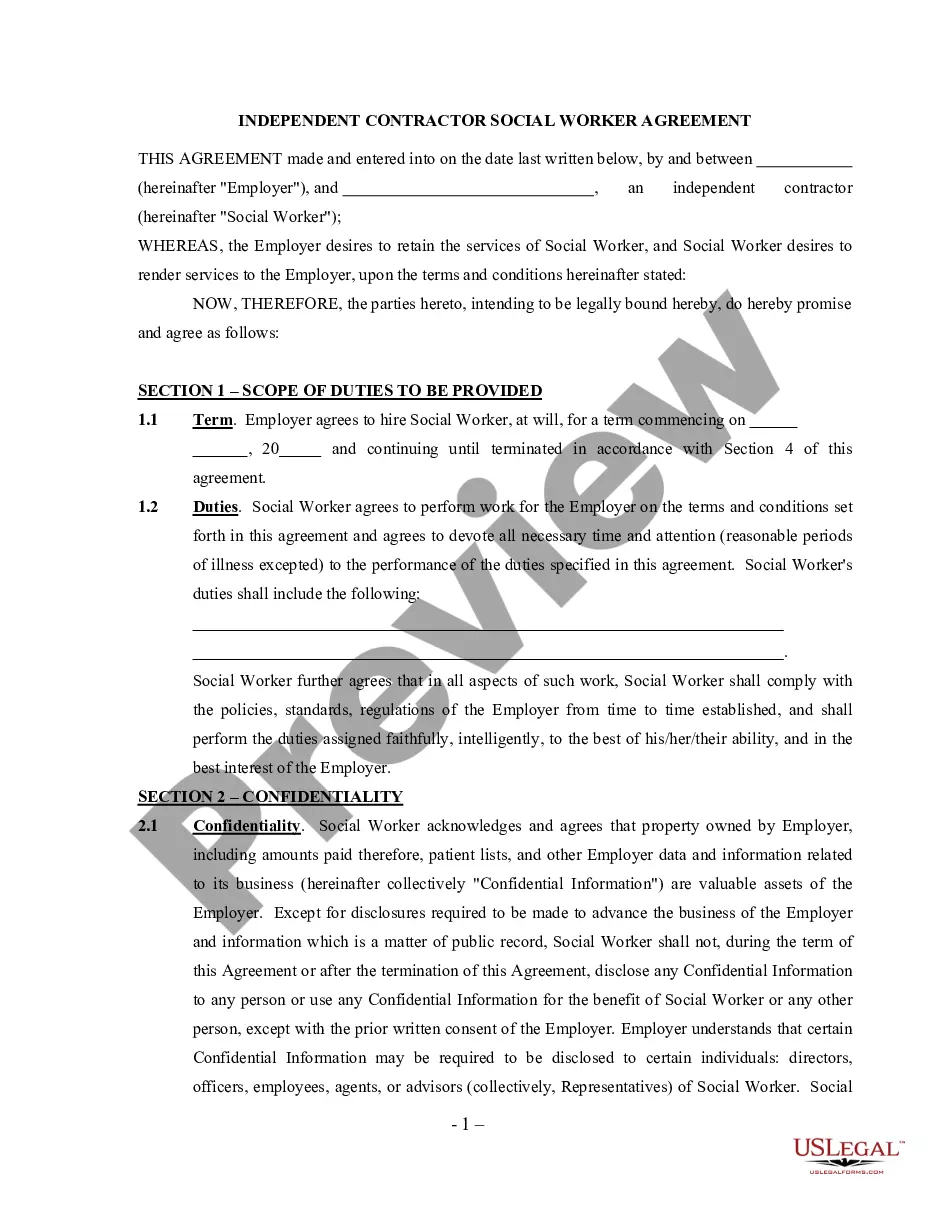
  • Preview Independent Contractor Agreement Between Licensed Counselor and Therapist and Licensed Counselor and Therapist Practicing as a Solo Practitioner
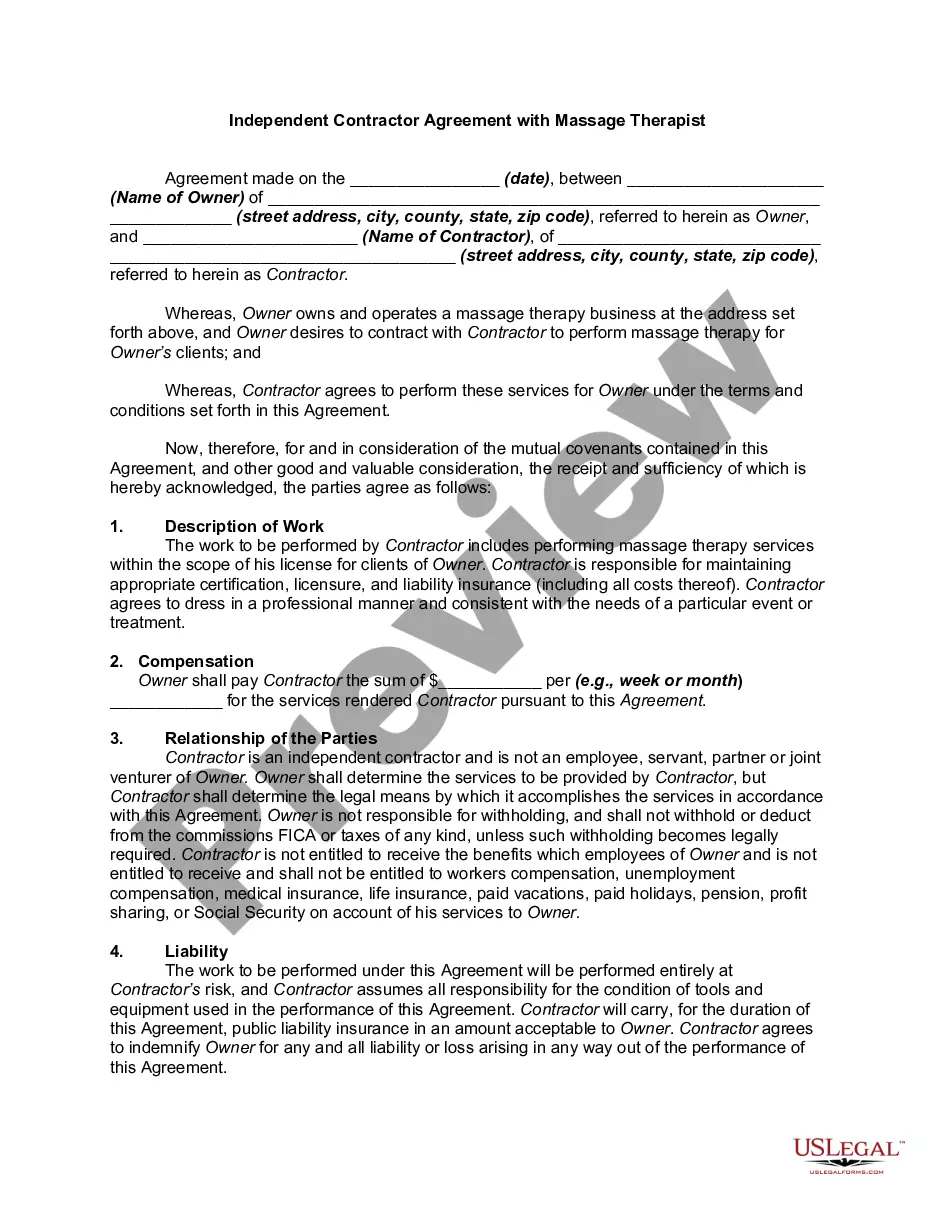
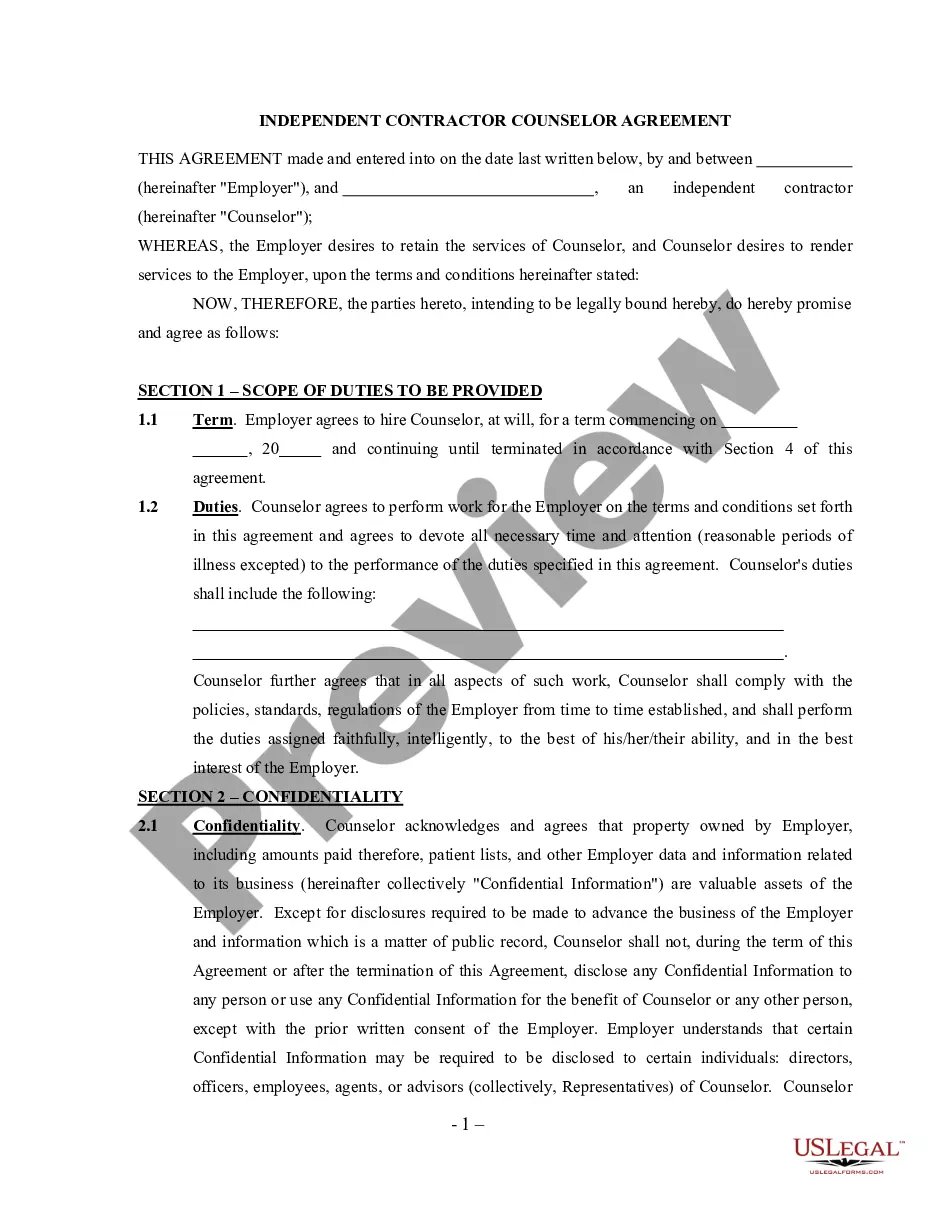
  • Preview Independent Contractor Agreement Between Licensed Counselor and Therapist and Licensed Counselor and Therapist Practicing as a Solo Practitioner
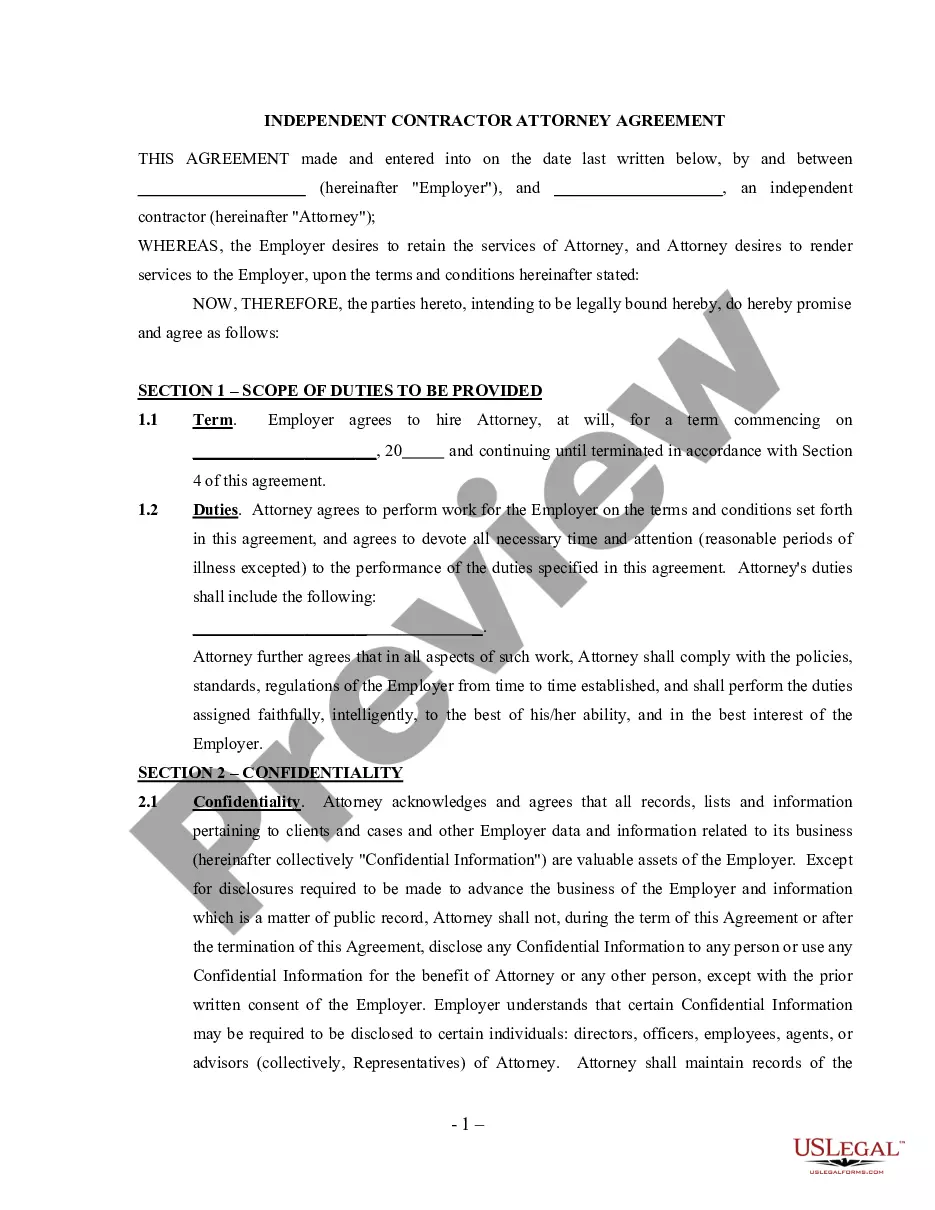
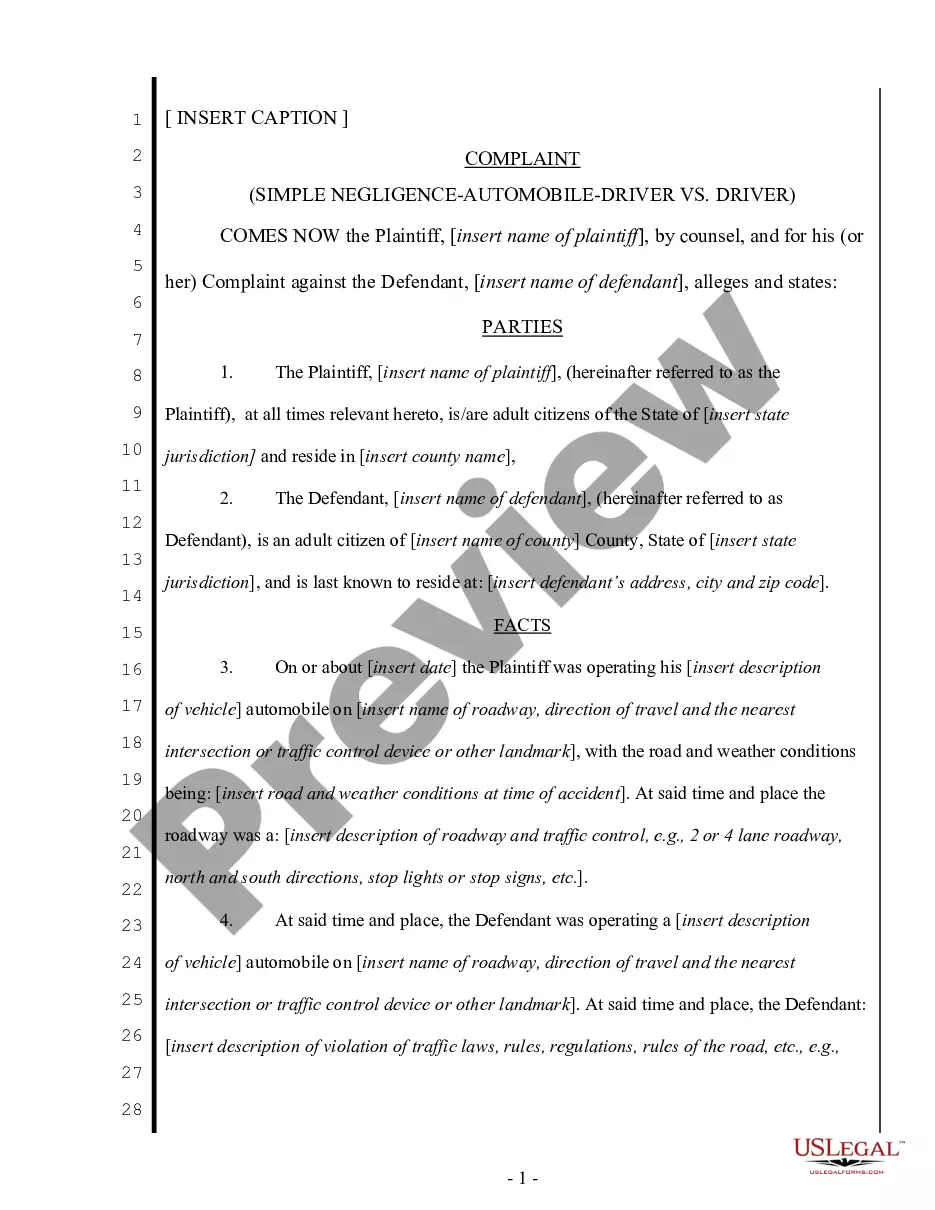
  • Preview Independent Contractor Agreement Between Licensed Counselor and Therapist and Licensed Counselor and Therapist Practicing as a Solo Practitioner

Get your form ready online

Our built-in tools help you complete, sign, share, and store your documents in one place.

Built-in online Word editor

Make edits, fill in missing information, and update formatting in US Legal Forms—just like you would in MS Word.

Export easily

Download a copy, print it, send it by email, or mail it via USPS—whatever works best for your next step.

E-sign your document

Sign and collect signatures with our SignNow integration. Send to multiple recipients, set reminders, and more. Go Premium to unlock E-Sign.

Notarize online 24/7

If this form requires notarization, complete it online through a secure video call—no need to meet a notary in person or wait for an appointment.

Store your document securely

We protect your documents and personal data by following strict security and privacy standards.

Form selector

Make edits, fill in missing information, and update formatting in US Legal Forms—just like you would in MS Word.

Form selector

Download a copy, print it, send it by email, or mail it via USPS—whatever works best for your next step.

Form selector

Sign and collect signatures with our SignNow integration. Send to multiple recipients, set reminders, and more. Go Premium to unlock E-Sign.

Form selector

If this form requires notarization, complete it online through a secure video call—no need to meet a notary in person or wait for an appointment.

Form selector

We protect your documents and personal data by following strict security and privacy standards.

Looking for another form?

This field is required
Ohio
Select state

How to fill out Independent Contractor Agreement Between Licensed Counselor And Therapist And Licensed Counselor And Therapist Practicing As A Solo Practitioner?

Locating the appropriate legal document design can be quite challenging.

Of course, there is an assortment of templates accessible online, but how can you acquire the legal document you need.

Use the US Legal Forms website. The service offers a vast selection of templates, such as the Indiana Independent Contractor Agreement Between Licensed Counselor and Therapist and Licensed Counselor and Therapist Practicing as a Solo Practitioner, which you may utilize for business and personal purposes.

You can review the document using the Preview feature and examine the document summary to ensure it is suitable for you.

  1. All the documents are reviewed by professionals and comply with federal and state regulations.
  2. If you are currently registered, Log In to your account and click the Obtain button to access the Indiana Independent Contractor Agreement Between Licensed Counselor and Therapist and Licensed Counselor and Therapist Practicing as a Solo Practitioner.
  3. Utilize your account to view the legal documents you have previously ordered.
  4. Navigate to the My documents section of your account and download another copy of the document you require.
  5. If you are a first-time user of US Legal Forms, here are straightforward instructions to follow.
  6. First, ensure you have selected the correct document for your city/region.

Form popularity

FAQ

The terms 'licensed counselor' and 'licensed therapist' often overlap but can vary in meaning based on state laws. Generally, licensed counselors focus more on specific mental health issues, while licensed therapists may employ a broader range of therapeutic methods. To clarify the distinctions and ensure proper representation in your Indiana Independent Contractor Agreement Between Licensed Counselor and Therapist and Licensed Counselor and Therapist Practicing as a Solo Practitioner, it’s advisable to specify the qualifications and services provided.

Yes, a licensed professional counselor (LPC) can own their own practice in Indiana. This permits them to offer counseling services independently or under a business entity. Drafting an Indiana Independent Contractor Agreement Between Licensed Counselor and Therapist and Licensed Counselor and Therapist Practicing as a Solo Practitioner can help ensure that all legal obligations and practices are formalized, providing a solid foundation for your practice.

In most states, including Indiana, you can own a therapy practice if you hire licensed therapists to provide services. However, you must comply with local laws regarding business ownership and mental health services. Consider using a well-structured Indiana Independent Contractor Agreement Between Licensed Counselor and Therapist and Licensed Counselor and Therapist Practicing as a Solo Practitioner to outline each party’s responsibilities and protect your business.

Yes, but this depends on their qualifications and the regulations in their state. Many states allow licensed professional counselors (LPCs) to refer to themselves as therapists. However, it’s important to ensure clarity and transparency regarding qualifications. If you are writing an Indiana Independent Contractor Agreement Between Licensed Counselor and Therapist and Licensed Counselor and Therapist Practicing as a Solo Practitioner, it’s crucial to outline titles based on qualifications.

PLLC stands for Professional Limited Liability Company. This structure is specifically designed for licensed professionals, including therapists and counselors. Choosing a PLLC allows you to limit your personal liability while maintaining professional standards. By using an Indiana Independent Contractor Agreement Between Licensed Counselor and Therapist and Licensed Counselor and Therapist Practicing as a Solo Practitioner, professionals can confirm their legitimacy and enhance their practice’s credibility.

The best business structure for a therapist often depends on individual circumstances and goals. Many therapists choose to operate as a Professional Limited Liability Company (PLLC) or a Sole Proprietorship. A PLLC offers liability protection, while keeping your personal assets safe. When creating an Indiana Independent Contractor Agreement Between Licensed Counselor and Therapist and Licensed Counselor and Therapist Practicing as a Solo Practitioner, the chosen structure can influence tax responsibilities and compliance with local laws.

A 70 30 salary split describes how salary is divided between two parties in a financial agreement, often utilized in the context of the Indiana Independent Contractor Agreement Between Licensed Counselor and Therapist and Licensed Counselor and Therapist Practicing as a Solo Practitioner. In this model, one party earns 70% of the total salary, while the other earns 30%. This structure can provide clarity in roles and expectations for compensation in collaborative settings. By using this split, both licensed professionals can benefit and maintain transparent financial relationships.

A 70/30 split refers to the distribution of revenue between two parties, typically used in business agreements, including in the Indiana Independent Contractor Agreement Between Licensed Counselor and Therapist and Licensed Counselor and Therapist Practicing as a Solo Practitioner. In this arrangement, one party retains 70% of the income, while the other receives 30%. This split can motivate solo practitioners to maximize their earnings while still providing a fair compensation framework. Understanding such terms helps both counselors and therapists align their financial interests.

The primary difference lies in the training and treatment approaches they use. Licensed therapists usually possess advanced degrees and provide more extensive mental health services, while licensed counselors may focus on specific issues or guidance. When navigating the Indiana Independent Contractor Agreement Between Licensed Counselor and Therapist and Licensed Counselor and Therapist Practicing as a Solo Practitioner, understanding these distinctions can help you choose the right professional for your needs.

PLLC stands for Professional Limited Liability Company, a business structure that protects the personal assets of a therapist. By forming a PLLC, therapists can operate their practice with legal and financial safeguards. This structure is often referenced in the Indiana Independent Contractor Agreement Between Licensed Counselor and Therapist and Licensed Counselor and Therapist Practicing as a Solo Practitioner when outlining business arrangements.

Trusted and secure by over 3 million people of the world’s leading companies

Indiana Independent Contractor Agreement Between Licensed Counselor and Therapist and Licensed Counselor and Therapist Practicing as a Solo Practitioner