Indiana Notice of Assignment to Living Trust
Overview of this form
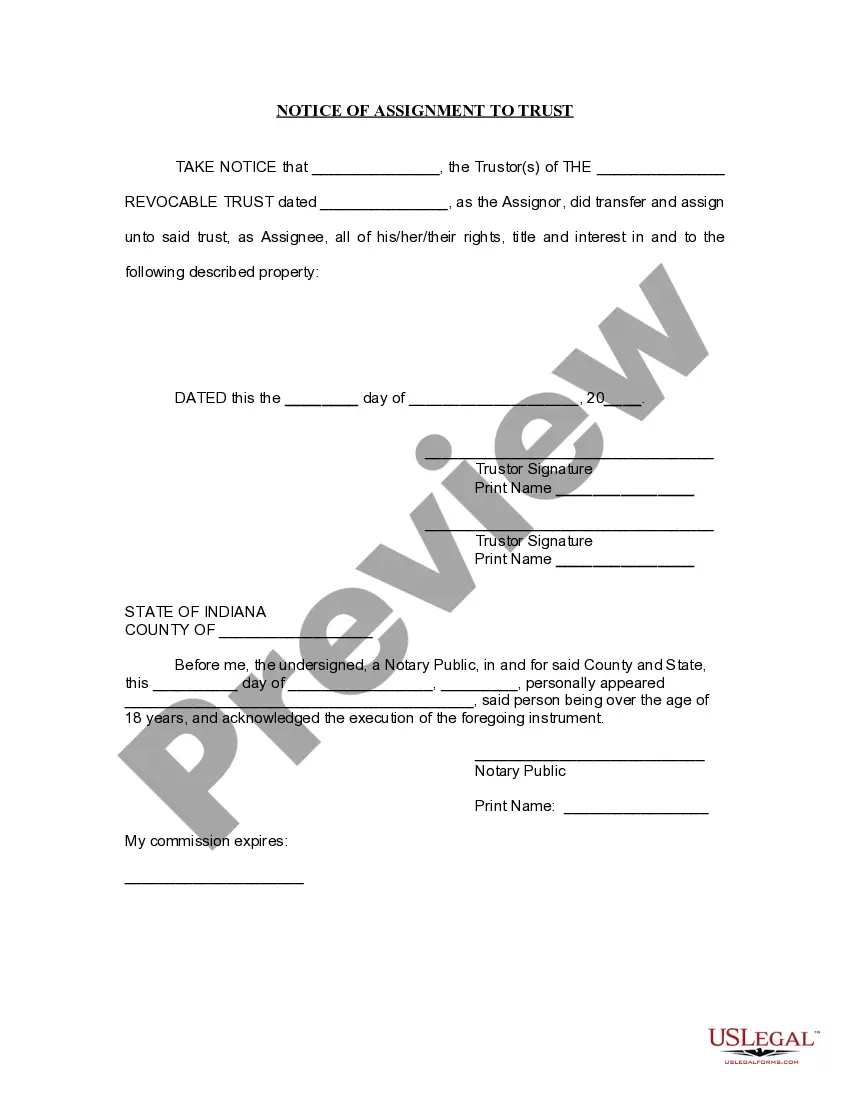
The Notice of Assignment to Living Trust is a legal document used to inform lienholders that specific property has been transferred to a living trust. A living trust is established during a person's lifetime and is used for estate planning. This form serves as formal notification that the trustor or trustors have assigned their rights, title, and interest in the described property to the living trust, distinguishing it from other forms of property transfer or estate planning documents.
What’s included in this form
- Identification of the Trustor(s) and the name of the living trust.
- Details of the property being transferred.
- Signatures of the Trustor(s) confirming the assignment.
- Notarization section for official acknowledgment of the execution.
When to use this document
This form should be used when a property owner decides to transfer their assets into a living trust. It is common in estate planning when transferring real property or significant personal property, ensuring that the trust is recognized by lienholders and other interested parties.
Intended users of this form
This form is intended for:
- Individuals establishing a living trust as part of their estate planning.
- Trustors who have transferred property into a living trust.
- Trustees or legal representatives managing a living trust on behalf of the trustor(s).
How to complete this form
- Identify the Trustor(s) and enter their names at the beginning of the form.
- Specify the name of the living trust and the date it was established.
- Describe the property being transferred into the trust in detail.
- Have the Trustor(s) sign and print their names where indicated.
- Complete the notarization section by having a notary public certify the signatures.
Notarization guidance
Yes, this form must be notarized to be legally valid. US Legal Forms offers integrated online notarization, allowing you to complete this process conveniently via a secure video call, available 24/7, ensuring legal equivalence without the need for travel.
Get your form ready online
Our built-in tools help you complete, sign, share, and store your documents in one place.
Make edits, fill in missing information, and update formatting in US Legal Forms—just like you would in MS Word.
Download a copy, print it, send it by email, or mail it via USPS—whatever works best for your next step.
Sign and collect signatures with our SignNow integration. Send to multiple recipients, set reminders, and more. Go Premium to unlock E-Sign.
If this form requires notarization, complete it online through a secure video call—no need to meet a notary in person or wait for an appointment.
We protect your documents and personal data by following strict security and privacy standards.

Make edits, fill in missing information, and update formatting in US Legal Forms—just like you would in MS Word.

Download a copy, print it, send it by email, or mail it via USPS—whatever works best for your next step.

Sign and collect signatures with our SignNow integration. Send to multiple recipients, set reminders, and more. Go Premium to unlock E-Sign.

If this form requires notarization, complete it online through a secure video call—no need to meet a notary in person or wait for an appointment.

We protect your documents and personal data by following strict security and privacy standards.
Common mistakes to avoid
- Failing to include all required signatures.
- Omitting important details about the property being transferred.
- Not notarizing the document when required.
Benefits of using this form online
- Convenient access to a professionally drafted legal form.
- Easy editing and customization to fit your specific situation.
- Reliable and secure downloading for immediate use.
Summary of main points
- The Notice of Assignment to Living Trust is essential for transferring property into a living trust.
- This form must be completed for each asset being assigned to ensure legal compliance.
- Notarization is required for the form to have legal standing.
Looking for another form?


Form popularity
FAQ
Under Declaration of Trust Most personal trusts are trusts under agreement, or "UA," in which the grantor and the trustee are different parties.
UDT is an abbreviation for under declaration of trust, which is the legal language used in some trust instruments to indicate that the grantor is both creating the trust and controlling its assets.Most personal trusts are trusts under agreement, or "UA," in which the grantor and the trustee are different parties.
DTD is just an abbreviation for "dated," meaning the date the trust was signed. When referring to a trust, one should always use the date of the trust.
Determine the Current Title and Vesting to Your Property. Prepare a Deed. Be Aware of Your Lender and Title Insurance. Prepare a Preliminary Change of Ownership Report. Execute Your Deed. Record Your Deed. Wait for the Deed to be Returned. Keep the Property in the Trust.
A living trust, specifically a revocable living trust, is a legal document that places your assetsinvestments, bank accounts, real estate, vehicles and valuable personal propertyin trust for your benefit during your lifetime, and spells out where you'd like these things to go upon your death.
Transferring Real Property to a Trust You can transfer your home (or any real property) to the trust with a deed, a document that transfers ownership to the trust. A quitclaim deed is the most common and simplest method (and one you can do yourself).
Ownership in a business can also be transferred through a living trust. To do this, the business owner must first transfer the business to the trust, then name the intended successor as successor trustee to the trust. The business owner, while living, would serve as both trustee and beneficiary of the trust.
The advantages of placing your house in a trust include avoiding probate court, saving on estate taxes and possibly protecting your home from certain creditors. Disadvantages include the cost of creating the trust and the paperwork.
How To Establish A Trust. You will need to retain an estate attorney to draft and execute your trust document. For a simple revocable or irrevocable trust, it may cost anywhere from $2,000 $5,000.