Louisiana Motion and Order to Continue Rule Date and Temporary Restraining Order
Overview of this form
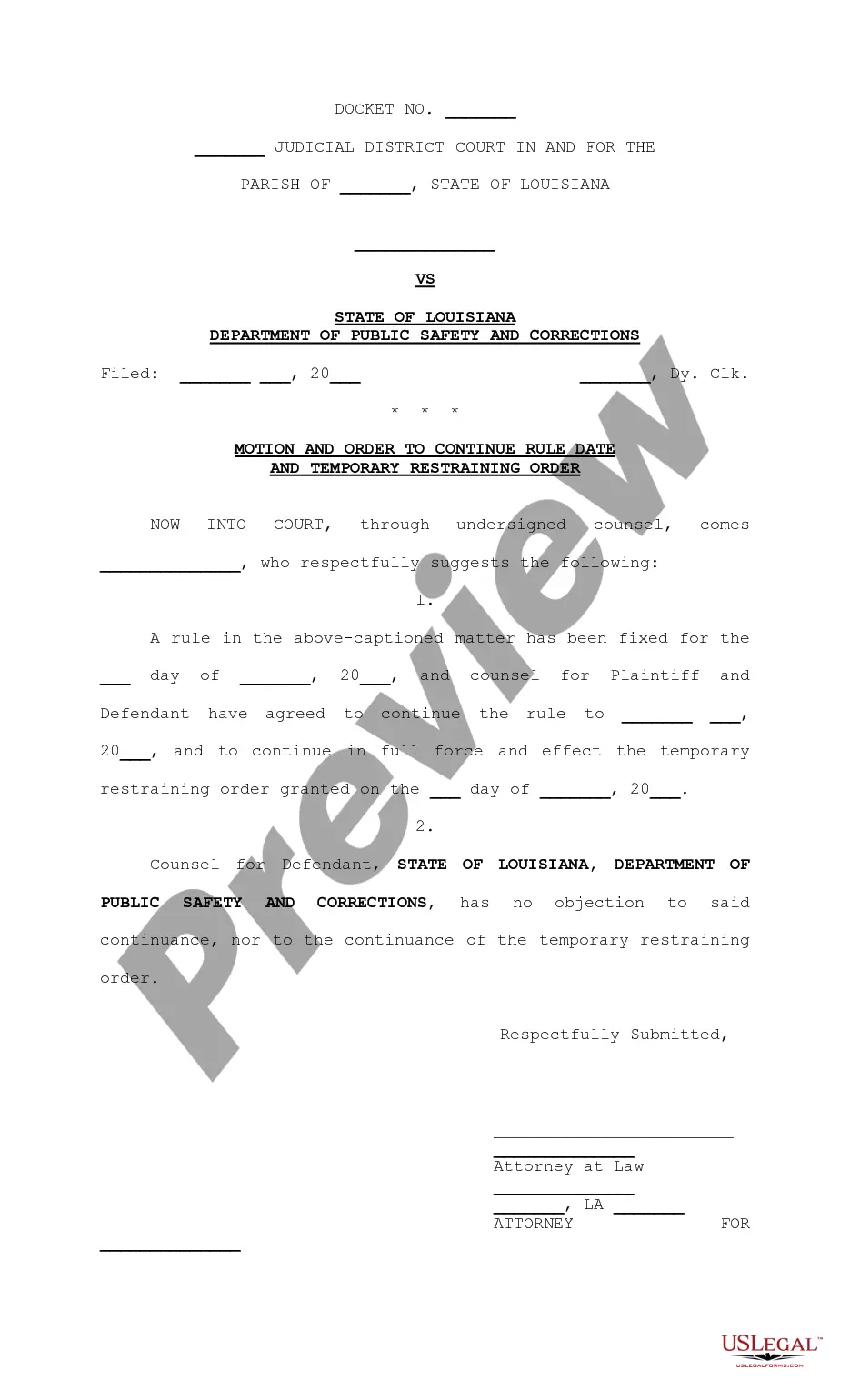
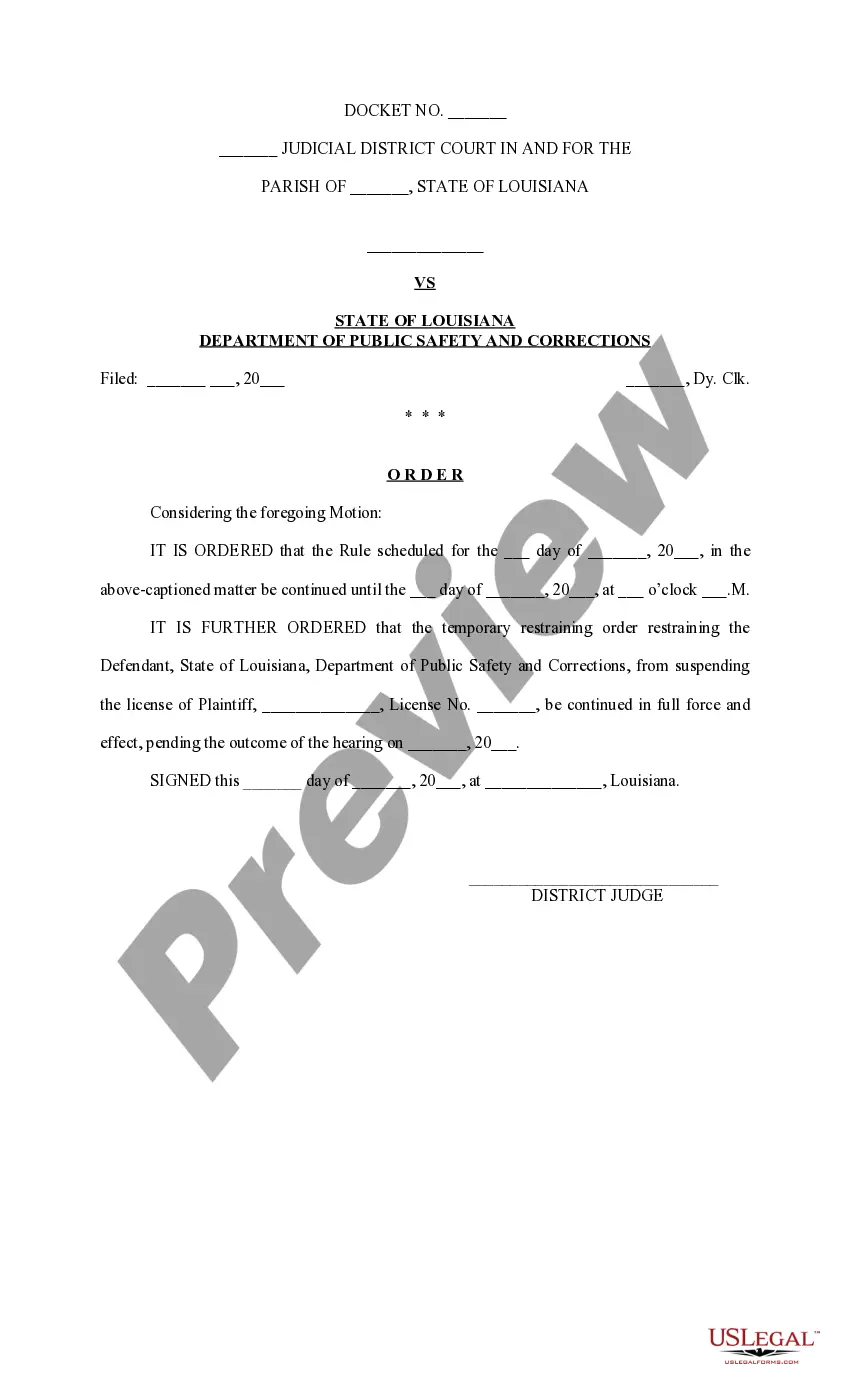
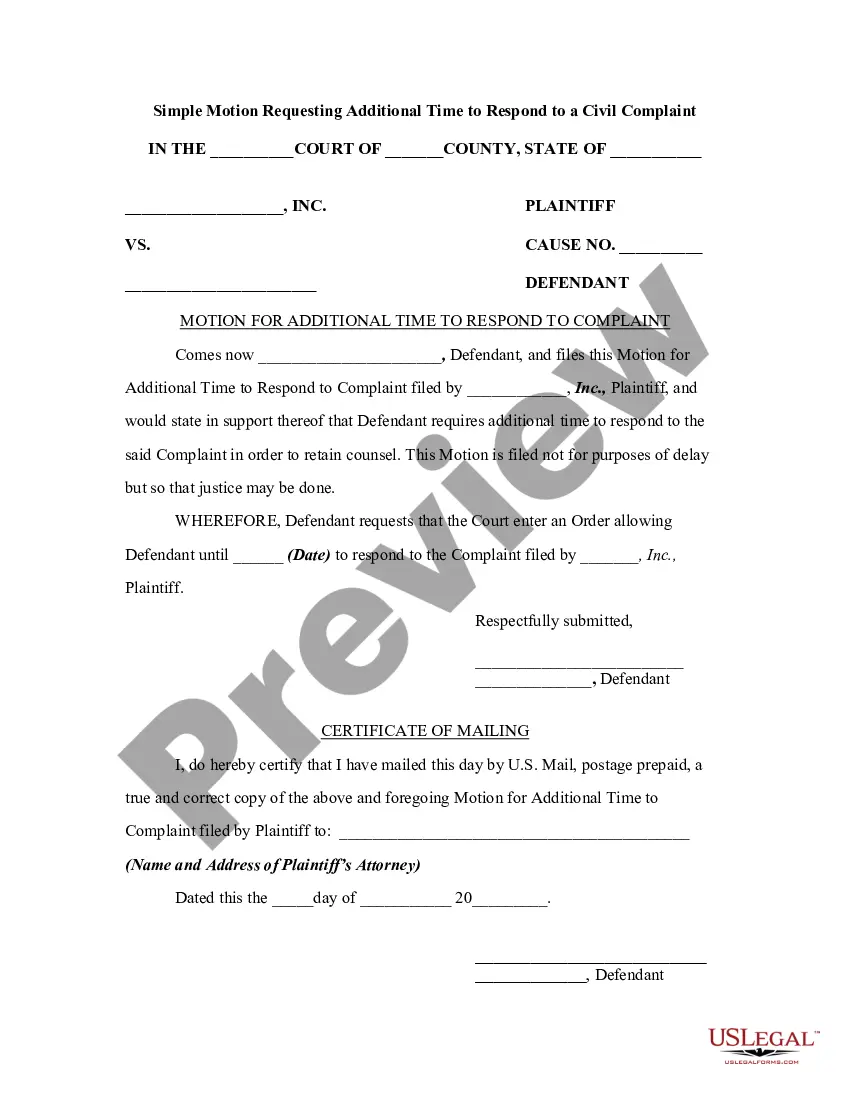
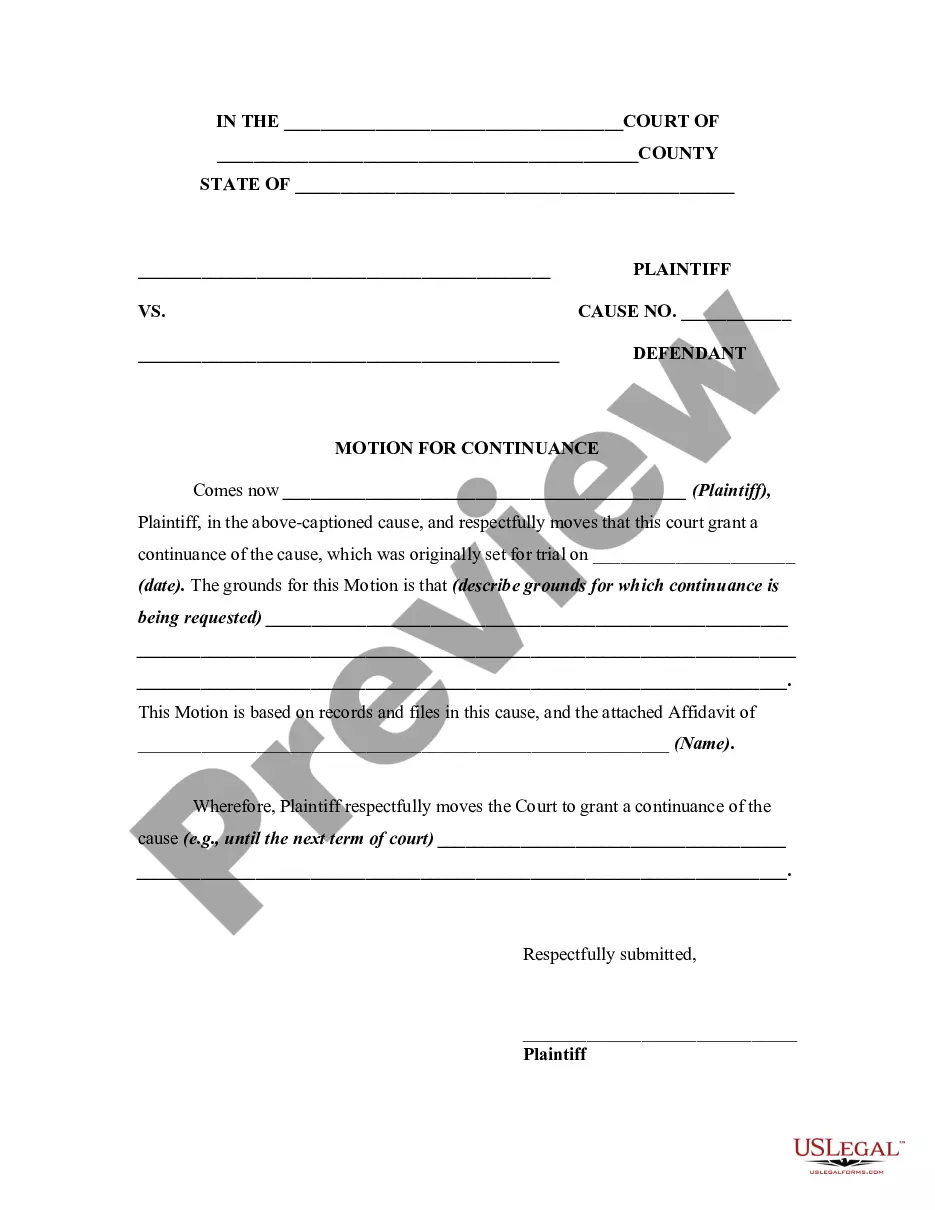
The Motion and Order to Continue Rule Date and Temporary Restraining Order is a legal document used in civil matters involving the State of Louisiana, Department of Public Safety and Corrections. This motion allows the plaintiff to request a postponement of the scheduled hearing date while also seeking to keep a temporary restraining order in effect, preventing the defendant from suspending the plaintiff's license. This form is specifically tailored for cases in Louisiana and ensures both parties are in agreement regarding its provisions.
Key parts of this document
- Identification of the judicial district and parties involved in the case.
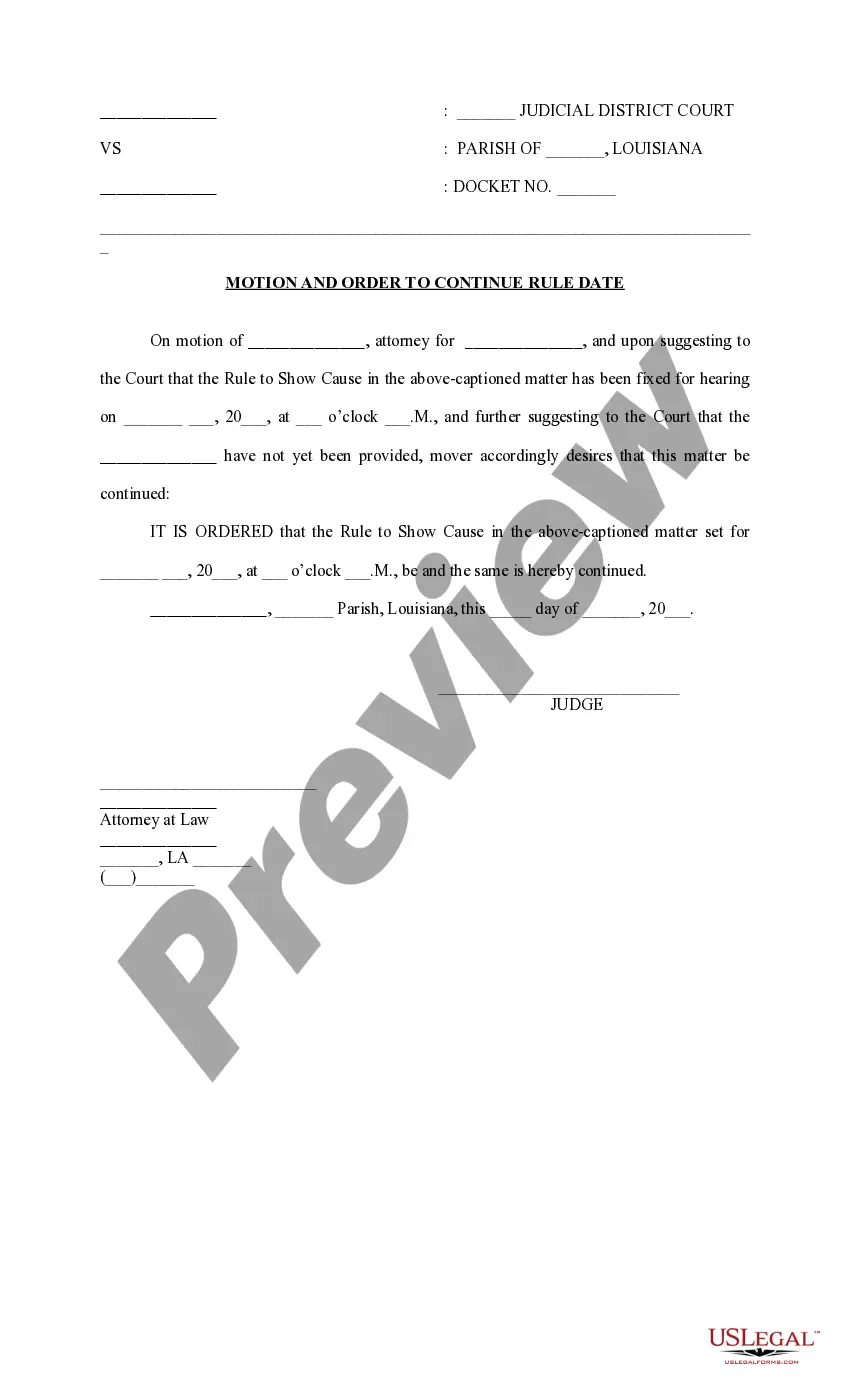
- Request for a continuance of the rule date to a specified future date.
- Statement that the temporary restraining order will remain in effect.
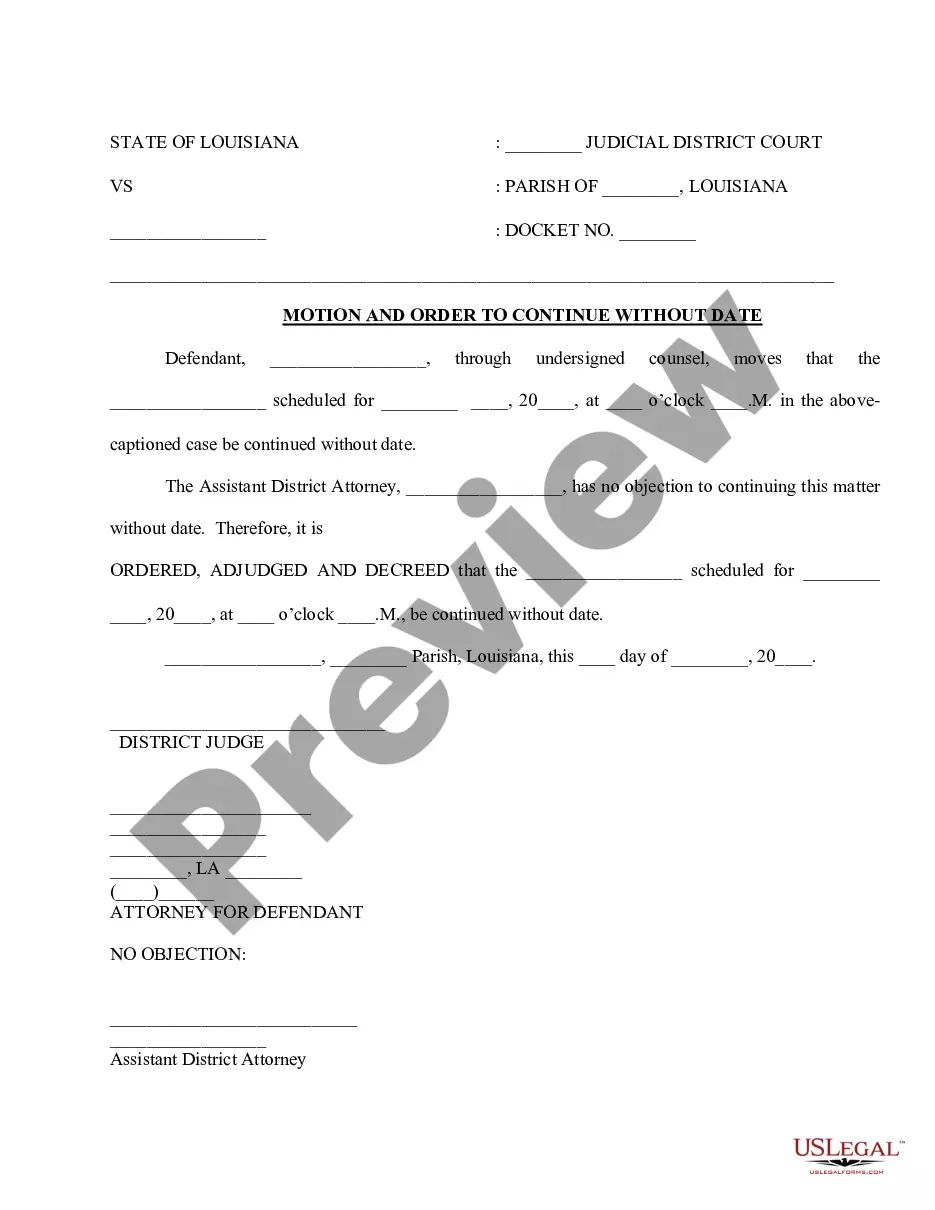
- Confirmation of no objection from the defending party's counsel.
- Final order signed by the district judge to formalize the granted motions.
When this form is needed
This form should be used when a plaintiff needs to delay a scheduled court hearing or rule date in a civil case against the State of Louisiana. It is most applicable in scenarios where the temporary restraining order must remain active while awaiting further judicial proceedings, ensuring continuity in legal protections for the plaintiff during the process.
Who can use this document
Eligibility to use this form includes:
- Individuals who are plaintiffs in civil matters against the State of Louisiana.
- Legal representatives or attorneys acting on behalf of the plaintiff.
- Parties involved in cases requiring a delay of court proceedings while retaining protective orders.
How to prepare this document
- Enter the name of the judicial district court and the parties involved.
- Specify the original rule date and the new date to which the rule is being continued.
- Include details regarding the temporary restraining order and ensure it is referenced as still being in effect.
- Obtain a signature from the attorney representing the plaintiff.
- Submit the completed form to the appropriate court for a judge's approval.
Does this document require notarization?
This form does not typically require notarization unless specified by local law. It is advisable to confirm with the court if any additional requirements are needed for your specific case.
Get your form ready online
Our built-in tools help you complete, sign, share, and store your documents in one place.
Make edits, fill in missing information, and update formatting in US Legal Forms—just like you would in MS Word.
Download a copy, print it, send it by email, or mail it via USPS—whatever works best for your next step.
Sign and collect signatures with our SignNow integration. Send to multiple recipients, set reminders, and more. Go Premium to unlock E-Sign.
If this form requires notarization, complete it online through a secure video call—no need to meet a notary in person or wait for an appointment.
We protect your documents and personal data by following strict security and privacy standards.

Make edits, fill in missing information, and update formatting in US Legal Forms—just like you would in MS Word.

Download a copy, print it, send it by email, or mail it via USPS—whatever works best for your next step.

Sign and collect signatures with our SignNow integration. Send to multiple recipients, set reminders, and more. Go Premium to unlock E-Sign.

If this form requires notarization, complete it online through a secure video call—no need to meet a notary in person or wait for an appointment.

We protect your documents and personal data by following strict security and privacy standards.
Common mistakes to avoid
- Failing to specify the new rule date clearly.
- Not obtaining confirmation from the defendant's counsel regarding their lack of objection.
- Leaving out necessary signatures or filed dates.
- Neglecting to keep the temporary restraining order language consistent with previous filings.
Benefits of completing this form online
- Convenience of accessing legal forms from anywhere at any time.
- Ability to edit the form easily to fit specific case details.
- Immediate download for quick filing.
- Forms crafted by licensed attorneys to ensure legal compliance.
Legal use & context
- This form is legally binding once filed and approved by the court.
- Maintaining a temporary restraining order is critical to preventing adverse actions during the course of litigation.
- Ensure compliance with local court rules for the motions and orders process.
Quick recap
- The form is essential for requesting a postponement of hearings and maintaining protective orders.
- It applies specifically to cases involving the State of Louisiana's Public Safety and Corrections Department.
- Completing the form correctly is critical to preserving your rights during legal proceedings.
Looking for another form?
Form popularity
FAQ
In most instances, permanent simply means that the restraining order will be enforceable for the specified period of time that is mandated by the court or until a party requests a change. An offender who is subject to a permanent restraining order may be able to file a request to have the order lifted.
In situations where a court issued a restraining order that lack jurisdiction, that order is also invalidated. If this is proven during the trial, you are not bound by such an order. Falsely accused. In case you are falsely accused of violating a restraining order, a defense attorney can clear you of all the charges.
Normally a TRO lasts for 14 days unless the court decides to dissolve or extend it. A notice for a hearing must be contained in the TRO and the hearing must take place within the 14 days after the TRO is granted.
If the court schedules a hearing and grants the motion, the protection order will become immediately void and unenforceable. A protection order can only be dissolved by the court.
The court can issue a TRO without the abuser present; however, the abuser will be notified of the rule against him, and a date for a hearing will be set. See RS 35. Long-term Protective Orders: After a hearing, a court can issue a protective order that lasts up to 18 months unless otherwise stated.
The temporary restraining order in California does not go into the CLETS database and will not come up on a background check. It will also generally not impact the restrained parties' ability to possess a firearm.
Stay Away Provision: Ordering the abuser to stay at least a certain number of yards or feet away from the victim, his or her home, job, school, and car. The stay-away distance can vary by state, judge or the lethality of the situation, but is often at least 100 yards or 300 feet.
Temporary restraining orders usually last between 20 and 25 days, until the court hearing date. When you go to court for the hearing that was scheduled for your TRO, the judge may issue a permanent restraining order. They are not really permanent because they usually last up to 5 years.
The court is looking for a description of your relationship to the respondent, when, where, what happened, and who did what to whom. Using the facts of the incident only, keep your statement brief and to the point. Briefly describe the most recent incident of abuse and/or threats of abuse or other behaviors.