Indiana Provisional Order
What is this form?
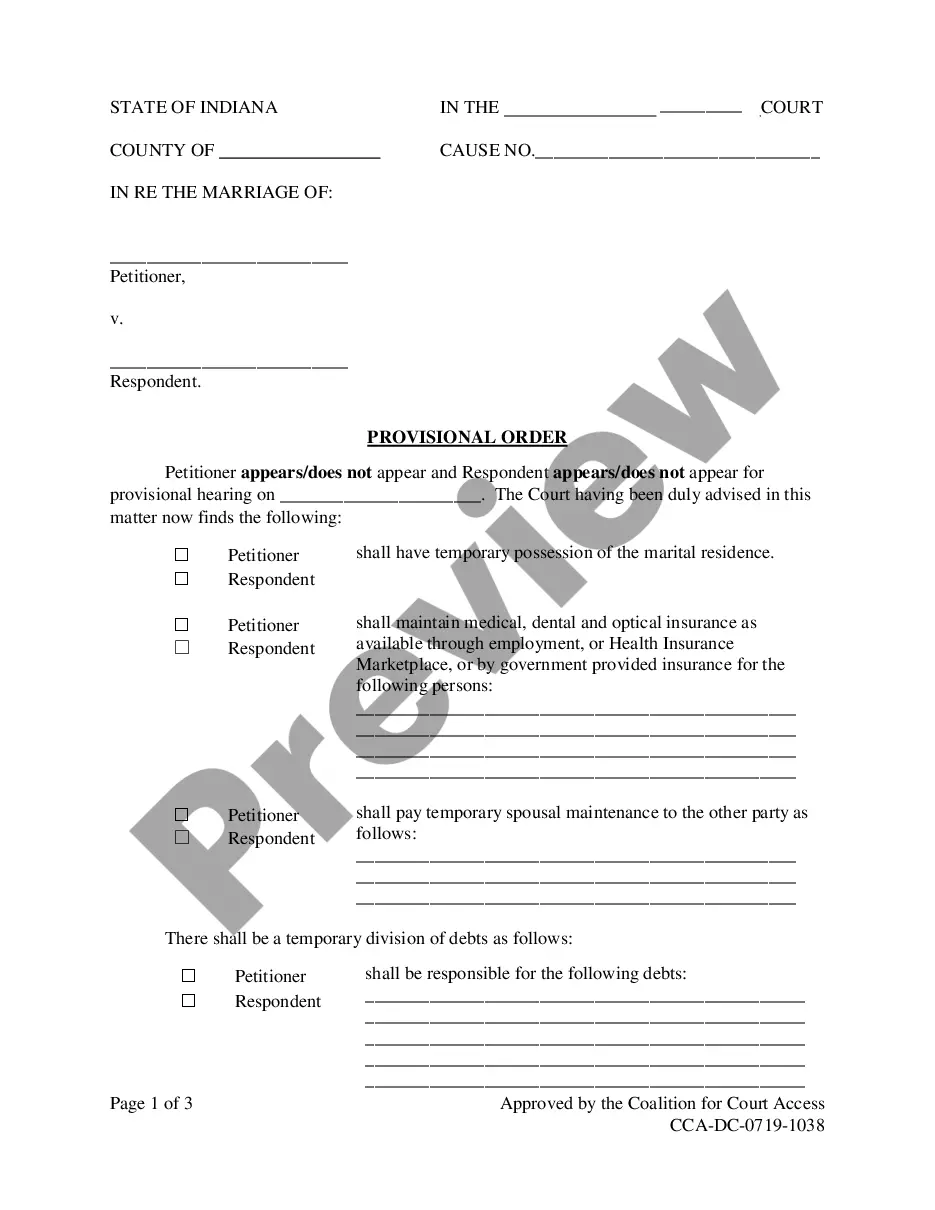
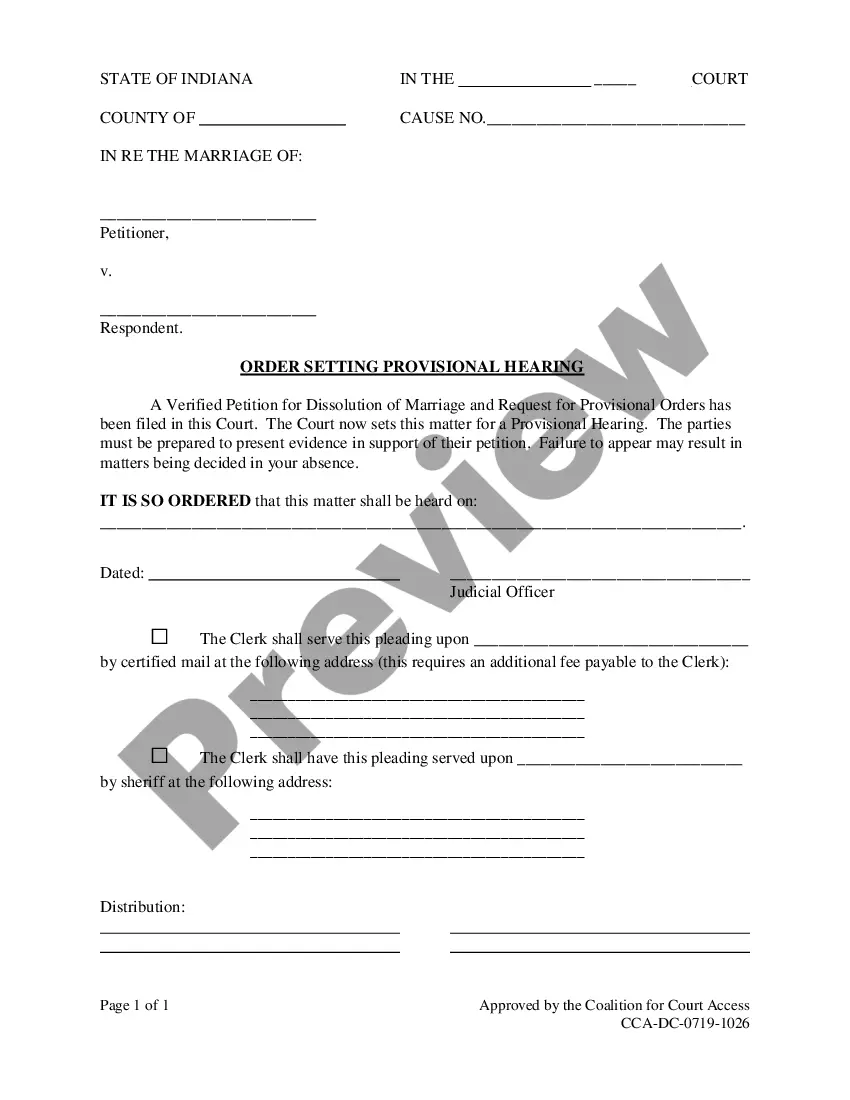
The Provisional Order is a legal document used during divorce proceedings to establish temporary arrangements for both parties while the case is ongoing. This form is essential for setting temporary guidelines about possession of marital property, insurance responsibilities, spousal maintenance, and more. Unlike a final divorce decree, a provisional order addresses immediate needs and provides stability until the divorce is finalized.
What’s included in this form
- Identifies the petitioner and respondent and the date of the provisional hearing.
- Specifies temporary possession details for the marital residence.
- Outlines insurance responsibilities for medical and dental coverage.
- Details temporary spousal maintenance obligations between the parties.
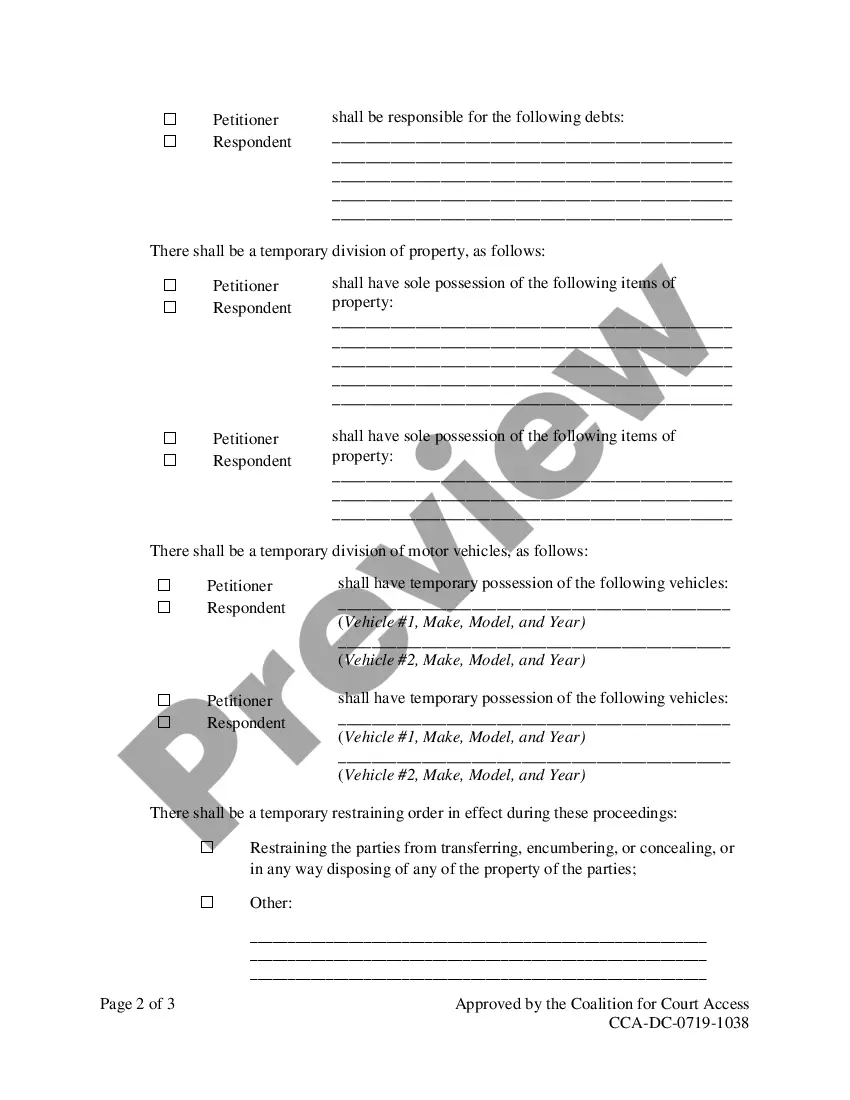
- Lists the division of debts and property, including specific items.
- Includes provisions for temporary restraining orders regarding property.


Common use cases
This form should be used at the beginning of divorce proceedings when one or both parties need immediate legal determinations regarding personal property, financial support, or other critical issues. It is particularly useful in situations where there is a concern about the potential waste or concealment of marital assets or where one party requires financial assistance during the separation.
Who this form is for
- Individuals initiating divorce proceedings in Indiana.
- Either party needing immediate orders regarding property or financial support.
- Spouses facing disputes about temporary arrangements during the divorce process.
Completing this form step by step
- Fill in the cause number, your name as the petitioner, and the respondent's name.
- Indicate whether each party appeared at the provisional hearing.
- Specify who will have temporary possession of the marital residence and other properties.
- Detail any temporary spousal maintenance to be provided between the parties.
- List responsibilities for debts and how property will be divided temporarily.
- Sign and date the form as required by the court.
Does this form need to be notarized?
This form does not typically require notarization unless specified by local law. It is important to check with the local court for any specific requirements that may apply.
Get your form ready online
Our built-in tools help you complete, sign, share, and store your documents in one place.
Make edits, fill in missing information, and update formatting in US Legal Forms—just like you would in MS Word.
Download a copy, print it, send it by email, or mail it via USPS—whatever works best for your next step.
Sign and collect signatures with our SignNow integration. Send to multiple recipients, set reminders, and more. Go Premium to unlock E-Sign.
If this form requires notarization, complete it online through a secure video call—no need to meet a notary in person or wait for an appointment.
We protect your documents and personal data by following strict security and privacy standards.

Make edits, fill in missing information, and update formatting in US Legal Forms—just like you would in MS Word.

Download a copy, print it, send it by email, or mail it via USPS—whatever works best for your next step.

Sign and collect signatures with our SignNow integration. Send to multiple recipients, set reminders, and more. Go Premium to unlock E-Sign.

If this form requires notarization, complete it online through a secure video call—no need to meet a notary in person or wait for an appointment.

We protect your documents and personal data by following strict security and privacy standards.
Common mistakes to avoid
- Failing to provide complete information about property and financial obligations.
- Not indicating both parties' agreement or disagreement on certain terms.
- Omitting necessary signatures or dates that validate the form.
Advantages of online completion
- Convenient access to the form from anywhere at any time.
- Easily editable and fillable fields, streamlining the completion process.
- Reliable legal templates drafted by licensed attorneys to ensure accuracy.
Looking for another form?
Form popularity
FAQ
Write a detailed history about your marital relationship, which should include dates and facts that support your case. Do not forget to pick the pictures, videos and other visual aids that you will present before the court as evidence.
Typically, a temporary orders hearing will be handled in one of two ways, either by calling witnesses (including the parties) to the stand and asking them questions aimed at eliciting direct testimony from them (referred to as an evidentiary hearing) or by your attorney offering summaries of what witnesses would say,
Provisional Orders are orders that the court may issue during the time a divorce case is pending. These are only temporary orders and are not intended to last forever. Think of provisional orders as rules to play by while the divorce is in process.
As their name says, temporary orders are not permanent. They're not intended to have a long-term, binding effect on a divorce settlement (though temporary orders can influence2026
Provisional Orders are orders that the court may issue during the time a divorce case is pending. These are only temporary orders and are not intended to last forever. Think of provisional orders as rules to play by while the divorce is in process.
The hearing usually is no longer than 20 minutes and is held either in a courtroom or the judge's office. The judge will listen to both sides and the declarations of any witnesses.
At a temporary hearing, for example, a Family Court Judge receives temporary hearing packets from both parties, reviews those packets, hears from each party's attorney regarding her/his client's position on the matter, and then makes a ruling, on a temporary basis, as to what terms the parties will abide by until the
Issues: In most states, parties can ask for temporary orders as to child support, parenting time schedules, decision making for the children, use and possession of property, including the marital residence or other properties, use and possession of cars, payment of expenses (including attorney fees) and debt, as well
A provisional order is a temporary order imposed by a judge in a divorce proceeding, generally, not long after a divorce has been filed or initiated. It is intended to maintain the status quo of the parties while the divorce is being litigated.