Indiana Affidavit that No Suit for Foreclosure Filed - Corporation or LLC
What this document covers
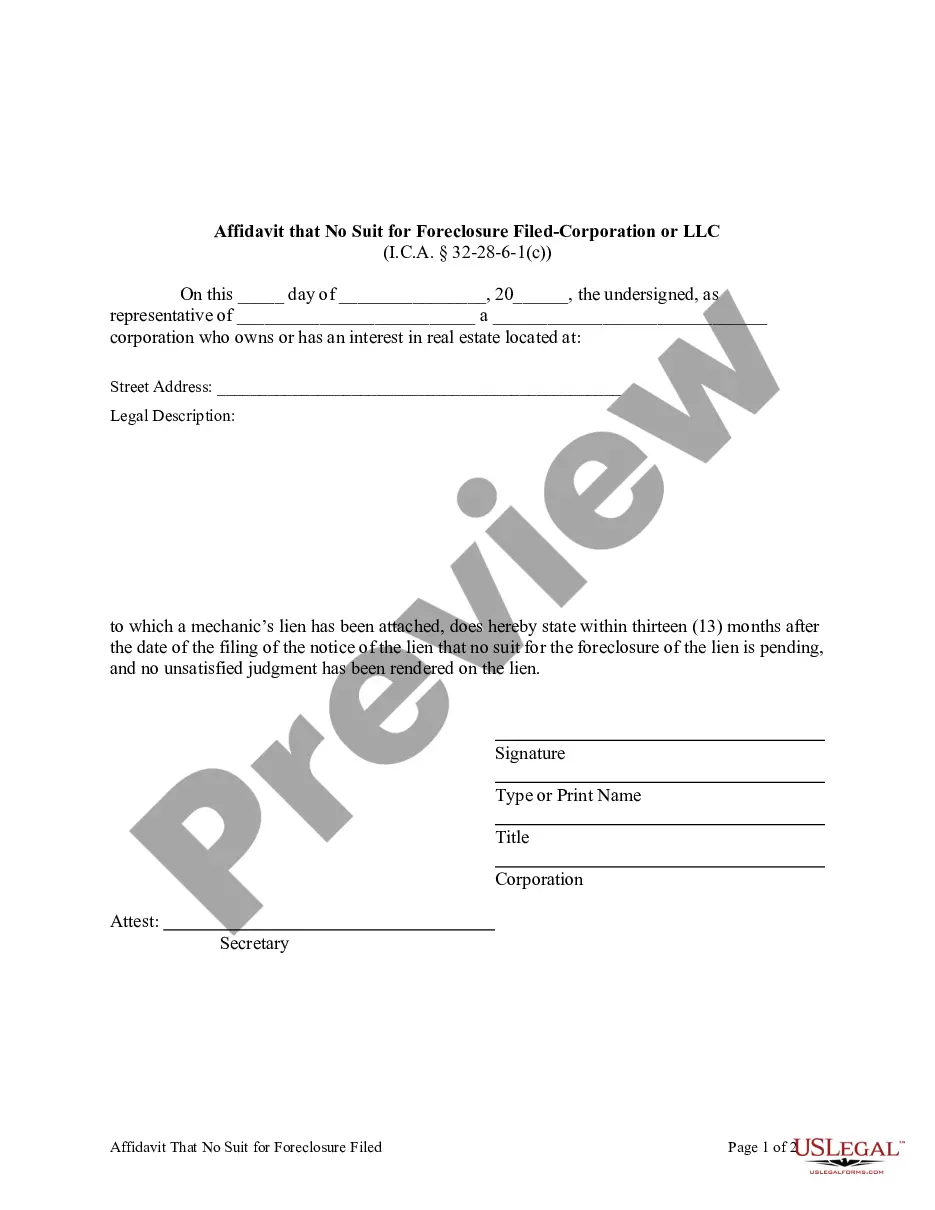
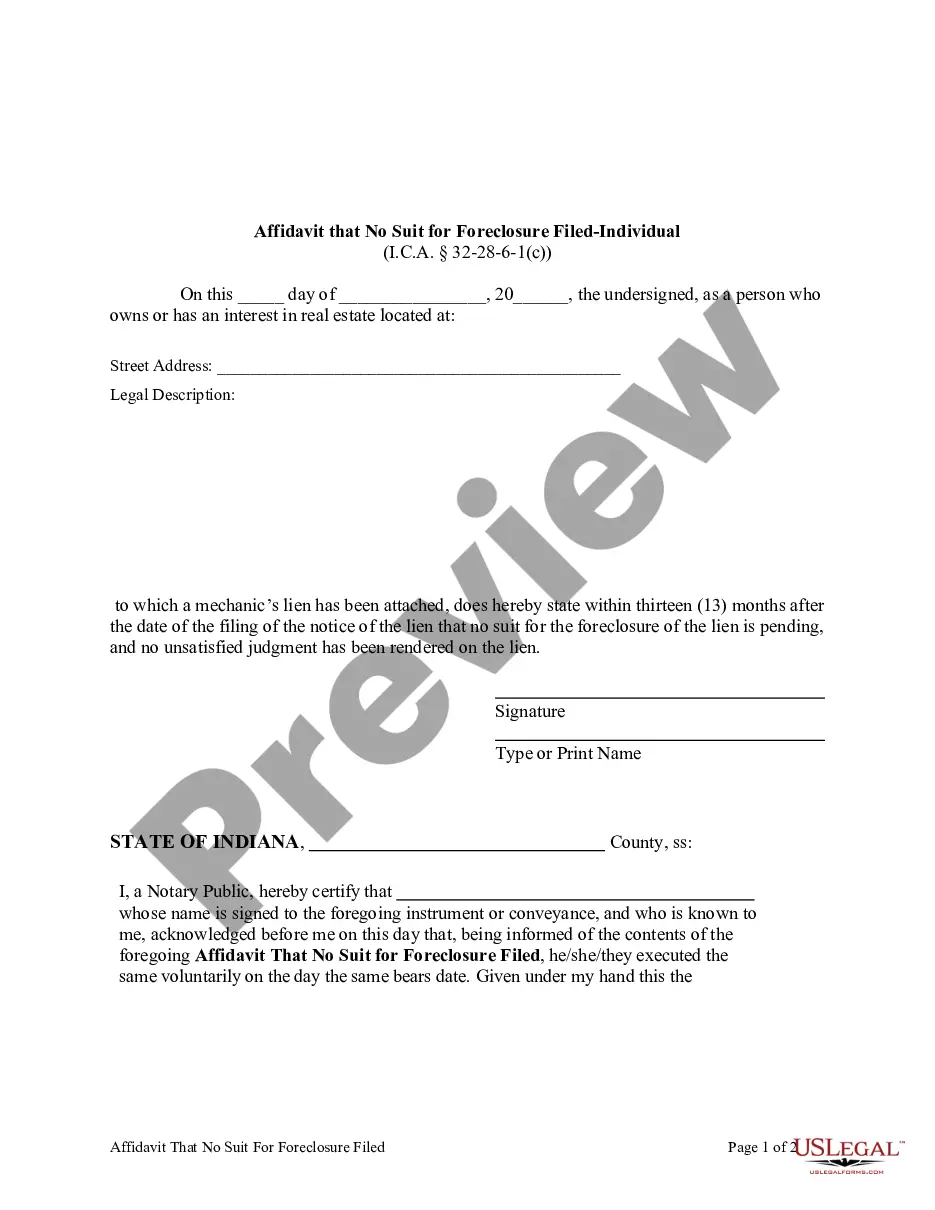
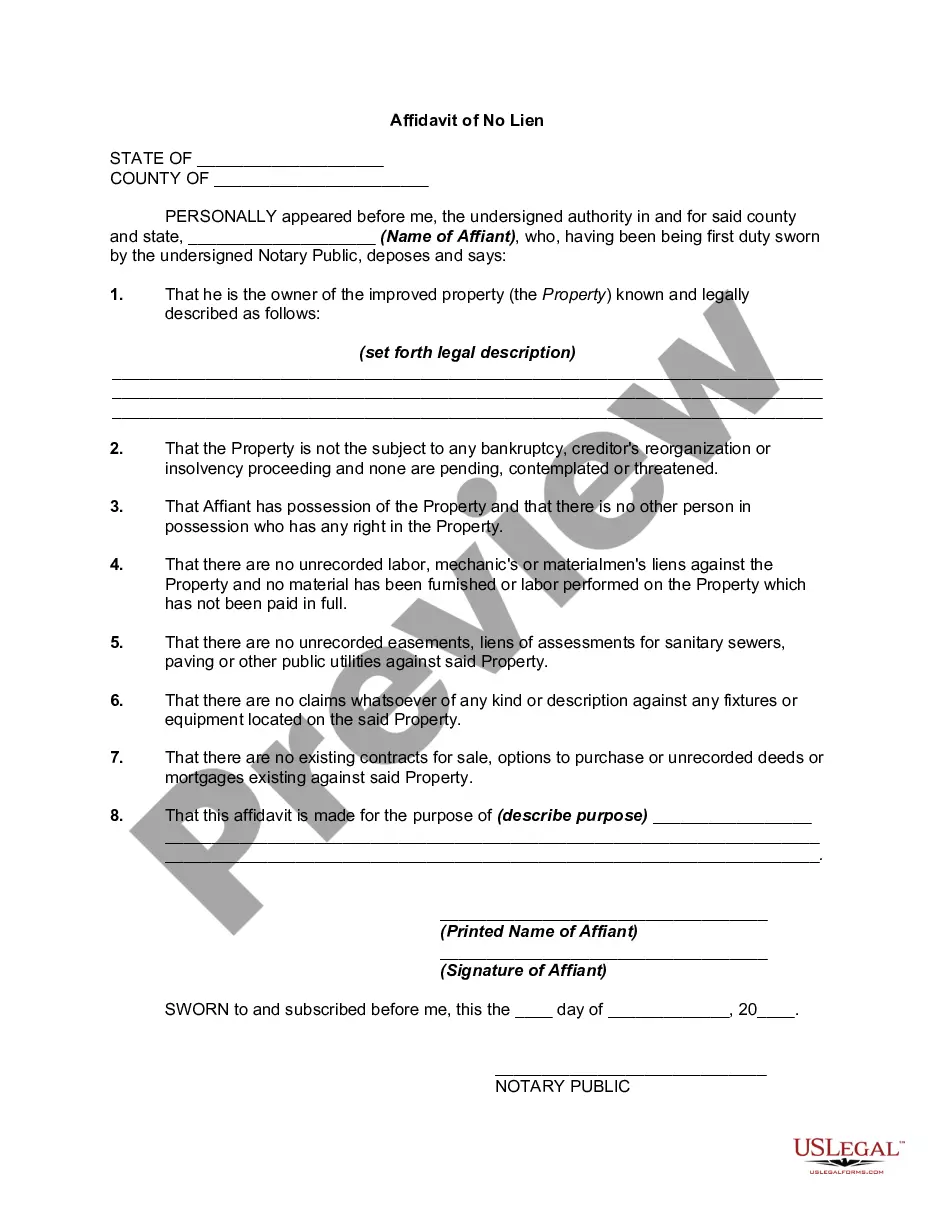
The Affidavit that No Suit for Foreclosure Filed is a legal document used by corporations or limited liability companies that own or have an interest in real estate. This affidavit serves to declare that, within 13 months of the mechanic's lien filing, no foreclosure suit is currently pending, and no unsatisfied judgment on the lien exists. This form is essential to prevent potential legal complications related to the attached mechanic's lien and differs from similar affidavits due to its specific focus on real estate interests held by corporate entities or LLCs.
Key parts of this document
- Date of affidavit execution
- Name of the corporation or LLC
- Description of the real estate property
- Signature of the authorized representative
- Confirmation of no pending foreclosure suit or unsatisfied judgments
When to use this document
This affidavit should be used when a corporation or LLC has had a mechanic's lien filed against its real estate. It is necessary to confirm that no legal actions regarding foreclosure are pending, which may be required for financial transactions, refinancing, or property sales. This form is particularly relevant when the lien has been established but no progress towards foreclosure exists within the stipulated timeframe.
Who this form is for
This form is intended for:
- Corporations owning real estate
- Limited liability companies (LLCs) with real estate interests
- Representatives authorized to act on behalf of these entities
Completing this form step by step
- Identify the date on which the affidavit is being signed.
- Enter the name of the corporation or LLC involved.
- Provide a description of the property affected by the mechanic's lien.
- Have the authorized representative sign the affidavit.
- Confirm and check that no foreclosure suit or unsatisfied judgment exists.
Does this document require notarization?
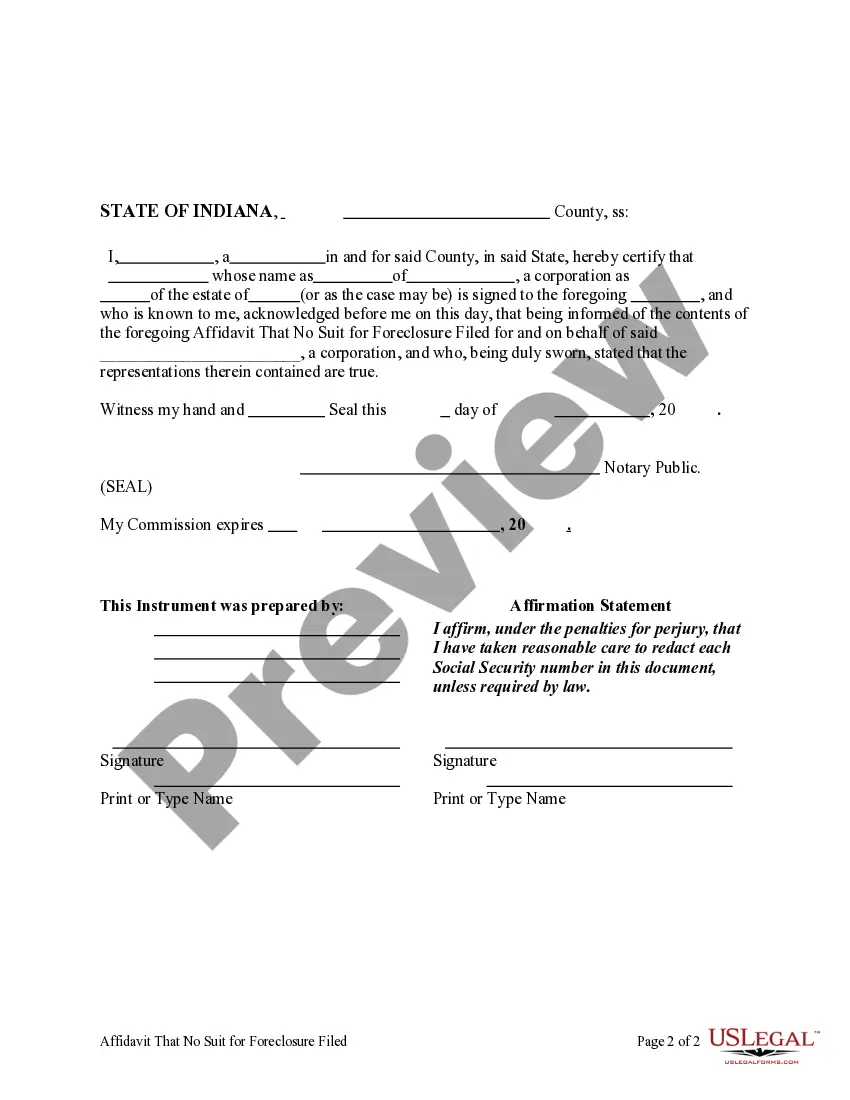
This form needs to be notarized to ensure legal validity. US Legal Forms provides secure online notarization powered by Notarize, allowing you to complete the process through a verified video call, available anytime.
Get your form ready online
Our built-in tools help you complete, sign, share, and store your documents in one place.
Make edits, fill in missing information, and update formatting in US Legal Forms—just like you would in MS Word.
Download a copy, print it, send it by email, or mail it via USPS—whatever works best for your next step.
Sign and collect signatures with our SignNow integration. Send to multiple recipients, set reminders, and more. Go Premium to unlock E-Sign.
If this form requires notarization, complete it online through a secure video call—no need to meet a notary in person or wait for an appointment.
We protect your documents and personal data by following strict security and privacy standards.

Make edits, fill in missing information, and update formatting in US Legal Forms—just like you would in MS Word.

Download a copy, print it, send it by email, or mail it via USPS—whatever works best for your next step.

Sign and collect signatures with our SignNow integration. Send to multiple recipients, set reminders, and more. Go Premium to unlock E-Sign.

If this form requires notarization, complete it online through a secure video call—no need to meet a notary in person or wait for an appointment.

We protect your documents and personal data by following strict security and privacy standards.
Typical mistakes to avoid
- Failing to complete the affidavit within the 13-month period.
- Not having the authorized representative sign the affidavit.
- Providing incomplete or inaccurate property descriptions.
- Neglecting to double-check for any pending suits or judgments.
Why complete this form online
- Convenience of instant download and digital completion.
- Editability allows for tailored modifications to fit specific needs.
- Reliability, as forms are drafted by licensed attorneys.
- Time-saving, as users can fill out and save forms immediately.
Looking for another form?

Form popularity
FAQ
Contact the lender. Make an opening offer. Remind the lender you can file bankruptcy if they are not willing to cooperate. Negotiate the payment terms. Get the agreement in writing. Report the forgiven debt as income on your federal and state taxes.
To get the deficiency judgment, the bank has to file an application with the court within three months of the foreclosure sale. The judge will then hold a fair value hearing to determine the property's value.
At the foreclosure sale, the lender will make a credit bid, which means that the bank won't come up with actual money. Instead, the bank will get credit for the total amount of the debt owed by the borrowerincluding the principal, interest, late fees, attorneys' fees, and foreclosure costs.
Proving Wrongful Foreclosure If you wish to sue the bank for wrongful foreclosure, you must prove the following: The lender owed you, the borrower, a legal duty. The lender breached that duty. The breach of duty caused your injury or loss (damages)
Deficiency Judgments After Judicial Foreclosures in California. Deficiency judgments are generally allowed after judicial foreclosures in California. But the lender can't get one if the loan was: used to buy a dwelling that consists of one to four units that's owner-occupied (called a purchase money loan)
The mortgage exposes the real estate to claim by the mortgagee and is the document that gives the creditor the right to sue for foreclosure.A trust deed conveys "naked title," that is, title without the right of possession. The deed is given as security for the loan to a third party, called the trustee.
Repayment Plan: Getting Current on the Loan. Mortgage Modification: Adjusting Your Loan Agreement. Short Sale: Selling the Property for Less Than You Owe. Deed in Lieu of Foreclosure: Give the Property to the Lender.
You can stop the foreclosure process by informing your lender that you will pay off the default amount and extra fees. Your lender would prefer to have the money much more than they would have your home, so unless there are extenuating circumstances, this should work.
A judgment creditor cannot force the sale of your home, unless the home can be sold for an amount that would satisfy (i.e. is greater than) the amount of the exemption and all prior liens.