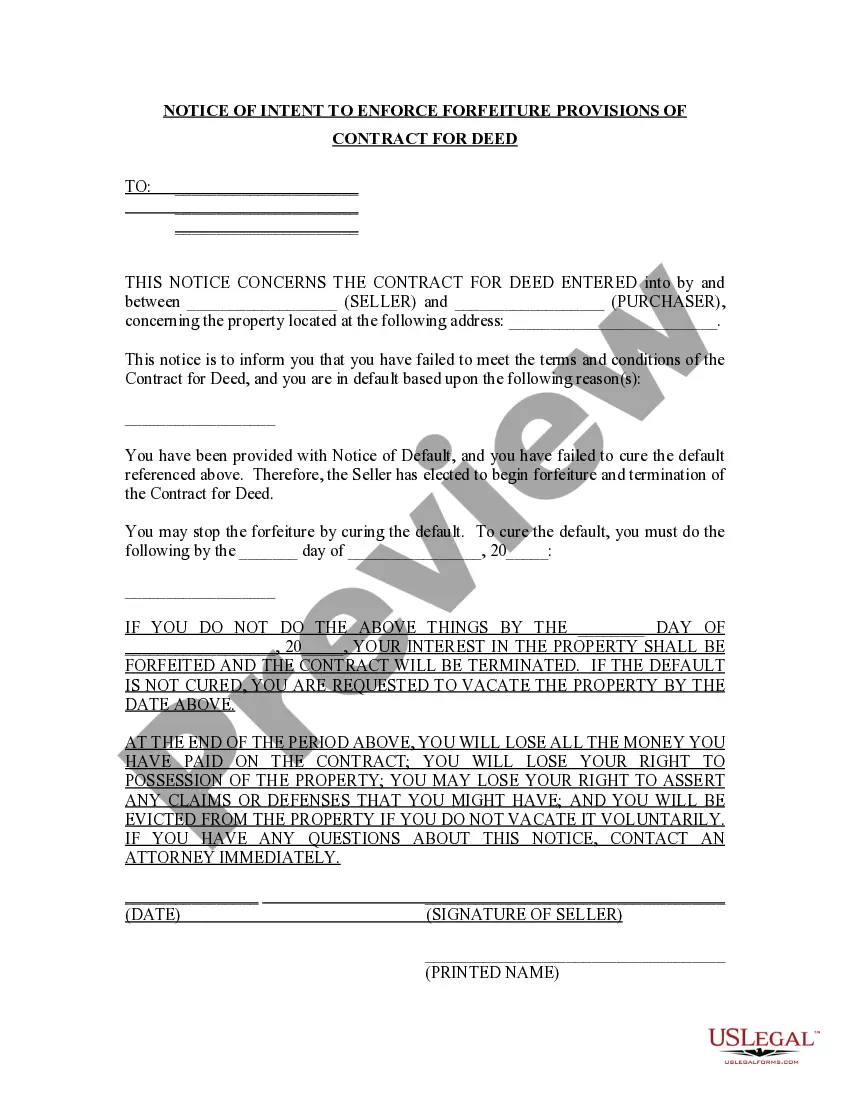
This is an initial Notice of Intent to enforce forfeiture provisions of contract for deed. It is to be used if nonpayment or other breach is not cured. Upon ordering, you may download the form in Word, Rich Text or Wordperfect formats.
Indiana Notice of Intent to Enforce Forfeiture Provisions of Contact for Deed
State:
Indiana
Control #:
IN-00470-11
Format:
Word;
Rich Text
Instant download
Description
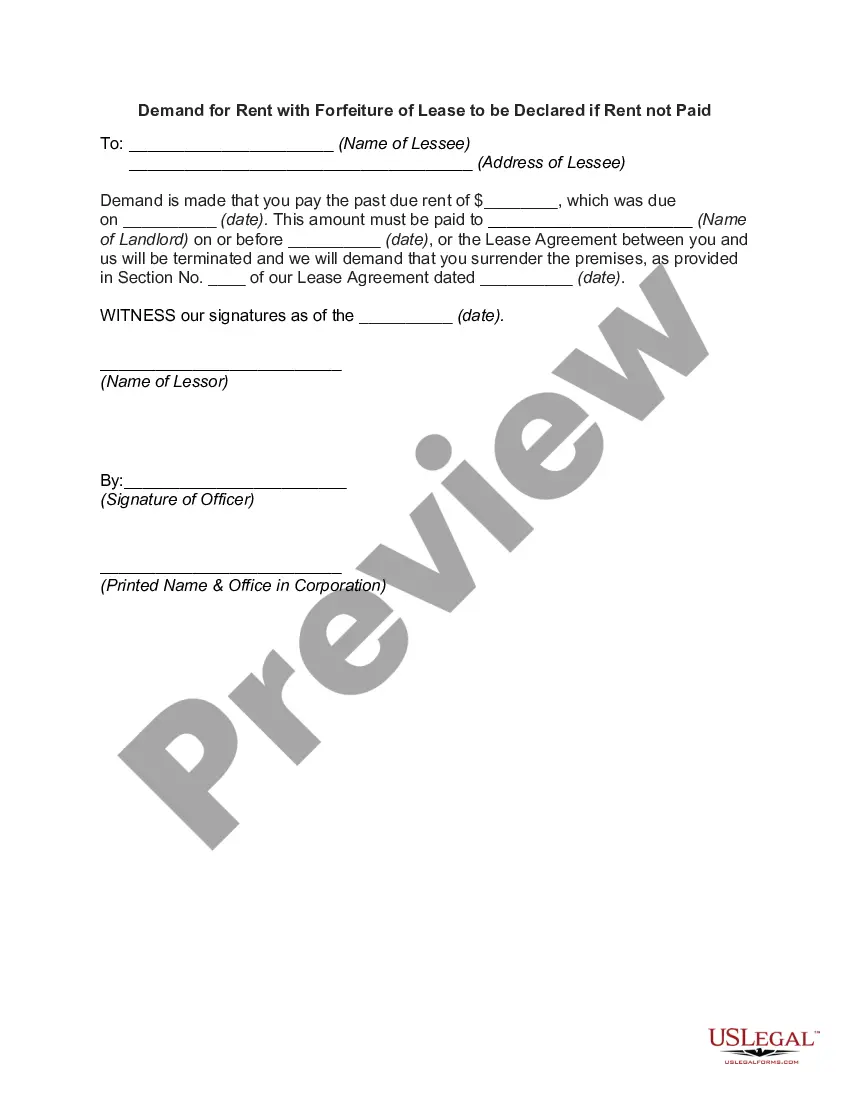
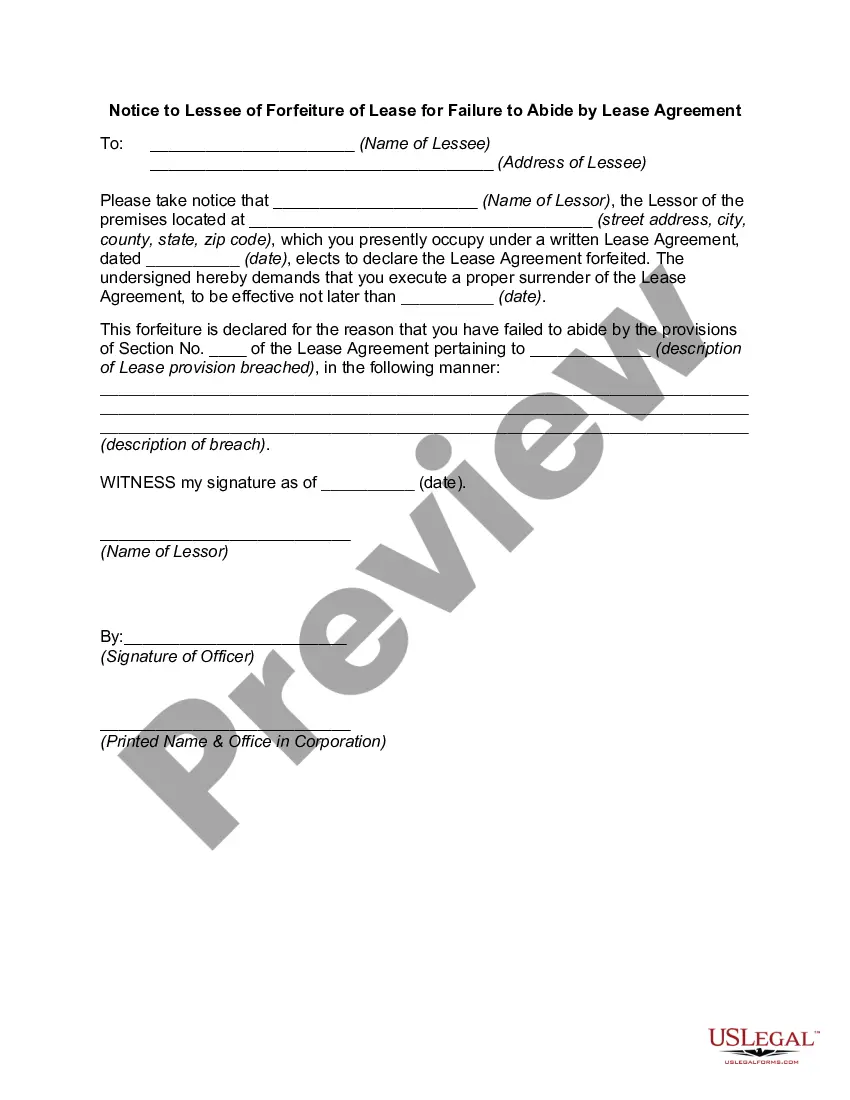
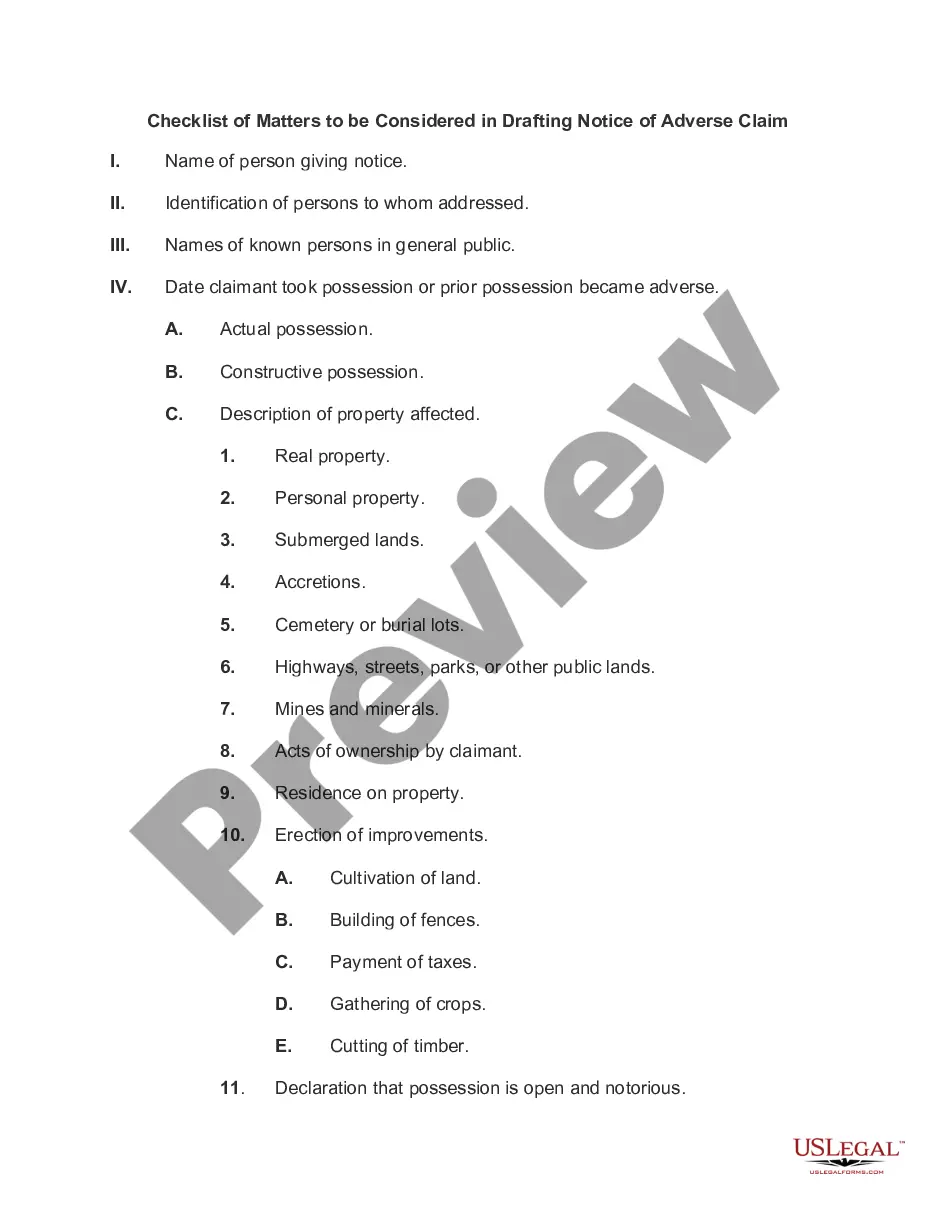
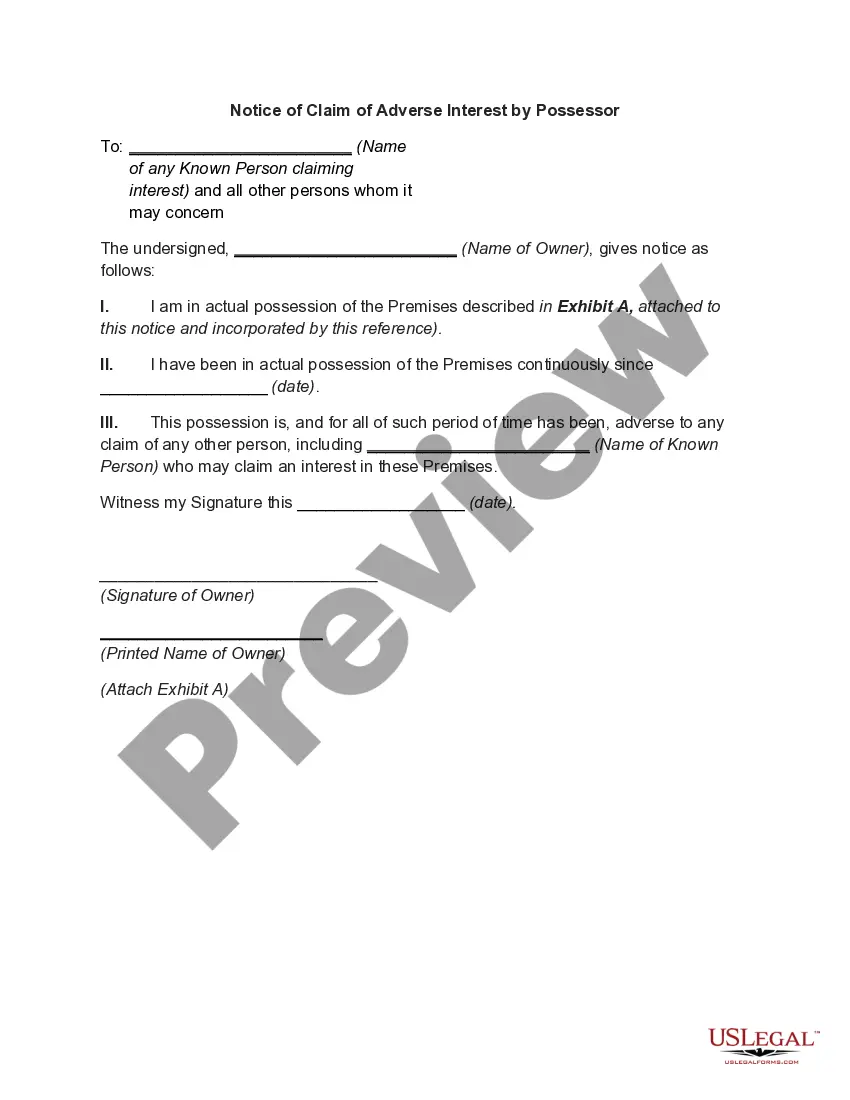

How to fill out Indiana Notice Of Intent To Enforce Forfeiture Provisions Of Contact For Deed?
Utilize US Legal Forms to acquire a printable Indiana Notice of Intent to Enforce Forfeiture Clauses of Contract for Deed.
Our legally acceptable forms are crafted and frequently refreshed by expert attorneys.
Ours is the most extensive Forms catalog online and offers reasonably priced and precise samples for consumers, legal practitioners, and small to medium-sized businesses.
US Legal Forms offers thousands of legal and tax templates and bundles for business and personal requirements, including the Indiana Notice of Intent to Enforce Forfeiture Clauses of Contract for Deed. Over three million users have successfully availed of our service. Select your subscription plan and obtain high-quality documents in just a few clicks.
- The documents are organized into state-specific categories and many can be previewed before downloading.
- To access samples, users must possess a subscription and Log In to their account.
- Click Download next to any form you desire and locate it in My documents.
- For individuals without a subscription, adhere to these steps to swiftly find and download the Indiana Notice of Intent to Enforce Forfeiture Clauses of Contract for Deed.
- Ensure you have the correct template for the necessary state.
- Examine the document by reviewing the description and using the Preview function.
- Click Buy Now if it’s the template you require.
- Create your account and make payment via PayPal or credit card.
- Download the template to your device and feel free to reuse it multiple times.
- Utilize the Search engine if you need to locate another document template.
Form popularity
FAQ
A deed is a document containing the terms of an agreement, especially an agreement concerning the ownership of land or a building. law He asked if I had the deeds to his father's property. Synonyms: document, title, contract, title deed More Synonyms of deed. Quick word challenge.
The general warranty deed is the standard instrument for home sales. Your notarized warranty deed is proof of ownership, and that the grantor transferred complete and clear title to you. A quitclaim deed also proves full land ownershipif the person who conveyed the interest to you had full ownership.
A deed is an official written document declaring a person's legal ownership of a property, while a title refers to the concept of ownership rights.
1 : something that is done : act a brave deed. 2 : a legal document by which a person transfers land or buildings to another. deed. verb.
Title deeds are documents which prove ownership of land or property.This means a record of your ownership is not held centrally at Land Registry. Your deeds may be held by a solicitor, a mortgage lender or by you, at home, or perhaps lodged at your bank.
The Difference Between A Title And A Deed A deed is an official written document declaring a person's legal ownership of a property, while a title refers to the concept of ownership rights.A deed, on the other hand, can (and must!) be in your physical possession after you purchase property.
A deed is a written instrument which is executed with the necessary formality and by which an interest, right or property passes or is confirmed, or an obligation binding on some person is created or confirmed.
The purpose of a deed is to transfer a title, a legal document proving ownership of a property or asset, to another person. For the document to be binding in a court of law, it must be filed in the public record by a local government official tasked with maintaining documents.
When you own a home, you own both the deed and title for that property. In real estate, title means you have ownership and a right to use the property.The deed is the physical legal document that transfers ownership. It shows who you bought your house from, and when you sell it, it shows who you sold it to.