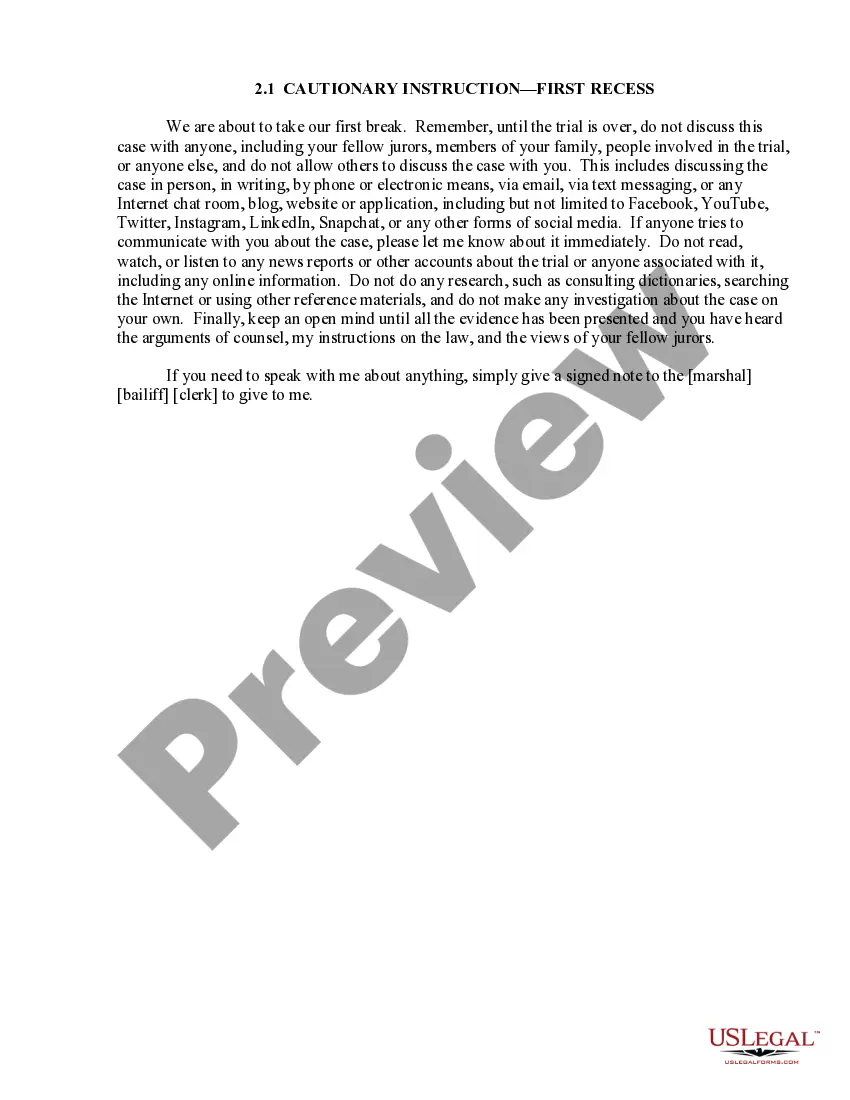
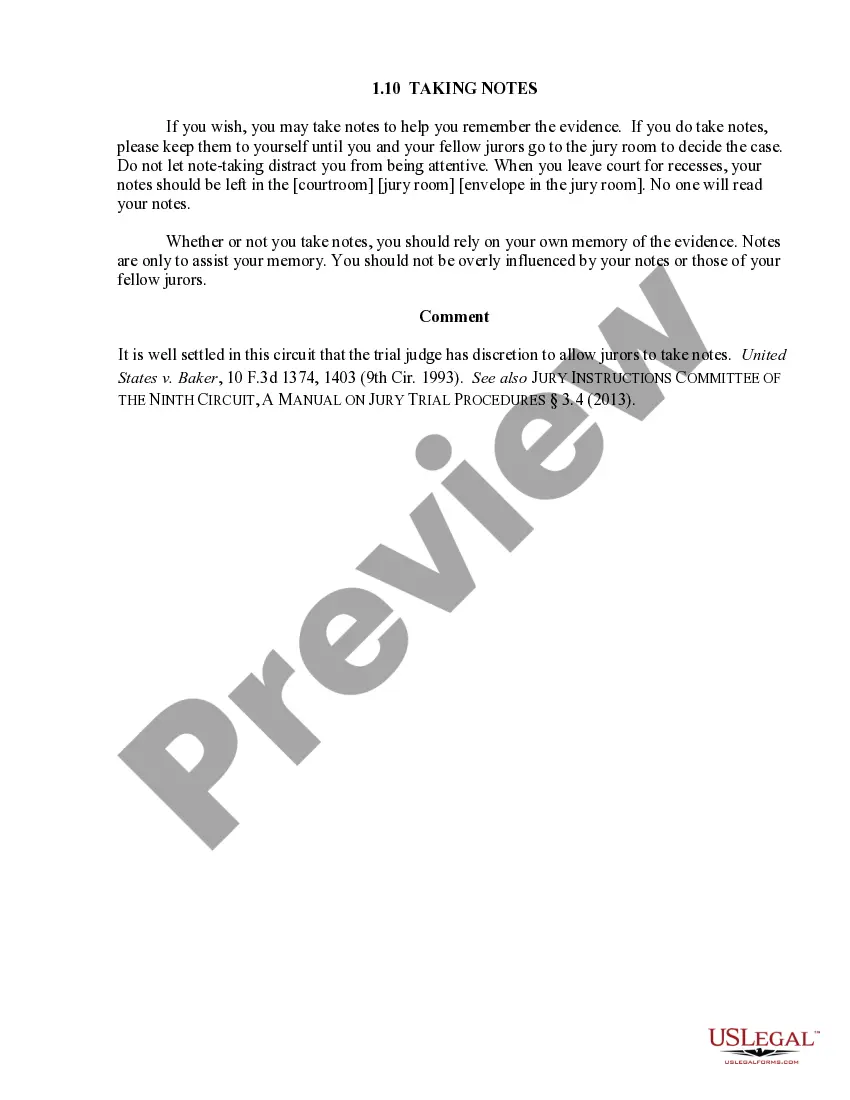
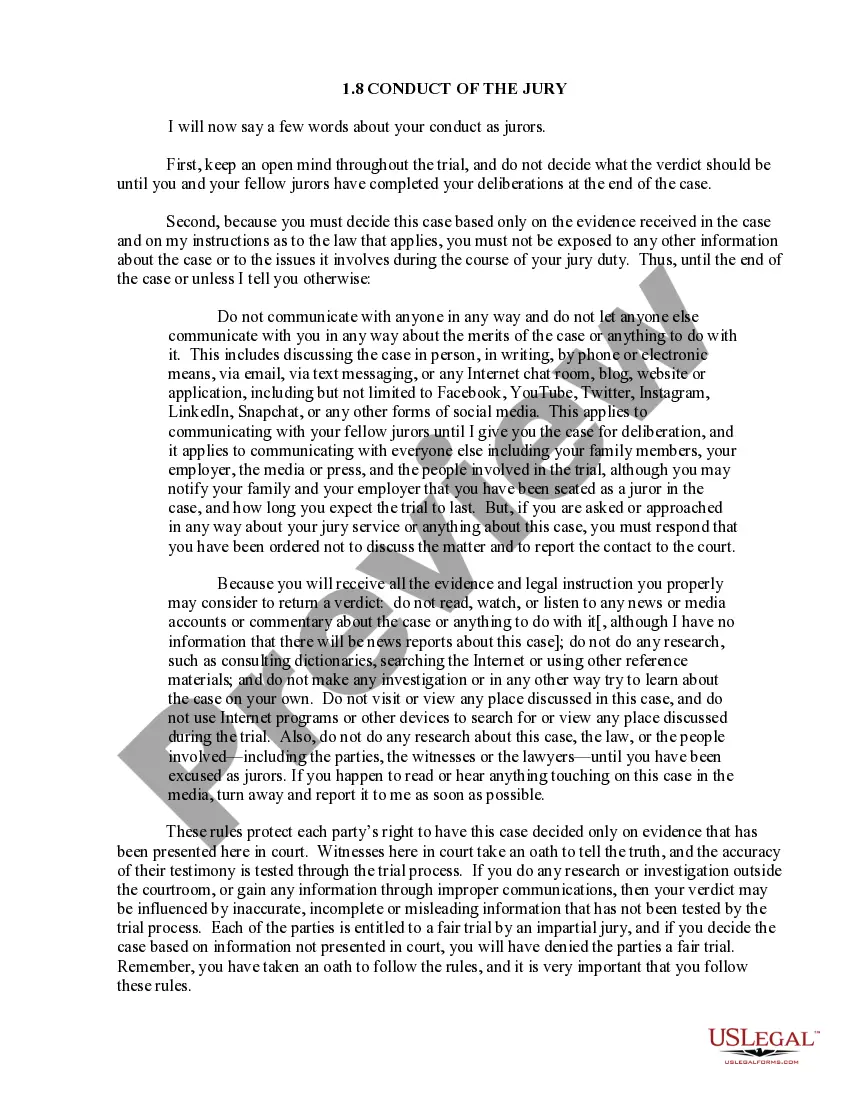
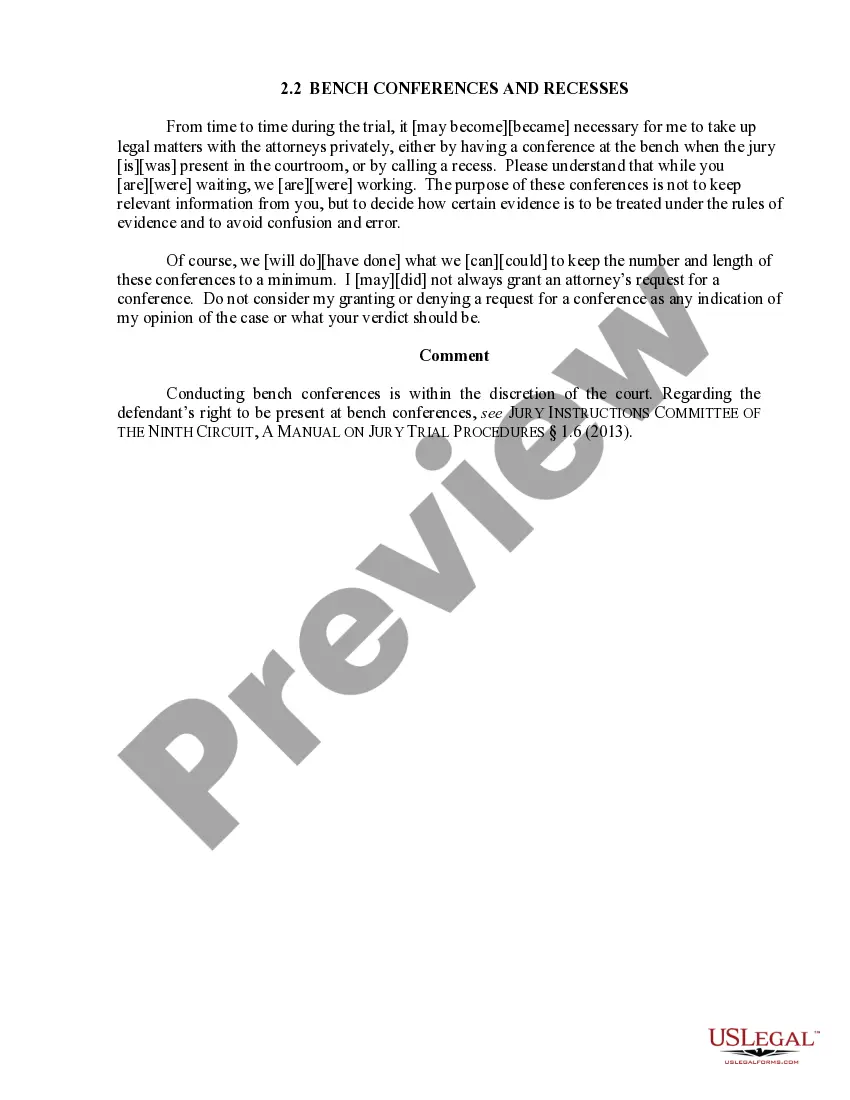
2.1 Cautionary Instruction-First Recess.
Notarization requirements for this form
Notarization is generally not required for this form. However, certain states or situations might demand it. You can complete notarization online through US Legal Forms, powered by Notarize, using a verified video call available anytime.
Get your form ready online
Our built-in tools help you complete, sign, share, and store your documents in one place.
Make edits, fill in missing information, and update formatting in US Legal Forms—just like you would in MS Word.
Download a copy, print it, send it by email, or mail it via USPS—whatever works best for your next step.
Sign and collect signatures with our SignNow integration. Send to multiple recipients, set reminders, and more. Go Premium to unlock E-Sign.
If this form requires notarization, complete it online through a secure video call—no need to meet a notary in person or wait for an appointment.
We protect your documents and personal data by following strict security and privacy standards.

Make edits, fill in missing information, and update formatting in US Legal Forms—just like you would in MS Word.

Download a copy, print it, send it by email, or mail it via USPS—whatever works best for your next step.

Sign and collect signatures with our SignNow integration. Send to multiple recipients, set reminders, and more. Go Premium to unlock E-Sign.

If this form requires notarization, complete it online through a secure video call—no need to meet a notary in person or wait for an appointment.

We protect your documents and personal data by following strict security and privacy standards.
Looking for another form?

Form popularity
FAQ
Another example of a curative instruction is when the judge tells the jury to disregard certain evidence or consider it for specific purposes only. This is called a cautionary instruction and is meant to prevent the evidence from unfairly influencing the jury's decision.
A cautionary instruction is a direction or guideline that a judge gives to a jury concerning the law of the case. It is usually given to warn the jury about certain evidence or to instruct them not to be influenced by outside factors.
Judge: Members of the jury, you have heard all of the testimony concerning this case. It is now up to you to determine the facts. You and you alone, are the judges of the fact. Once you decide what facts the evidence proves, you must then apply the law as I give it to you to the facts as you find them.
A jury instruction in which the judge instructs the jury to consider a piece of evidence for a specific purpose and ignore it for any other purpose. At trial, a court may admit evidence that is admissible for one purpose or against one party but not another.
The judge may make the decision right away or may take a recess to give the decision. The recess may be only for a few hours or it may take days or weeks to give the final decision.
Ideally, children should get four 15-minute recesses every day, says Debbie Rhea, a professor of kinesiology at Texas Christian University in Forth Worth and director of the LiiNK Project, which advocates for outdoor play in schools.
Recess is a break in a trial, other adjudicatory proceedings or legislative session until a specified date and time. Recess is not to be confused with adjournment, which winds up the proceedings. For example, the trial transcript of Gonzalez v.
Adjournment. The means through which a session is ended. Recess. A temporary suspension of a session; a break within a session.