Illinois Military Leave Policy
Description
Get your form ready online
Our built-in tools help you complete, sign, share, and store your documents in one place.
Make edits, fill in missing information, and update formatting in US Legal Forms—just like you would in MS Word.
Download a copy, print it, send it by email, or mail it via USPS—whatever works best for your next step.
Sign and collect signatures with our SignNow integration. Send to multiple recipients, set reminders, and more. Go Premium to unlock E-Sign.
If this form requires notarization, complete it online through a secure video call—no need to meet a notary in person or wait for an appointment.
We protect your documents and personal data by following strict security and privacy standards.

Make edits, fill in missing information, and update formatting in US Legal Forms—just like you would in MS Word.

Download a copy, print it, send it by email, or mail it via USPS—whatever works best for your next step.

Sign and collect signatures with our SignNow integration. Send to multiple recipients, set reminders, and more. Go Premium to unlock E-Sign.

If this form requires notarization, complete it online through a secure video call—no need to meet a notary in person or wait for an appointment.

We protect your documents and personal data by following strict security and privacy standards.
Looking for another form?

How to fill out Military Leave Policy?
You can invest hours online searching for the legal document template that meets the state and federal requirements you need.
US Legal Forms offers a multitude of legal forms that are reviewed by experts.
It is easy to download or print the Illinois Military Leave Policy from the service.
If available, use the Review button to look through the document template as well.
- If you already have a US Legal Forms account, you can Log In and click on the Download button.
- Then, you can complete, modify, print, or sign the Illinois Military Leave Policy.
- Each legal document template you acquire is yours permanently.
- To obtain another copy of any purchased form, visit the My documents tab and click the corresponding button.
- If you are using the US Legal Forms website for the first time, follow the simple instructions outlined below.
- First, ensure that you have chosen the correct document template for the area/city of your selecting.
- Read the form description to confirm you have selected the right form.
Form popularity
FAQ
Can an employer require an employee to produce military orders before granting a military leave of absence? No. The Uniformed Services Employment and Reemployment Rights Act (USSERA) requires that an employee or a responsible military official provide advance notice to the employer of military service.
Members of the Reserve and National Guard are not charged military leave for non-duty days (i.e., weekends and holidays) that occur within the period of military service. Salary Payments - Employees on military leave under 5 U.S.C. 6323 (a) are entitled to retain both their military and Federal civilian pay.
As part of the military pay and benefits package, military service members earn 30 days of paid leave per year. You start at zero and for every month of military service, 2.5 days of leave get added to your leave account.
You have the responsibility to provide unpaid leave to perform military service. Employees who are in the uniformed services may be called away to perform their duties voluntarily or involuntarily.
Whether an individual voluntarily or involuntarily takes leave to undertake military services, the USERRA protects his/her job rights. USERRA is applicable to all employers no matter how many people are employed and all employees are eligible no matter how many hours they have worked for their employer.
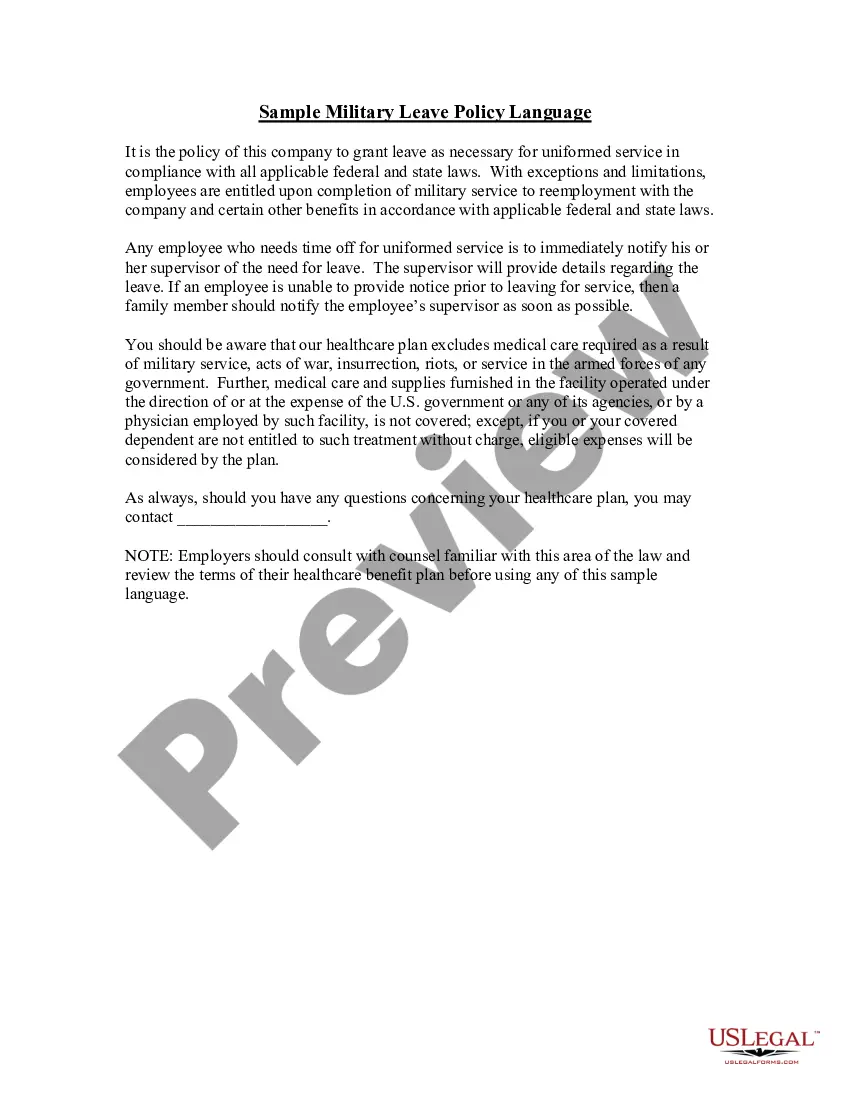
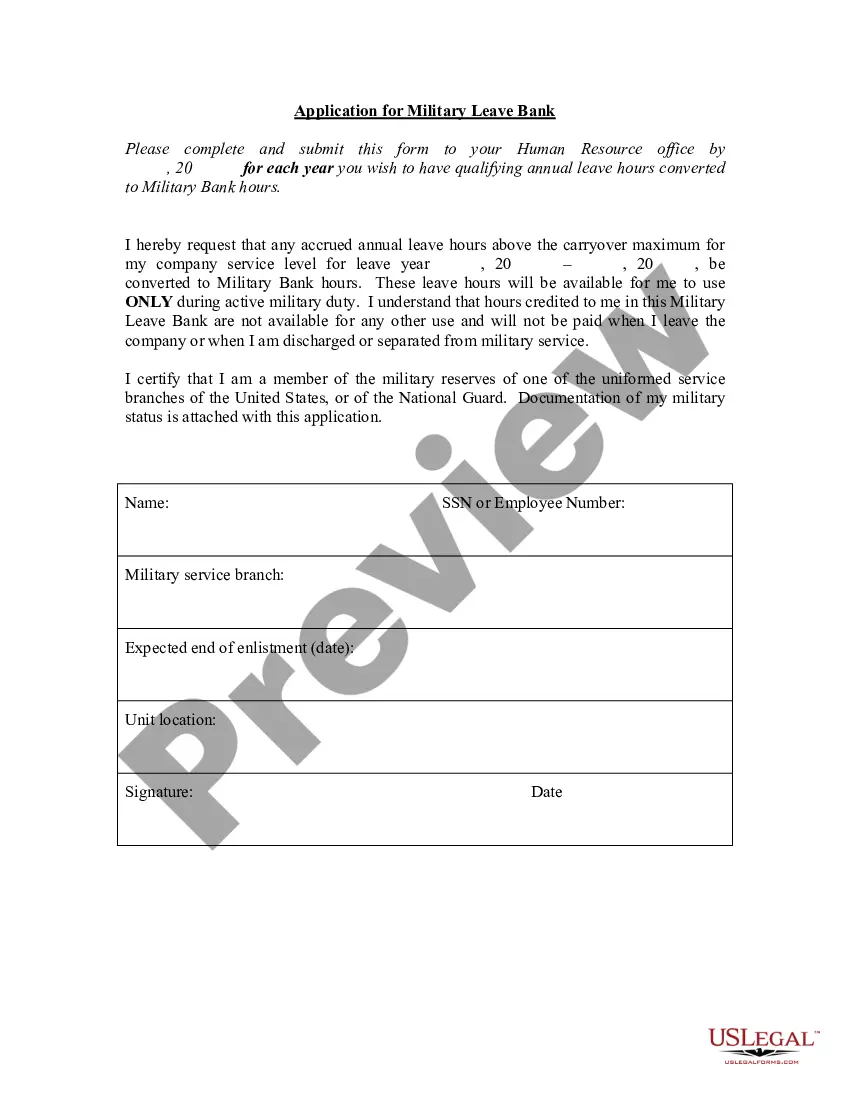
Definition. "Military Leave" is any time off that is provided to staff who are members of the National Guard or other reserve component of the United States Armed Services and who are called to active duty, attend scheduled reserve service, and/or temporary training duty.
Regular military leave is any paid leave taken for personal reasons, including vacations, family care, errands or any other purpose. Regular leave is used on workdays and also any time the service member is leaving the vicinity of their duty station, as defined by their command, on a weekend or holiday.
No. As stated previously, an employer may not require documentation for notification prior to military duty. Further, an employer does not have a"right of refusal" for military leave of absence, so long as the employee has not exceeded the 5 years of cumulative service provided under USERRA.
The Uniformed Services Employment and Reemployment Rights Act (USERRA) guarantees the rights of military service members to take a leave of absence from their civilian jobs for active military service and to return to their jobs with accrued seniority and other employment protections.