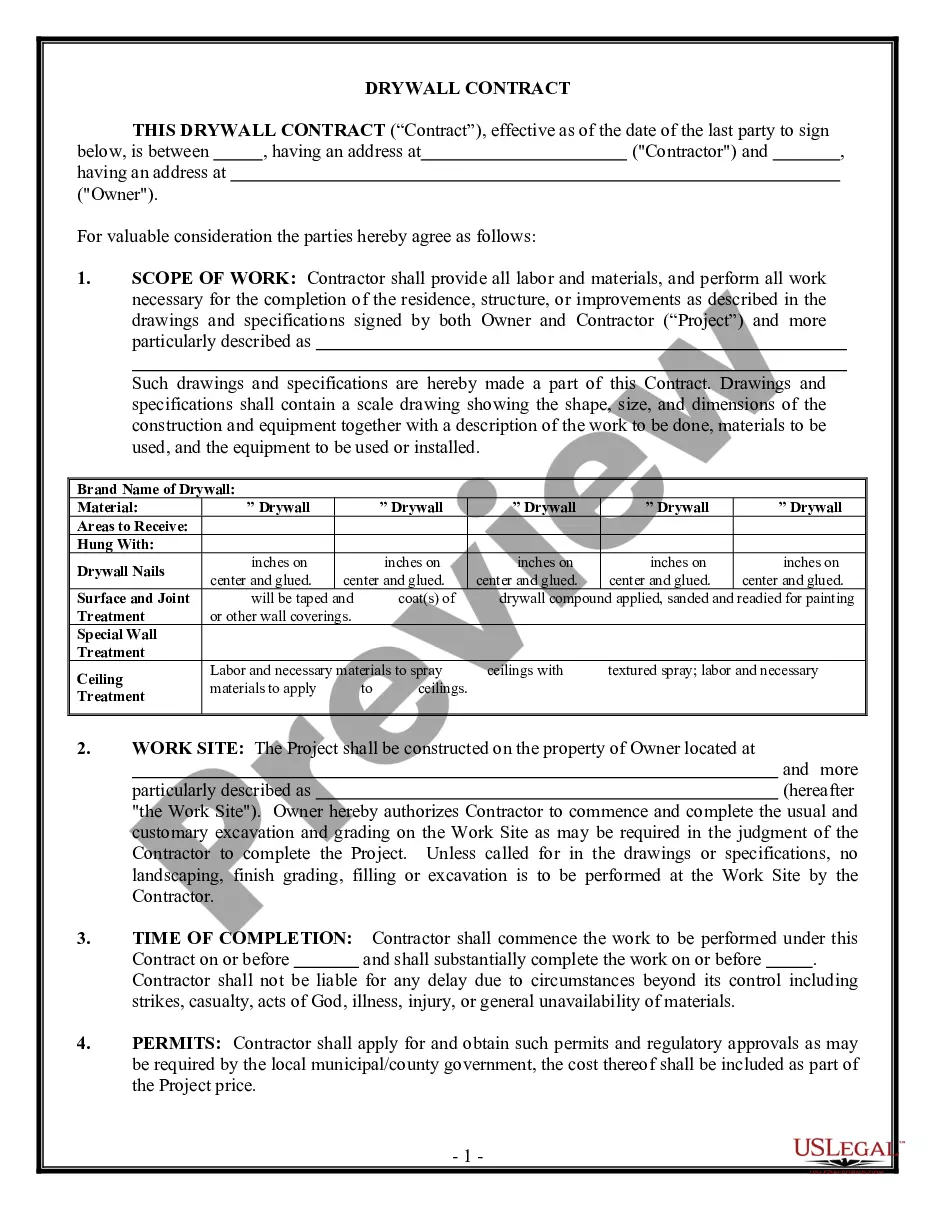
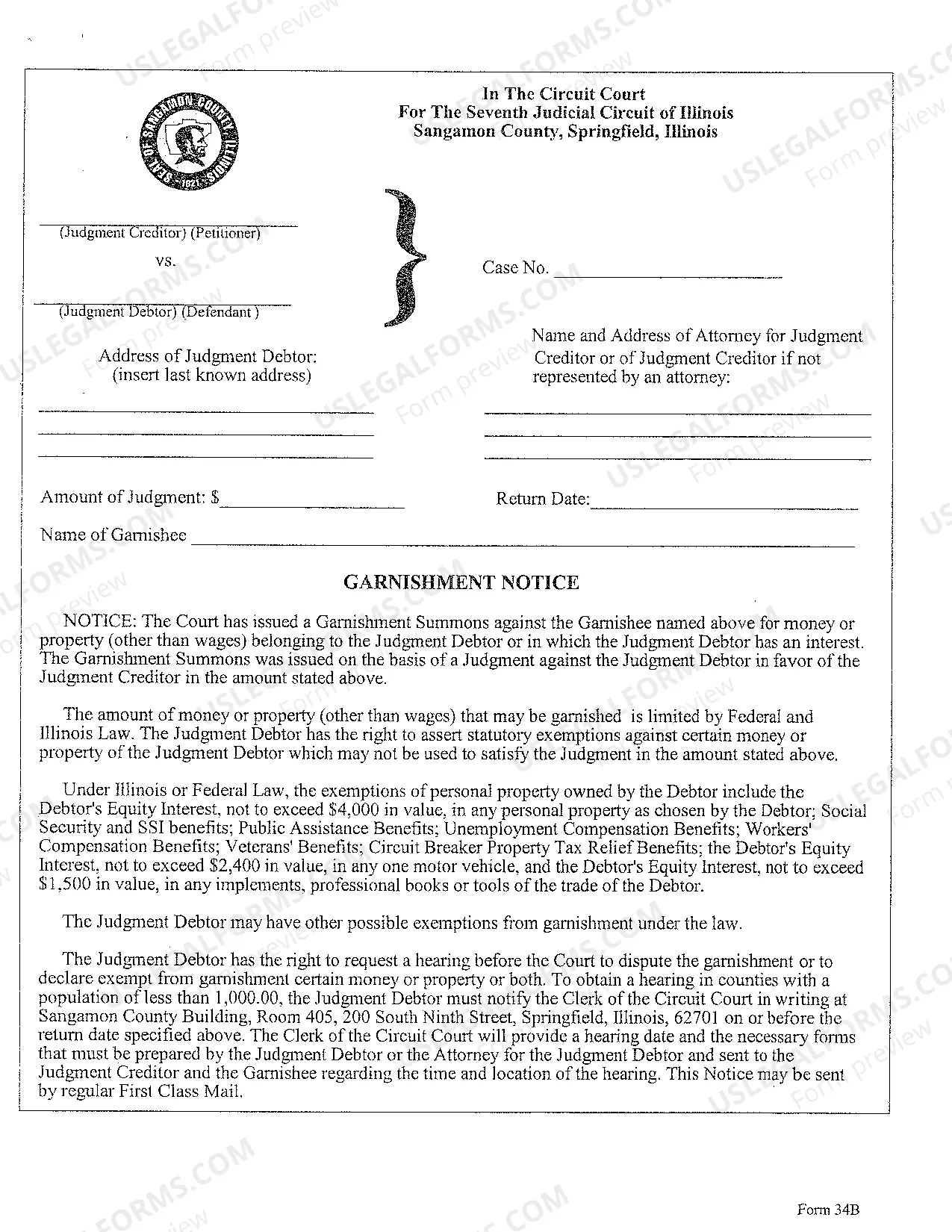
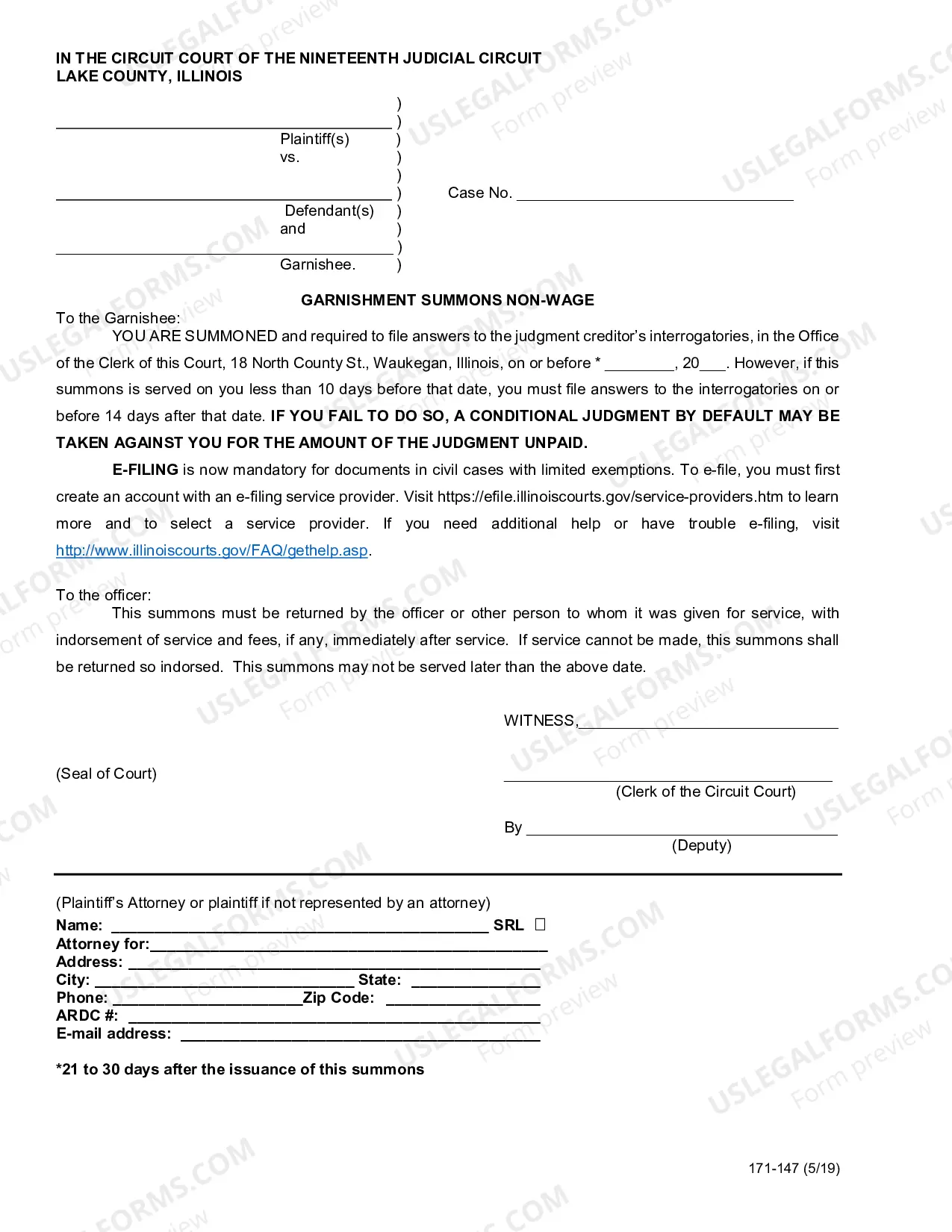
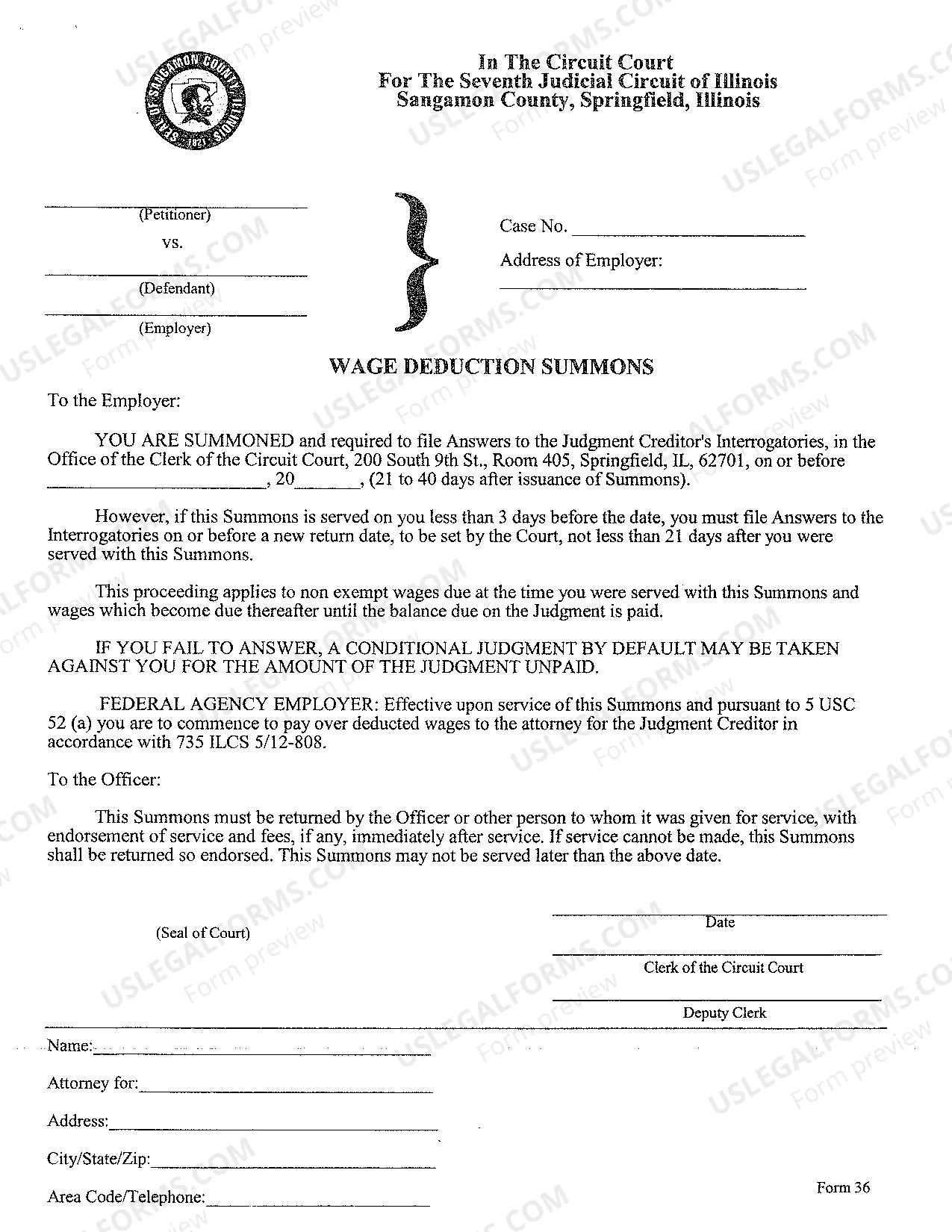
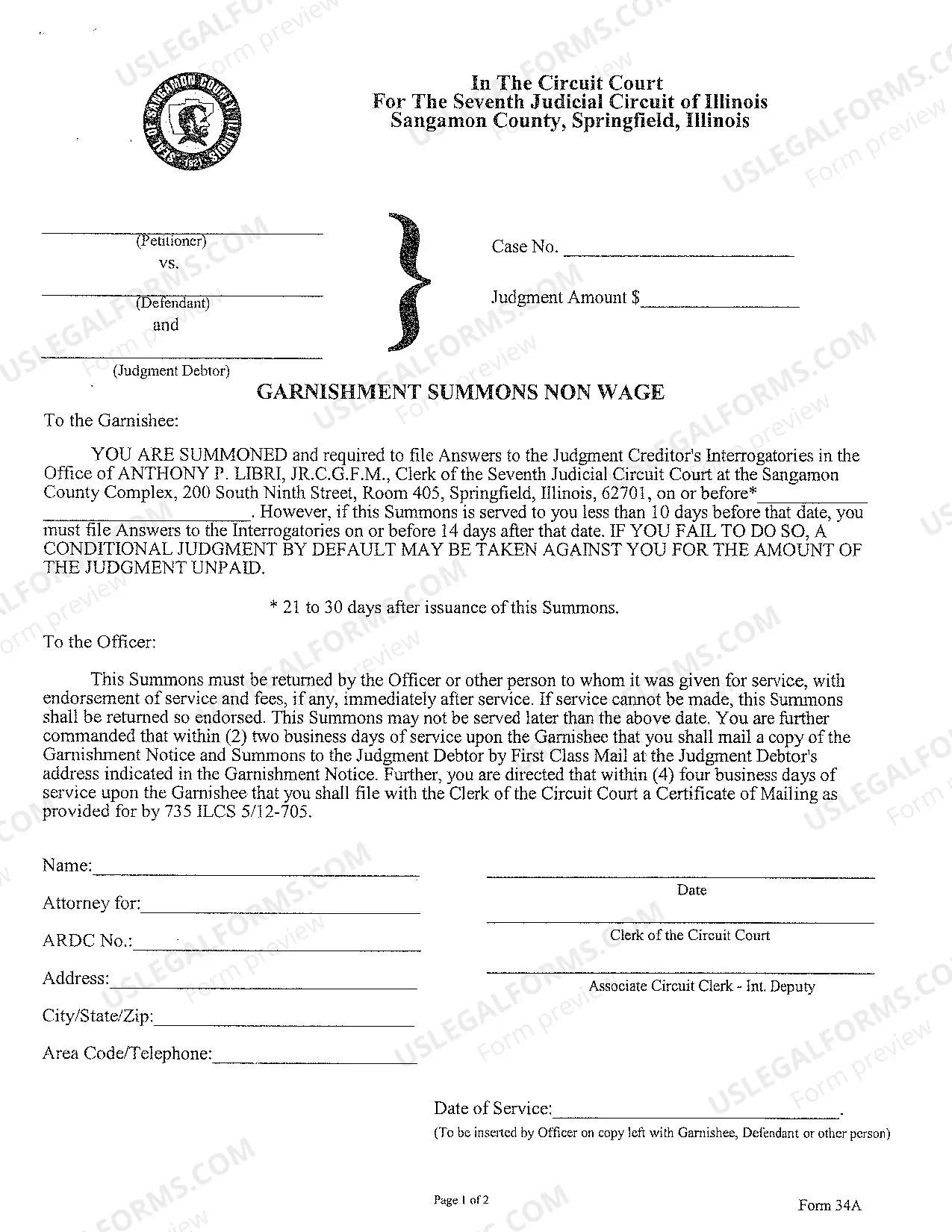
An Illinois Garnishment Notice is a legal document issued by the court to a third party, such as an employer, informing them of a pending garnishment of wages or income in the state of Illinois. This notice is used to collect unpaid debt from an individual or business by withholding a portion of their wages or income. There are three types of Illinois Garnishment Notices: wage garnishment, income withholding, and financial institution garnishment. Wage garnishment is the most common type of garnishment, and requires a court order to withhold a set amount of money from the debtor's paycheck on a regular basis. Income withholding is similar to wage garnishment, but instead of withholding money directly from the debtor's paycheck, the money is taken from non-wage sources of income such as Social Security, tax refunds, or other government benefits. Financial institution garnishment is a process in which the court orders a bank, credit union, or other financial institution to freeze a certain amount of the debtor's funds until the debt is paid in full.
Illinois Garnishment Notice
Description
Get your form ready online
Our built-in tools help you complete, sign, share, and store your documents in one place.
Make edits, fill in missing information, and update formatting in US Legal Forms—just like you would in MS Word.
Download a copy, print it, send it by email, or mail it via USPS—whatever works best for your next step.
Sign and collect signatures with our SignNow integration. Send to multiple recipients, set reminders, and more. Go Premium to unlock E-Sign.
If this form requires notarization, complete it online through a secure video call—no need to meet a notary in person or wait for an appointment.
We protect your documents and personal data by following strict security and privacy standards.

Make edits, fill in missing information, and update formatting in US Legal Forms—just like you would in MS Word.

Download a copy, print it, send it by email, or mail it via USPS—whatever works best for your next step.

Sign and collect signatures with our SignNow integration. Send to multiple recipients, set reminders, and more. Go Premium to unlock E-Sign.

If this form requires notarization, complete it online through a secure video call—no need to meet a notary in person or wait for an appointment.

We protect your documents and personal data by following strict security and privacy standards.
Looking for another form?

How to fill out Illinois Garnishment Notice?
How much time and resources do you frequently allocate to creating formal documentation.
There’s a superior method to obtain such forms than employing legal experts or spending hours searching online for an appropriate template. US Legal Forms is the premier online repository that provides professionally drafted and authenticated state-specific legal documents for any reason, like the Illinois Garnishment Notice.
Another advantage of our library is that you can access previously obtained documents securely stored in your profile in the My documents tab. Retrieve them at any time and redo your paperwork as often as you need.
Conserve time and effort preparing formal paperwork with US Legal Forms, one of the most reliable web services. Register with us today!
- Review the form content to verify it complies with your state regulations. To do this, examine the form description or utilize the Preview option.
- If your legal template does not fulfill your requirements, find an alternative using the search bar at the top of the page.
- If you already possess an account with us, Log In and download the Illinois Garnishment Notice. Otherwise, continue with the next instructions.
- Click Buy now when you identify the appropriate document. Choose the subscription plan that fits you best to gain access to our library’s complete offerings.
- Sign up for an account and process your subscription payment. You can complete the transaction with your credit card or via PayPal - our service is entirely secure for that.
- Download your Illinois Garnishment Notice on your device and fill it out on a printed hard copy or digitally.
Form popularity
FAQ
To enforce a judgment in Illinois, you must first obtain a court order confirming the judgment. After that, you can take legal steps such as filing for wage garnishment or placing liens on property. Understanding the procedures can be complex, but tools like USLegalForms can assist you in navigating the legal landscape efficiently, ensuring you understand your rights and the processes involved.
For the most part, there are only two ways to stop wage garnishments in Illinois. First, you can pay off the judgment. You may be able to pay the judgment in a lump sum, or you may have to wait for the garnishment to run its course. The second way to stop a garnishment is by filing bankruptcy.
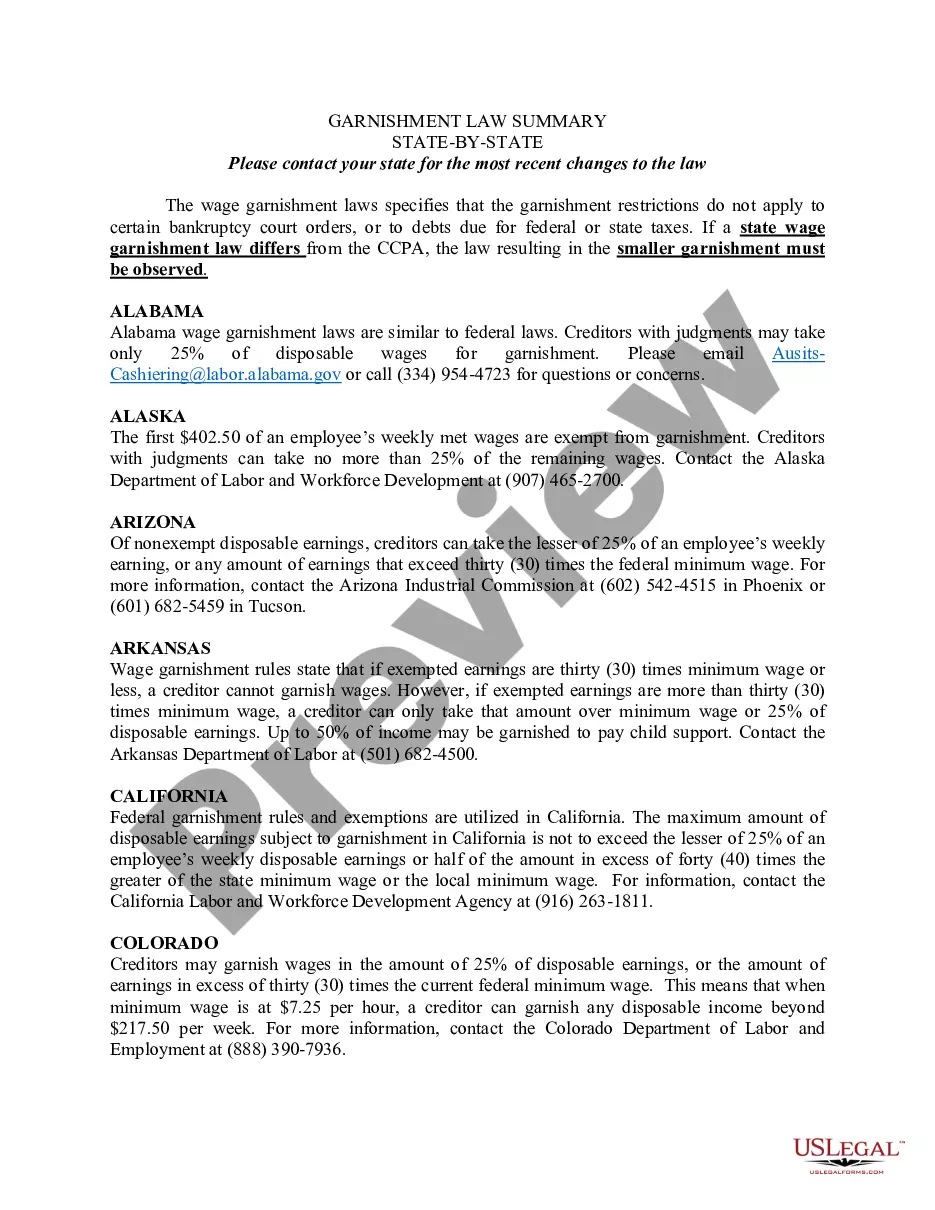
Wage Garnishment in Illinois In Illinois, if a creditor wins a court judgment against you, the maximum your employer can garnish from your weekly earnings is either 15 percent of your earnings or the amount left over after you deduct 45 hours' worth of Illinois' minimum wage.
The most the employer can hold out for you is 15% of the debtor's gross income before taxes or deductions. However, the withholding can't leave the debtor with less than 45 times the state minimum wage as weekly take-home pay.
Up to 15% of your gross wages for that week, or. the amount of disposable earnings that remains after deducting the Illinois minimum wage (or the federal minimum wage if it's greater than the Illinois minimum wage) multiplied by 45. (735 Ill.
For the most part, there are only two ways to stop wage garnishments in Illinois. First, you can pay off the judgment. You may be able to pay the judgment in a lump sum, or you may have to wait for the garnishment to run its course. The second way to stop a garnishment is by filing bankruptcy.
Here's how to find out how much an employer can take from a debtor's paycheck: Multiply the debtor's gross weekly wages by . 15, and write this number down, and. Subtract 585 from the debtor's net (take home) weekly wages, and write this number down.
In non-wage garnishments, 735 ILCS 5/12-701 requires the judgment creditor, or other person, to file an affidavit stating that the affiant believes the garnishee is indebted to the judgment debtor or has property of the judgment debtor. Failure to file such affidavit invalidates the garnishment.
The Debt Collection Improvement Act authorizes federal agencies or collection agencies under contract with them to garnish up to 15% of disposable earnings to repay defaulted debts owed to the U.S. government.