Illinois Certificate of Levy
Overview of this form
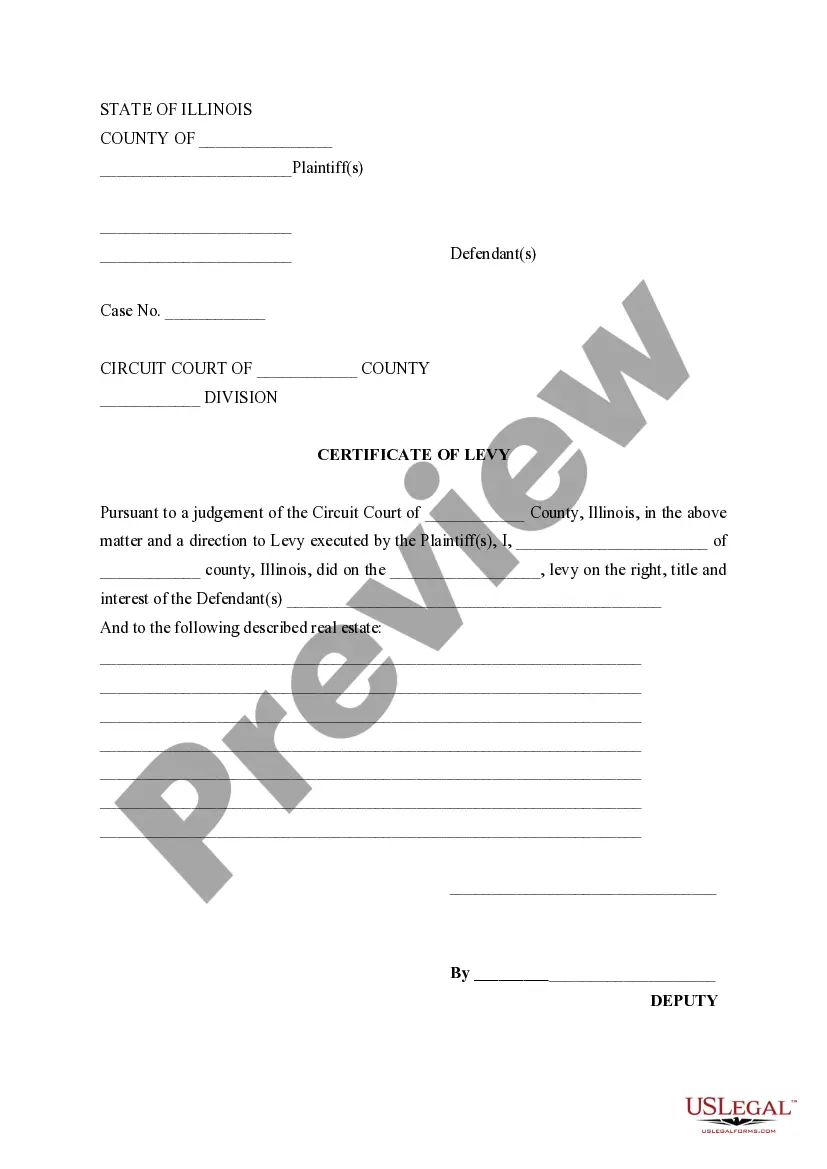
The Certificate of Levy is a legal document that confirms a preliminary seizure of a defendant's property as part of enforcing a court judgment. It serves to notify involved parties of the property being levied upon, distinguishing itself from other court or property-related forms by specifically reflecting the enforcement actions taken under a courtâs directive. This document is essential for proceeding with the enforcement of legal claims against individuals or entities with outstanding obligations.
Main sections of this form
- State and county information to establish jurisdiction.
- Details of the plaintiff(s) initiating the levy.
- Identification of the defendant(s) whose property is being levied.
- Case number for reference in the Circuit Court.
- Description of the property being levied, detailing its location and specifics.
- Signature line for the Deputy levying the property.
Common use cases
This form is used when a plaintiff wants to enforce a judgment against a defendant by seizing their property. It is particularly applicable in situations where the court has ruled in favor of the plaintiff, and there is a need to take action against the defendant's real estate or personal property to satisfy the court's decision.
Who this form is for
- Plaintiffs seeking to enforce a judgment issued by the court.
- Legal representatives acting on behalf of plaintiffs.
- Deputies or officials responsible for executing court orders in property seizures.
- Defendants who need to understand any claims being made against their property.
How to complete this form
- Fill in the state and county where the court is located.
- Enter the names of the plaintiff(s) and defendant(s) involved in the case.
- Provide the case number issued by the Circuit Court.
- Clearly describe the property being seized, including its location and other identifying details.
- Complete the date of the levy and the signature of the Deputy executing the levy.
Does this form need to be notarized?
This form does not typically require notarization unless specified by local law. However, check with local regulations to ensure compliance with any specific requirements that may apply to your situation.
Get your form ready online
Our built-in tools help you complete, sign, share, and store your documents in one place.
Make edits, fill in missing information, and update formatting in US Legal Forms—just like you would in MS Word.
Download a copy, print it, send it by email, or mail it via USPS—whatever works best for your next step.
Sign and collect signatures with our SignNow integration. Send to multiple recipients, set reminders, and more. Go Premium to unlock E-Sign.
If this form requires notarization, complete it online through a secure video call—no need to meet a notary in person or wait for an appointment.
We protect your documents and personal data by following strict security and privacy standards.

Make edits, fill in missing information, and update formatting in US Legal Forms—just like you would in MS Word.

Download a copy, print it, send it by email, or mail it via USPS—whatever works best for your next step.

Sign and collect signatures with our SignNow integration. Send to multiple recipients, set reminders, and more. Go Premium to unlock E-Sign.

If this form requires notarization, complete it online through a secure video call—no need to meet a notary in person or wait for an appointment.

We protect your documents and personal data by following strict security and privacy standards.
Mistakes to watch out for
- Failing to provide accurate property descriptions, leading to potential legal issues.
- Missing signatures from required parties, which can invalidate the form.
- Incorrectly listing the case number or plaintiff/defendant names.
Benefits of using this form online
- Immediate access to legal documents without the need for physical visits to legal offices.
- Editable templates that allow for easy customization of details related to your case.
- Reliability ensured through professionally drafted forms created by licensed attorneys.
Looking for another form?
Form popularity
FAQ
In most counties, property taxes are paid in two installments, usually June 1 and September 1. If the tax bills are mailed late (after May 1), the first installment is due 30 days after the date on your tax bill.The second installment is prepared and mailed by June 30 and is for the balance of taxes due.
Illinois Department of Revenue, Local Government, Understanding Your Property Tax Bill, http://tax.illinois.gov (The equalized assessed value, or EAV, is the result of applying the state equalization factor to the assessed value of a parcel of property.
To stop a state tax levy, you will need to act quickly.Once you start a payment plan, the IRS will stop the levy. Submit a counteroffer: Your tax lawyer can submit an offer in compromise to the IRS. This offer will request that you pay less than the amount you owe in taxes.
A levy is a legal seizure of your property to satisfy a tax debt. Levies are different from liens. A lien is a legal claim against property to secure payment of the tax debt, while a levy actually takes the property to satisfy the tax debt.
What is a local levy? a. A local property tax passed by voters of a school district that generates tax revenue for local school districts. All money generated by school district levies goes directly to the school district to pay for enhancements to the state funded basic education.
More In File The IRS can also release a levy if it determines that the levy is causing an immediate economic hardship. If the IRS denies your request to release the levy, you may appeal this decision. You may appeal before or after the IRS places a levy on your wages, bank account, or other property.
The Congress shall have Power To lay and collect Taxes, Duties, Imposts and Excises, to pay the Debts and provide for the common Defence and general Welfare of the United States; but all Duties, Imposts and Excises shall be uniform throughout the United States; . . . 240 U.S. at 12.
Levy of taxTax is levied at the tax rate and assessment ratio applicable for the year. Taxing jurisdictions levy tax on property following a preliminary or final determination of value. Property taxes in the United States generally are due only if the taxing jurisdiction has levied or billed the tax.
The federal government is the country's largest landowner; its holdings in towns and cities across the continent, on mountains and plains, in forests and parks amount to more than one acre in every five.Yet the government holdings are almost entirely exempt from payment of local or state property taxes.