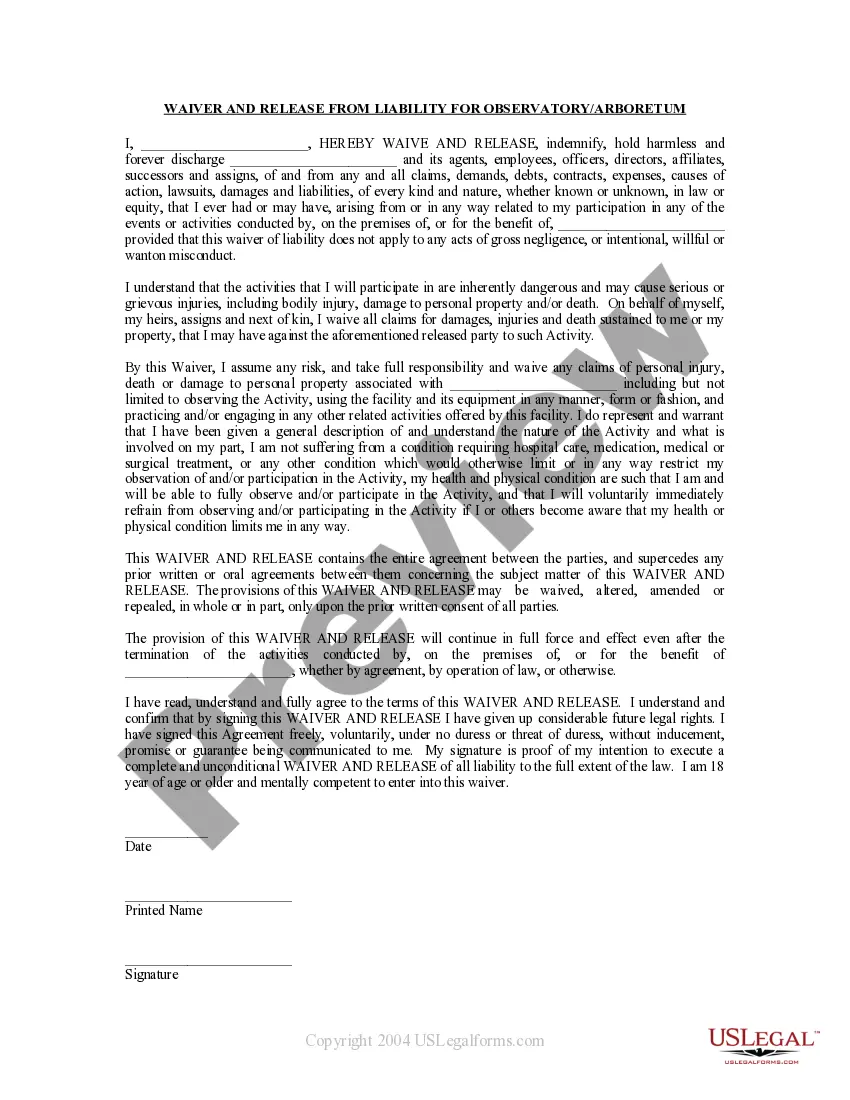
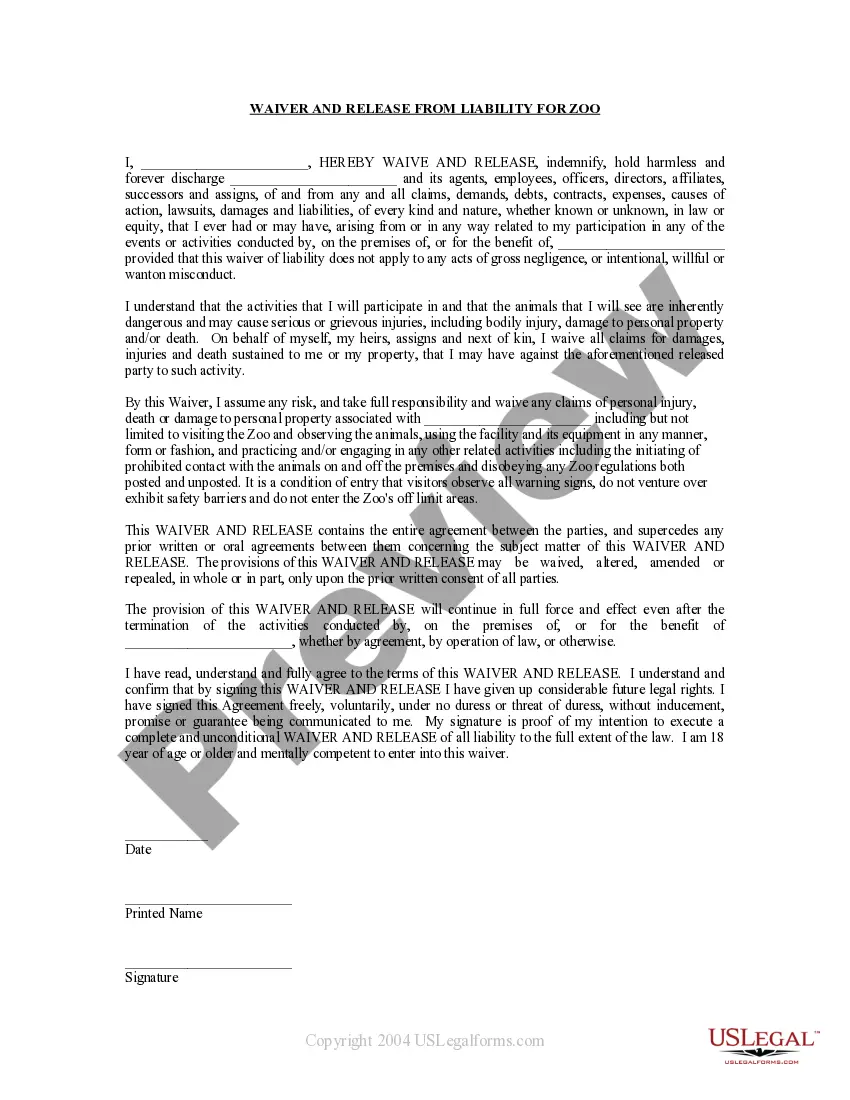
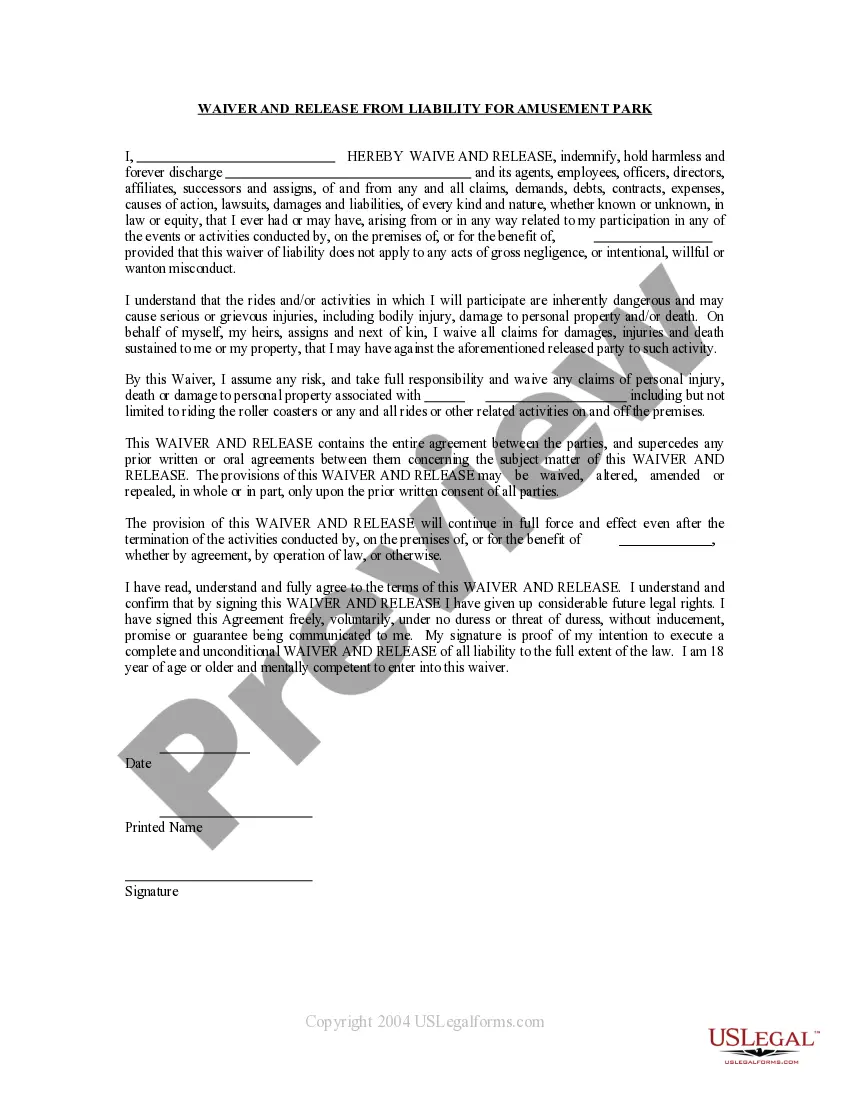
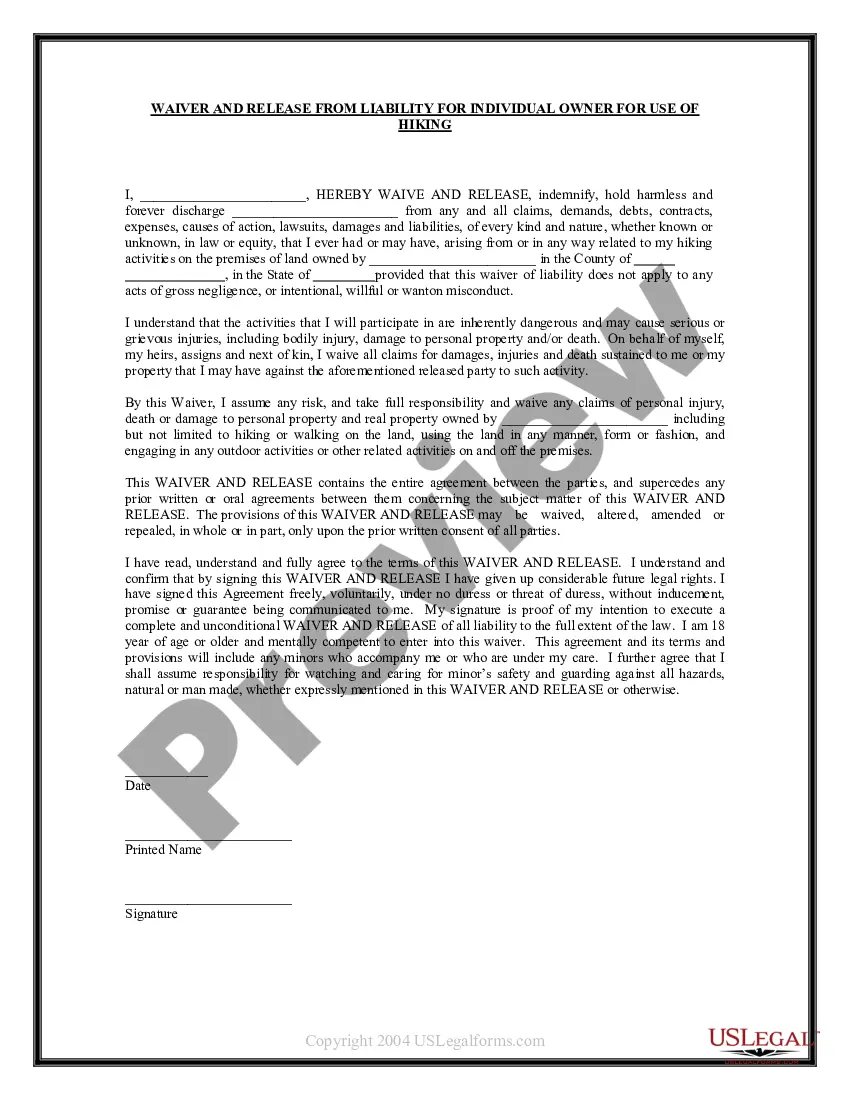
This form allows an adult to release a observatory or arboretum from liability for injuries which may be incurred while on the premises, taking part in activities, etc.
Hawaii Waiver and Release From Liability For Adult for Observatory or Arboretum
Category:
State:
Multi-State
Control #:
US-WAV-18A
Format:
Word;
Rich Text
Instant download
Description

How to fill out Waiver And Release From Liability For Adult For Observatory Or Arboretum?
Are you presently in a scenario where you will require documents for various organizational or personal purposes almost all the time.
There is a range of legitimate document templates accessible online, but obtaining forms you can trust is not simple.
US Legal Forms provides a vast collection of template forms, including the Hawaii Waiver and Release From Liability For Adult for Observatory or Arboretum, which are designed to meet state and federal requirements.
Once you find the correct form, click Buy now.
Choose the pricing plan you desire, complete the necessary information to create your account, and place an order using your PayPal or credit card.
- If you are currently familiar with the US Legal Forms website and have an account, simply Log In.
- After that, you can download the Hawaii Waiver and Release From Liability For Adult for Observatory or Arboretum template.
- If you do not have an account and wish to start using US Legal Forms, follow these steps.
- Obtain the form you need and ensure it is for the correct city/area.
- Utilize the Preview button to review the document.
- Examine the outline to confirm that you have selected the appropriate form.
- If the form is not what you need, use the Search section to find the form that fulfills your requirements.
Form popularity
FAQ
Filling out the Hawaii Waiver and Release From Liability For Adult for Observatory or Arboretum is straightforward. Start by reading the entire document to understand your rights and responsibilities. Next, provide your personal information, including your name, address, and contact details. Finally, sign and date the form to confirm your acceptance of the terms. If you have any questions during the process, uslegalforms offers valuable resources and guidance to assist you.
Winning a premises liability case can be challenging, as the burden of proof lies with the injured party. They must demonstrate that the property owner was negligent and that this negligence directly caused their injuries. Factors such as the clarity of the waiver, the nature of the injuries, and the circumstances surrounding the incident can all impact the outcome. Utilizing a Hawaii Waiver and Release From Liability For Adult for Observatory or Arboretum can strengthen your understanding of these legal nuances.
Hawaii's premises liability law holds property owners accountable for injuries that occur on their property due to unsafe conditions. Owners must take reasonable steps to prevent accidents and ensure safety for guests. When utilizing a Hawaii Waiver and Release From Liability For Adult for Observatory or Arboretum, individuals must acknowledge the inherent risks while recognizing the limits of the property owner's liability. This law aims to balance the rights of both property owners and visitors.
In Hawaii, premises liability refers to the legal responsibility of property owners to maintain a safe environment for visitors. This includes ensuring that walkways are clear, hazards are marked, and proper maintenance is performed. When a visitor is injured due to a property owner's negligence, they may have grounds for a claim. Using a Hawaii Waiver and Release From Liability For Adult for Observatory or Arboretum can help clarify the risks involved for adults engaging in activities on the property.
A premises liability policy offers protection to property owners against claims arising from injuries on their property. This type of policy covers incidents that occur due to unsafe conditions, such as slip-and-fall accidents. Understanding this policy is crucial when using a Hawaii Waiver and Release From Liability For Adult for Observatory or Arboretum, as it helps clarify the responsibilities of property owners. It ensures both parties are aware of their rights and obligations.
A waiver of liability, like the Hawaii Waiver and Release From Liability For Adult for Observatory or Arboretum, generally aims to limit the liability of the provider. However, it cannot always waive all liability, especially in cases of gross negligence or intentional harm. Courts may scrutinize these waivers to ensure they are fair and reasonable. Therefore, it’s essential to understand the limitations of such waivers.
A release of liability, also known as a liability waiver or a hold harmless agreement, is a contract in which one party agrees not to hold another party liable for damages or injury. These contracts are common in fields that involve some risk to property, finances, or health.
HOW LONG SHOULD I KEEP A RELEASE? The department sponsoring the activity must keep releases for at least three years after the activity ends. Releases signed by a parent or guardian on behalf of a minor must be retained for at least three years after the activity ends or until the minor turns 20, whichever is longer.
In California, waivers of liability are generally enforceable so long as they have been drafted correctly, are explicit as to the scope of coverage, are legible and use high-visibility text, and do not illegally waive unknown or unrelated claims.
Waivers must be stored by the department supervising the activity for at least three years after the activity ends. Waivers signed on behalf of a minor must be retained for three years after the activity ends or until the minor turns 20, whichever is longer.