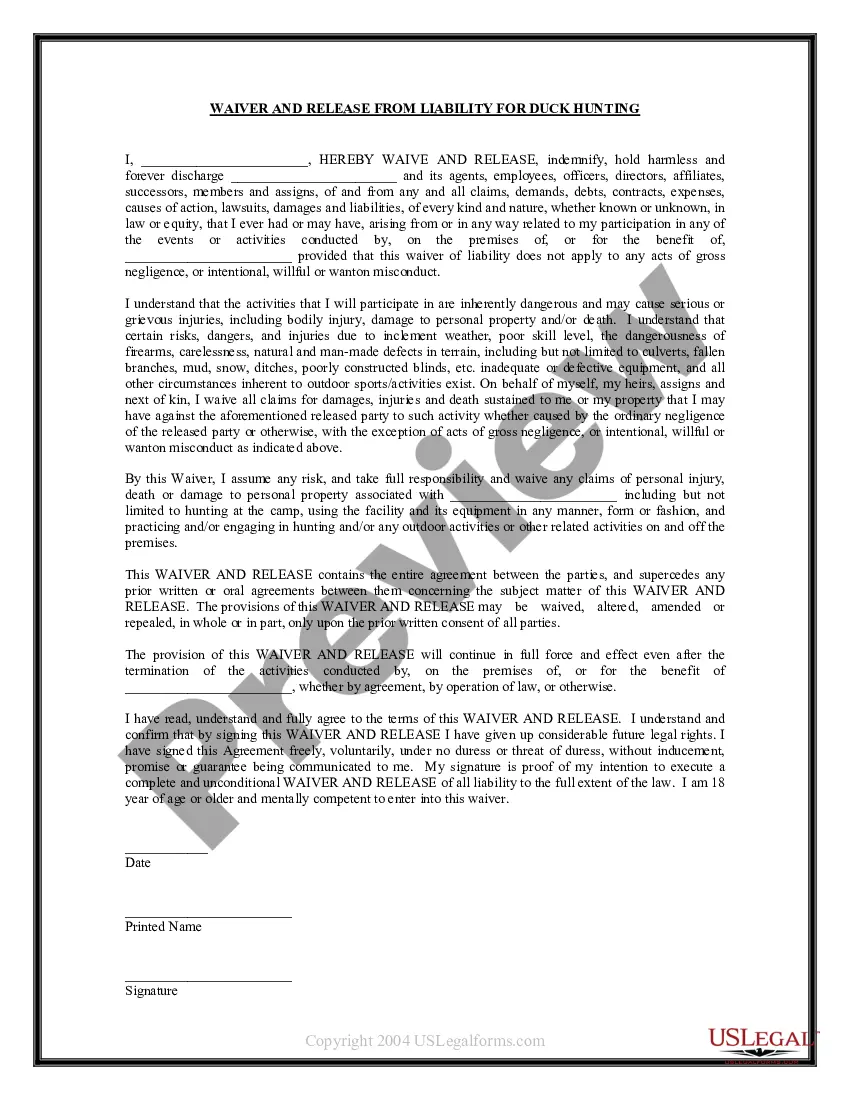
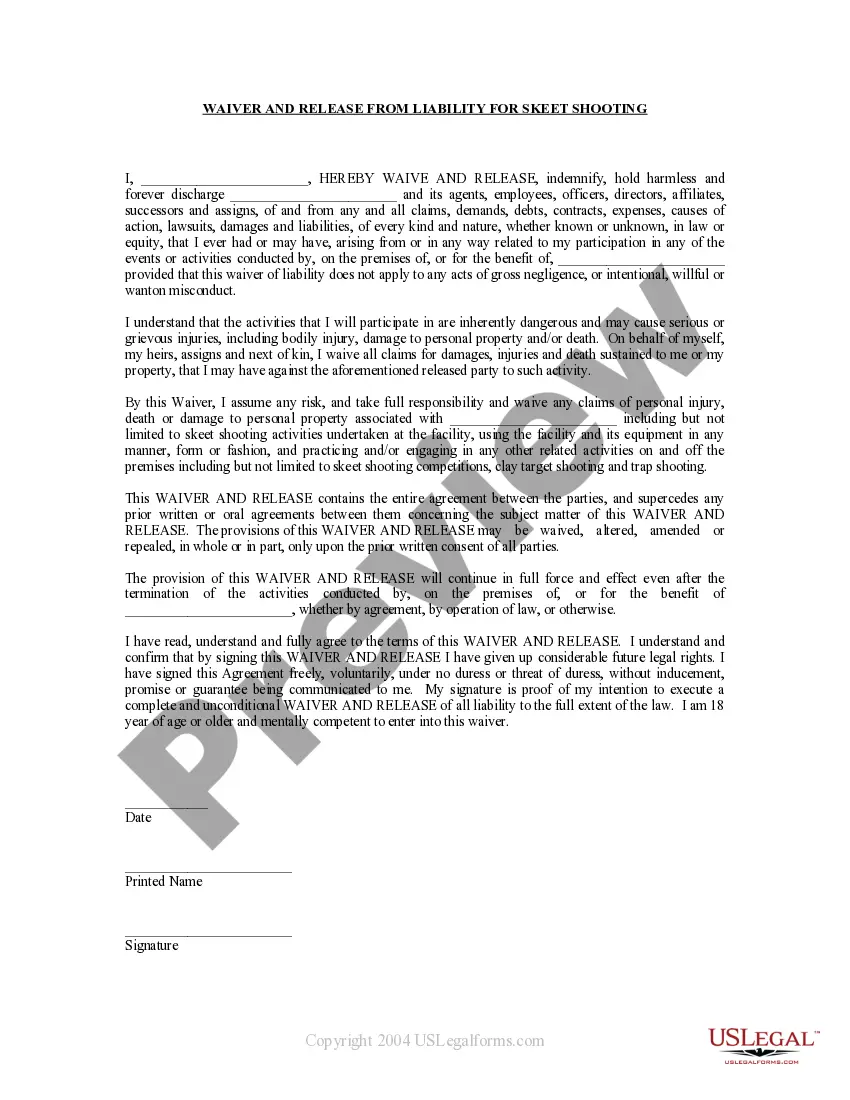
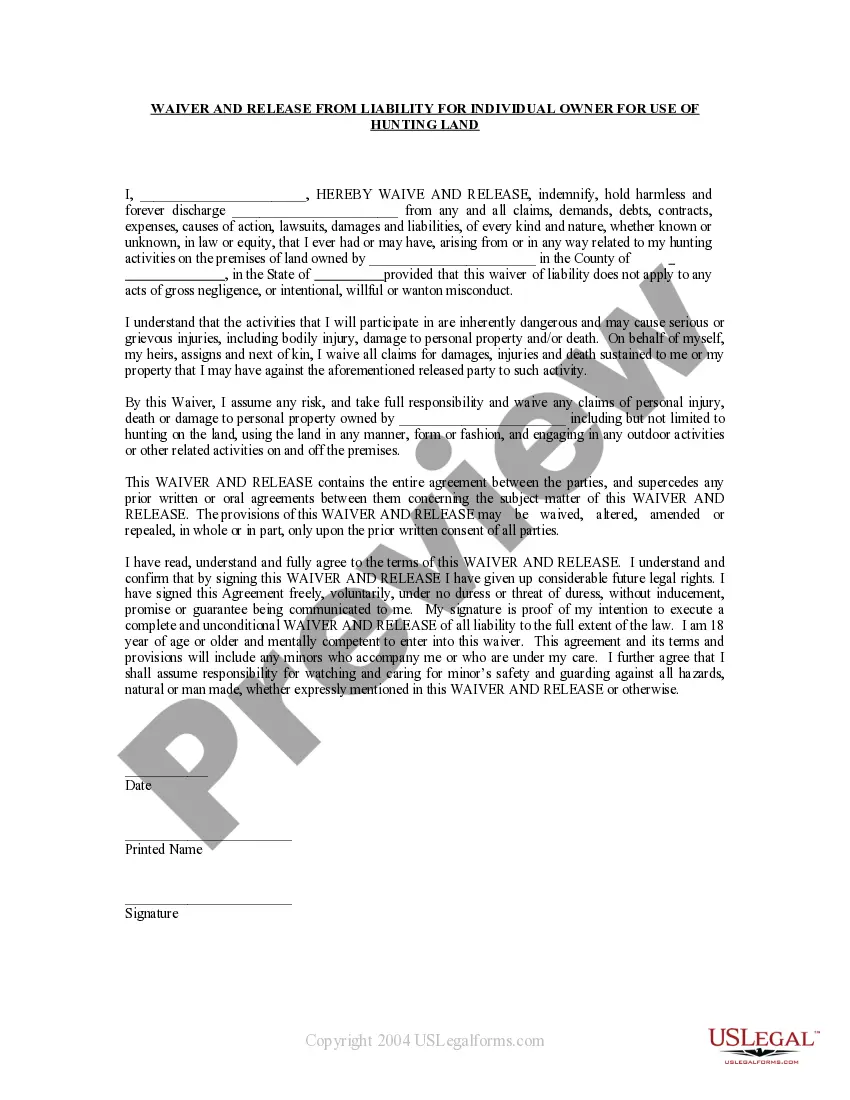
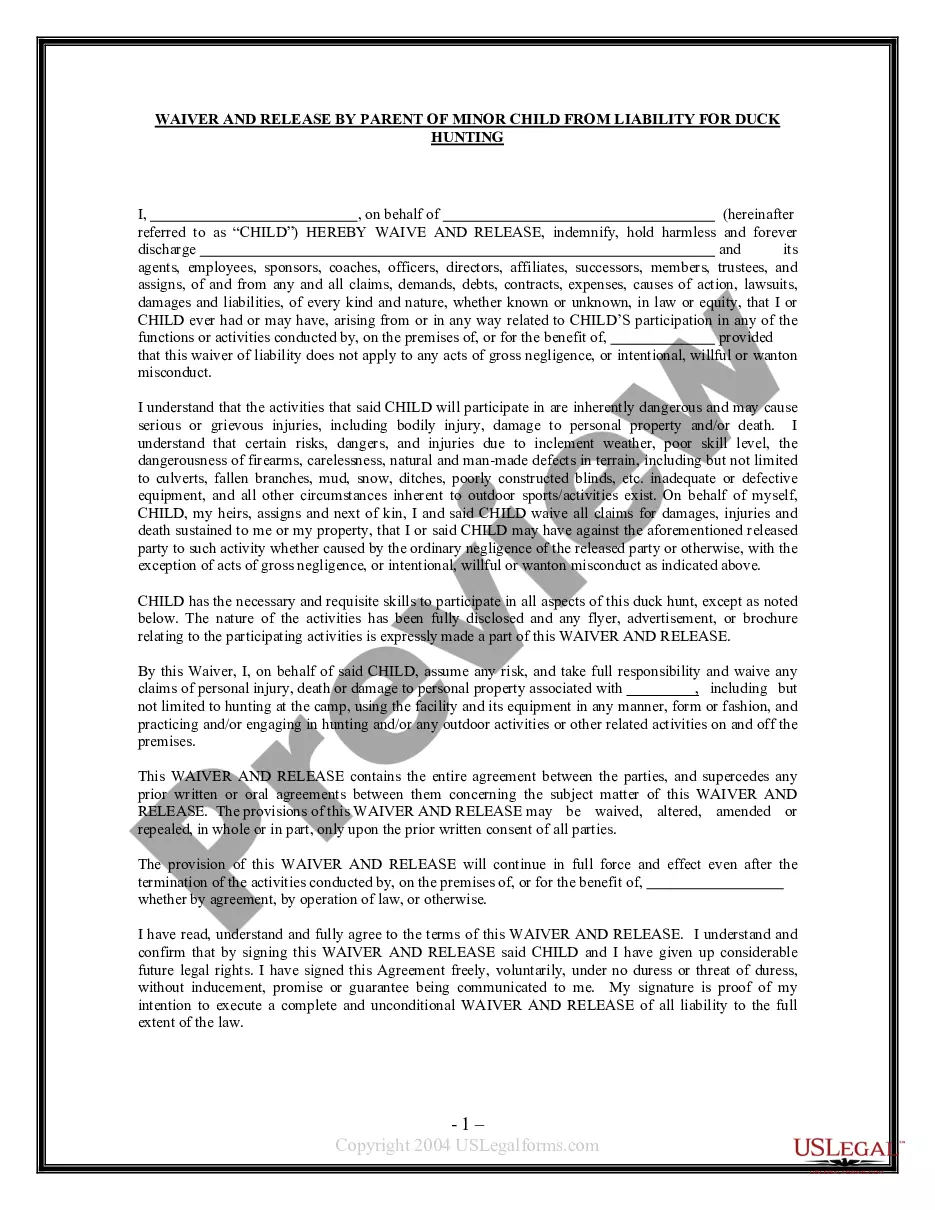
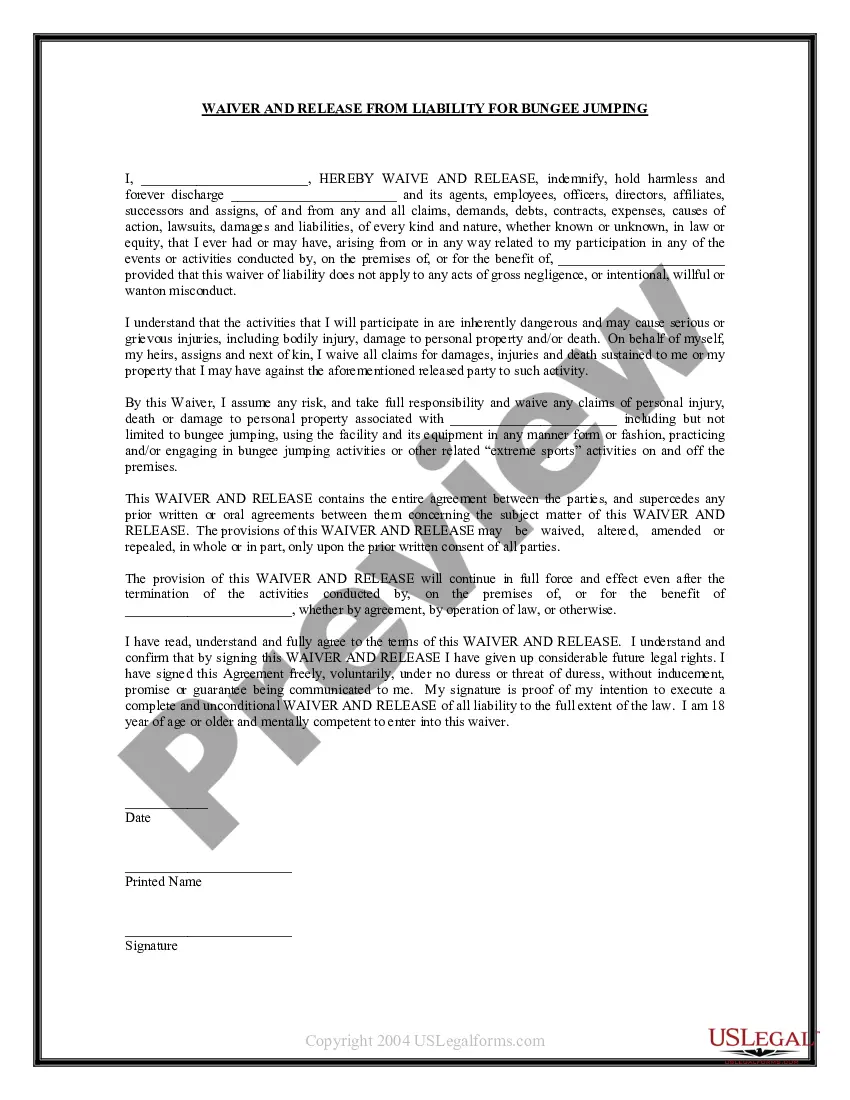
This form releases a property owner from liability for permitting an individual to participate in duck hunting.
Georgia Waiver and Release From Liability For Adult for Duck Hunting
Category:
State:
Multi-State
Control #:
US-WAV-85A
Format:
Word;
Rich Text
Instant download
Description

How to fill out Waiver And Release From Liability For Adult For Duck Hunting?
US Legal Forms - one of the most substantial collections of legal documents in the United States - offers a variety of legal form templates that you can download or print. By using the website, you can access thousands of forms for business and personal purposes, organized by categories, states, or keywords. You can find the most recent versions of forms such as the Georgia Waiver and Release From Liability For Adult for Duck Hunting in moments.
If you already have a subscription, sign in and download the Georgia Waiver and Release From Liability For Adult for Duck Hunting from the US Legal Forms library. The Download button will appear on each form you view. You can access all previously acquired forms from the My documents section of your account.
If you wish to use US Legal Forms for the first time, here are simple steps to get started: Ensure you have selected the correct form for your area/state. Click the Preview button to review the form’s content. Check the form details to confirm that you have chosen the right form. If the form doesn’t meet your needs, use the Search box at the top of the screen to find one that does. If you are satisfied with the form, confirm your selection by clicking the Purchase now button. Then, select the pricing plan you prefer and provide your credentials to register for an account. Complete the payment. Use your credit card or PayPal account to finalize the transaction. Choose the format and download the form to your device. Make modifications. Fill out, edit, and print and sign the acquired Georgia Waiver and Release From Liability For Adult for Duck Hunting. Every template you add to your account has no expiration date and is yours indefinitely. So, if you wish to download or print another copy, just go to the My documents section and click on the form you need.
- Access the Georgia Waiver and Release From Liability For Adult for Duck Hunting with US Legal Forms, one of the most extensive libraries of legal form templates.
- Utilize thousands of professional and state-specific templates that fulfill your business or personal needs and requirements.
Form popularity
FAQ
Release Versus Waiver The main difference between releases and waivers is the transferring of ownership. When rights are released, they are transferred to another party. When rights are waived, they are gone altogether.
Here is all that pertains writing an effective liability waiver:Get help. Writing a waiver should not be complicated.Use the correct structure.Proper formatting.Include a subject line.Include a caution!Talk about the activity risks.Do not forget an assumption of risk.Hold harmless.More items...?
The definition of a waiver is the act of voluntarily giving up rights or privileges, usually through a written statement. An example of waiver is a person signing a form releasing the owners of an event location from liability if the person signing the waiver was injured while at the event. noun.
Elements of a Liability waiverFormal structure. A waiver should follow a certain structure to be termed as valid:Risk involved section.Assumption of risk section.Choice of law provision section.Confirmation.Signature.
A release of liability, also known as a liability waiver or a hold harmless agreement, is a contract in which one party agrees not to hold another party liable for damages or injury. These contracts are common in fields that involve some risk to property, finances, or health.
A liability waiver, or release waiver, is a legal document that a company or organization requires members of the public to sign in order to protect their organization from being sued if you sustain an injury.
Liability waiver form protects your business against any lawsuit if someone is injured during a business-hosted event....Elements of a Liability waiverFormal structure.Risk involved section.Assumption of risk section.Choice of law provision section.Confirmation.Signature.
How to Write(1) Calendar Date Of Document. Record the date when this release is filled out and completed.(2) Releasor Name.(3) Releasor Address.(4) Releasee Name.(5) Releasee Address.(6) Event Or Actions Being Indemnified.(7) No Payment By Releasee.(8) Required Payment For Release.More items...?
Waiver and release refers to the waiving of rights or privileges and the release of a party from their obligations or rights.
A release of liability, also known as a liability waiver or a hold harmless agreement, is a contract in which one party agrees not to hold another party liable for damages or injury. These contracts are common in fields that involve some risk to property, finances, or health.