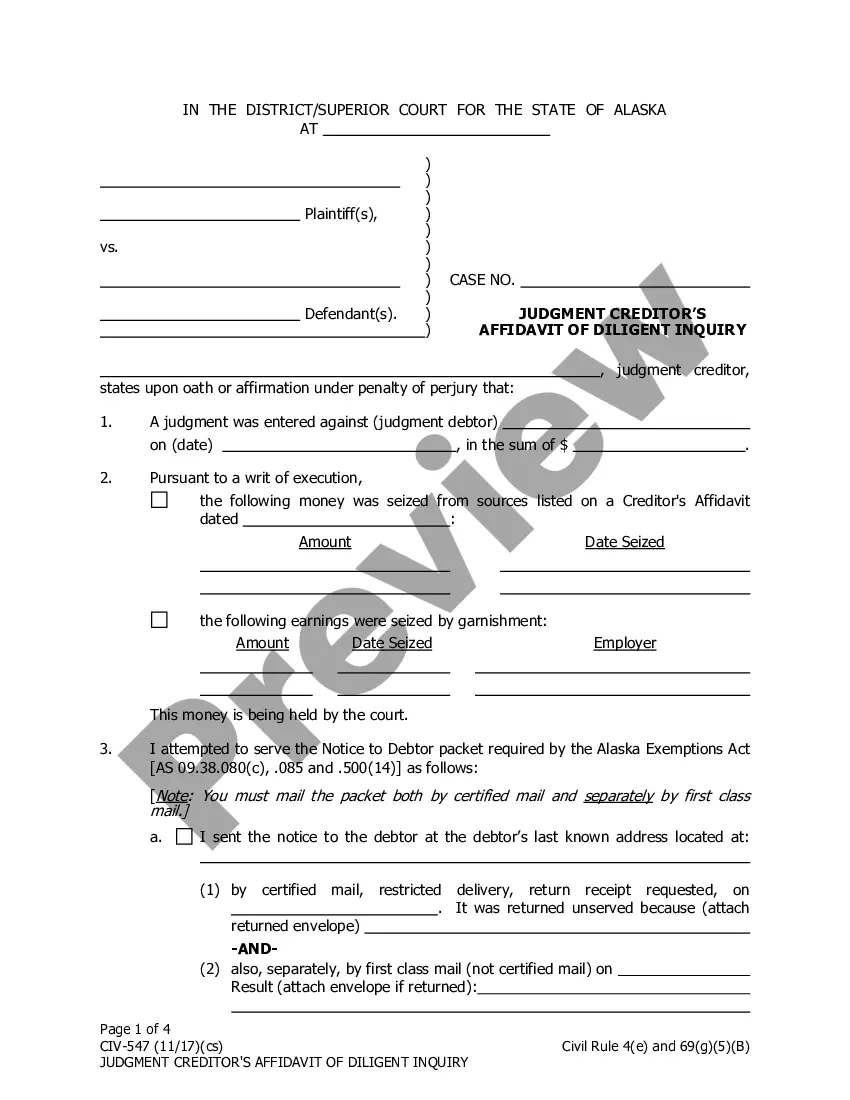
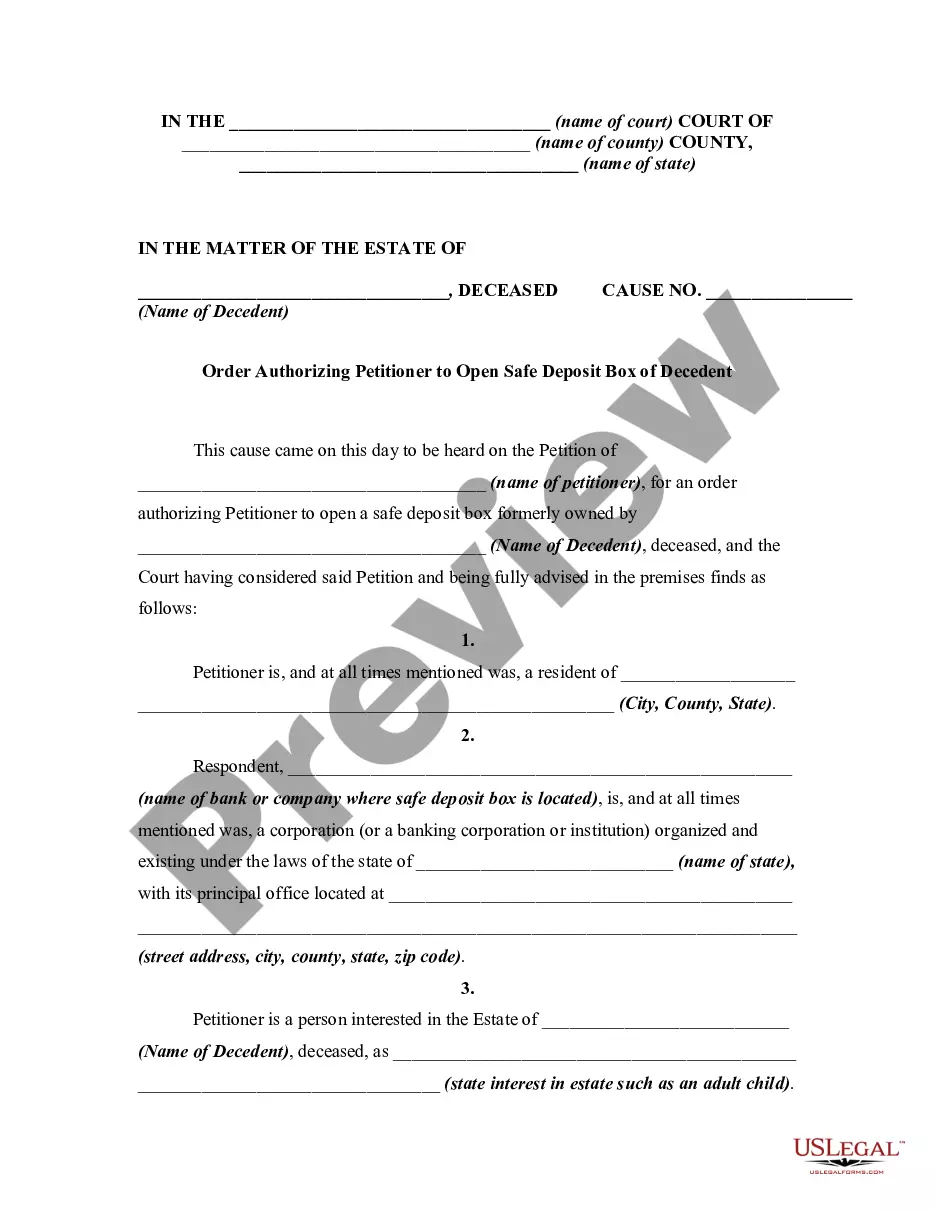
Order Authorizing Petitioner to Open Safe Deposit Box of Decedent
What this document covers
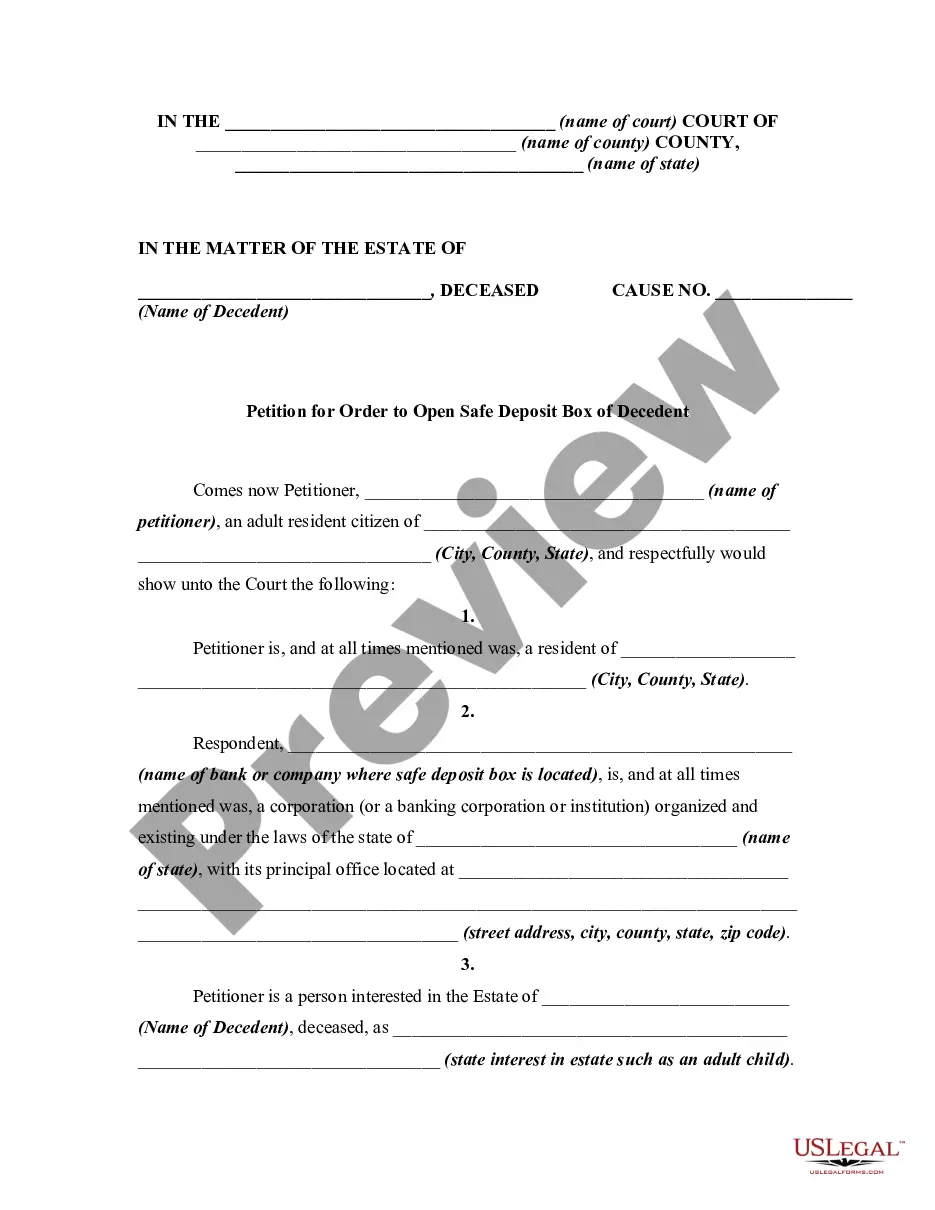
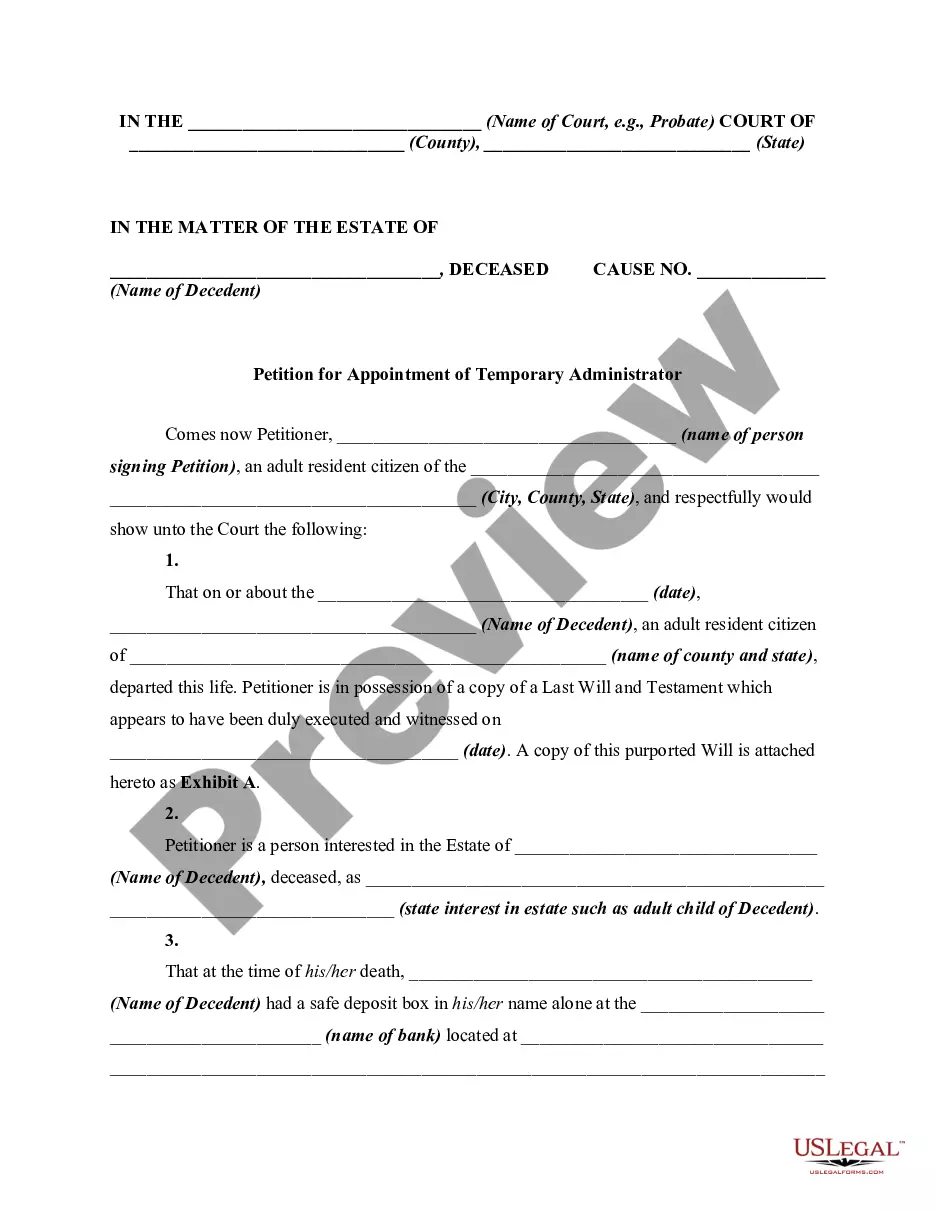
The Order Authorizing Petitioner to Open Safe Deposit Box of Decedent is a legal document that allows an individual to gain access to the safe deposit box of a deceased person. The primary purpose of this form is to ensure that essential documents, such as a will or insurance policies, can be retrieved after a person's death. Unlike other legal forms related to estate management, this order provides a specific mechanism for accessing a safe deposit box, which may otherwise require a prolonged court process.
Form components explained
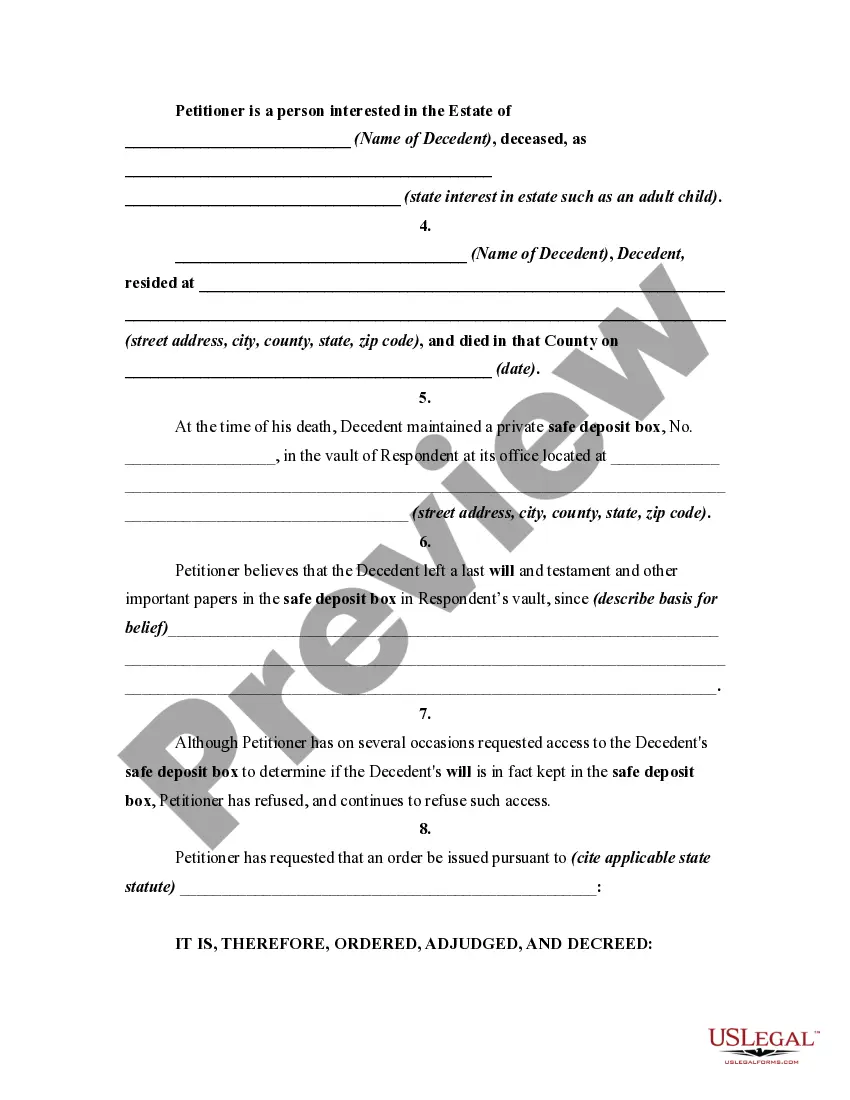
- Petitionerâs information, including their relationship to the decedent.
- Details about the bank or company where the safe deposit box is located.
- Description of the decedent, including their address and date of death.
- Request for court permission to open the safe deposit box.
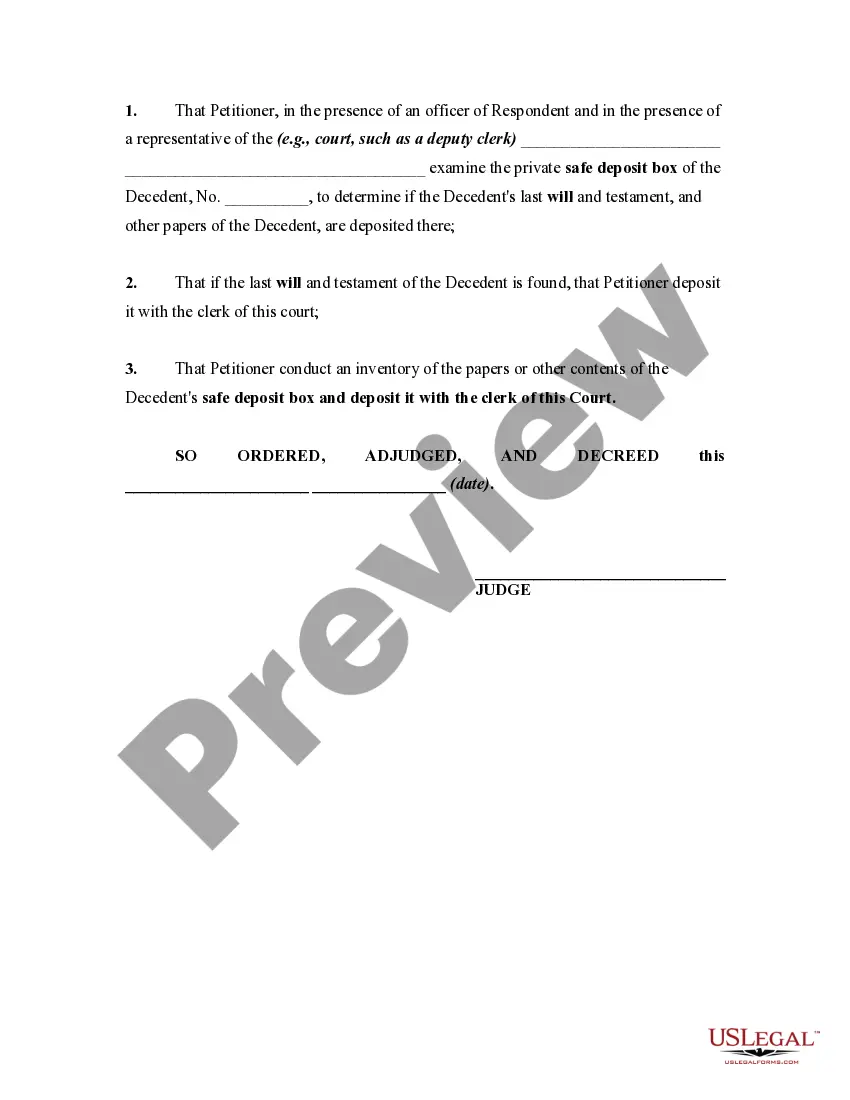
- Instructions for the inventory of contents found within the safe deposit box.
Situations where this form applies
This form should be used when a decedent's safe deposit box is believed to contain important documents, such as a will or other estate planning materials. It is often necessary when family members or the executor of the estate cannot access the box without court authorization, especially if there are disputes or uncertainties regarding its contents.
Who should use this form
- Executors of the decedentâs estate.
- Family members, such as children, who need access to the safe deposit box.
- Individuals named as beneficiaries in the decedent's will or estate planning documents.
Steps to complete this form
- Identify the parties involved, including the petitioner and the decedent.
- Enter the bank or institution's name where the safe deposit box is located.
- Provide details about the decedent, including their last known address and date of death.
- State your belief regarding the contents of the safe deposit box.
- Include the appropriate citation to the state statute authorizing the request.
Notarization guidance
This form does not typically require notarization unless specified by local law. It is advisable to check your state regulations for any specific requirements regarding notarization of this order.
Get your form ready online
Our built-in tools help you complete, sign, share, and store your documents in one place.
Make edits, fill in missing information, and update formatting in US Legal Forms—just like you would in MS Word.
Download a copy, print it, send it by email, or mail it via USPS—whatever works best for your next step.
Sign and collect signatures with our SignNow integration. Send to multiple recipients, set reminders, and more. Go Premium to unlock E-Sign.
If this form requires notarization, complete it online through a secure video call—no need to meet a notary in person or wait for an appointment.
We protect your documents and personal data by following strict security and privacy standards.

Make edits, fill in missing information, and update formatting in US Legal Forms—just like you would in MS Word.

Download a copy, print it, send it by email, or mail it via USPS—whatever works best for your next step.

Sign and collect signatures with our SignNow integration. Send to multiple recipients, set reminders, and more. Go Premium to unlock E-Sign.

If this form requires notarization, complete it online through a secure video call—no need to meet a notary in person or wait for an appointment.

We protect your documents and personal data by following strict security and privacy standards.
Mistakes to watch out for
- Failing to clearly state the relationship to the decedent, which is crucial for the petition.
- Not providing sufficient details about the safe deposit box and its location.
- Omitting necessary signatures or filing the form without the required court fees.
Benefits of using this form online
- Convenience of downloading and completing the form at your own pace.
- Editable fields allow for easy customization based on your specific situation.
- Access to legal guidelines and support while filling out the form.
Quick recap
- The form is essential for accessing a deceased person's safe deposit box.
- It requires specific details about the decedent and the petitioner.
- Using the form simplifies the process of retrieving important documents after death.
Looking for another form?



Form popularity
FAQ
The Florida Probate Code allows access to the contents of a decedent's safety deposit box if certain requirements are met.Banks will usually require a death certificate before granting access to the safe deposit box. Once the box has been opened, these two parties are then required to make and sign an inventory.
You can deduct safe deposit box rent if you use the box to store taxable income-producing stocks, bonds, or investment-related papers and documents. You can Not deduct the rent if you use the box only for jewelry, other personal items, or tax-exempt securities.
An additional method for access to a safe deposit box is for the executor or personal representative of an estate to present letters testamentary or letters of general administration issued by the court to the holder of the safe deposit box.
If there is cash in the box, the IRS will assume that it was not reported on an income tax return unless there is some proof to the contrary. The IRS also might assume the same for any other valuables for which there is no record of the purchase.
In addition to freezing accounts, levying accounts, garnishing wages, and seizing assets, the IRS can get a court order to freeze and seize or force a sale of the contents of a safe deposit box to satisfy a tax debt or penalty.
Spare Keys Think about it: You only have access to your safe deposit box during normal banking hours and only if you have the box's key with you. If you're like most people, your safe deposit box key is squirreled away somewhere inside your home2026from which you're currently locked out.
A: If one key is lost, bring in the remaining key and close the box. If both keys are lost, the box must be forced open by a safe deposit service company in your presence and at your expense.
California law provides that on the death of the box owner, the institution at which the box is located may deliver the contents to certain defined people (including, but not limited to, a relative) if: a) the institution has no reason to believe there is a dispute over the contents; b) the person to whom the
Identify an interested party who can petition the court. An interested party can be the decedent's spouse, beneficiary or a named fiduciary in the Will. Identify the location of the safe deposit box. Petition the Court. Contact the Financial Institution to Review the Contents of the Box. Retrieve the Contents.