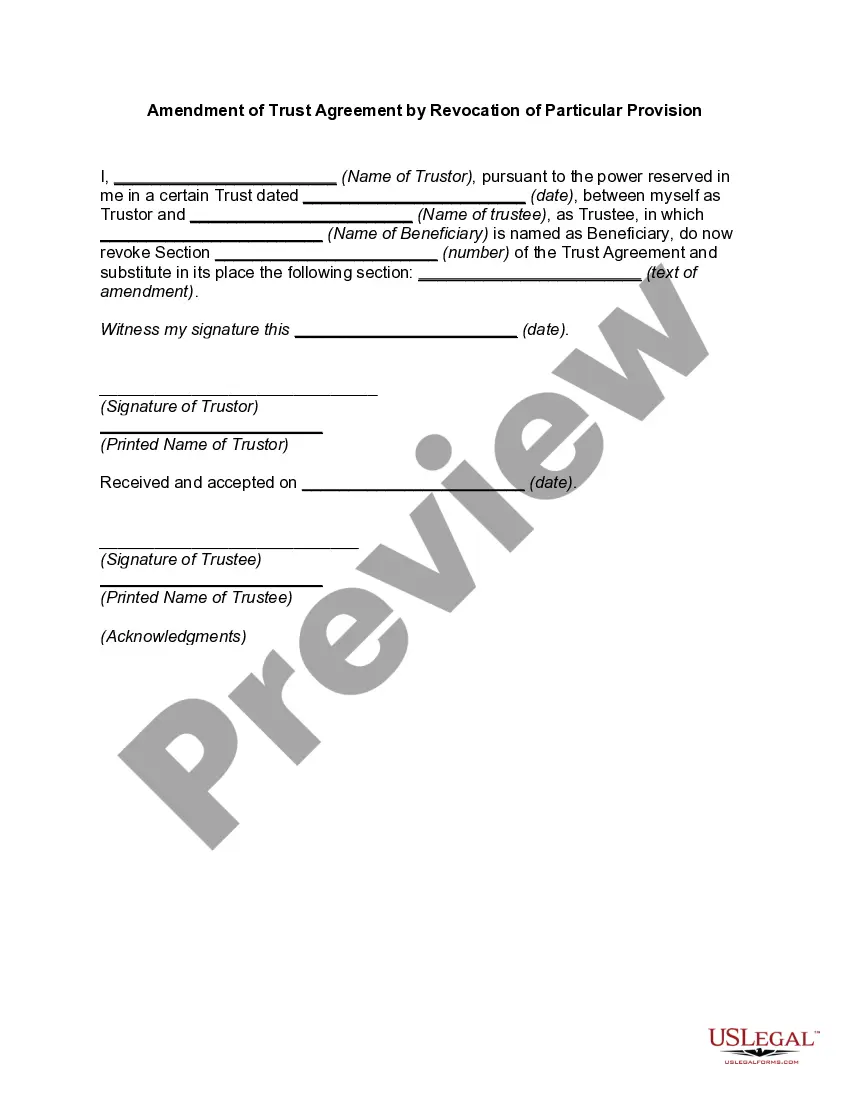
Amendment of Trust Agreement by Revocation of Particular Provision
Understanding this form
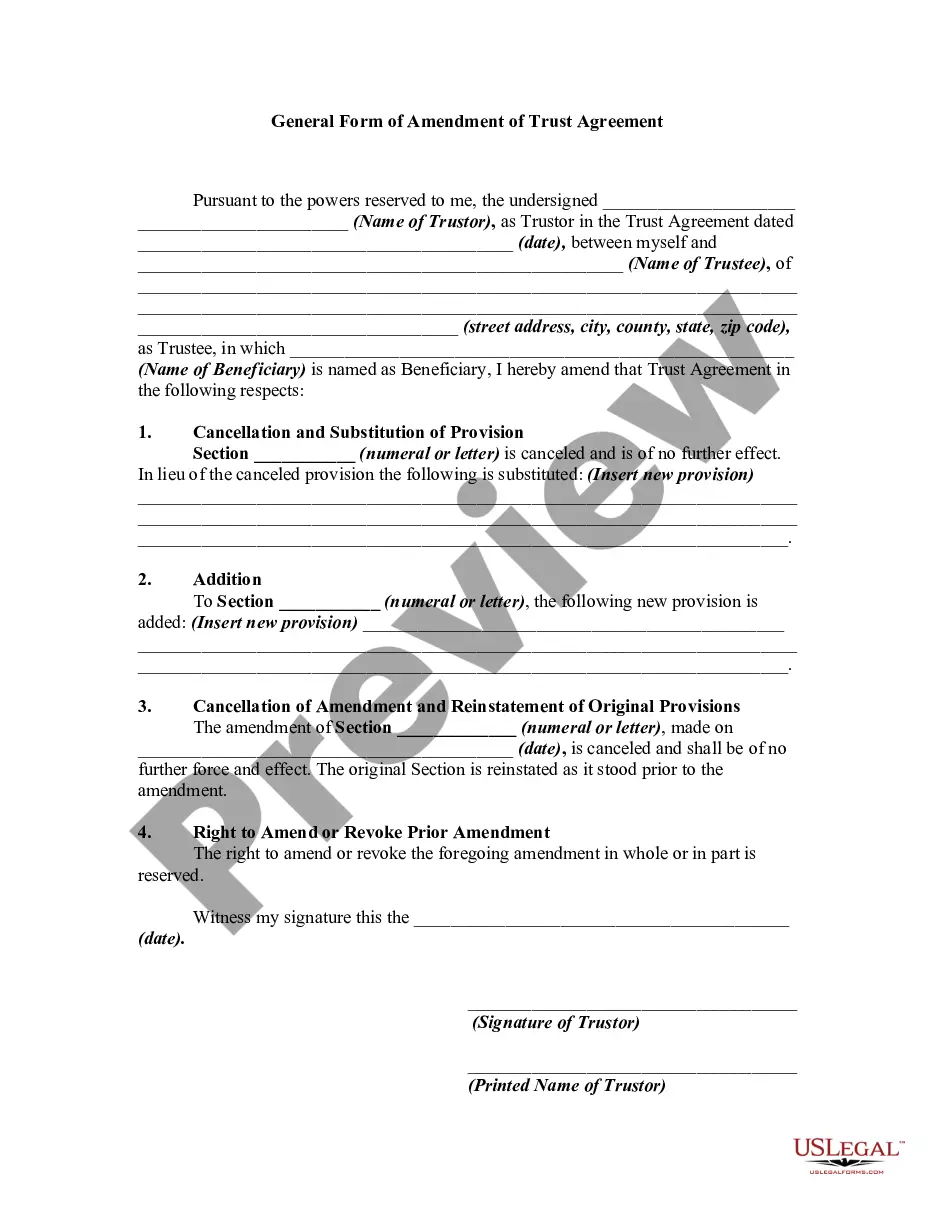
The Amendment of Trust Agreement by Revocation of Particular Provision is a legal document that allows the Trustor to modify specific sections of an existing trust agreement. This form is used to revoke a designated section and replace it with a new provision, providing flexibility in managing trust terms. Unlike creating a new trust, this amendment maintains the original agreement while allowing changes to beneficiaries, asset disposition, or trustee roles.
Key parts of this document
- Name of Trustor: The individual making the amendment.
- Date of the original Trust: The effective date of the initial trust agreement.
- Name of Trustee: The individual or entity managing the trust.
- Name of Beneficiary: The person who benefits from the trust.
- Section Number: The specific section of the trust being revoked.
- Text of Amendment: The new text replacing the revoked section.
- Signatures: Spaces for both the Trustor and Trustee to sign and date the amendment.
When this form is needed
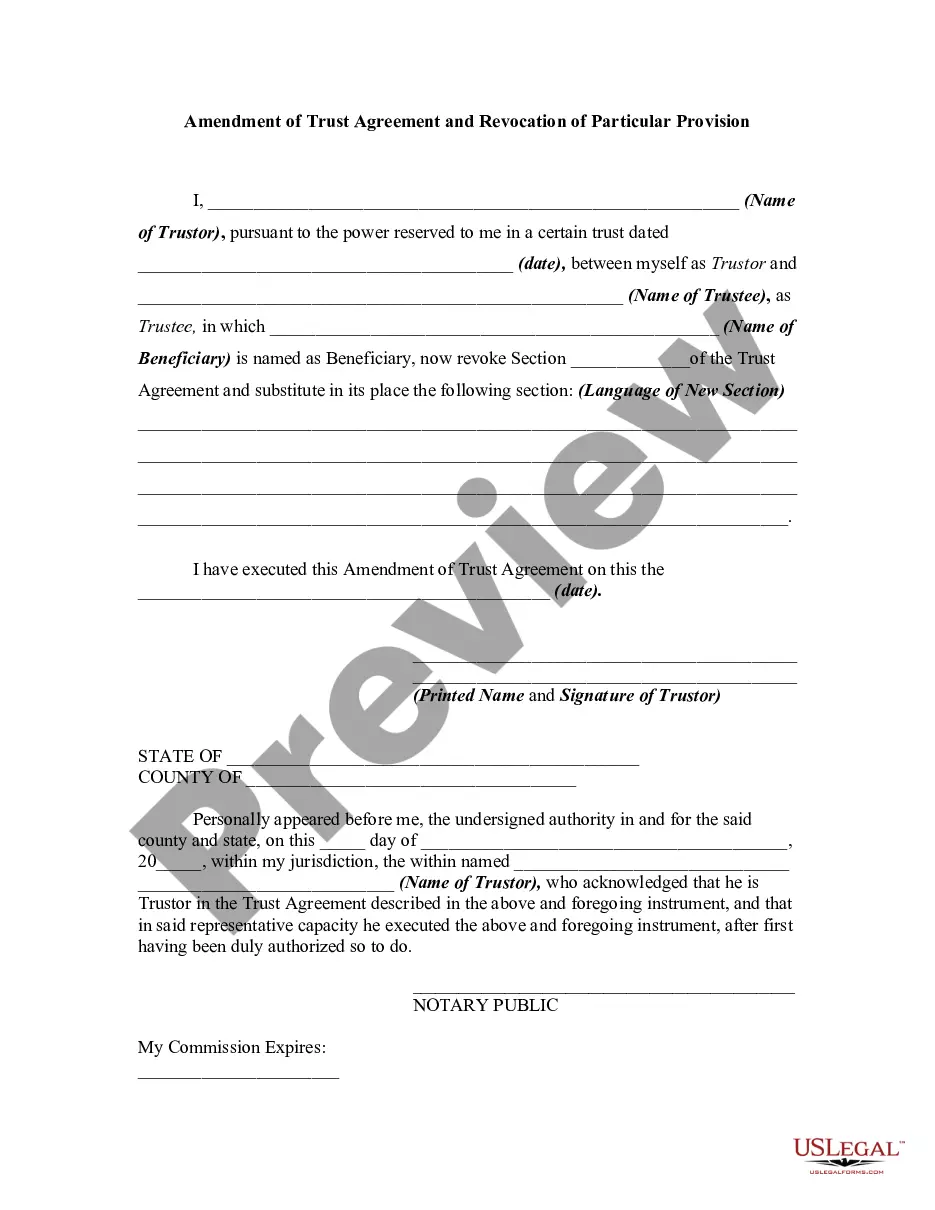
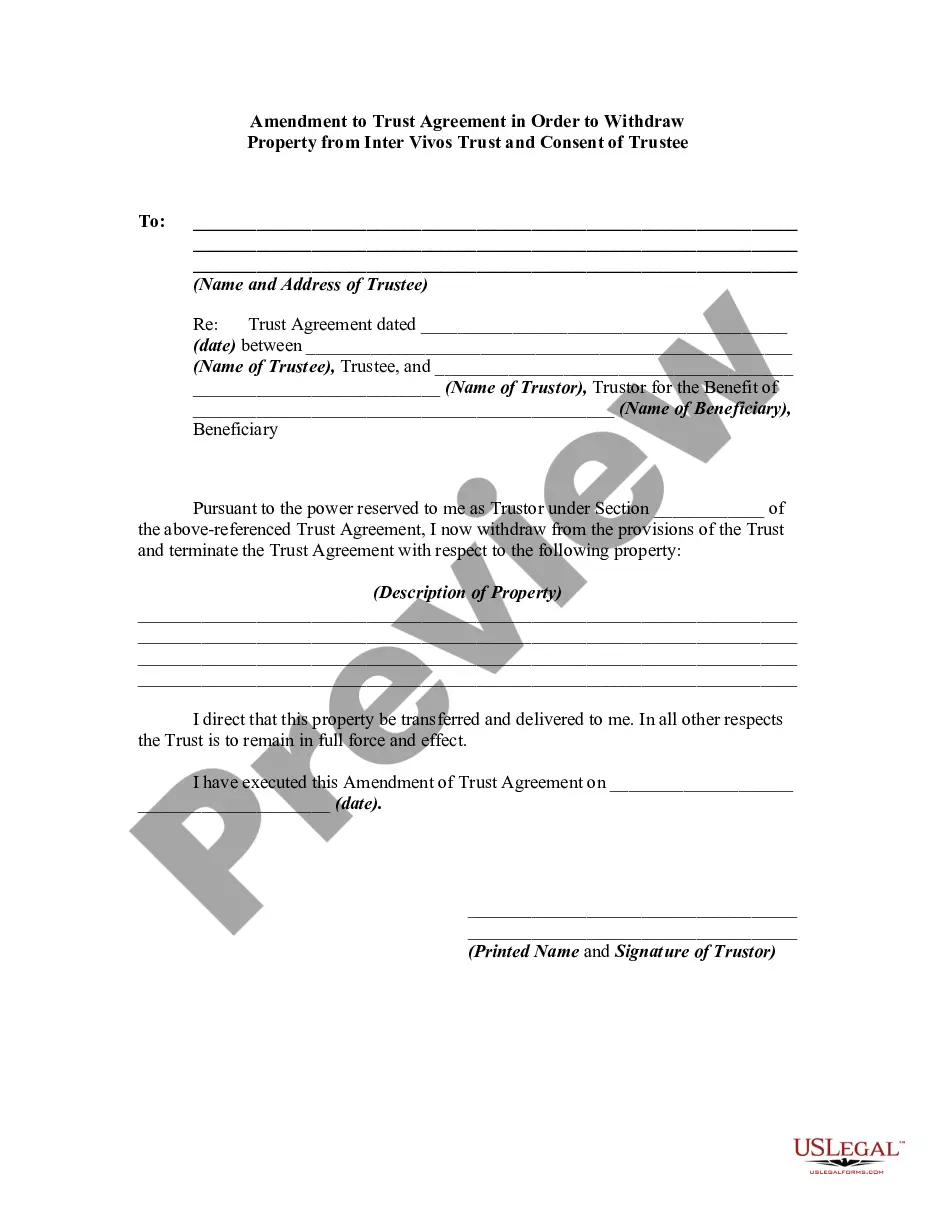
This form should be used when the Trustor needs to alter the terms of an existing trust agreement without creating a new trust. Common scenarios include changing beneficiaries due to family circumstances, adjusting asset distributions as circumstances evolve, or replacing a trustee who may no longer be able to fulfill their duties.
Who this form is for
- Individuals acting as Trustors who wish to amend their trust agreements.
- Trustees needing authorization from the Trustor to make changes.
- Beneficiaries who want to understand changes being made to the trust they benefit from.
Steps to complete this form
- Identify the parties involved: Clearly state the names of the Trustor and Trustee.
- Specify the original trust date: Input the date of the trust to be amended.
- Indicate the revoked section: Enter the specific section number being revoked.
- Write the amendment text: Clearly detail the new provision that replaces the revoked section.
- Sign and date the form: Both the Trustor and Trustee should sign and date to validate the amendment.
Notarization guidance
This form does not typically require notarization to be legally valid. However, some jurisdictions or document types may still require it. US Legal Forms provides secure online notarization powered by Notarize, available 24/7 for added convenience.
Get your form ready online
Our built-in tools help you complete, sign, share, and store your documents in one place.
Make edits, fill in missing information, and update formatting in US Legal Forms—just like you would in MS Word.
Download a copy, print it, send it by email, or mail it via USPS—whatever works best for your next step.
Sign and collect signatures with our SignNow integration. Send to multiple recipients, set reminders, and more. Go Premium to unlock E-Sign.
If this form requires notarization, complete it online through a secure video call—no need to meet a notary in person or wait for an appointment.
We protect your documents and personal data by following strict security and privacy standards.

Make edits, fill in missing information, and update formatting in US Legal Forms—just like you would in MS Word.

Download a copy, print it, send it by email, or mail it via USPS—whatever works best for your next step.

Sign and collect signatures with our SignNow integration. Send to multiple recipients, set reminders, and more. Go Premium to unlock E-Sign.

If this form requires notarization, complete it online through a secure video call—no need to meet a notary in person or wait for an appointment.

We protect your documents and personal data by following strict security and privacy standards.
Common mistakes to avoid
- Failing to specify the correct section number being revoked.
- Not providing adequate details in the text of the amendment.
- Omitting signatures from both the Trustor and Trustee.
Advantages of online completion
- Convenient access: Download the form anytime from the comfort of your home.
- Editability: Easily customize the form to suit your specific trust needs.
- Legal reliability: Each form is crafted by licensed attorneys to ensure compliance with legal standards.
What to keep in mind
- The Amendment of Trust Agreement by Revocation of Particular Provision allows Trustors to modify specific terms of an existing trust.
- The form is essential when changes are needed in beneficiaries, asset distributions, or trustee roles.
- Completing the form accurately ensures that the intended modifications are legally enforceable.
Looking for another form?
Form popularity
FAQ
A trust might also be revoked simply in the event that the grantor wishes to make changes that are so extensive that it would be easier to dissolve the trust and create a new one than to try to alter it. A revocable trust may also be revoked if the grantor wants to change the provisions of the trust completely.
When it comes to protection of assets, an irrevocable trust is far better than a revocable trust. Again, the reason for this is that if the trust is revocable, an individual who created the trust retains complete control over all trust assets.
A trust amendment form is a legal document you use to make changes to your revocable trust. It isn't meant to change your trust document as a whole. Instead, a trust amendment form is used to change certain trust provisions, which are the terms or ?rules? you've set in your trust document.
The restatement is a cleaner, more concise way to update your Trust, but can be costly because of the time required to complete. Amendments are easier to do and more cost-effective, but are really just intended for simple changes.
A revocable trust provides a way to ensure the continued management and preservation of your assets, should you die or become incapacitated, and allows the avoidance of a probate court proceeding after your death.
If you created an individual living trust, you can revoke it at any time. Either grantor can revoke a shared trust, wiping out all terms of the trust. The trust property is returned to each person ing to how they owned it before transferring it to the trust.
Here is an example of a trust revocation declaration: ?I, John Doe, hereby revoke the John Doe Revocable Living Trust, created by the Declaration of Trust signed MONTH, DAY, YEAR, ing to the power reserved to me. All property held in the trust shall be returned to the settlor. ?