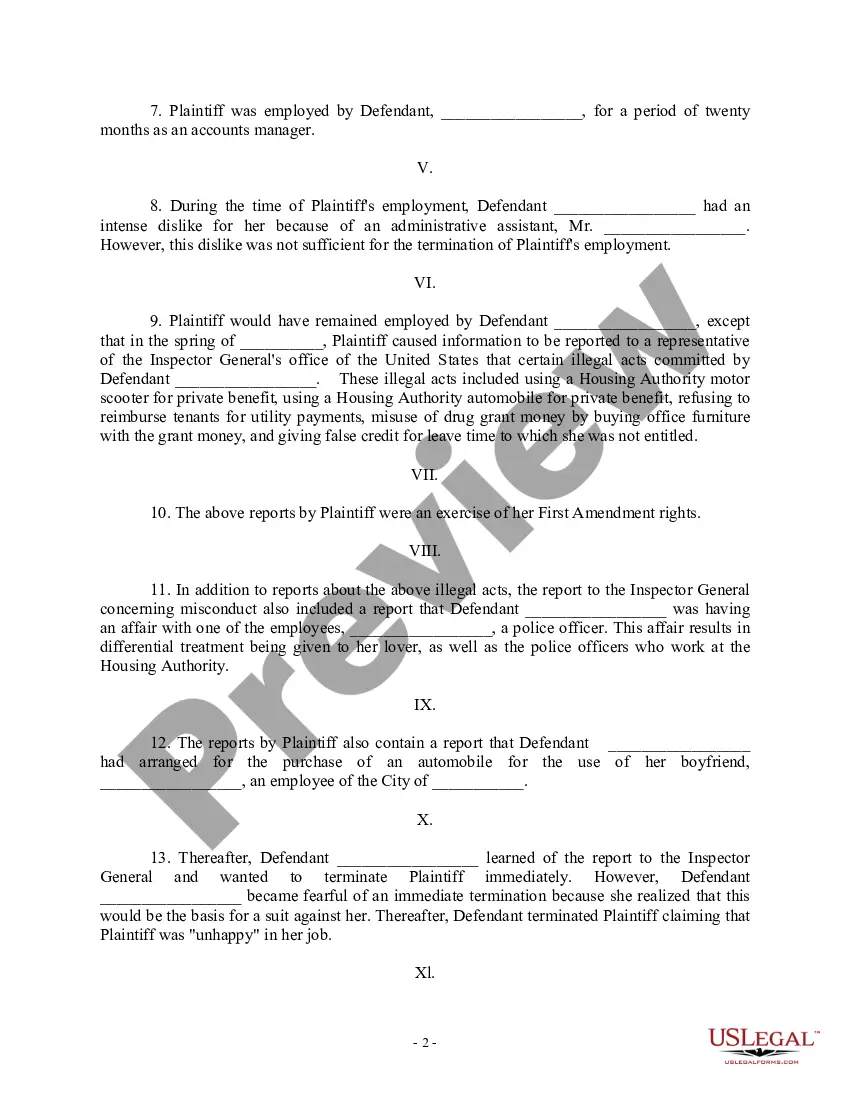
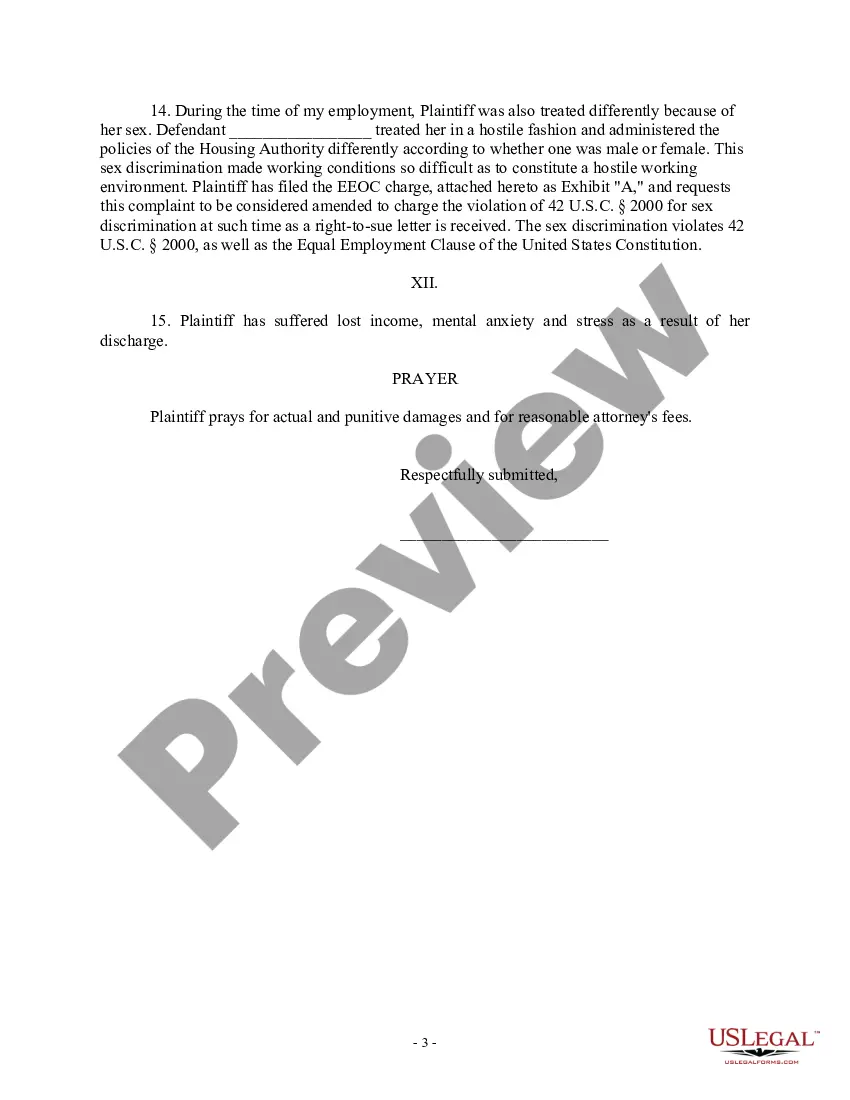
Plaintiff seeks to recover damages for violation of the First Amendment of the United States Constitution. Plaintiff states that she was unlawfully terminated and treated differently because of her gender.
Georgia Complaint for Violation of Civil Rights and for Wrongful Discharge for Reporting Illegal Acts - 1st, 14th Amendments, US Constitution - Jury Trial Demand
Category:
State:
Multi-State
Control #:
US-000284
Format:
Word;
Rich Text
Instant download
Description
Free preview





How to fill out Complaint For Violation Of Civil Rights And For Wrongful Discharge For Reporting Illegal Acts - 1st, 14th Amendments, US Constitution - Jury Trial Demand?
If you have to comprehensive, down load, or print legal document themes, use US Legal Forms, the biggest collection of legal kinds, that can be found online. Make use of the site`s easy and hassle-free search to find the files you need. A variety of themes for enterprise and personal purposes are sorted by categories and states, or key phrases. Use US Legal Forms to find the Georgia Complaint for Violation of Civil Rights and for Wrongful Discharge for Reporting Illegal Acts - 1st, 14th Amendments, US Constitution - Jury Trial Demand in a few clicks.
Should you be currently a US Legal Forms buyer, log in for your account and then click the Down load switch to obtain the Georgia Complaint for Violation of Civil Rights and for Wrongful Discharge for Reporting Illegal Acts - 1st, 14th Amendments, US Constitution - Jury Trial Demand. You may also gain access to kinds you formerly downloaded inside the My Forms tab of your own account.
If you are using US Legal Forms the first time, refer to the instructions under:
- Step 1. Ensure you have selected the shape to the right area/country.
- Step 2. Utilize the Review option to look through the form`s information. Do not forget to learn the explanation.
- Step 3. Should you be not satisfied with the develop, utilize the Search area near the top of the display to discover other types of your legal develop design.
- Step 4. After you have discovered the shape you need, click on the Acquire now switch. Choose the prices strategy you like and add your references to register to have an account.
- Step 5. Process the purchase. You may use your charge card or PayPal account to perform the purchase.
- Step 6. Find the file format of your legal develop and down load it on your own product.
- Step 7. Total, revise and print or indicator the Georgia Complaint for Violation of Civil Rights and for Wrongful Discharge for Reporting Illegal Acts - 1st, 14th Amendments, US Constitution - Jury Trial Demand.
Every legal document design you purchase is your own property eternally. You might have acces to each develop you downloaded within your acccount. Click on the My Forms segment and choose a develop to print or down load yet again.
Be competitive and down load, and print the Georgia Complaint for Violation of Civil Rights and for Wrongful Discharge for Reporting Illegal Acts - 1st, 14th Amendments, US Constitution - Jury Trial Demand with US Legal Forms. There are millions of professional and state-distinct kinds you can use to your enterprise or personal requires.
Form popularity
FAQ
Yes, a jury demand can be included in the initial complaint. This demand informs the court and all parties involved that you request a jury trial for your case, which is particularly important in a Georgia Complaint for Violation of Civil Rights and for Wrongful Discharge for Reporting Illegal Acts - 1st, 14th Amendments, US Constitution - Jury Trial Demand, ensuring that your case receives the jury's attention.
Yes, in Georgia, if a plaintiff files an amended complaint, the defendant must respond with an answer. It is crucial to address any changes or new claims presented in the amended complaint, particularly in cases like a Georgia Complaint for Violation of Civil Rights and for Wrongful Discharge for Reporting Illegal Acts - 1st, 14th Amendments, US Constitution - Jury Trial Demand to protect your rights.
A 'jury demand' is a formal request made by a party in a lawsuit to have the case decided by a jury rather than a judge. This demand is essential in cases involving a Georgia Complaint for Violation of Civil Rights and for Wrongful Discharge for Reporting Illegal Acts - 1st, 14th Amendments, US Constitution - Jury Trial Demand, as it allows individuals to have their grievances evaluated by a group of peers.
An example of a civil rights complaint might involve an employee who claims wrongful termination for reporting illegal activities within their organization. This could be part of a broader case like a Georgia Complaint for Violation of Civil Rights and for Wrongful Discharge for Reporting Illegal Acts - 1st, 14th Amendments, US Constitution - Jury Trial Demand, where the individual seeks justice for violations of their civil rights.
In Georgia, jury trial waivers can be enforceable, but they typically require clear consent from all parties involved. It is essential to consult legal experts when dealing with a Georgia Complaint for Violation of Civil Rights and for Wrongful Discharge for Reporting Illegal Acts - 1st, 14th Amendments, US Constitution - Jury Trial Demand to understand the implications of waiving this right.
Jurors should never discuss the case with anyone outside the jury, including family and friends. Additionally, they must avoid conducting their own independent research about the case. These actions can compromise the integrity of the trial process, especially in cases like a Georgia Complaint for Violation of Civil Rights and for Wrongful Discharge for Reporting Illegal Acts - 1st, 14th Amendments, US Constitution - Jury Trial Demand.
To succeed on a Section 1983 claim, a plaintiff must prove that his constitutional rights were violated, and that the violation was caused by a person acting under color of law.
For example, if you want to file a Section 1983 lawsuit against a Pennsylvania police officer for excessive force resulting in physical and emotional harm, the statute of limitations would be two years.
Making room for these innovations, the Court has determined that due process requires, at a minimum: (1) notice; (2) an opportunity to be heard; and (3) an impartial tribunal.
The Eleventh Circuit, however, held that federal court's apply their forum state's statute of limitations for personal injury actions to actions brought under § 1983. Thus, the four-year limitations period in § 95.11(3) Applies to § 1983 claims arising in Florida. See: Ellison v. Lester, 275 Fed.