Florida Last Will and Testament for a Widow or Widower with Adult Children

About this form
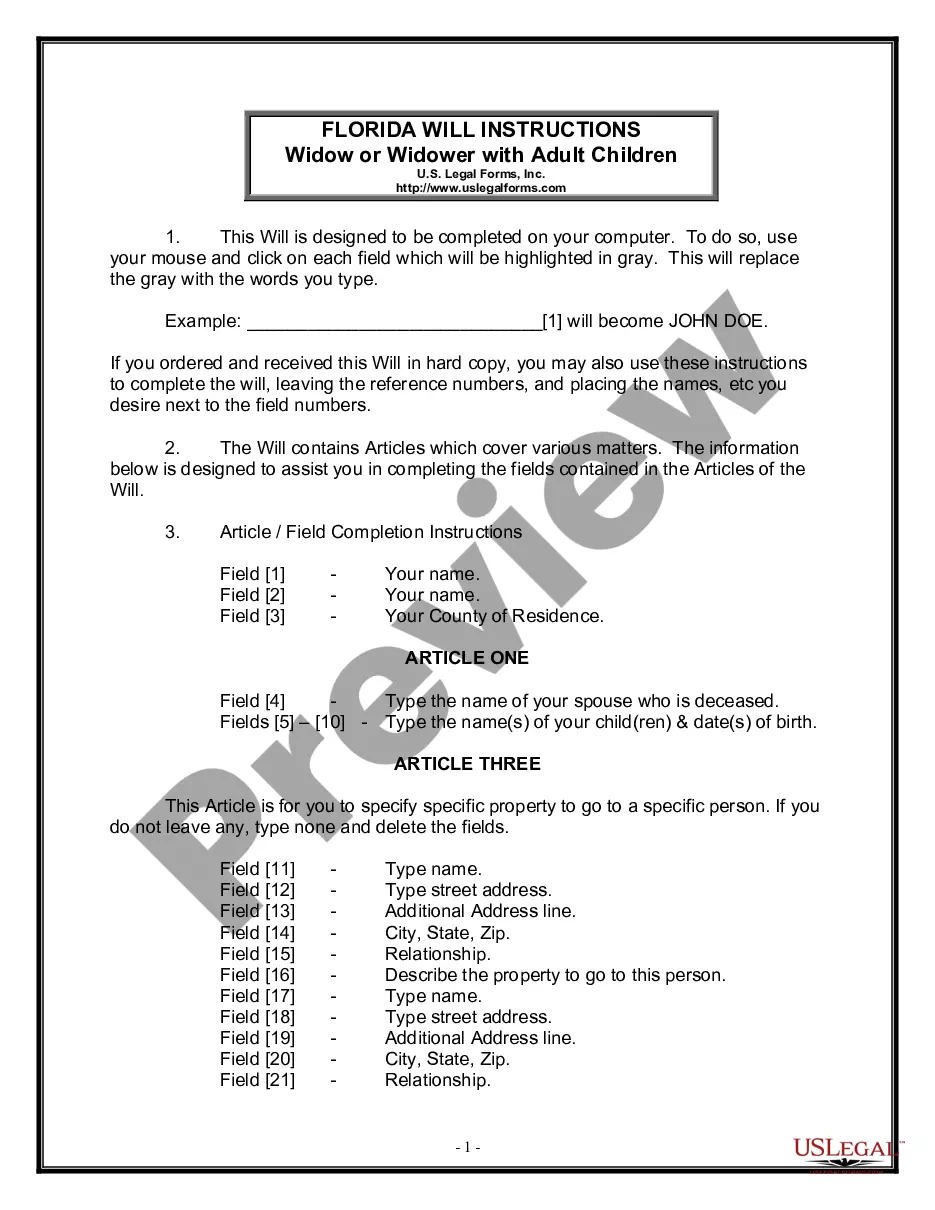
The Last Will and Testament for a Widow or Widower with Adult Children is a legal document that outlines how your assets will be distributed upon your death. This form is specifically designed for individuals who are widowed or widowed and have adult children, differentiating it from standard wills by including provisions that cater to the needs of adult offspring. It establishes an executor who will manage your estate and allows for specific bequests to be made to your children and other individuals.
What’s included in this form
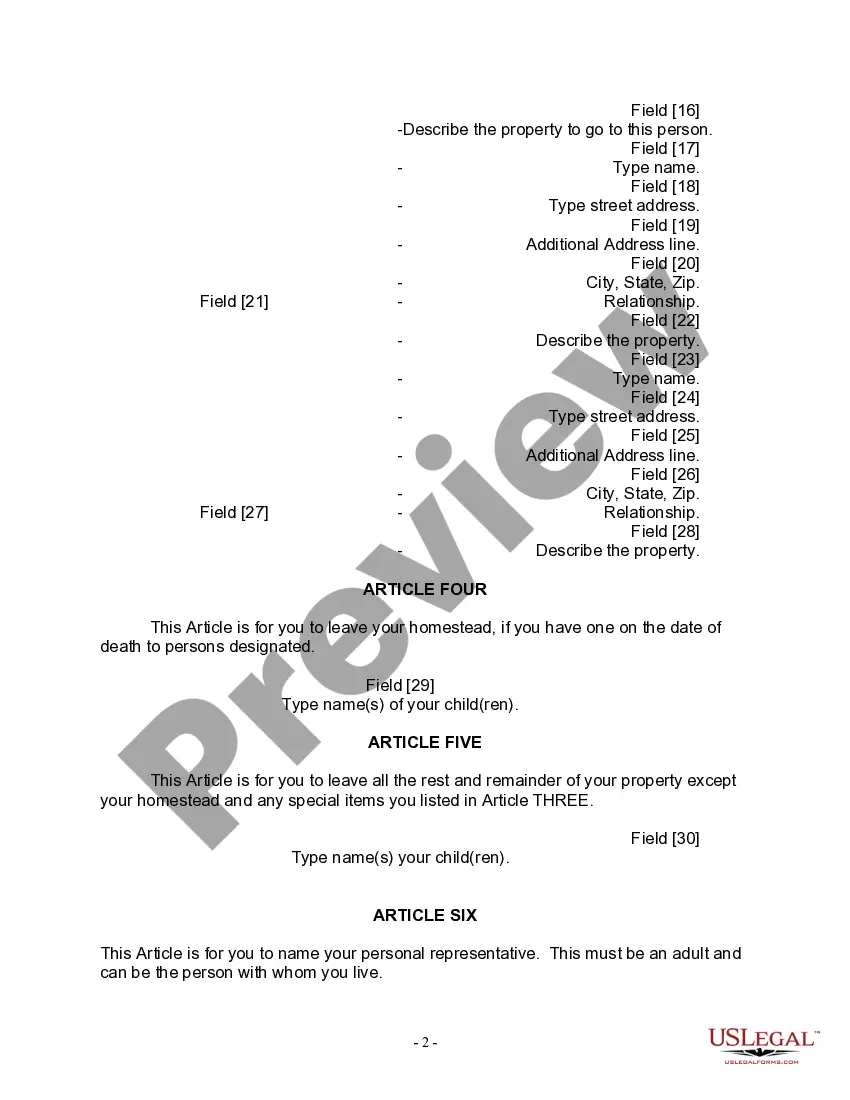
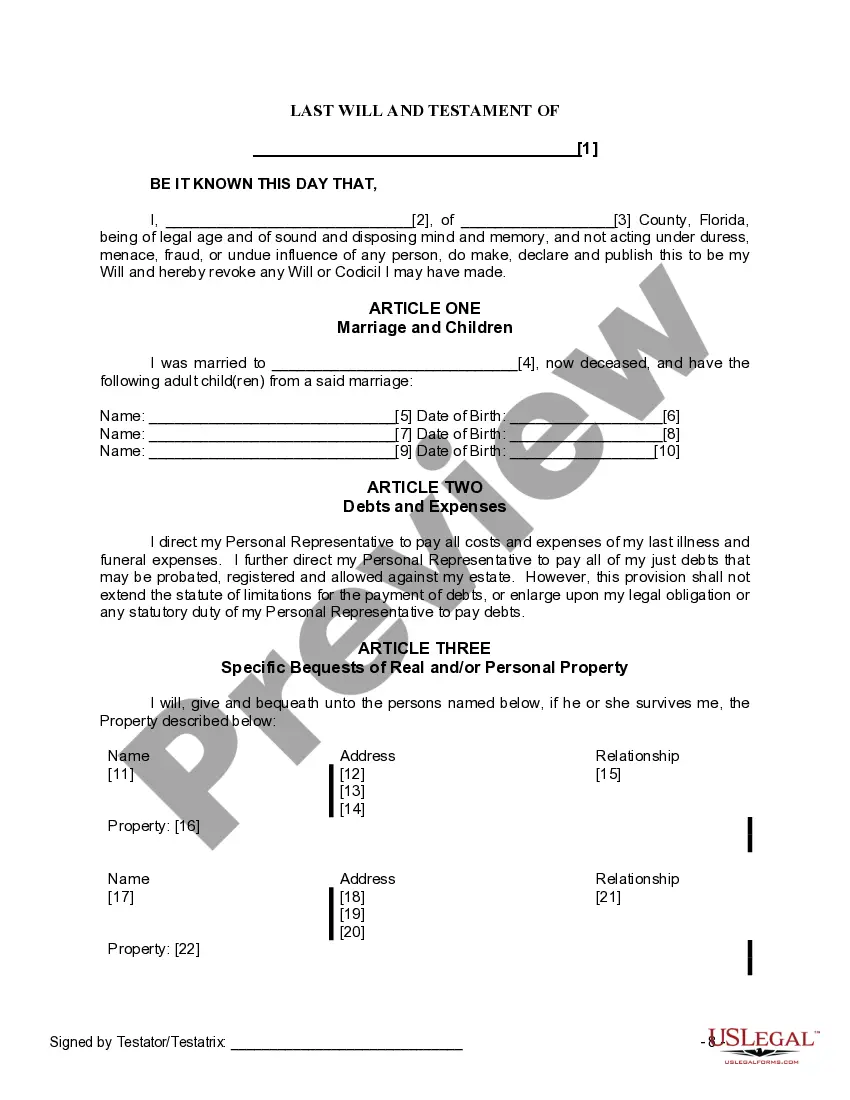
- Your personal information, including your name and county of residence.
- Details about your deceased spouse and your adult children, including their names and dates of birth.
- Provisions for specific property you wish to bequeath to individuals, if any.
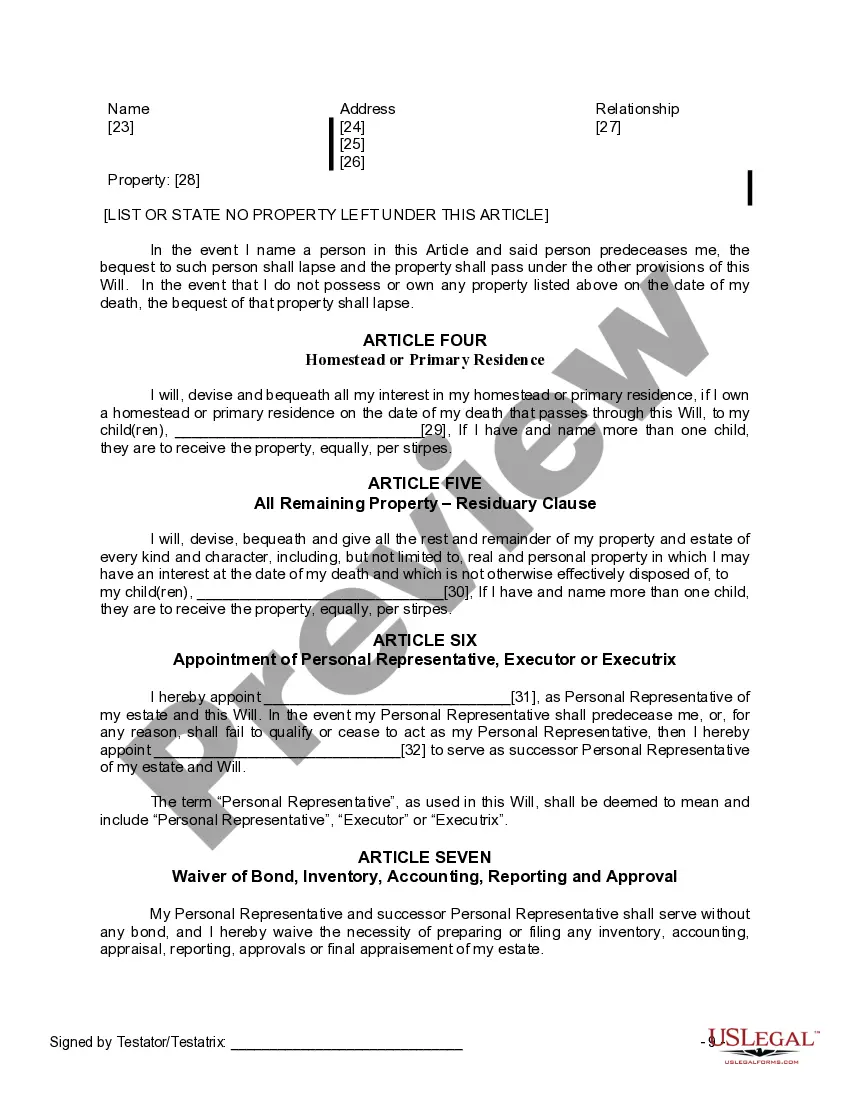
- Distribution of your homestead or primary residence to your children.
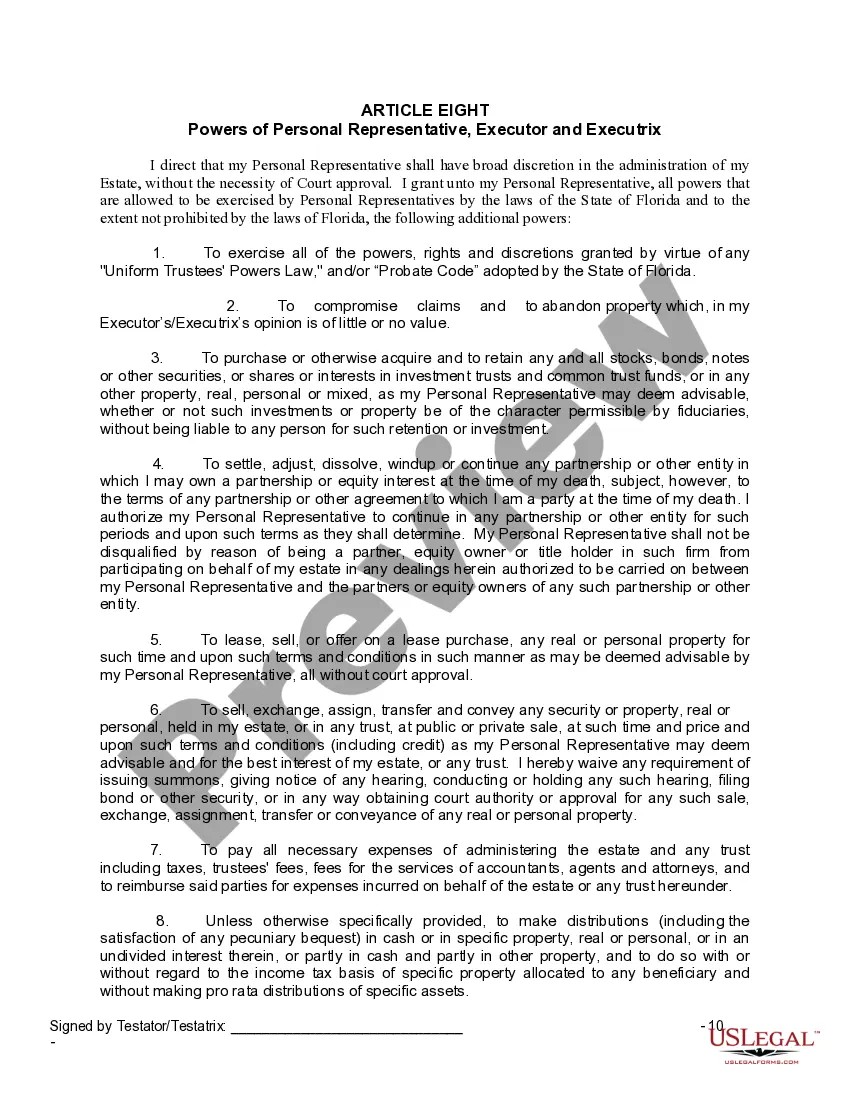
- Designation of your personal representative (executor) who will manage your estate.
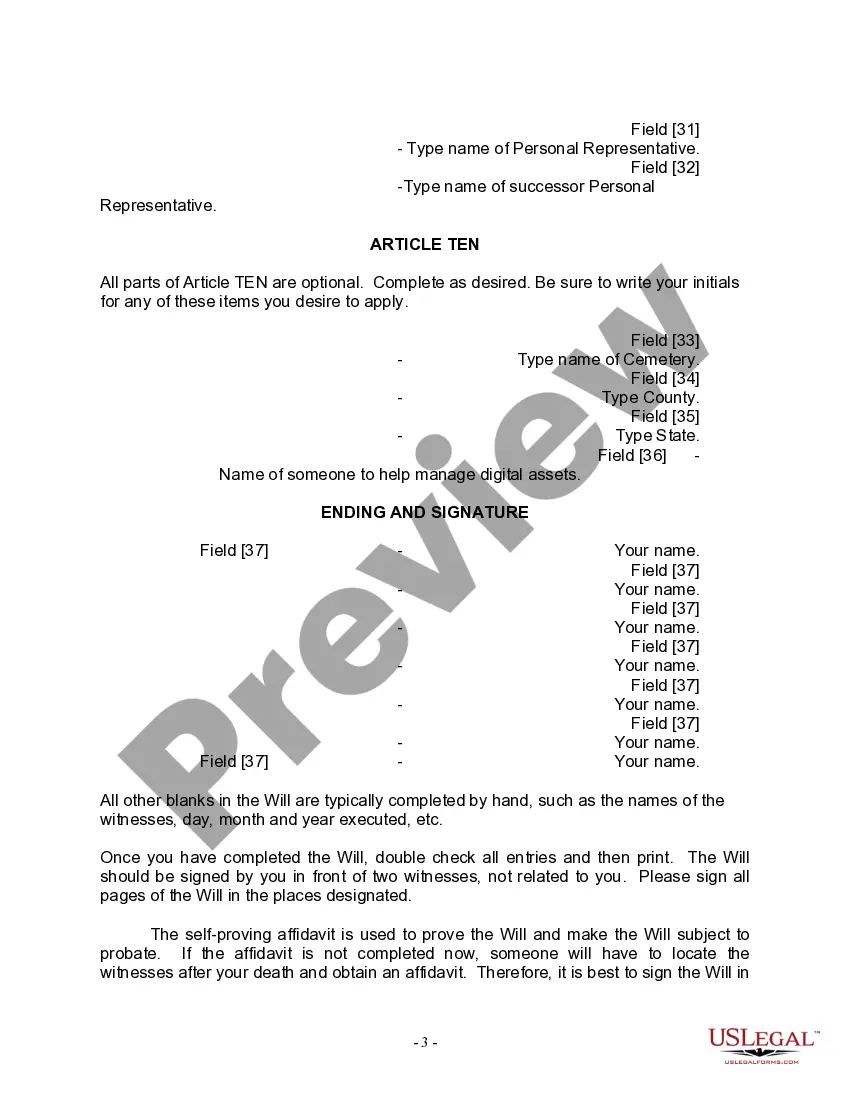
- Optional articles that allow for additional wishes regarding your burial or cremation.

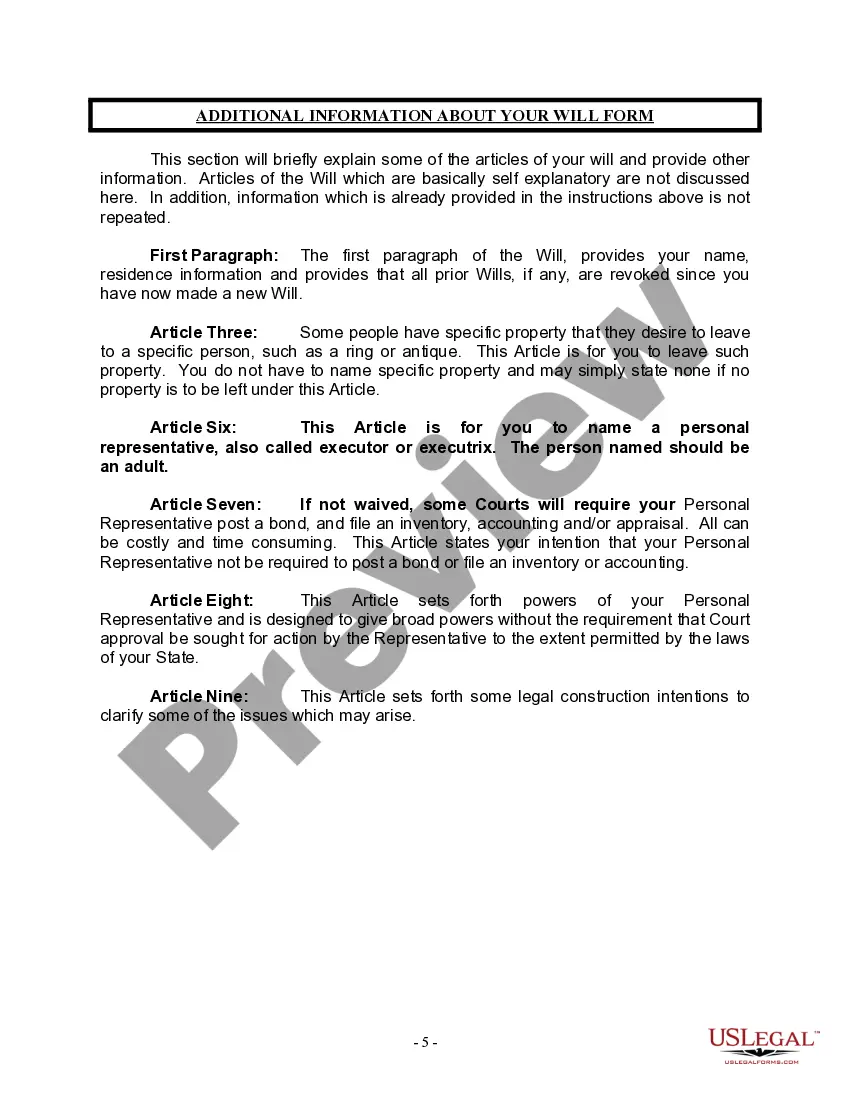
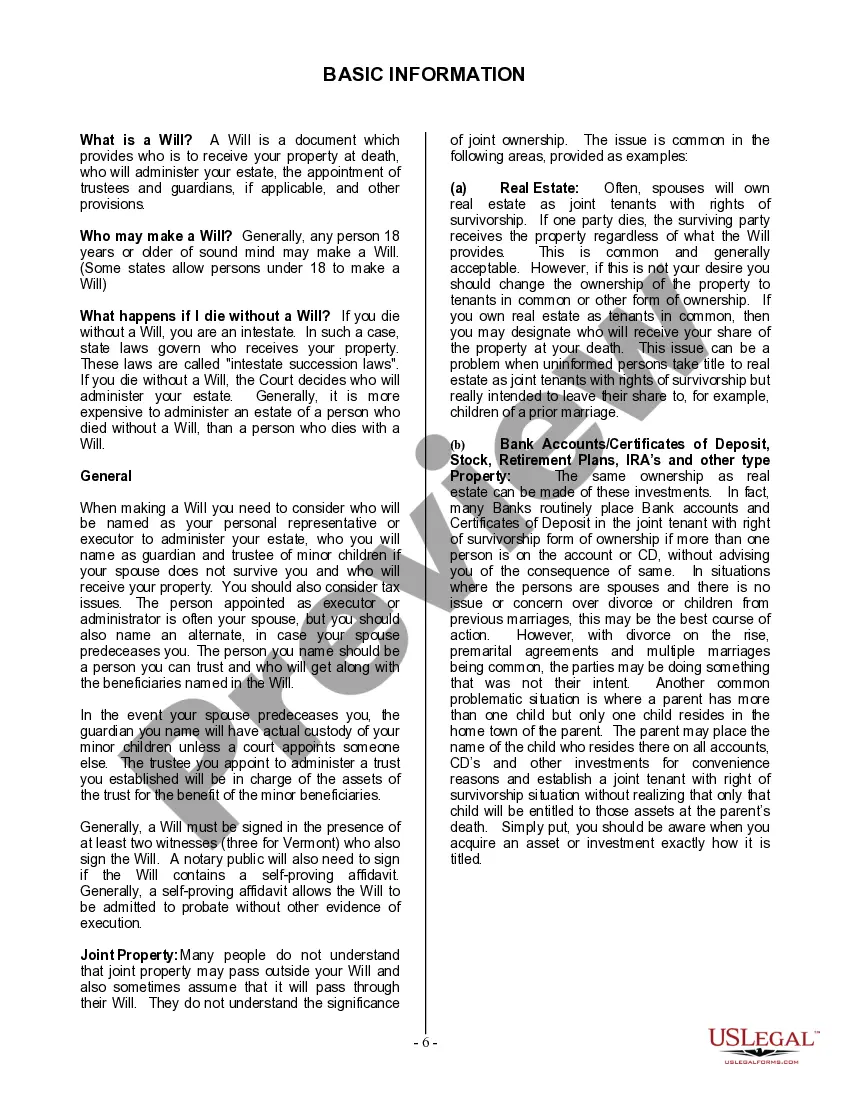



When to use this form
This form should be used when a widow or widower wishes to specify how their assets and estate will be managed and distributed after their death. It is particularly relevant if you have adult children and want to clearly communicate your wishes regarding their inheritance and any specific property you intend to leave.
Who should use this form
This form is intended for:
- Widowed individuals who have adult children.
- Those looking to clearly outline their wishes regarding the distribution of their assets.
- Anyone who desires to appoint a personal representative to manage their estate posthumously.
How to complete this form
- Open the document on your computer and fill in your personal information in the designated fields.
- Enter the name of your deceased spouse and the names and birth dates of your adult children.
- Specify any specific property you wish to gift to individuals, or indicate "none" if you do not have such items.
- Designate your personal representative who will administer your estate.
- Print the completed will and sign it in the presence of two witnesses, followed by any necessary notarization.
Does this document require notarization?
This form must be notarized to be legally valid. US Legal Forms provides secure online notarization powered by Notarize, allowing you to complete the process through a verified video call.
Get your form ready online
Our built-in tools help you complete, sign, share, and store your documents in one place.
Make edits, fill in missing information, and update formatting in US Legal Forms—just like you would in MS Word.
Download a copy, print it, send it by email, or mail it via USPS—whatever works best for your next step.
Sign and collect signatures with our SignNow integration. Send to multiple recipients, set reminders, and more. Go Premium to unlock E-Sign.
If this form requires notarization, complete it online through a secure video call—no need to meet a notary in person or wait for an appointment.
We protect your documents and personal data by following strict security and privacy standards.

Make edits, fill in missing information, and update formatting in US Legal Forms—just like you would in MS Word.

Download a copy, print it, send it by email, or mail it via USPS—whatever works best for your next step.

Sign and collect signatures with our SignNow integration. Send to multiple recipients, set reminders, and more. Go Premium to unlock E-Sign.

If this form requires notarization, complete it online through a secure video call—no need to meet a notary in person or wait for an appointment.

We protect your documents and personal data by following strict security and privacy standards.
Common mistakes to avoid
- Not completing the form in full; ensure all applicable fields are filled out.
- Failing to gather two disinterested witnesses for signature.
- Neglecting to check if notarization is needed in your state.
- Not storing the Will in a safe and accessible location.
Why complete this form online
- You can complete the Last Will and Testament at your convenience, ensuring you can reflect on your decisions.
- The digital format allows for easy edits and modifications as needed.
- Access to attorney-drafted templates provides peace of mind regarding legal accuracy and compliance.
- Save on costs compared to hiring a lawyer for a custom will.
Legal use & context
- This will is designed to conform with the laws governing wills and estates, ensuring that your wishes are legally enforceable.
- Utilizing a self-proving affidavit enhances the likelihood of smoother probate proceedings.
- In the absence of a valid will, state intestacy laws will dictate the distribution of your assets, which may not reflect your wishes.
Quick recap
- This will is tailored for widowers or widows with adult children, specifying their distribution wishes.
- Completing the will with the correct procedural steps, like signing before witnesses, is crucial for legality.
- Online completion simplifies the process, ensuring it is accessible and editable.
- Notarization can facilitate smoother probate proceedings, so consider this step during execution.
Looking for another form?



Form popularity
FAQ
You do not need a lawyer to file a will in Florida. However, having legal guidance can simplify the process of creating a Florida Last Will and Testament for a Widow or Widower with Adult Children. A lawyer can help ensure that the will meets all legal requirements and can address any specific concerns you may have about your estate. If you prefer a more straightforward approach, platforms like USLegalForms offer the necessary tools and templates to create your will effectively.
Yes, you can technically exclude your wife from your will in Florida. However, under state law, she may still have legal rights to a portion of your estate unless you take specific measures in your Florida Last Will and Testament for a Widow or Widower with Adult Children. If you are considering this option, it is crucial to understand the potential legal ramifications. Consulting a legal professional can help ensure your intentions are clearly articulated and legally enforceable.
While Florida does not require a lawyer to create a valid will, seeking legal advice can ensure that your Florida Last Will and Testament for a Widow or Widower with Adult Children addresses all legal requirements and intentions. Using resources like USLegalForms can simplify the process, providing templates that cover essential elements. A lawyer can help clarify any complex issues, especially regarding asset distribution and potential disputes.
In Florida, a wife may have rights to her husband's estate, particularly under the laws governing intestate succession. If he dies without a will, the Florida Last Will and Testament for a Widow or Widower with Adult Children defines how property will be distributed. Even with a will, certain provisions may protect a wife's interests. It's advisable to consult a legal expert to understand your specific situation and rights.
In Florida, a surviving spouse cannot unilaterally change the executor named in a deceased spouse's will. However, they can petition the court to remove an executor if there is valid reasoning, such as misconduct or incapacity. If you need support in understanding the process, consider utilizing resources from US Legal Forms to help you navigate this complex situation effectively.
Yes, a self-written will, or holographic will, can be legal in Florida if it meets specific requirements. It must be in your handwriting and signed by you, and while it does not require witnesses, having them can fortify its validity. It's also wise to use US Legal Forms to ensure that your will meets all the necessary legal standards, providing peace of mind.
In Florida, a last will and testament typically outlines your wishes regarding the distribution of your assets after death. However, Florida law provides certain protections to surviving spouses, which may affect your will. To ensure that your will aligns with your intentions, especially for a widow or widower with adult children, consider consulting with an attorney or using helpful resources like US Legal Forms.
In Florida, a living will does not require notarization, but it must be signed by two witnesses who are not related to you or beneficiaries of your estate. This ensures that your wishes regarding medical treatment are clearly documented and respected. If you prefer added security, you may choose to have it notarized as an extra layer of validation.
In Florida, you do not need to record your last will and testament immediately. However, it is advisable to store it in a safe place and inform your family about its location. Once you pass away, your will should be filed with the local probate court to initiate the probate process for distributing your estate.
In Florida, to create a valid last will and testament for a widow or widower with adult children, you must be at least 18 years old and of sound mind. The will needs to be in writing and signed by you, along with two witnesses. It's important that the witnesses are present when you sign the document, as this ensures its validity under Florida law.