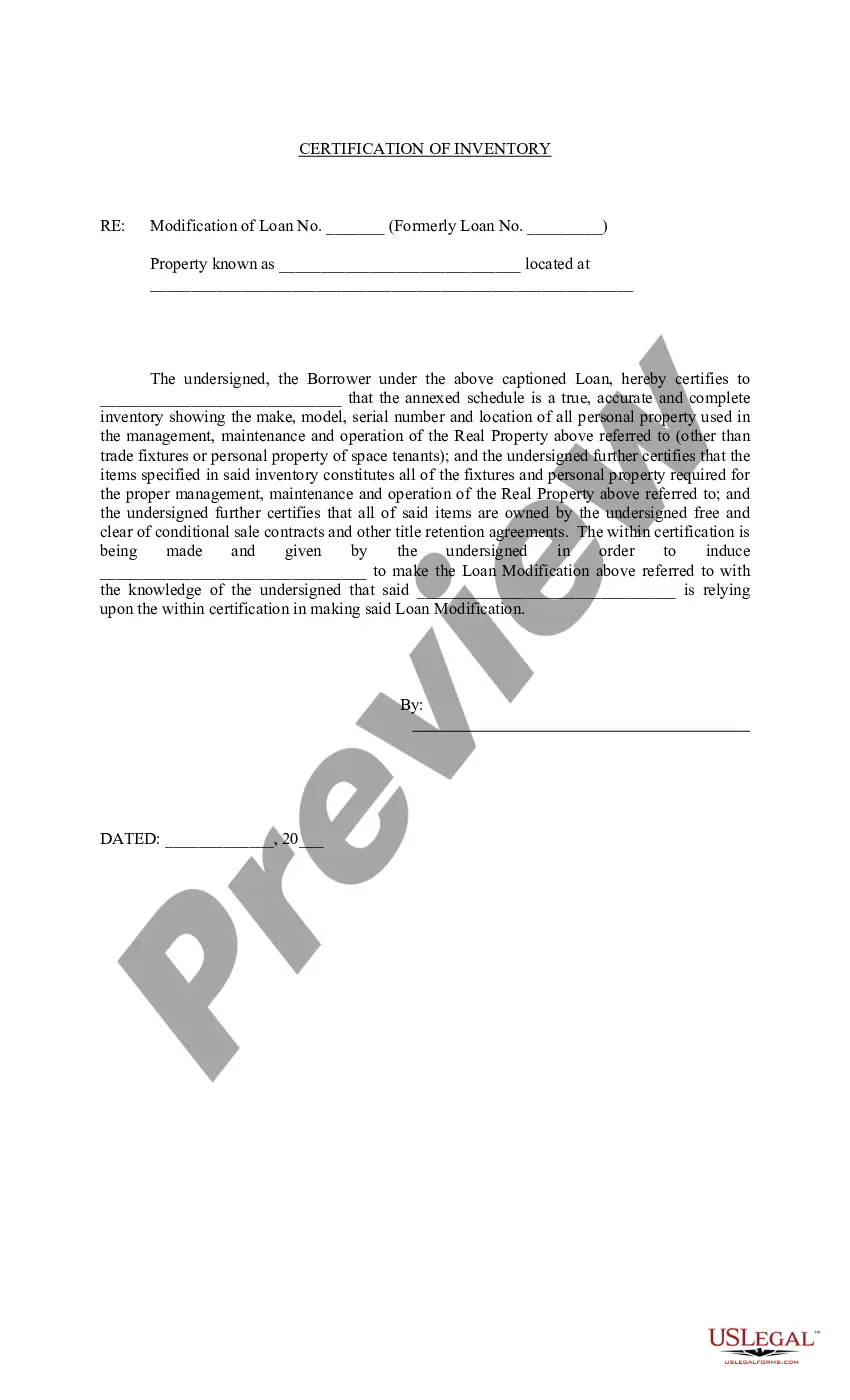
Borrowers Certification of Inventory
What is this form?
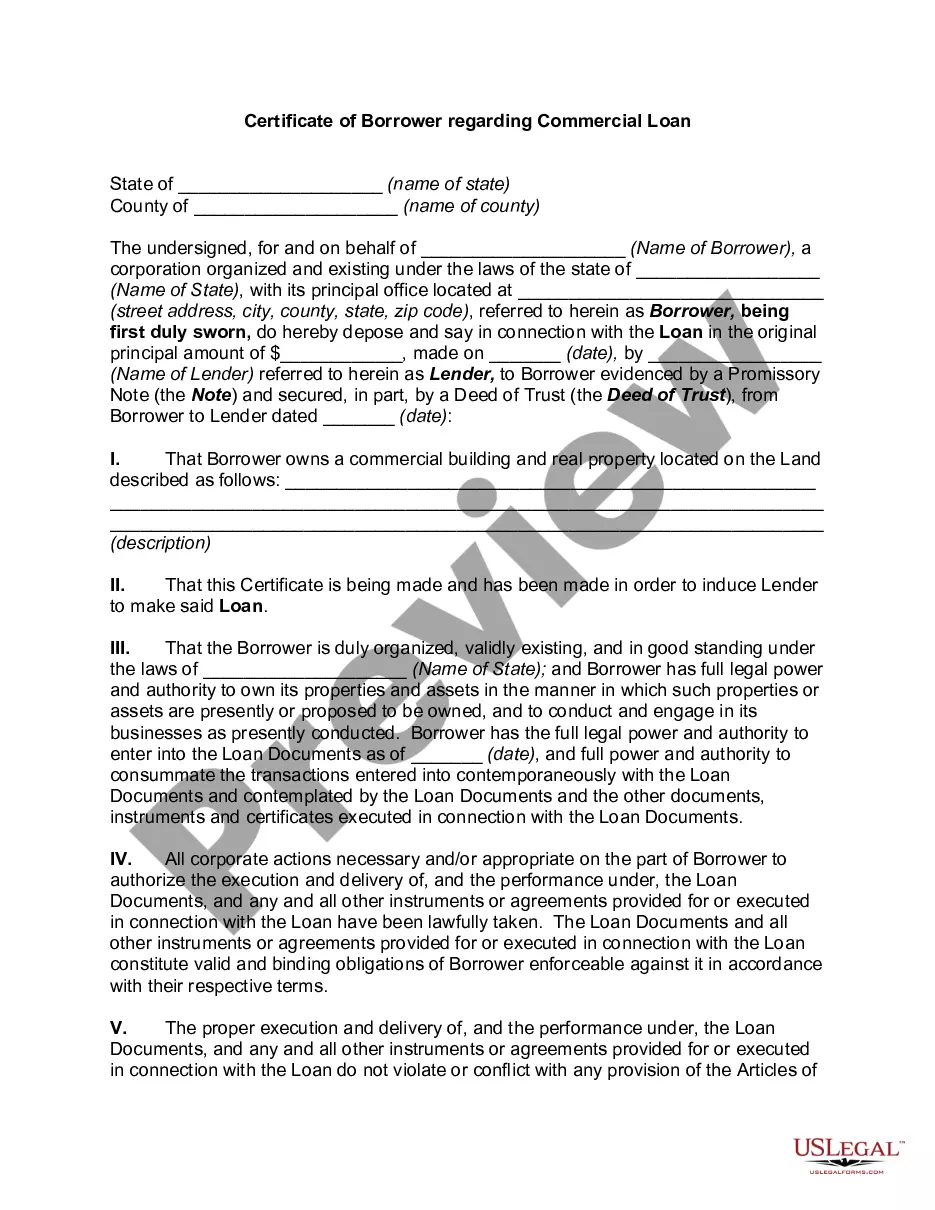
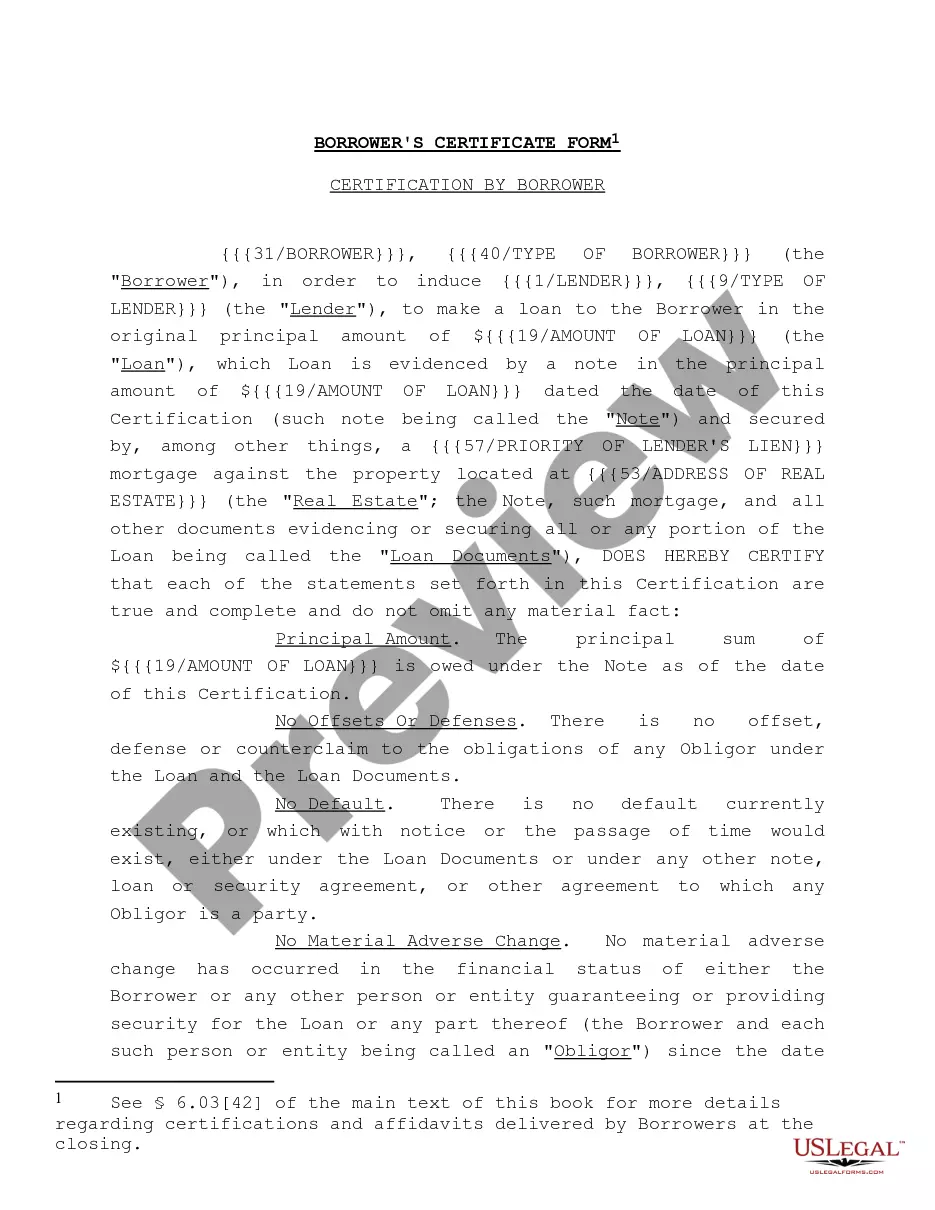
The Borrowers Certification of Inventory is a legal document used by borrowers to certify an inventory of personal property associated with real estate. This form is crucial in the context of loan modifications, as it provides lenders with verified details about the assets that support the property's management and maintenance. Unlike other inventory forms, this document specifically affirms ownership and the accuracy of the listed items, ensuring a trustworthy basis for loan assessments.
Form components explained
- Certification of inventory details, including make, model, and serial numbers.
- Signature of the Borrower attesting to the accuracy of the inventory.
- Date of certification, indicating when the form was completed.
- Identification of the loan modification referenced in the document.
- Certifying statement regarding ownership free of conditional sales or title retention agreements.
When to use this document
This form is essential when a borrower seeks to modify an existing loan backed by real property. It is used to confirm that all personal property utilized in the operation and management of the property is properly documented, which can facilitate the lender's review process for the loan modification. Utilizing this form helps establish trust and transparency between the borrower and lender.
Who needs this form
- Borrowers applying for a loan modification on real property.
- Lenders requiring verification of inventory for loan assessments.
- Business owners who need to certify inventory related to their property.
How to complete this form
- Identify the property associated with the loan modification.
- List all personal property along with their make, model, and serial numbers.
- Verify that all listed items are owned free of any encumbrances.
- Sign and date the certification to authenticate your statements.
- Submit the form to the lender as part of the loan modification application.
Notarization guidance
This form does not typically require notarization to be legally valid. However, some jurisdictions or document types may still require it. US Legal Forms provides secure online notarization powered by Notarize, available 24/7 for added convenience.
Get your form ready online
Our built-in tools help you complete, sign, share, and store your documents in one place.
Make edits, fill in missing information, and update formatting in US Legal Forms—just like you would in MS Word.
Download a copy, print it, send it by email, or mail it via USPS—whatever works best for your next step.
Sign and collect signatures with our SignNow integration. Send to multiple recipients, set reminders, and more. Go Premium to unlock E-Sign.
If this form requires notarization, complete it online through a secure video call—no need to meet a notary in person or wait for an appointment.
We protect your documents and personal data by following strict security and privacy standards.

Make edits, fill in missing information, and update formatting in US Legal Forms—just like you would in MS Word.

Download a copy, print it, send it by email, or mail it via USPS—whatever works best for your next step.

Sign and collect signatures with our SignNow integration. Send to multiple recipients, set reminders, and more. Go Premium to unlock E-Sign.

If this form requires notarization, complete it online through a secure video call—no need to meet a notary in person or wait for an appointment.

We protect your documents and personal data by following strict security and privacy standards.
Common mistakes
- Failing to include all relevant personal property in the inventory.
- Not certifying that items are owned free and clear of debts.
- Leaving out signatures or dates, which can invalidate the form.
Why use this form online
- Convenience of downloading the form at any time from anywhere.
- Editable templates allow easy customization to meet personal needs.
- Access to reliable legal resources drafted by licensed attorneys.
Legal use & context
- This certification is a crucial part of the loan modification process, helping to solidify the borrower's claims regarding the inventory of personal property.
- Accurate and complete information can affect the lender's decision-making regarding the modification of loan terms.
- Non-compliance or inaccuracies can lead to delays or denial of the loan modification application.
Looking for another form?

Form popularity
FAQ
The borrower intends to get that object or the money for its purpose and its obligation to repay the same without any default. The lender's objective is to earn a premium over the object or money that he has in access. It's his obligation to be fair with the borrower and do not take any undue advantage.
Understanding How Borrowing and Lending Works In the most basic sense, lending is the act of giving money to someone now with the expectation they will pay you back in the future.In return for lending the money, the lender charges the borrower a percentage of the amount borrowed, which is known as an interest rate.
The relationship between the borrower and lender has always been known to be an integral factor in the loan approval process. As the lender gains more information on the borrower through a longer relationship, the terms of the loan will change.
The buyer of a bond is a lender. The seller of a bond is a borrower. The bond buyers pay now in exchange for promises of future repaymentthat is, they are lenders. The bond sellers receive money now and in exchange for their promises of future repaymentthat is, they are borrowers.
A person or company that has received money from another party with the agreement that the money will be repaid. Most borrowers borrow at interest, meaning they pay a certain percentage of the principal amount to the lender as compensation for borrowing.
A borrowing base is the amount of money that a lender is willing to loan a company, based on the value of the collateral the company pledges.The resulting numerical figure represents the amount of money a lender will loan out to the company.
Total up the value of all your assets: inventory, equipment and accounts receivable. This is your collateral amount. To determine your borrowing base, multiply you collateral amount by the percentage at which the bank is willing to loan to you.
Dilution of receivables.Dilution of receivables represents the difference between the gross amount of invoices and the cash actually collected for such invoices. Factors such as bad debt write-offs, warranty returns, invoicing errors, trade discounts and returned goods all are involved in computing dilution.