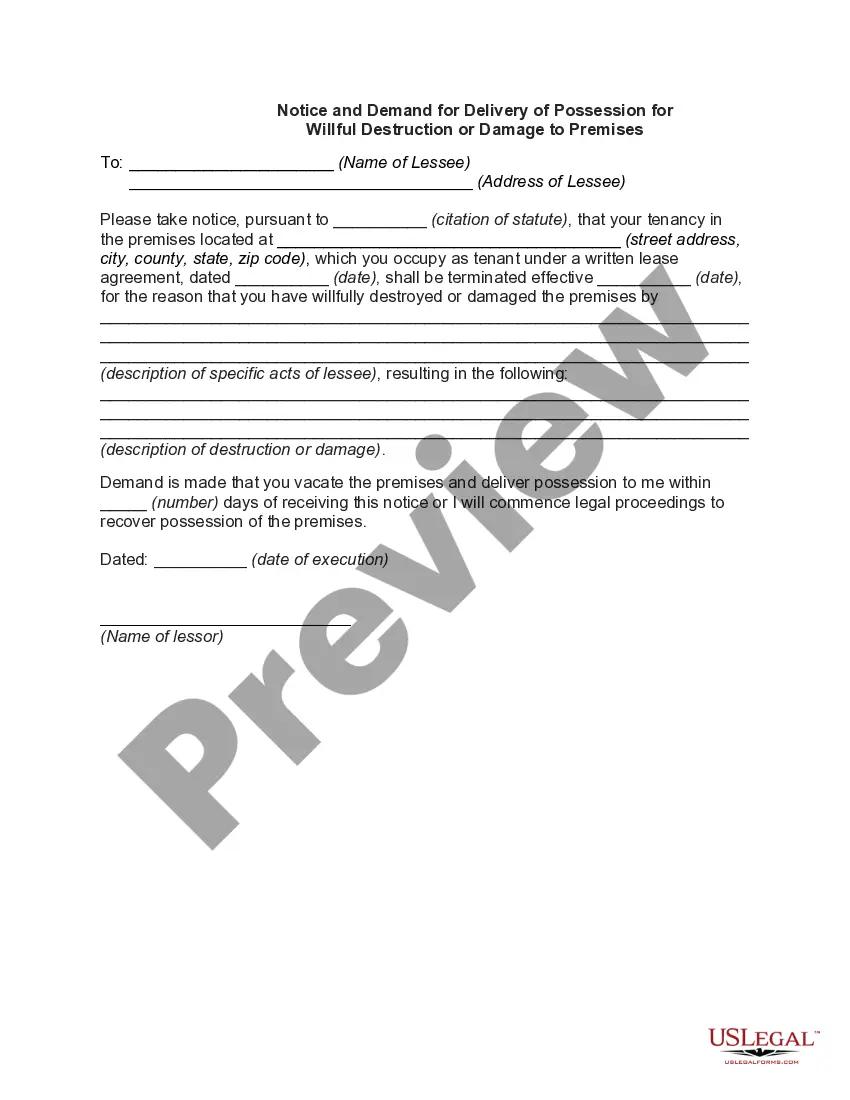
Florida Notice to Tenant and Demand for Delivery of Possession for Disorderly Conduct of Tenant/Lessee
Description

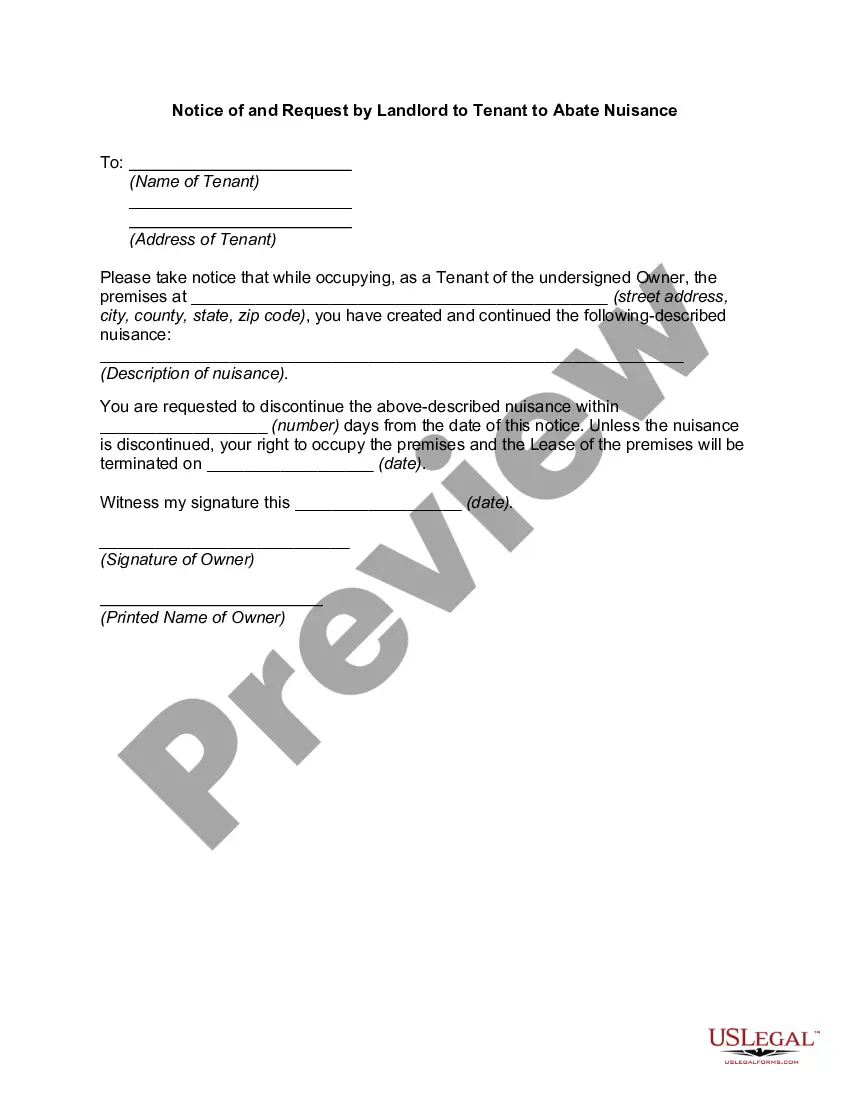



How to fill out Notice To Tenant And Demand For Delivery Of Possession For Disorderly Conduct Of Tenant/Lessee?
US Legal Forms - one of the largest collections of legal documents in the USA - provides a variety of legal document templates that you can download or print.
By using the website, you can find thousands of templates for business and personal purposes, organized by categories, states, or keywords. You can locate the most recent templates such as the Florida Notice to Tenant and Demand for Delivery of Possession for Disorderly Conduct of Tenant/Lessee in just a few minutes.
If you already have a subscription, Log In and download the Florida Notice to Tenant and Demand for Delivery of Possession for Disorderly Conduct of Tenant/Lessee from the US Legal Forms library. The Download button will appear on each form you view. You have access to all previously acquired forms under the My documents tab of your account.
Complete the transaction. Use a credit card or PayPal account to finalize the transaction.
Select the format and download the form to your device. Make adjustments. Fill in, edit, and print/sign the downloaded Florida Notice to Tenant and Demand for Delivery of Possession for Disorderly Conduct of Tenant/Lessee. Each template you add to your account has no expiration date and is yours forever. Thus, if you wish to download or print another copy, simply navigate to the My documents section and click on the form you need. Access the Florida Notice to Tenant and Demand for Delivery of Possession for Disorderly Conduct of Tenant/Lessee with US Legal Forms, the largest legal document template repository. Utilize thousands of professional and state-specific templates that fulfill your business or personal requirements.
- Make sure you've selected the correct form for your city/area.
- Click on the Preview button to review the content of the form.
- Check the description of the form to ensure it's the right one.
- If the form doesn’t meet your needs, utilize the Search field at the top of the screen to find one that does.
- If you are satisfied with the form, confirm your choice by clicking the Buy Now button.
- Then, select the pricing plan you prefer and provide your credentials to register for an account.
Form popularity
FAQ
The moratorium applies in Florida. Unlike other moratoriums, the CDC Moratorium does not require that your financial hardship be related to COVID-19. The CDC eviction moratorium was extended through 2020 and into mid-2021. Those extensions stopped any action by a landlord to remove a tenant until JUNE 30, 2021.
In Florida, landlords only have to give tenants 15 days' notice to terminate the lease. Ending a month-to-month lease in Florida is a lot simpler than ending a year-long leaselandlords and tenants can terminate their agreement at any time, as long as they give a minimum of 15 days' written notice.
The landlord must serve the tenant a written notice allowing three days, excluding weekends and legal holidays, for the payment of the rent or vacating of the premises. If the tenant does not pay the rent or vacate, the landlord may begin legal action to evict.
When the tenancy is month-to-month, the tenant must give the landlord 15 days' notice before the end of any monthly period. (In Miami, the tenant must give the landlord 30 days' notice before the end of the monthly period).
According to the Fair Housing Act, Florida landlords cannot ask potential renters questions about medical history, age, any disability, familial status, ancestry, national origin, marital status, sexual orientation, religion, color or race. Tenants cannot be discriminated against due to any of these reasons.
Notice Requirements for Florida Tenants It is equally easy for tenants in Florida to get out of a month-to-month rental agreement. You must provide the same amount of notice (15 days) as the landlord.
What is an Eviction? Under Florida State laws, if your tenant is unable to or refuses to pay, the only way to remove them legally is through the eviction process. Normally, the police does not get involved with the removal of a tenant as such process is handled through the civil eviction process and not criminal law.
If your landlord wants to end your periodic tenancy, they usually have to give you 90 days' notice. In some cases, your landlord only has to give you 42 days' notice. They will need to tell you the reason why they're giving you less notice though.
What are some reasons I can evict a tenant?Failure to pay rent.Violation of lease.Damage to rental property.Lack of basic property maintenance.Disturbing the peace.End of lease.
Unless they have a defense, they will be evicted. On other other hand, to remove a Tenant for illegal activity, they need strong evidence that it occurred. For example, a police report can be provided if a Tenant is arrested at the property.