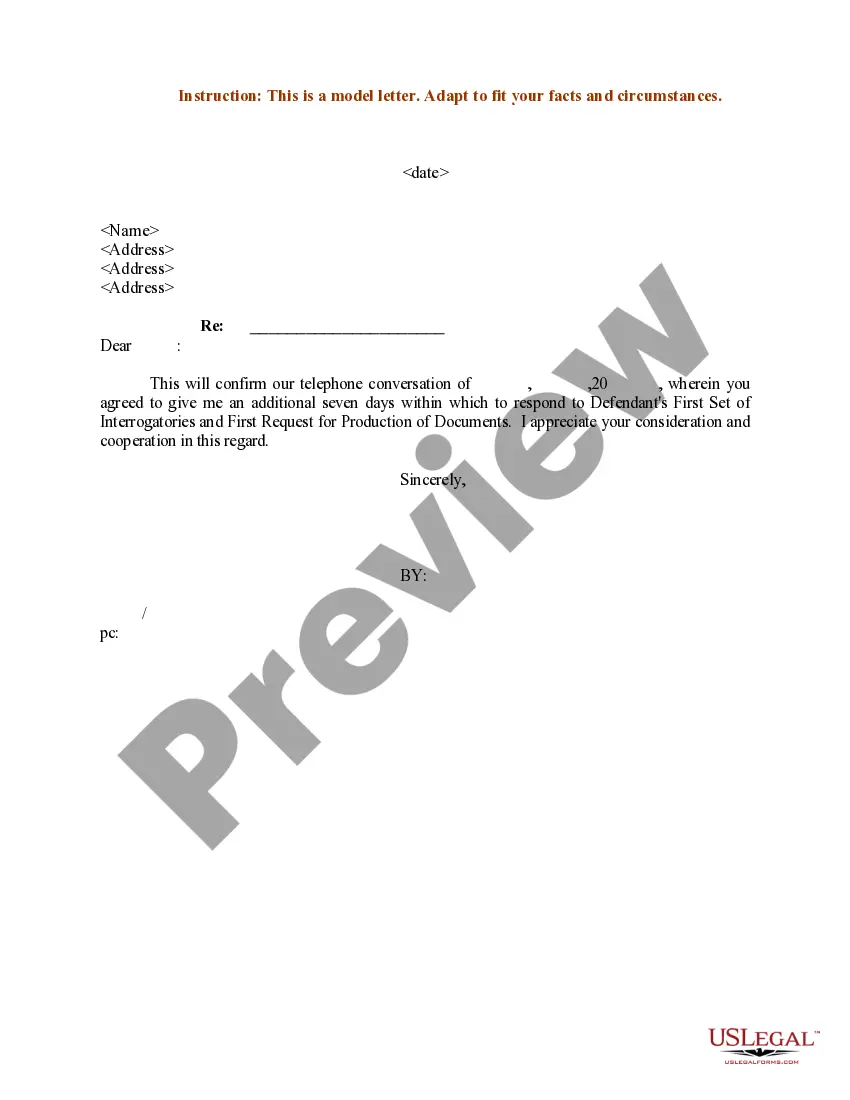
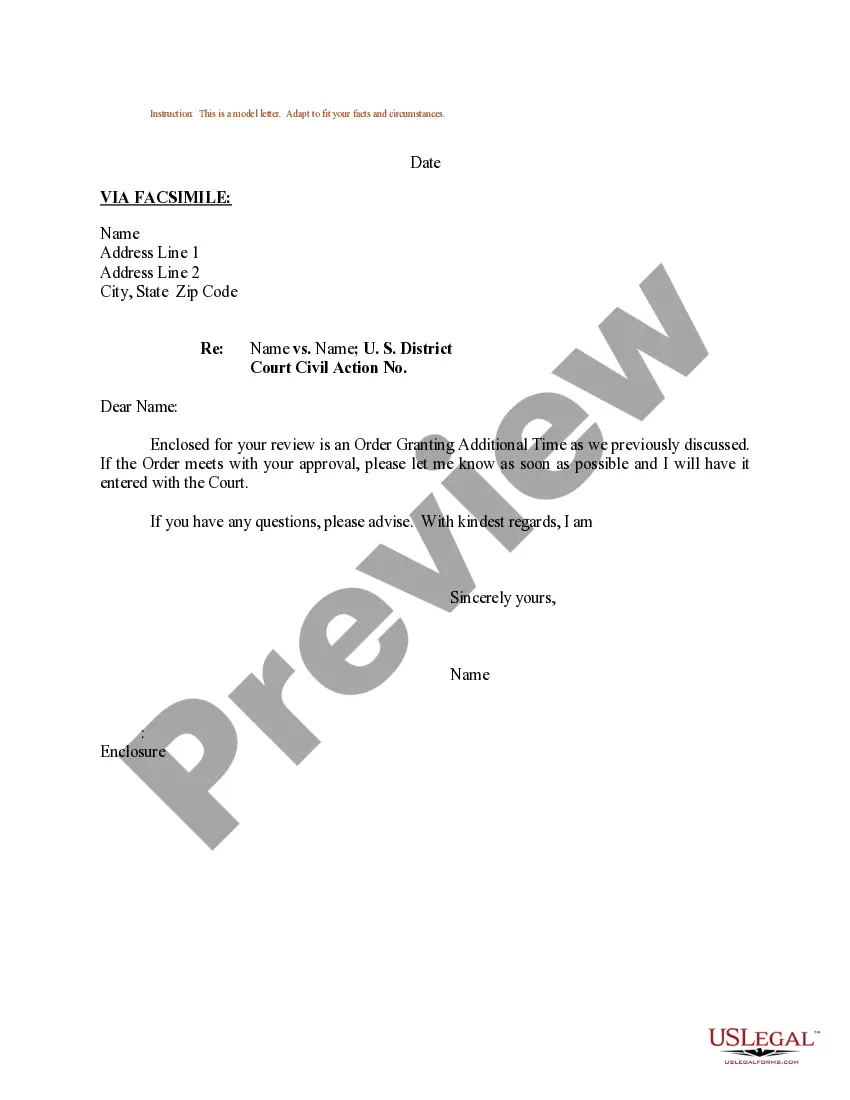
Florida Sample Letter Confirming Additional Time to Respond to Defendant's First Set of Interrogatories and First Request for Production of Documents
Description

Get your form ready online
Our built-in tools help you complete, sign, share, and store your documents in one place.
Make edits, fill in missing information, and update formatting in US Legal Forms—just like you would in MS Word.
Download a copy, print it, send it by email, or mail it via USPS—whatever works best for your next step.
Sign and collect signatures with our SignNow integration. Send to multiple recipients, set reminders, and more. Go Premium to unlock E-Sign.
If this form requires notarization, complete it online through a secure video call—no need to meet a notary in person or wait for an appointment.
We protect your documents and personal data by following strict security and privacy standards.

Make edits, fill in missing information, and update formatting in US Legal Forms—just like you would in MS Word.

Download a copy, print it, send it by email, or mail it via USPS—whatever works best for your next step.

Sign and collect signatures with our SignNow integration. Send to multiple recipients, set reminders, and more. Go Premium to unlock E-Sign.

If this form requires notarization, complete it online through a secure video call—no need to meet a notary in person or wait for an appointment.

We protect your documents and personal data by following strict security and privacy standards.
Looking for another form?
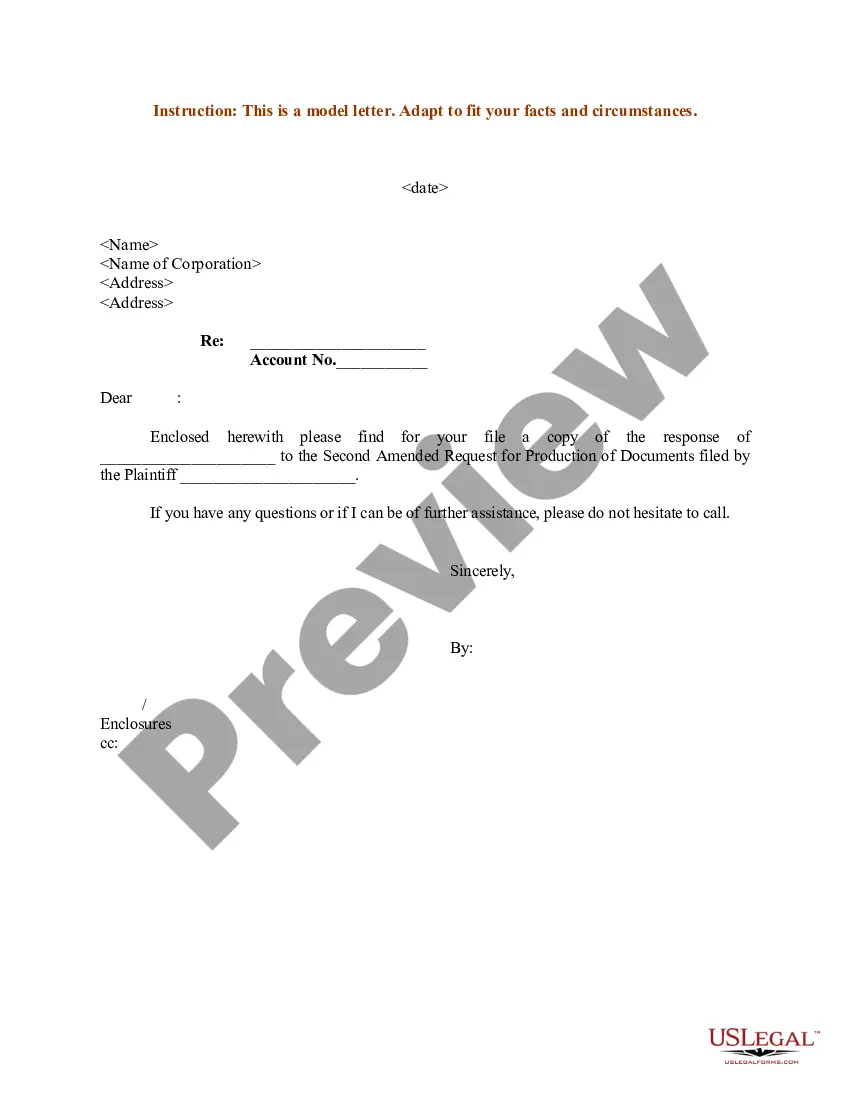
How to fill out Sample Letter Confirming Additional Time To Respond To Defendant's First Set Of Interrogatories And First Request For Production Of Documents?
It is feasible to spend numerous hours online attempting to locate the valid document template that meets the federal and state requirements you seek.
US Legal Forms offers thousands of valid forms that are reviewed by professionals.
You can effortlessly download or print the Florida Sample Letter Confirming Additional Time to Respond to Defendant's First Set of Interrogatories and First Request for Production of Documents from the service.
If available, use the Preview option to review the document template as well. If you wish to obtain another version of the form, use the Search field to find the template that suits your needs and requirements. Once you have found the template you want, click on Acquire now to proceed. Select the pricing plan you prefer, enter your credentials, and register for an account on US Legal Forms. Complete the transaction. You can use your credit card or PayPal account to pay for the valid document. Choose the format of the document and download it to your device. Make modifications to your document if necessary. You can complete, edit, and sign and print the Florida Sample Letter Confirming Additional Time to Respond to Defendant's First Set of Interrogatories and First Request for Production of Documents. Acquire and print thousands of document templates using the US Legal Forms website, which offers the largest selection of valid forms. Utilize professional and state-specific templates to address your business or personal needs.
- If you already have a US Legal Forms account, you can Log In and select the Acquire option.
- Then, you can complete, edit, print, or sign the Florida Sample Letter Confirming Additional Time to Respond to Defendant's First Set of Interrogatories and First Request for Production of Documents.
- Every valid document template you purchase is yours indefinitely.
- To obtain another copy of a purchased form, navigate to the My documents tab and click on the relevant option.
- If you are visiting the US Legal Forms website for the first time, follow the simple instructions below.
- First, ensure that you have selected the correct document template for the state/city of your choice.
- Review the form description to confirm you have chosen the appropriate form.
Form popularity
FAQ
They are provided for your information. There is no form for your answer, but you typically have to respond in a specified format, using paper with numbers down the left-hand side, with your name and address at the top left, the name of the court and of the case, and the case number.
If you do not answer the questions by the deadline, which is usually about a month, the other side could ask the judge to order you to respond to the interrogatories. If you miss the second deadline, the judge could impose a fine against you or strike your pleadings.
However, you can object to interrogatories that call for legal conclusions. You can also object to questions if they are not at all related to the court case. To object, you need to write out the reasons for the objection instead of answering the question.
Interrogatories, which are written questions about things that are relevant or important to the case. (NRCP 33; JCRCP 33) Requests for production of documents or things, which are written requests that demand the other side provide particular documents or items. (NRCP 34; JCRCP 34.)
Courts enforce their orders by imposing sanctions on a party who fails to comply. Sanctions can be monetary, such as requiring one party to pay the other parties attorneys' fees and/or imposing a monetary fine, or they can hamper a party's ability to put on their case.
If you are unable to answer an interrogatory because it is too vague, ambiguous, or somehow objectionable, you can state an objection and the reason for your objection. You must then answer to the extent the interrogatory is not objectionable.
If the other person does not respond, or their response is still incomplete, you can ask the court to order them to respond. You have 45 days from the service of the most recent responses to ask the court to make an order requiring an answer. If the response was served by mail, 5 extra days are added.
Requests for Production or Demands for Inspection require you to produce documents for copying or in some cases actual items for inspection. Responding to the request has 2 parts: State if you can comply with the request (all of it or some of it) or give the reason why you can't comply.