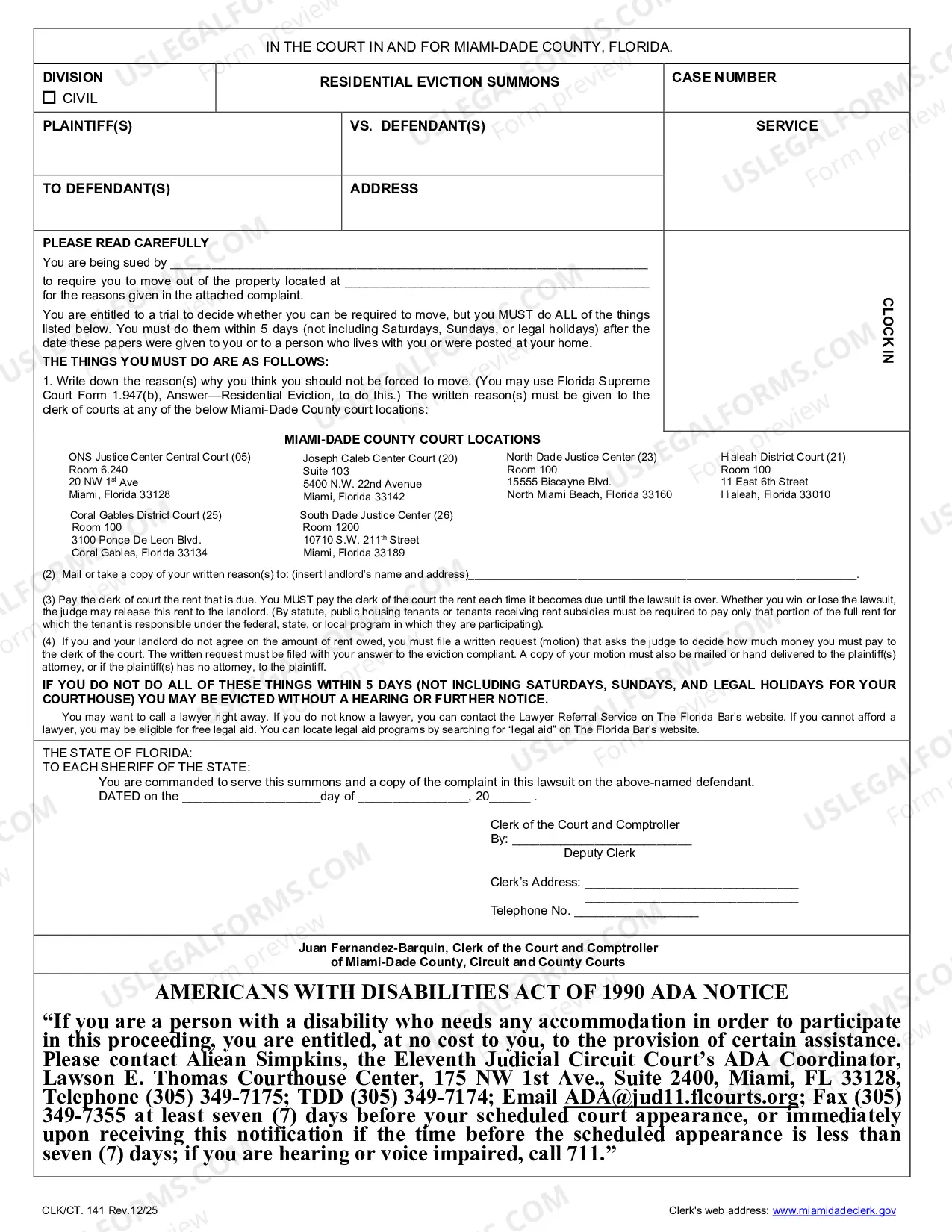
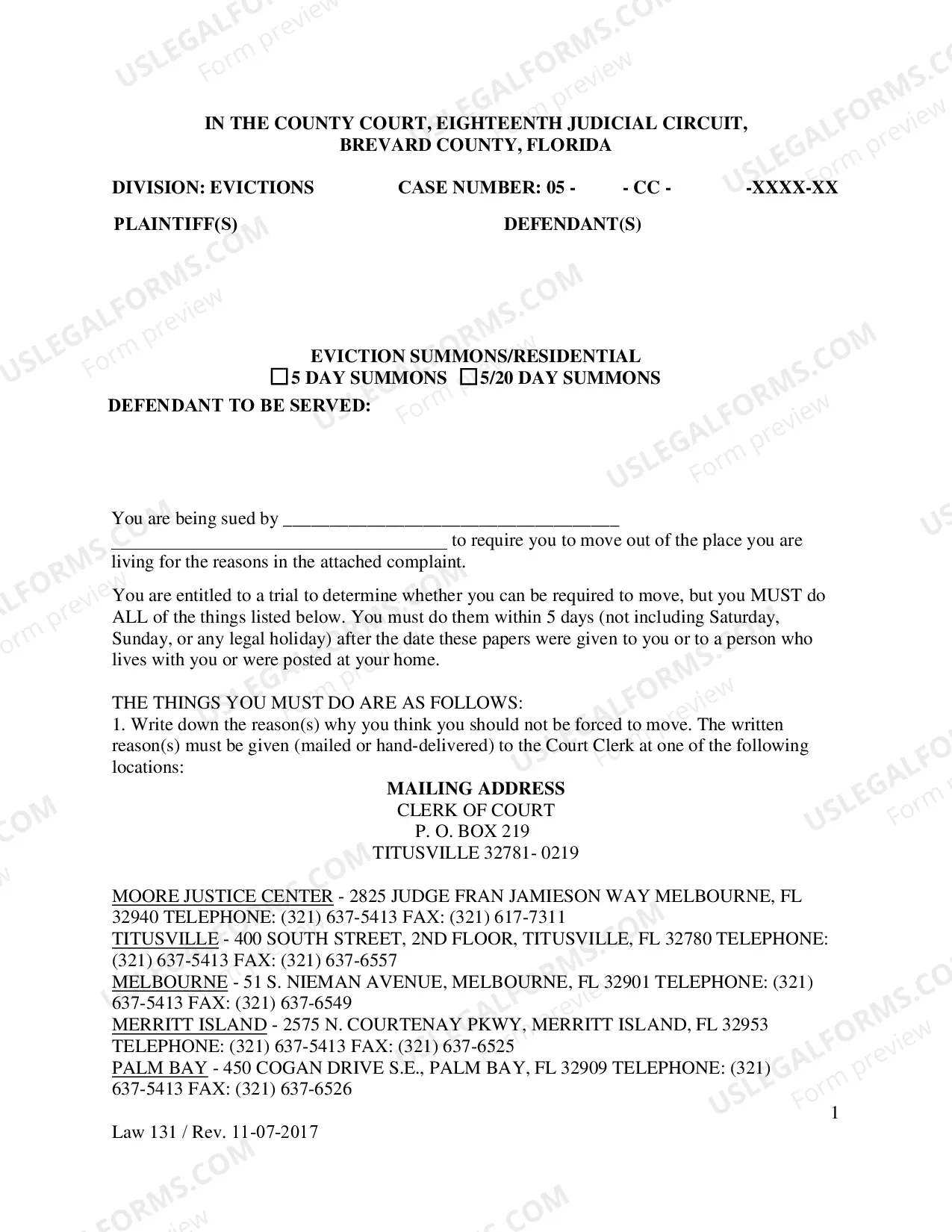
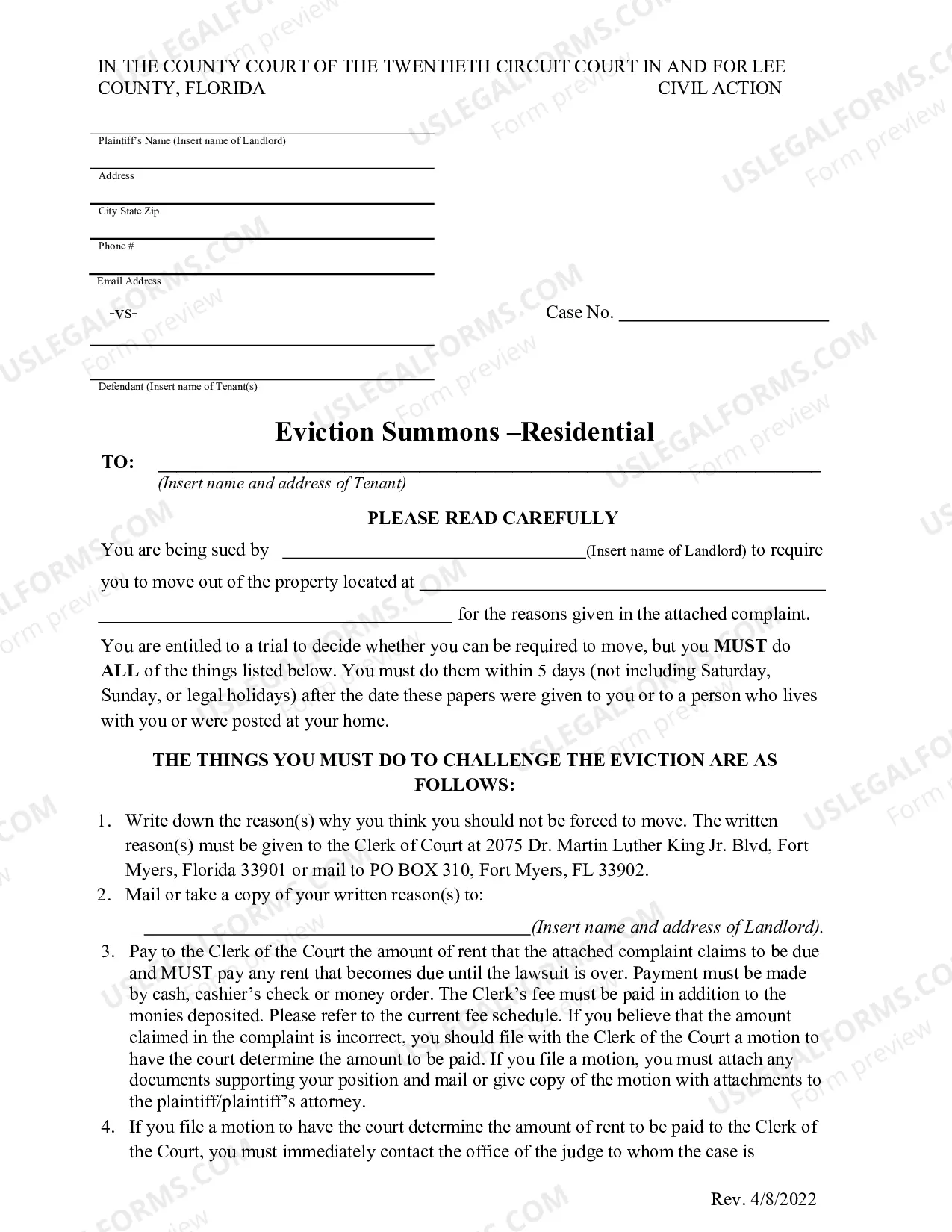
Florida Residential Eviction Summons is a formal document issued by a court in the State of Florida to a tenant in an eviction case. It is the first step in the eviction process, and is served to the tenant by a court clerk or a sheriff’s deputy. The summons informs the tenant of their rights and the court’s decision in the case. It will also include the amount of rent due, late fees, court costs, and any other legal costs associated with the case. The tenant must appear in court on the date indicated on the summons or risk a default judgment. There are two types of Florida Residential Eviction Summons: the 3-Day Notice to Vacate and the 7-Day Notice to Vacate. The 3-Day Notice is served when a tenant is late in paying their rent or when they have violated the terms of the lease. The tenant must leave the premises within three days or face eviction. The 7-Day Notice is served when a tenant has committed a more serious offense, such as destruction of property or illegal activity. The tenant is given seven days to leave the premises or face eviction.
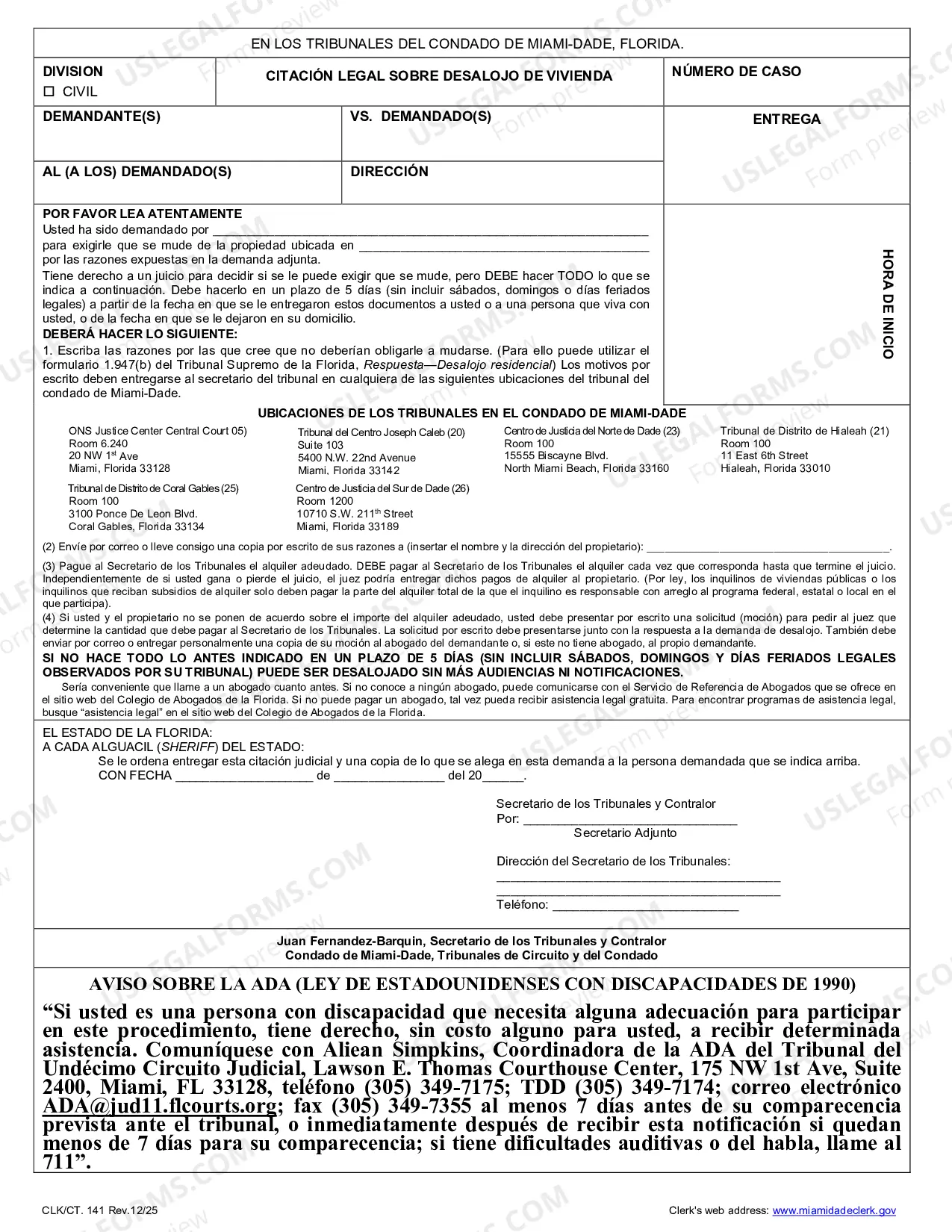
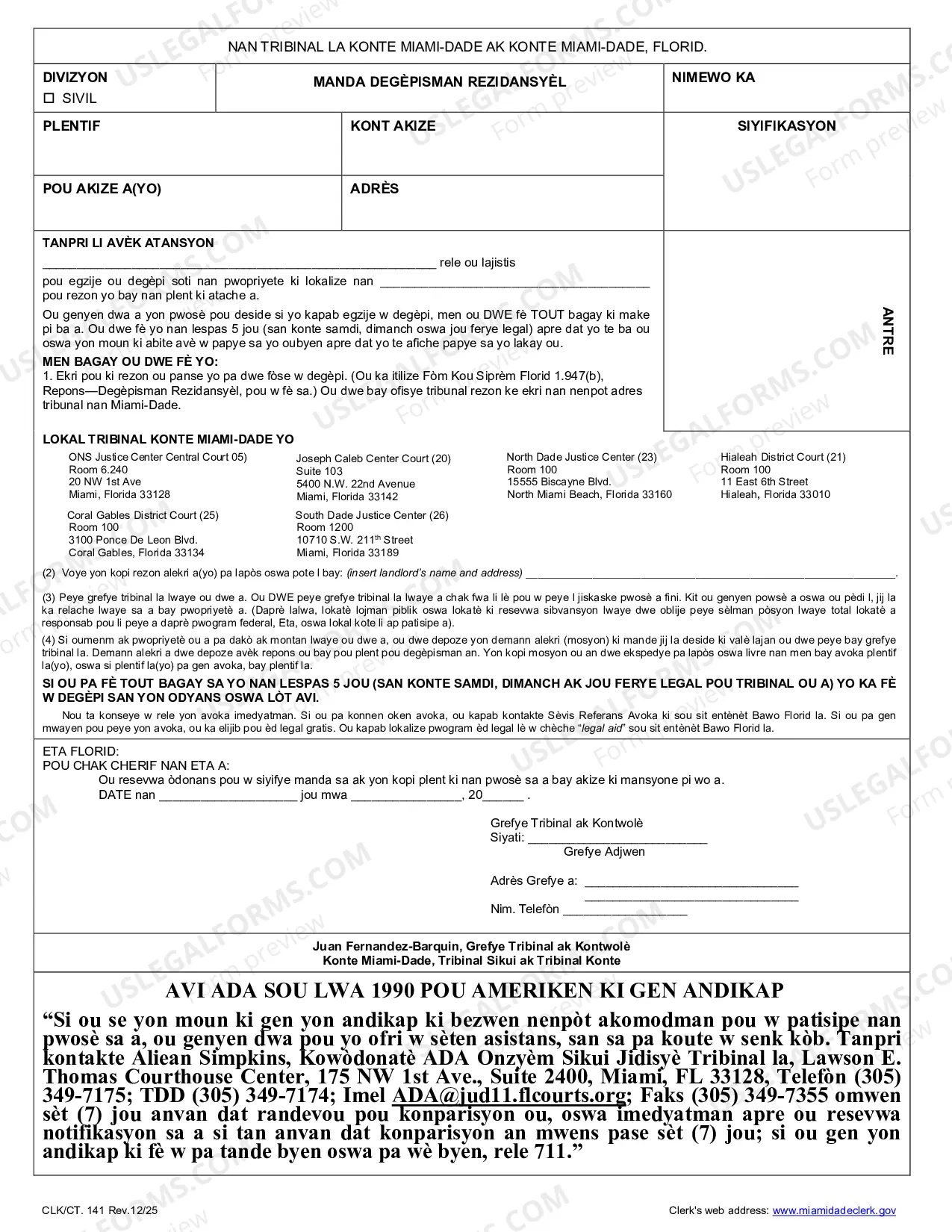
Florida Residential Eviction Summons
Description
Get your form ready online
Our built-in tools help you complete, sign, share, and store your documents in one place.
Make edits, fill in missing information, and update formatting in US Legal Forms—just like you would in MS Word.
Download a copy, print it, send it by email, or mail it via USPS—whatever works best for your next step.
Sign and collect signatures with our SignNow integration. Send to multiple recipients, set reminders, and more. Go Premium to unlock E-Sign.
If this form requires notarization, complete it online through a secure video call—no need to meet a notary in person or wait for an appointment.
We protect your documents and personal data by following strict security and privacy standards.

Make edits, fill in missing information, and update formatting in US Legal Forms—just like you would in MS Word.

Download a copy, print it, send it by email, or mail it via USPS—whatever works best for your next step.

Sign and collect signatures with our SignNow integration. Send to multiple recipients, set reminders, and more. Go Premium to unlock E-Sign.

If this form requires notarization, complete it online through a secure video call—no need to meet a notary in person or wait for an appointment.

We protect your documents and personal data by following strict security and privacy standards.
Looking for another form?

How to fill out Florida Residential Eviction Summons?
Managing legal documents demands focus, accuracy, and utilizing well-prepared templates. US Legal Forms has been assisting individuals nationwide in doing just that for 25 years, so when you select your Florida Residential Eviction Summons template from our collection, you can rest assured that it complies with federal and state regulations.
Interacting with our service is simple and swift. To acquire the necessary document, all you need is an account with an active subscription. Here’s a short guide for you to obtain your Florida Residential Eviction Summons in just a few minutes.
All documents are designed for multiple uses, like the Florida Residential Eviction Summons you see on this page. If you require them again, you can fill them out without additional payment - simply navigate to the My documents tab in your profile and complete your document whenever you need it. Experience US Legal Forms and prepare your business and personal paperwork efficiently and in full legal compliance!
- Ensure to thoroughly review the form's content and its alignment with general and legal standards by previewing it or examining its description.
- Look for an alternative formal template if the one you opened does not fit your scenario or state laws (that tab is located in the top corner of the page).
- Log in to your account and save the Florida Residential Eviction Summons in your preferred format. If it’s your first time using our service, click Buy now to continue.
- Create an account, select your subscription plan, and pay using your credit card or PayPal account.
- Decide on the format in which you wish to save your form and click Download. You can print the blank form or upload it to a professional PDF editor for electronic submission.
Form popularity
FAQ
To file an eviction lawsuit in Florida, you must begin by preparing the Florida Residential Eviction Summons, which you'll submit to your local courthouse. Ensure that you have correctly filled out the summons with all necessary details, including the tenant's information and the grounds for the eviction. After submitting, you will receive a case number, and you must then serve the summons to the tenant legally. Consider using US Legal Forms to access reliable templates and resources, making the process smoother and more efficient.
Writing an eviction notice in Florida requires specific formats and details that comply with local laws regarding the Florida Residential Eviction Summons. Begin by including the tenant's name, the property address, and the notice date. Clearly state the reasons for the eviction and the time frame within which the tenant must respond. Utilizing resources from platforms like USLegalForms can provide you with templates and legal guidance to ensure your notice is properly structured.
When facing eviction in court, focus on presenting clear arguments that relate to your rights under the Florida Residential Eviction Summons. Start by stating your case clearly and professionally, outlining the reasons for eviction. Be sure to emphasize any breaches of the lease agreement by the tenant. Presenting your case objectively, with evidence, will help you make a strong impression.
To effectively represent yourself in eviction court, begin by thoroughly understanding the Florida Residential Eviction Summons process. Gather all necessary evidence that supports your claim, such as payment history or any damaging behavior from the tenant. Organize your information clearly and practice articulating your key points. Additionally, consider using platforms like USLegalForms, which can provide essential documents and guidance for your case.
When representing yourself in court, avoid using emotional language or making personal attacks, as these can undermine your position regarding Florida Residential Eviction Summons. Stick to the facts and relevant evidence that supports your case. It's also wise not to speculate or guess about legal matters; always rely on documented information. Focusing on clarity and professionalism can significantly improve your credibility.
To represent yourself in eviction court, start by understanding the rules and procedures surrounding Florida Residential Eviction Summons. Gather all necessary documents, such as the lease agreement and any correspondence with the tenant. Prepare your arguments logically and practice them before your hearing. Familiarizing yourself with the court system will also enhance your confidence and effectiveness during your case.
Representing yourself in court can be challenging, especially when dealing with complex processes like Florida Residential Eviction Summons. Without legal knowledge, you might struggle with court procedures and paperwork. However, many individuals successfully represent themselves by researching the law and preparing adequately for their case. It's important to understand your rights and responsibilities to navigate the process more easily.
The time it takes to evict a residential tenant in Florida can vary, but it generally takes about two to four weeks from filing the eviction notice to obtaining a judgment. After the judgment, the tenant may have a few more days to vacate the property before the sheriff's office intervenes. This timeline can be influenced by various factors, including court schedules and the tenant's response. By understanding the process of a Florida Residential Eviction Summons, you can better prepare for the steps involved.
A summons for eviction in Florida is a legal document issued by the court, notifying a tenant of the landlord's intent to evict them from the property. This document details the reasons for the eviction and provides the tenant with a specific time frame to respond. Understanding this process is essential for tenants facing a Florida Residential Eviction Summons, as it outlines the legal steps that will follow. Knowing your rights will help you navigate this challenging situation.
To respond to a Florida Residential Eviction Summons, you must file a written response with the court within five days of receiving the summons. This response should clearly outline your defense against the eviction. Additionally, you may want to consider seeking assistance through platforms like US Legal Forms to ensure that your response is properly drafted and filed. Remember, timely action is crucial to protect your rights.