Florida Demand For Reclamation Form - Construction - Mechanic Liens - Corporation or LLC
What this document covers
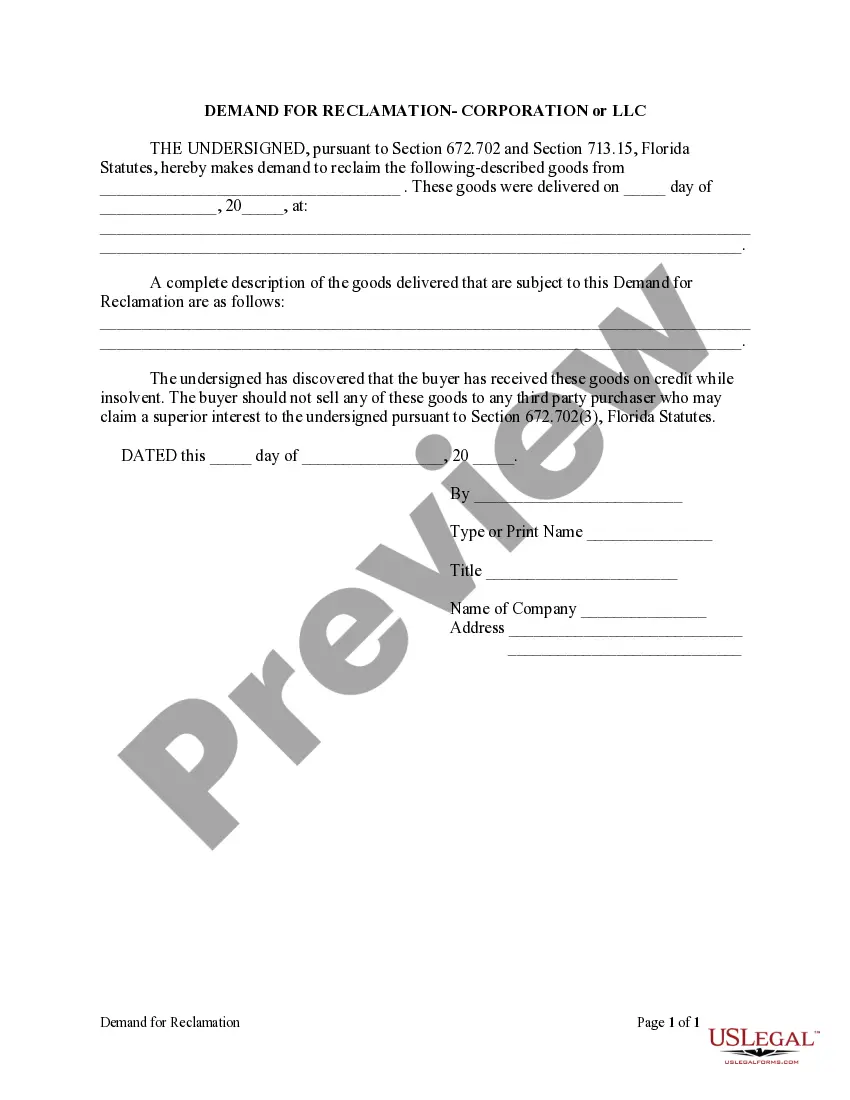
The Demand for Reclamation Form allows a corporation or LLC to request the return of materials that were delivered but not utilized in a construction project. This form is essential for ensuring that any goods delivered on credit are reclaimed, particularly when the buyer is insolvent, distinguishing it from other lien-related forms.
Form components explained
- Identification of the buyer and their contact information
- Date of delivery of the goods
- Description of the goods being reclaimed
- Statement of insolvency regarding the buyer
- Signature of the authorized corporate representative
- Title and corporate information including the name and address
When to use this document
This form is used when a corporation or LLC has delivered materials for a construction project but has not received payment for those materials, and the buyer is insolvent. It is crucial in situations where a business needs to reclaim goods to prevent further financial loss and ensure compliance with Florida statutes.
Who can use this document
- Corporations and LLCs involved in construction projects
- Business owners looking to reclaim delivered materials
- Legal representatives of corporations handling reclamation of goods
How to prepare this document
- Identify the buyer's name and contact information at the top of the form.
- Specify the date the goods were delivered.
- Provide a detailed description of the goods being reclaimed.
- Indicate the insolvency of the buyer reinforcing the reclamation claim.
- Ensure the authorized representative signs and includes their title and corporation name.
- Complete the corporation's address for official records.
Does this document require notarization?
This form does not typically require notarization to be legally valid. However, some jurisdictions or document types may still require it. US Legal Forms provides secure online notarization powered by Notarize, available 24/7 for added convenience.
Get your form ready online
Our built-in tools help you complete, sign, share, and store your documents in one place.
Make edits, fill in missing information, and update formatting in US Legal Forms—just like you would in MS Word.
Download a copy, print it, send it by email, or mail it via USPS—whatever works best for your next step.
Sign and collect signatures with our SignNow integration. Send to multiple recipients, set reminders, and more. Go Premium to unlock E-Sign.
If this form requires notarization, complete it online through a secure video call—no need to meet a notary in person or wait for an appointment.
We protect your documents and personal data by following strict security and privacy standards.

Make edits, fill in missing information, and update formatting in US Legal Forms—just like you would in MS Word.

Download a copy, print it, send it by email, or mail it via USPS—whatever works best for your next step.

Sign and collect signatures with our SignNow integration. Send to multiple recipients, set reminders, and more. Go Premium to unlock E-Sign.

If this form requires notarization, complete it online through a secure video call—no need to meet a notary in person or wait for an appointment.

We protect your documents and personal data by following strict security and privacy standards.
Common mistakes to avoid
- Failing to accurately describe the goods being reclaimed.
- Not completing the buyer's contact information.
- Omitting the date of delivery.
- Not having the appropriate corporate representative sign the form.
Benefits of using this form online
- Convenient access and ability to download immediately.
- Edit the form as needed before printing or submission.
- Reliable templates drafted by licensed attorneys for accuracy.
- Streamlined process to manage legal documents effectively.
Looking for another form?
Form popularity
FAQ
You can file a lien in Florida even without a signed contract, but proving your case may become more challenging. Demonstrating the work conducted and the agreed-upon terms is vital. The Florida Demand For Reclamation Form - Construction - Mechanic Liens - Corporation or LLC helps organize your claim effectively. For support and resources, explore what USLegalForms offers.
The construction lien law in Florida allows contractors, subcontractors, and suppliers to claim a property if they remain unpaid for their services or materials. This law ensures that individuals who contribute to a construction project can protect their financial interests. To navigate this complex area, the Florida Demand For Reclamation Form - Construction - Mechanic Liens - Corporation or LLC is essential. Consider utilizing resources from USLegalForms for clarity and compliance.
Yes, a contractor can file a lien in Florida without a contract, but it may complicate the claims process. If the contractor has provided services or materials to a property and has not been compensated, they still have the right to seek payment through a lien. Utilizing the Florida Demand For Reclamation Form - Construction - Mechanic Liens - Corporation or LLC will aid in creating a strong claim. USLegalForms can assist you with templates and guidance.
In Florida, you can file a lien without a formal contract if the work performed derives from your relationship with the property owner. However, having a written agreement can enhance your claim's validity. Using the Florida Demand For Reclamation Form - Construction - Mechanic Liens - Corporation or LLC can provide a framework for your lien regardless of a contract. For templates and support, check out USLegalForms.
Yes, a mechanics lien can lead to foreclosure in Florida if the lien remains unpaid. When you file a lien against a property, you establish a legal claim that can ultimately compel a sale to recover owed amounts. However, it is essential to adhere to Florida's regulations regarding mechanics liens. For guidance, consider using the Florida Demand For Reclamation Form - Construction - Mechanic Liens - Corporation or LLC through USLegalForms.
Filing a lien in Florida requires you to provide specific elements, including a notice of lien and the amount owed. You need to file this paperwork in the clerk's office of the county where the property is located. It is crucial to use the Florida Demand For Reclamation Form - Construction - Mechanic Liens - Corporation or LLC to ensure all legal requirements are met. Resources from USLegalForms can guide you through this process effectively.
To file a mechanics lien in Florida, you need to gather key information about your claim. This includes the property owner's details, a description of the work performed, and any unpaid amounts. You must complete the Florida Demand For Reclamation Form - Construction - Mechanic Liens - Corporation or LLC accurately to initiate the process. Utilizing a platform like USLegalForms can help streamline the documentation.
Removing a lien without a lawyer in Florida starts by understanding the lien's basis and seeking a lien release. You may be able to negotiate directly with the lien holder or file a self-prepared notice of contest. Utilizing resources like uslegalforms can help simplify this process by providing necessary forms and guidance.
In Florida, a mechanic's lien generally lasts for one year from the date of recording. However, this period can extend if legal action is initiated before the one-year mark. It is crucial to keep track of these timelines to take appropriate actions regarding the Florida Demand For Reclamation Form - Construction - Mechanic Liens - Corporation or LLC.
To dispute a mechanic's lien in Florida, you should first review the specifics of the lien to determine any inaccuracies. You can draft a formal notice of contest and file it with the clerk of court. Additionally, you can opt for mediation or file a lawsuit, if necessary, to resolve the dispute.