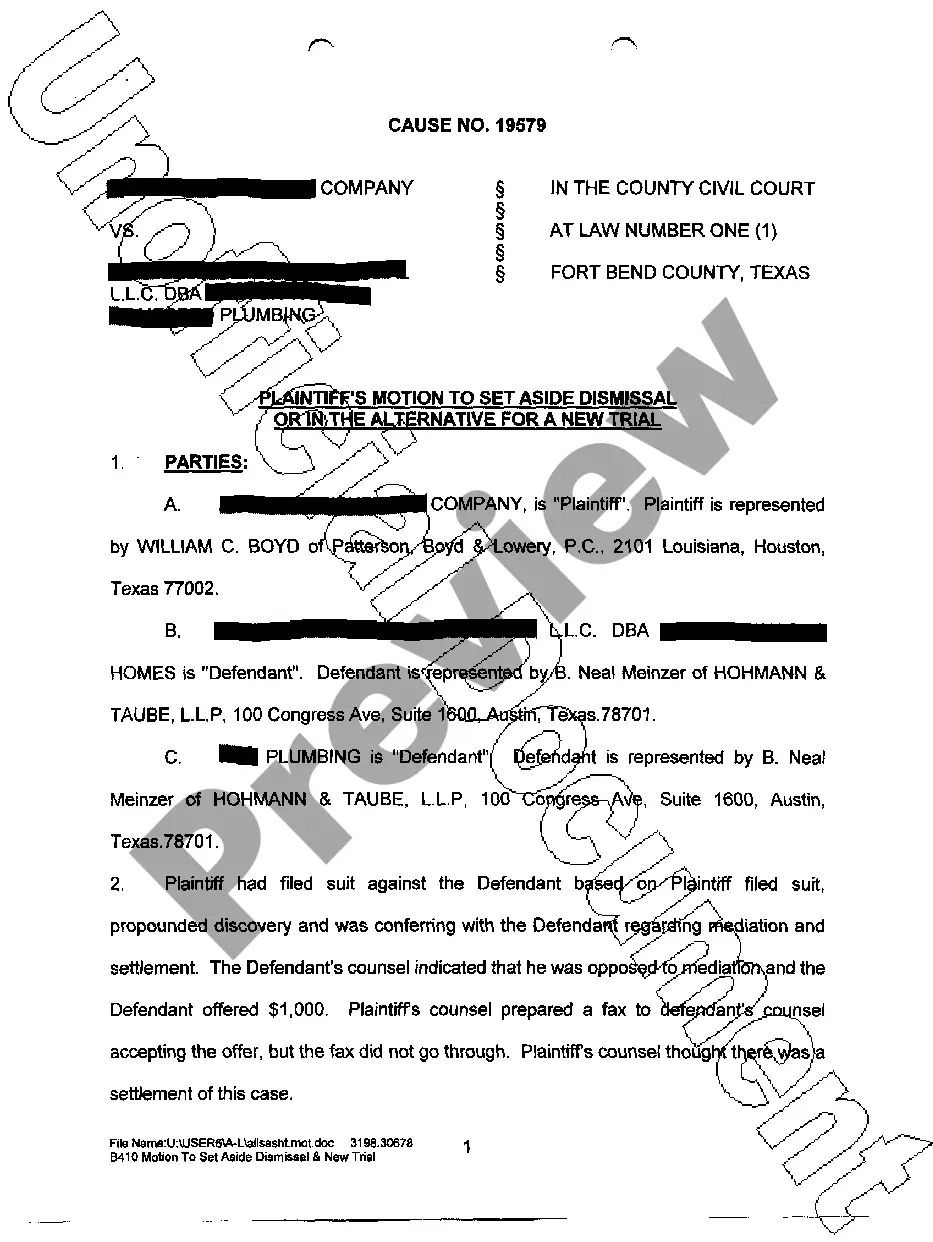
Florida Joinder In Certificate Of Payment Form - Construction - Mechanic Liens - Individual
About this form
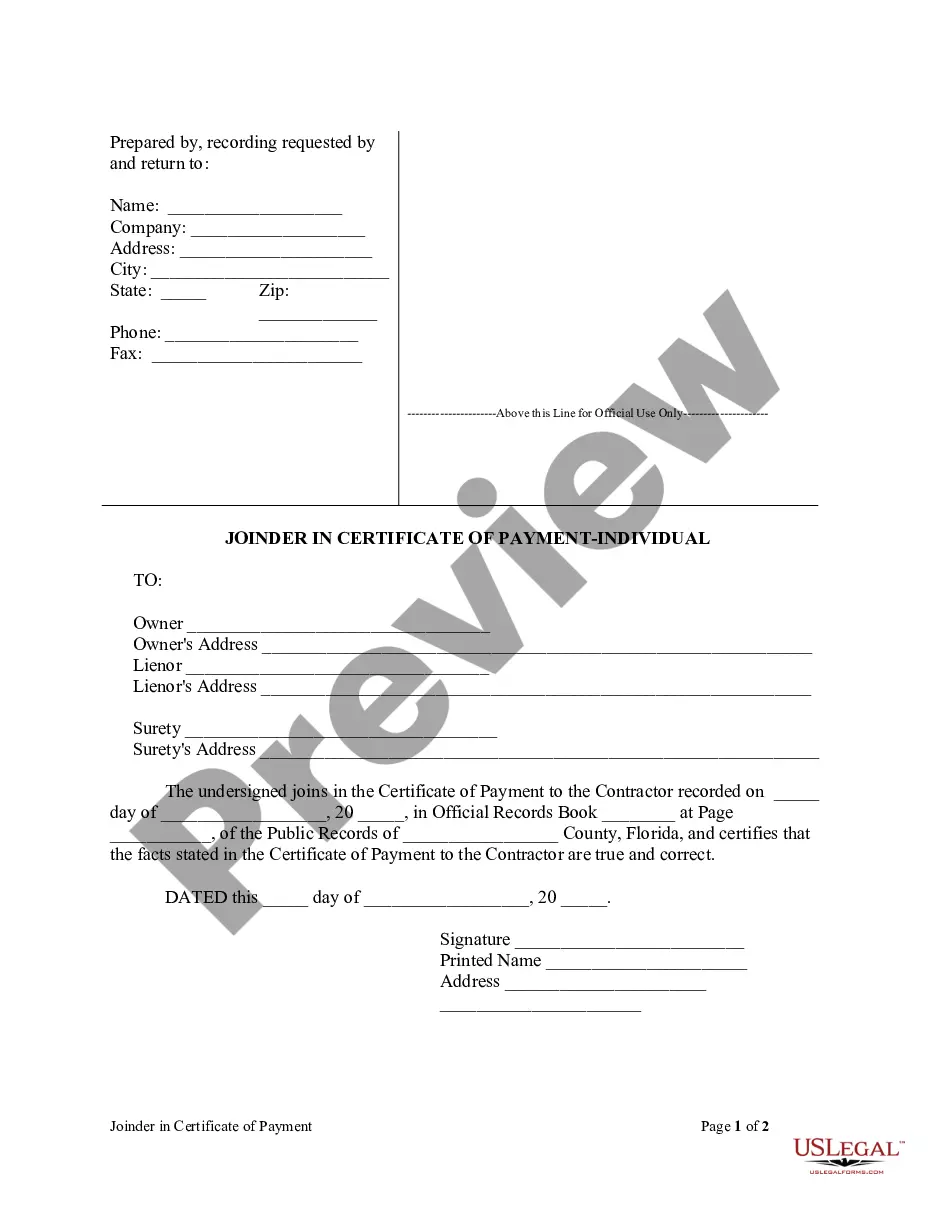
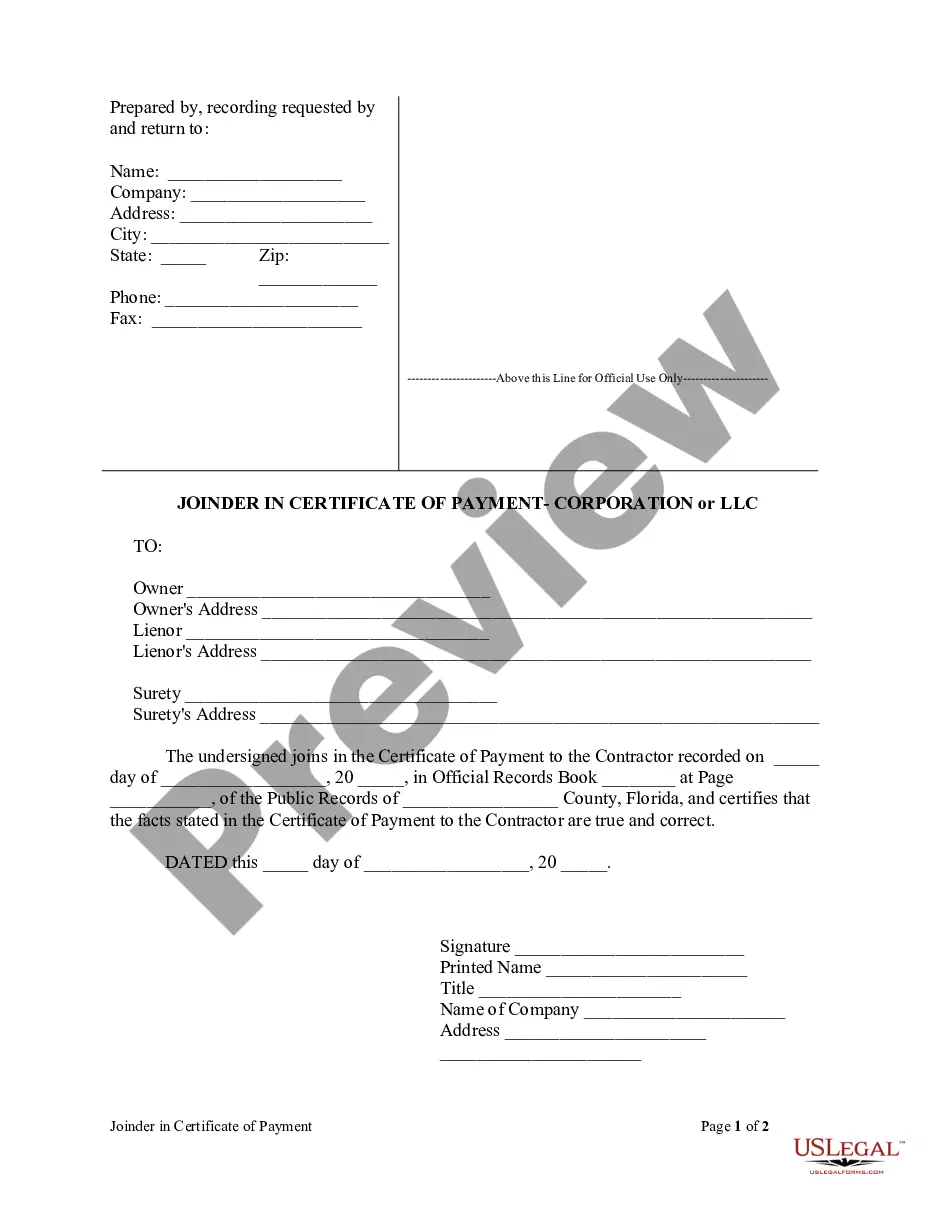
The Joinder In Certificate Of Payment form is a legal document used in construction contexts when an individual acknowledges a payment related to mechanic liens. This form certifies that the information in the Certificate of Payment to the contractor is correct and is an essential part of the lien process, ensuring that all parties, such as the owner, surety, and lienor, are informed of the transaction. Unlike similar documents, this form specifically includes a notarization requirement, which adds a layer of authenticity and legal standing.
Main sections of this form
- Prepared by and returned to specific individuals or entities.
- Identification of the Owner, Lienor, and Surety with their contact details.
- Details of the payment made to the contractor, including date and official recording information.
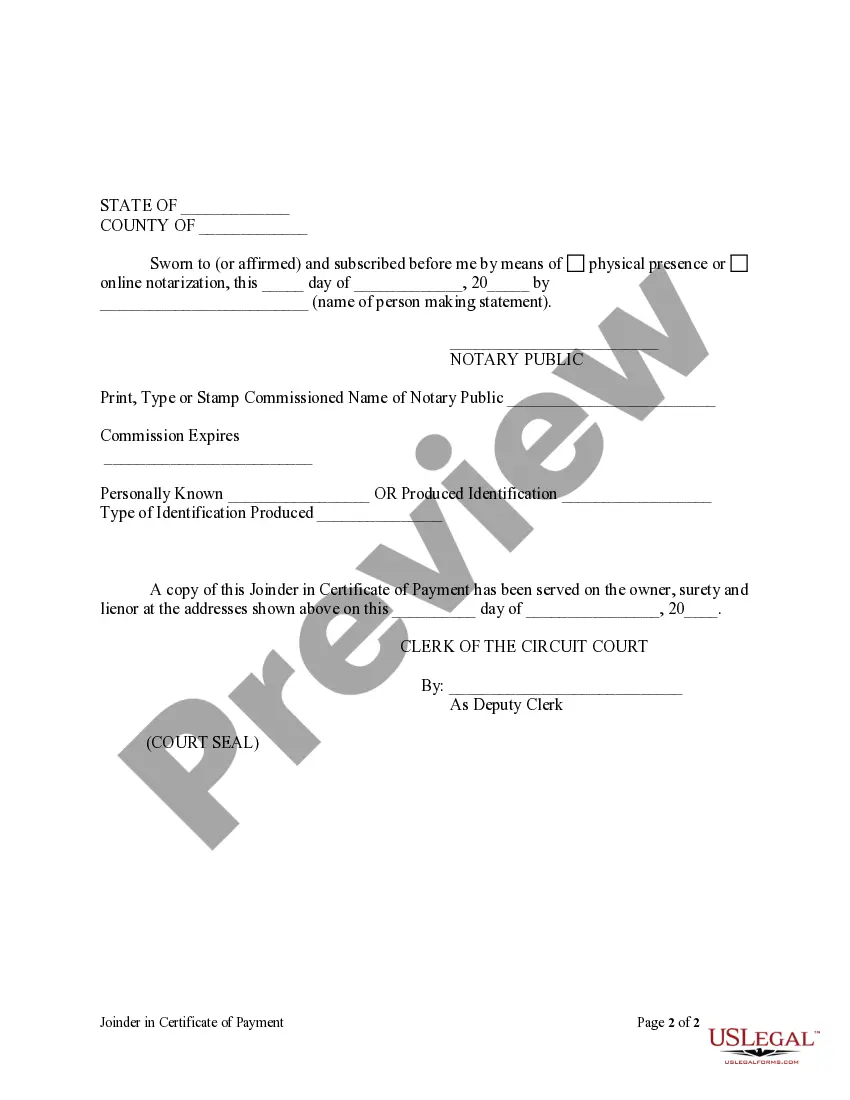
- Certification of the truthfulness of the statement, requiring notarization.
- Signature, printed name, and address of the individual completing the form.
- Notification of service to the owner, surety, and lienor.
When to use this form
Who this form is for
- Individuals who have made a payment to a contractor for construction work.
- Owners of properties engaged in construction projects.
- Sureties involved in the payment process.
- Any lienor requiring formal acknowledgment of payment.
How to prepare this document
- Identify the parties involved, including the Owner, Lienor, and Surety, and fill in their details accurately.
- Enter the date of the recorded Certificate of Payment and the corresponding official book and page number.
- Certify the truth of the information by signing the form in front of a Notary Public.
- Provide your printed name and address following the signature.
- Confirm that copies of the form have been served to all parties listed in the document.
Notarization requirements for this form
This form must be notarized to be legally valid. US Legal Forms provides secure online notarization powered by Notarize, allowing you to complete the process through a verified video call.
Get your form ready online
Our built-in tools help you complete, sign, share, and store your documents in one place.
Make edits, fill in missing information, and update formatting in US Legal Forms—just like you would in MS Word.
Download a copy, print it, send it by email, or mail it via USPS—whatever works best for your next step.
Sign and collect signatures with our SignNow integration. Send to multiple recipients, set reminders, and more. Go Premium to unlock E-Sign.
If this form requires notarization, complete it online through a secure video call—no need to meet a notary in person or wait for an appointment.
We protect your documents and personal data by following strict security and privacy standards.

Make edits, fill in missing information, and update formatting in US Legal Forms—just like you would in MS Word.

Download a copy, print it, send it by email, or mail it via USPS—whatever works best for your next step.

Sign and collect signatures with our SignNow integration. Send to multiple recipients, set reminders, and more. Go Premium to unlock E-Sign.

If this form requires notarization, complete it online through a secure video call—no need to meet a notary in person or wait for an appointment.

We protect your documents and personal data by following strict security and privacy standards.
Common mistakes
- Failing to provide complete and accurate addresses for all parties involved.
- Not providing the required notarization, which may invalidate the document.
- Leaving out the date or other critical information regarding the original Certificate of Payment.
- Not serving copies of the document to the owner, surety, and lienor.
Benefits of completing this form online
- Convenient access to a legally vetted form created by licensed attorneys.
- Editable format allowing you to easily customize the document for your needs.
- Instant download capabilities to get your form immediately, saving time.
- Secure and reliable, ensuring your sensitive information is protected.
Looking for another form?
Form popularity
FAQ
Typically, individuals or entities that did not contribute labor or materials directly to the property improvement cannot file a mechanic's lien. For example, suppliers who did not supply materials to the specific project may be excluded. Understanding the specifics surrounding the Florida Joinder In Certificate Of Payment Form - Construction - Mechanic Liens - Individual can help clarify who qualifies to file a lien.
In Florida, contractors generally need a written contract to file a lien; however, exceptions may apply under certain conditions. If a contractor can demonstrate they provided work or materials, they may still have a claim. To navigate these complexities, referring to the Florida Joinder In Certificate Of Payment Form - Construction - Mechanic Liens - Individual can help clarify the documentation needed.
In Florida, a mechanic's lien allows contractors, subcontractors, and suppliers to claim payment for work performed or materials supplied. Once recorded, the lien can be enforced through legal action if payment is not received. The Florida Joinder In Certificate Of Payment Form - Construction - Mechanic Liens - Individual is a crucial document that aids in this process by detailing all necessary information.
To record a mechanic's lien in Florida, you must file the lien with the county clerk in the county where the property is located. The lien must include specific details about the work done and the amount owed. Utilizing the Florida Joinder In Certificate Of Payment Form - Construction - Mechanic Liens - Individual can streamline this process and ensure proper filing.
Yes, a handyman can file a lien in Florida if they have provided labor or materials for a construction project. However, certain conditions must be met, such as having a written contract or an agreement that specifies the work done. The Florida Joinder In Certificate Of Payment Form - Construction - Mechanic Liens - Individual may be useful for handymen to assert their rights effectively.
The statute governing mechanic liens in Florida is primarily found in Chapter 713 of the Florida Statutes. It establishes the rights of those who provide labor or materials for the improvement of property. To ensure protection, it is crucial to understand how the Florida Joinder In Certificate Of Payment Form - Construction - Mechanic Liens - Individual operates within this framework.
In certain situations, someone can place a lien on your property without a contract in Florida, especially if services were provided under the belief that payment would be made. This can create complications, so it’s essential to understand your rights and protections. Utilizing the Florida Joinder In Certificate Of Payment Form - Construction - Mechanic Liens - Individual can help clarify your position and assist in addressing any potential liens.
A handyman can file a mechanic's lien in Florida, provided they meet the state's requirements for lien rights. This usually means they have performed work that merits payment, regardless of the contract's formalities. Employing the Florida Joinder In Certificate Of Payment Form - Construction - Mechanic Liens - Individual can assist in properly documenting the work done.
Yes, a contractor can generally file a lien without notifying the owner first, but it's essential to follow specific guidelines. However, if the contractor is not a direct contractor or has not provided prior notice, this may affect the ability to enforce the lien. Utilizing the Florida Joinder In Certificate Of Payment Form - Construction - Mechanic Liens - Individual helps clarify your legal standing and strengthens your case.
To place a lien on a house for unpaid work in Florida, you must file a notice of lien with the county clerk in the county where the property is located. You need to complete the Florida Joinder In Certificate Of Payment Form - Construction - Mechanic Liens - Individual to support your claim and provide details of the work performed. Ensure you adhere to all deadlines to maintain your lien rights.