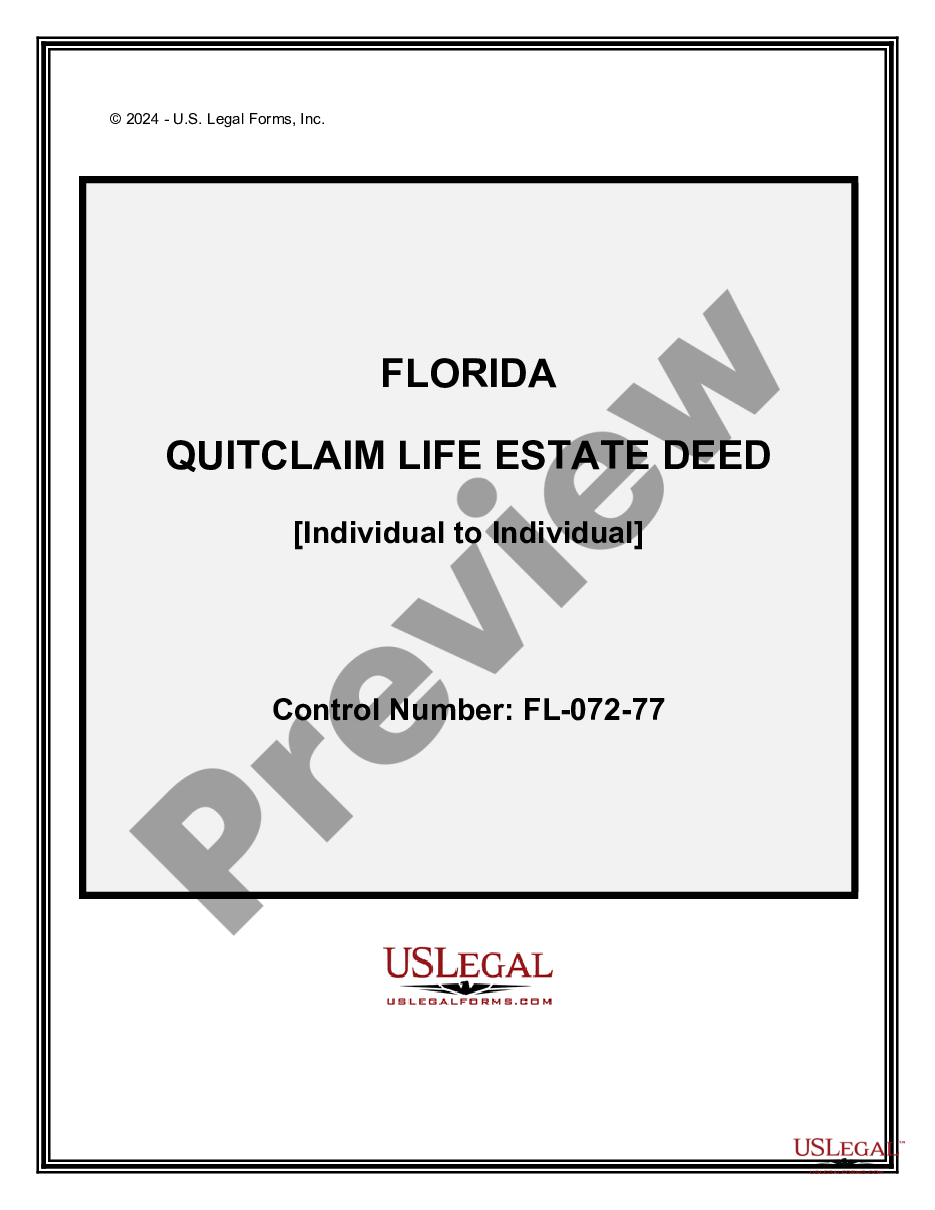
Florida Quitclaim Deed - Individual to Individual with Reserved Life Estate
Overview of this form
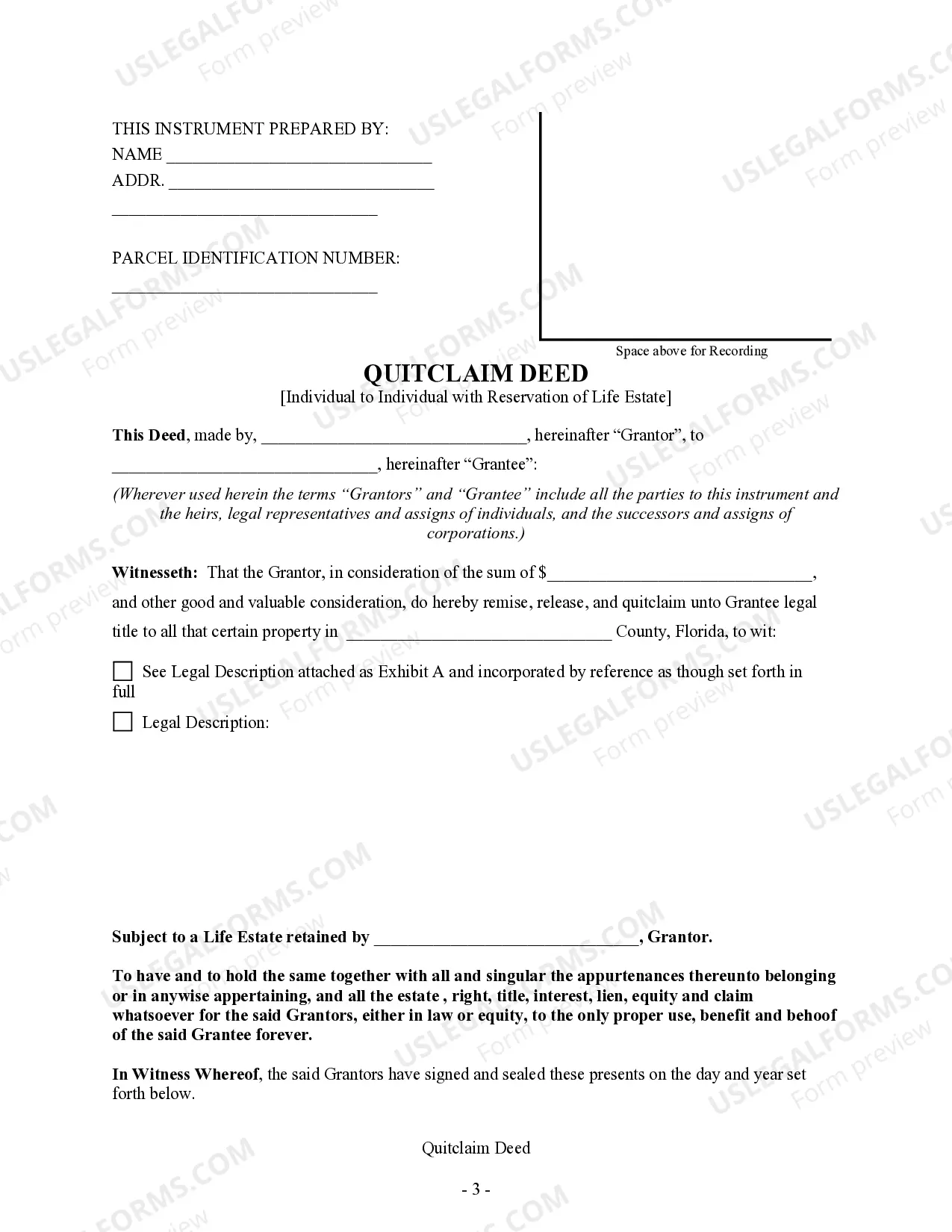
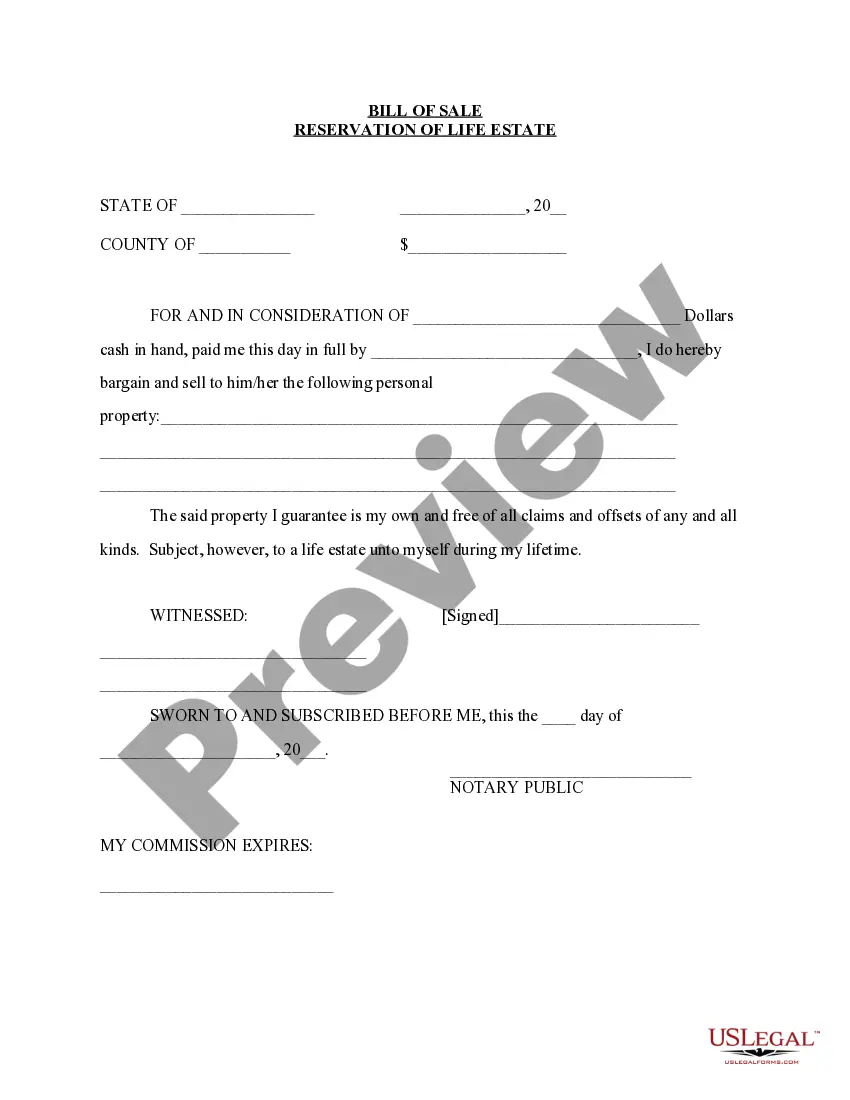
A Quitclaim Deed - Individual to Individual with Reserved Life Estate is a legal document that facilitates the transfer of property rights from one individual (the grantor) to another individual (the grantee). Unlike other types of deeds, a quitclaim deed does not guarantee that the grantor has clear title to the property; it simply releases any interest the grantor may have in the property. This specific form includes a reserved life estate, allowing the grantor to retain ownership rights to use the property during their lifetime, while transferring future interest to the grantee.
Main sections of this form
- Grantor and grantee identification
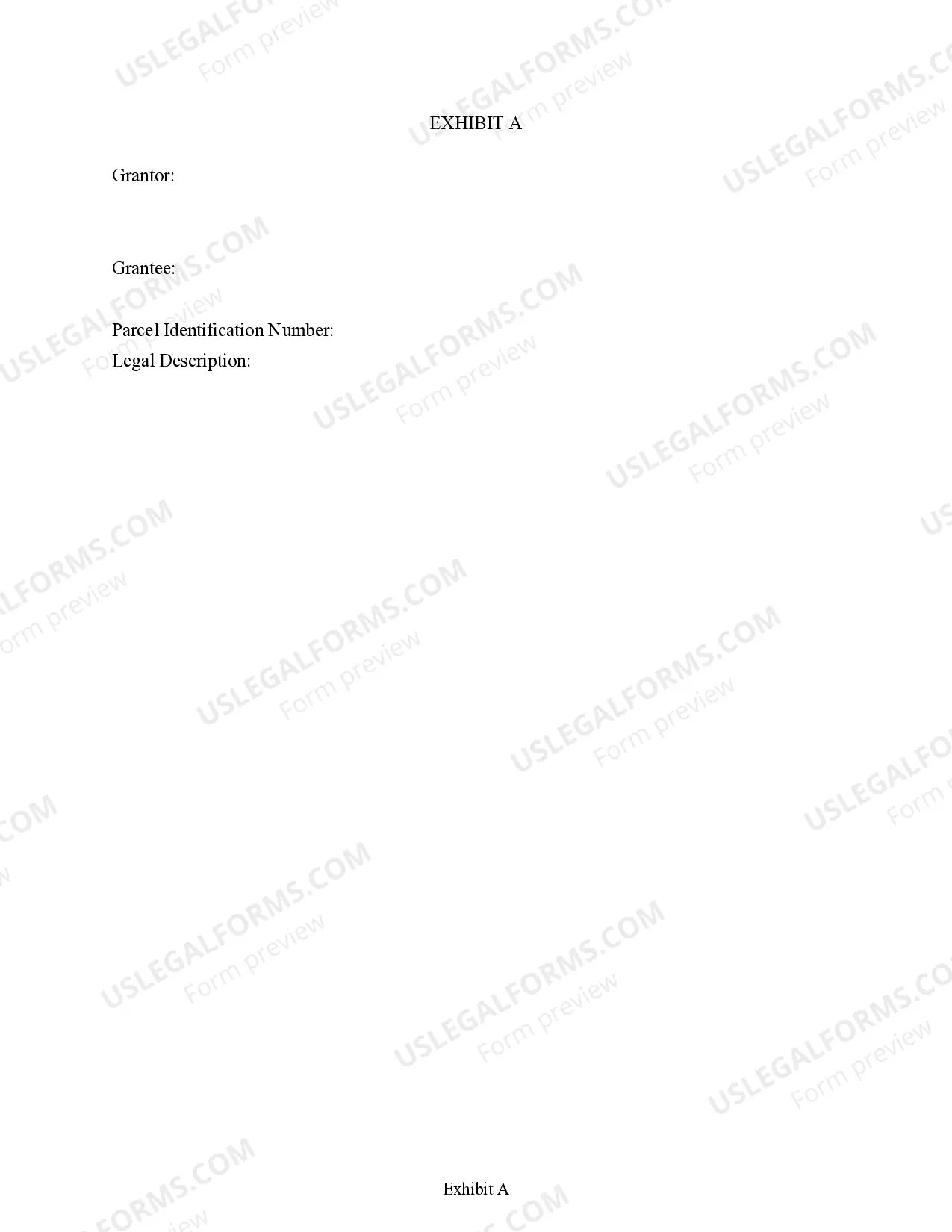
- Description of the property being conveyed
- Reservation of life estate clause
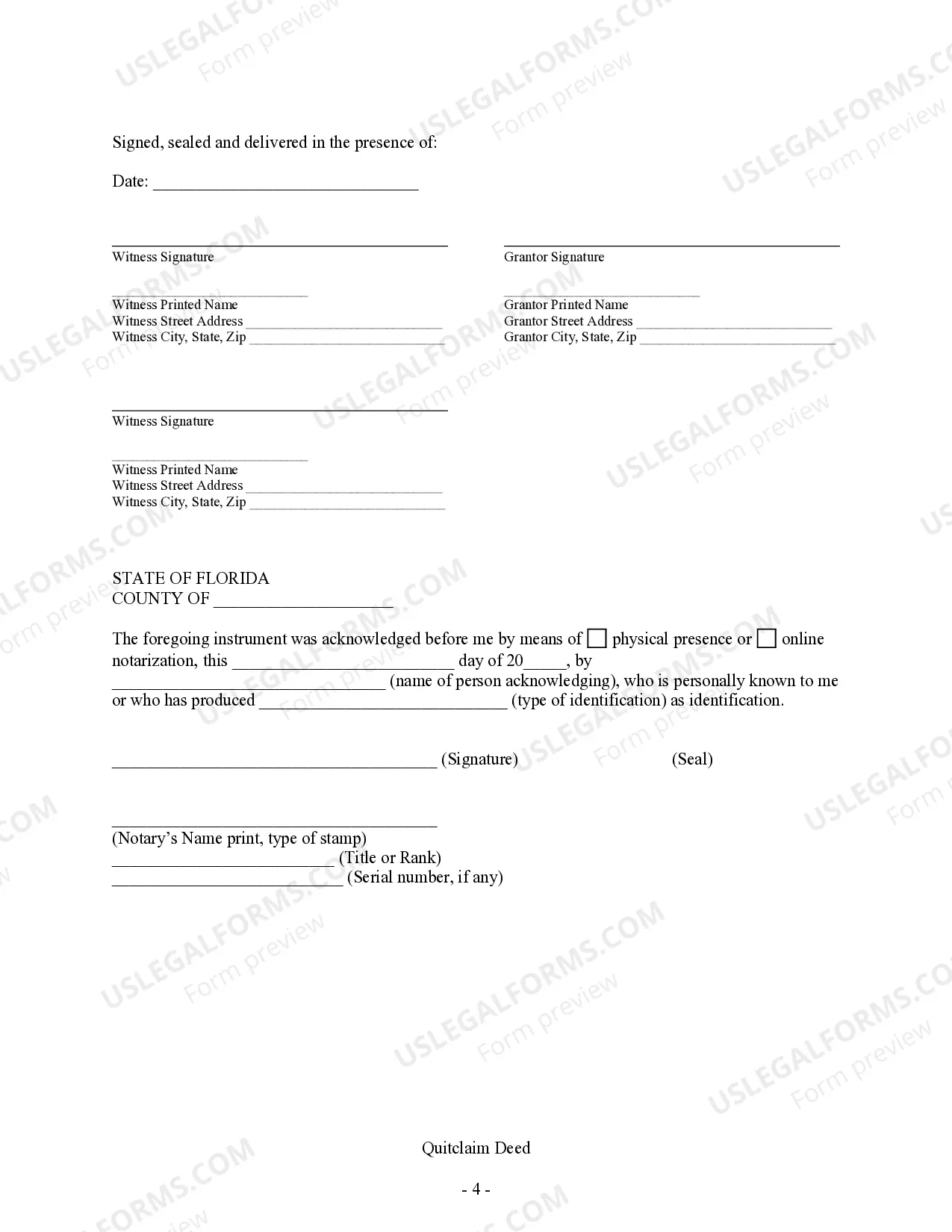
- Signatures of the grantor and witnesses
- Notary acknowledgment section

When to use this form
This form is appropriate when an individual wishes to transfer property ownership to another individual while retaining the right to live on or use the property throughout their lifetime. Common scenarios include transferring property to a family member or friend while ensuring the original owner has continual access to the property until their death.
Who can use this document
This form is intended for:
- Individuals wishing to transfer property ownership
- People retaining a life estate in the conveyed property
- Family members or close friends involved in property transfers
- Individuals seeking a simple and quick method for property transfer without extensive legal processes
How to complete this form
- Identify the parties: Clearly state the name of the grantor and the grantee.
- Specify the property: Provide a legal description of the property being transferred.
- Include the reservation of life estate: Detail the rights retained by the grantor.
- Gather signatures: The grantor must sign the deed in the presence of witnesses.
- Notarize the document: Depending on local regulations, complete the notary acknowledgment section.
Is notarization required?
This form needs to be notarized to ensure legal validity. US Legal Forms provides secure online notarization powered by Notarize, allowing you to complete the process through a verified video call, available anytime.
Get your form ready online
Our built-in tools help you complete, sign, share, and store your documents in one place.
Make edits, fill in missing information, and update formatting in US Legal Forms—just like you would in MS Word.
Download a copy, print it, send it by email, or mail it via USPS—whatever works best for your next step.
Sign and collect signatures with our SignNow integration. Send to multiple recipients, set reminders, and more. Go Premium to unlock E-Sign.
If this form requires notarization, complete it online through a secure video call—no need to meet a notary in person or wait for an appointment.
We protect your documents and personal data by following strict security and privacy standards.

Make edits, fill in missing information, and update formatting in US Legal Forms—just like you would in MS Word.

Download a copy, print it, send it by email, or mail it via USPS—whatever works best for your next step.

Sign and collect signatures with our SignNow integration. Send to multiple recipients, set reminders, and more. Go Premium to unlock E-Sign.

If this form requires notarization, complete it online through a secure video call—no need to meet a notary in person or wait for an appointment.

We protect your documents and personal data by following strict security and privacy standards.
Avoid these common issues
- Failing to include a proper legal description of the property.
- Not signing the document in front of required witnesses.
- Omitting the reservation of life estate clause, if applicable.
- Forgetting to notarize the deed, if required by local laws.
Benefits of completing this form online
- Convenient access to the form at any time.
- Editable fields allow for easy completion.
- Reliable templates drafted by licensed attorneys.
- Option to download and print for personal use.
Main things to remember
- A quitclaim deed transfers property without guarantees about the title.
- This specific form allows the grantor to retain use of the property during their lifetime.
- Proper completion includes clear identification of all parties and a detailed property description.
- Notarization is generally required for legal validity.
Looking for another form?

Form popularity
FAQ
To remove someone from a life estate, you need to execute a new Florida Quitclaim Deed - Individual to Individual with Reserved Life Estate. This deed will transfer ownership rights from the current life tenant to another party, effectively removing their interest. It may be wise to get legal advice to navigate this process correctly. After executing the deed, ensure it is filed with the appropriate county office to complete the removal.
No, a will typically cannot override a life estate deed. The life estate deed creates a legal interest that remains active despite the terms in a will. However, it can be useful to consult a legal expert to discuss how your will interacts with existing deeds. This way, you can ensure your estate plans align with your wishes regarding the Florida Quitclaim Deed - Individual to Individual with Reserved Life Estate.
To reverse a life estate deed, you must create a new Florida Quitclaim Deed - Individual to Individual with Reserved Life Estate. This process typically involves the current life tenant transferring their interest back to the original grantor or a new party. You should also consider consulting a qualified attorney to ensure all legal requirements are met. Once completed, file the new deed with the county clerk to make the change official.
To transfer a life estate deed, you generally need to complete a Florida Quitclaim Deed - Individual to Individual with Reserved Life Estate that clearly defines the terms. This document should outline the granting of the life estate and the names of the involved parties. Consultation with a legal professional can streamline the process and ensure compliance with Florida laws.
You can convey a life estate to someone else, but this typically requires a formal agreement and proper documentation. The original life tenant must consent to the new arrangement, ensuring that the remainderman is also informed. Using a Florida Quitclaim Deed - Individual to Individual with Reserved Life Estate can help facilitate this conveyance effectively.
When someone dies in Florida, transferring the house deed usually involves probate, unless the deceased holder had a surviving spouse or a designated beneficiary. If the property was held in a life estate, the remainderman automatically gains full ownership. For easy navigation of these legal processes, consider using a Florida Quitclaim Deed - Individual to Individual with Reserved Life Estate.
A quitclaim deed reserving a life estate enables an individual to transfer their ownership in a property while retaining the right to live in it for the rest of their life. This type of deed is often used to pass property to heirs while retaining control as a life tenant. Utilizing a Florida Quitclaim Deed - Individual to Individual with Reserved Life Estate simplifies this process.
One disadvantage of a life estate deed is that it restricts the life tenant's ability to sell or modify the property without the remainderman's consent. Additionally, it can complicate the distribution of assets upon death. Understanding these implications is essential when considering a Florida Quitclaim Deed - Individual to Individual with Reserved Life Estate.
Transferring a life estate deed usually involves completing a Florida Quitclaim Deed - Individual to Individual with Reserved Life Estate. You need to draft the deed clearly indicating the life estate and the parties involved. Working with a legal professional ensures that all relevant laws are followed for a proper transfer.
You can sell a property with a life estate in Florida; however, it requires the consent of both the life tenant and the remainderman. The life tenant has the right to use the property for their lifetime, but the new buyer must understand this arrangement. Therefore, a Florida Quitclaim Deed - Individual to Individual with Reserved Life Estate can facilitate the transfer while preserving the life estate.