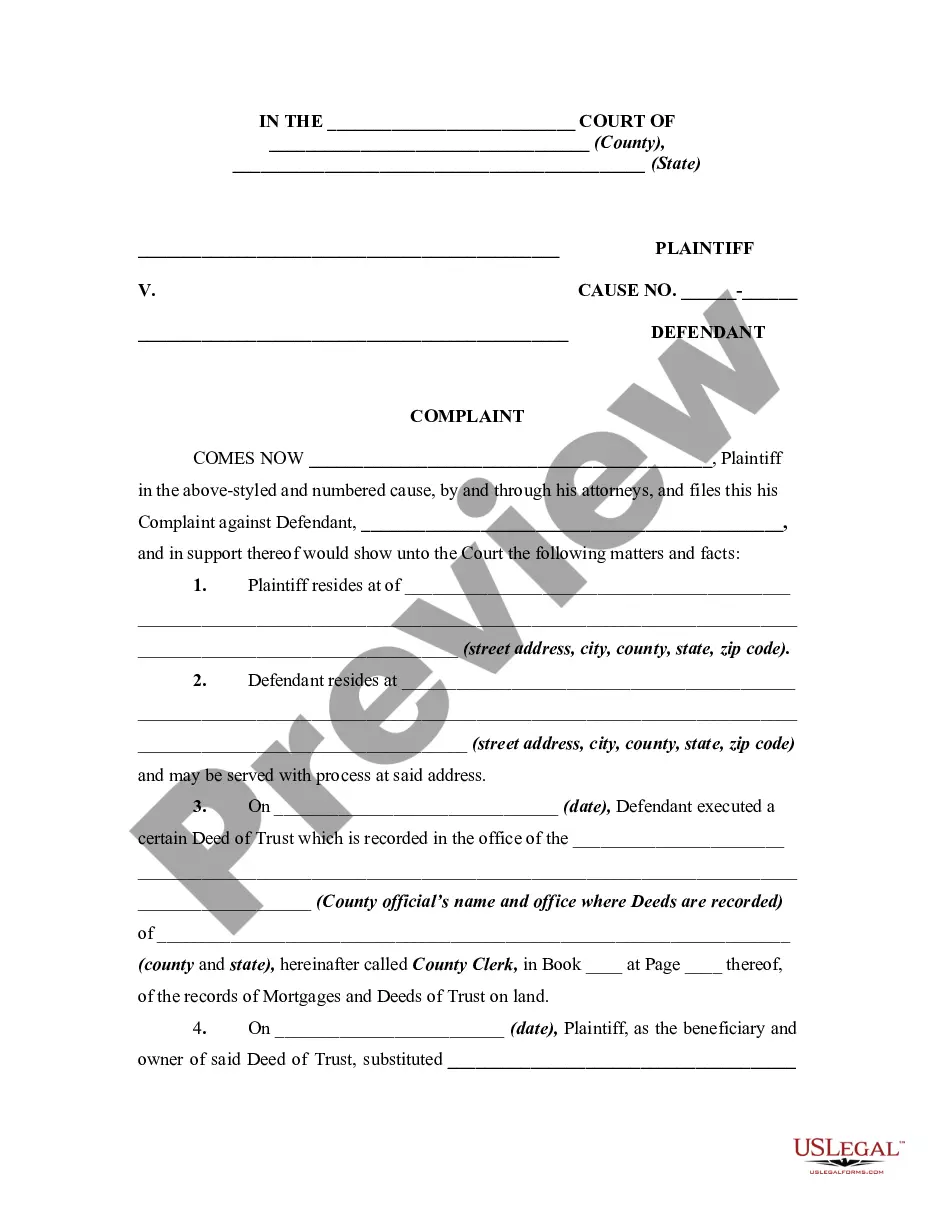
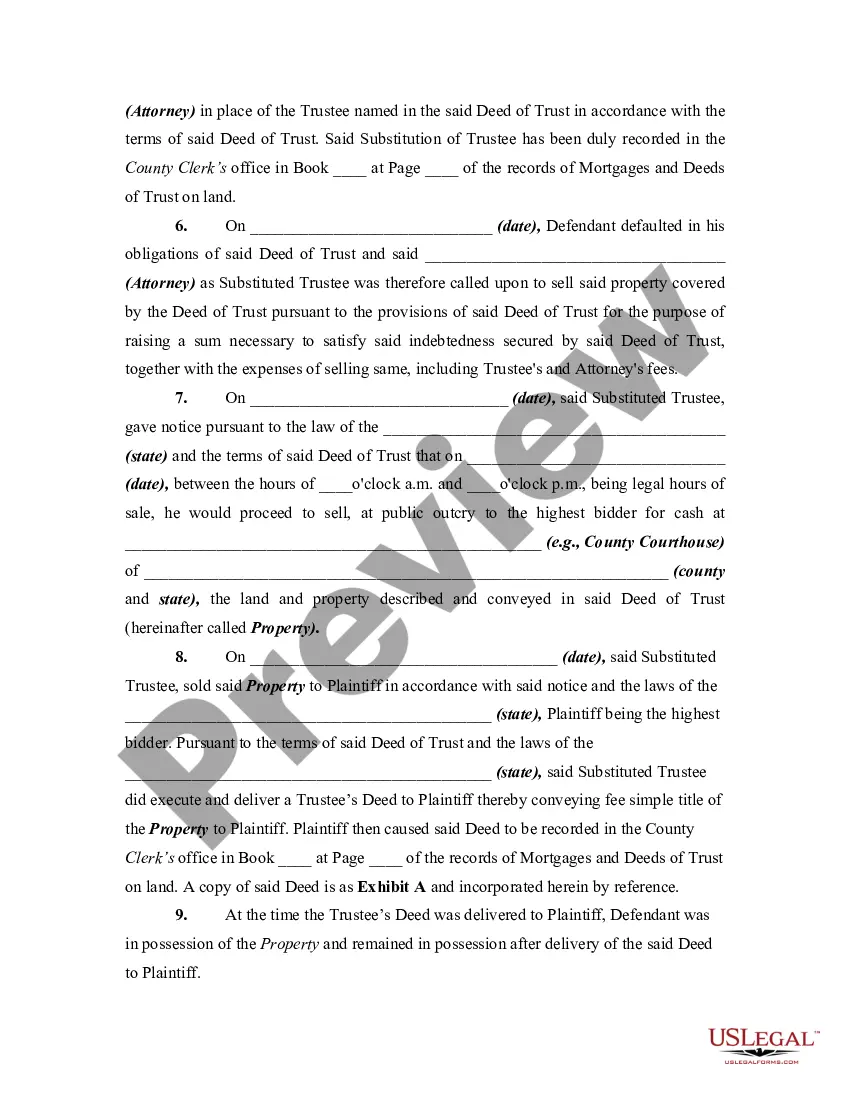
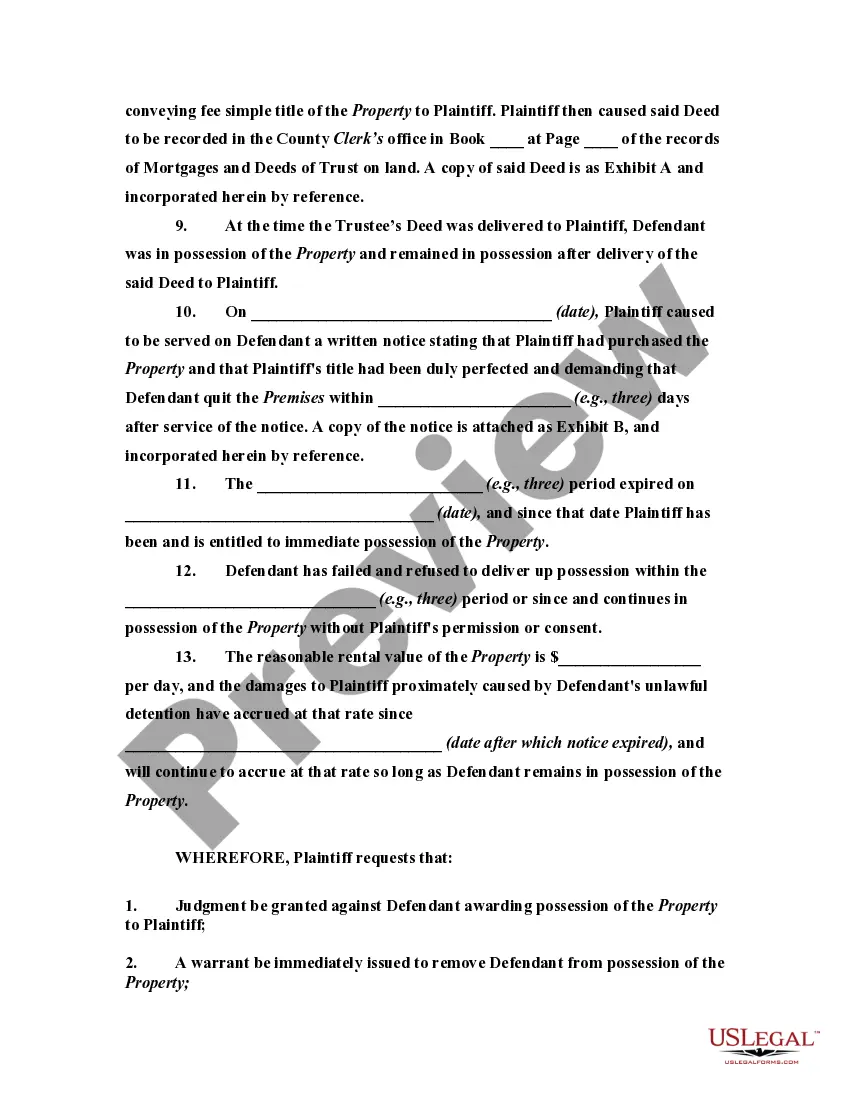
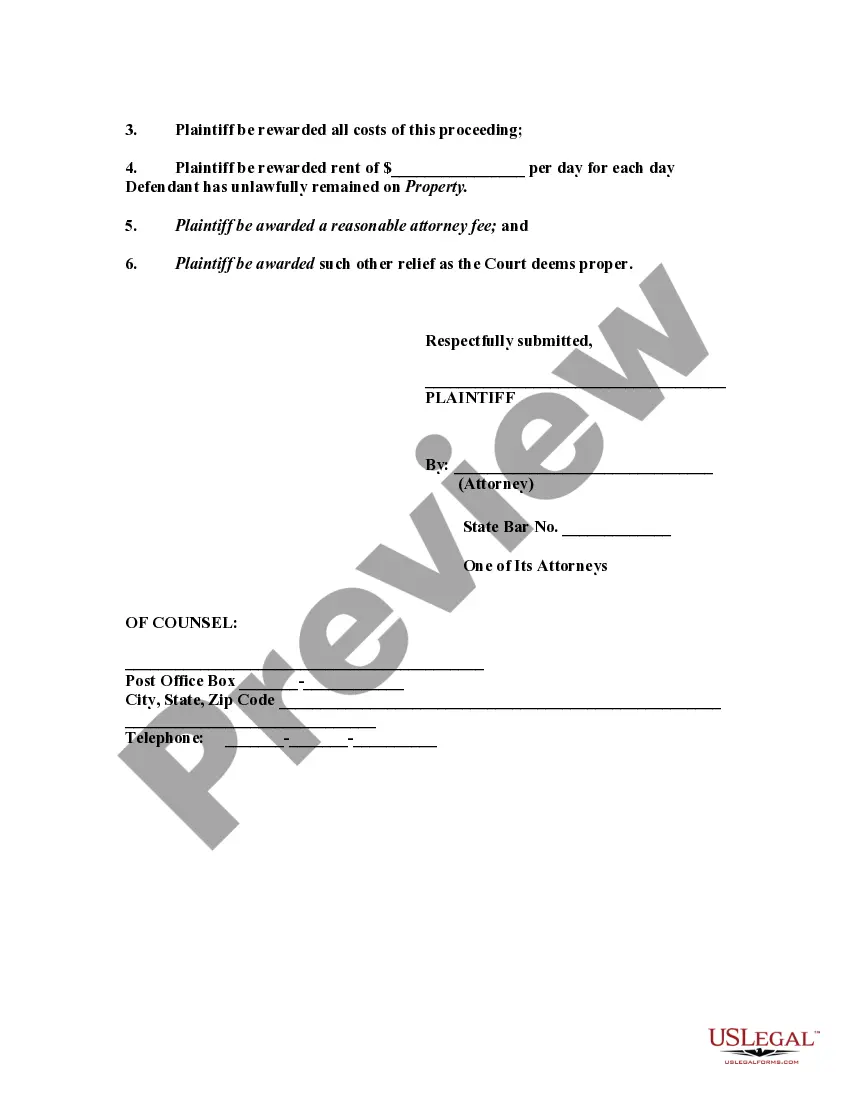
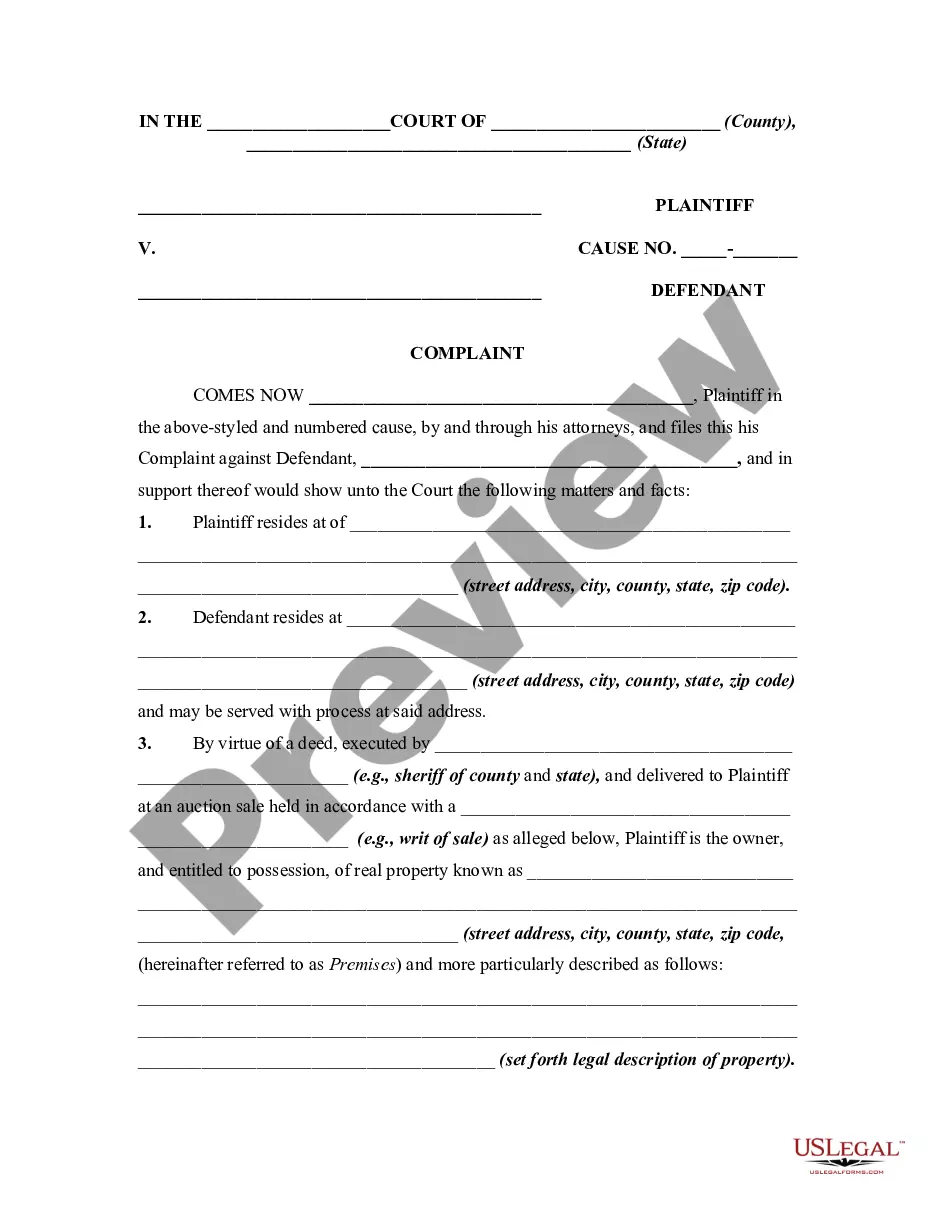
Keeping possession of real property without a right, such as after a lease has expired or after the real property has be sold by the possessor, may entitle the owner to file a lawsuit for "unlawful detainer," asking for possession by court order, unpaid rent and damages. This form is for illustrative purposes only. Local laws should be consulted to determine any specific requirements for such a notice in a particular jurisdiction.
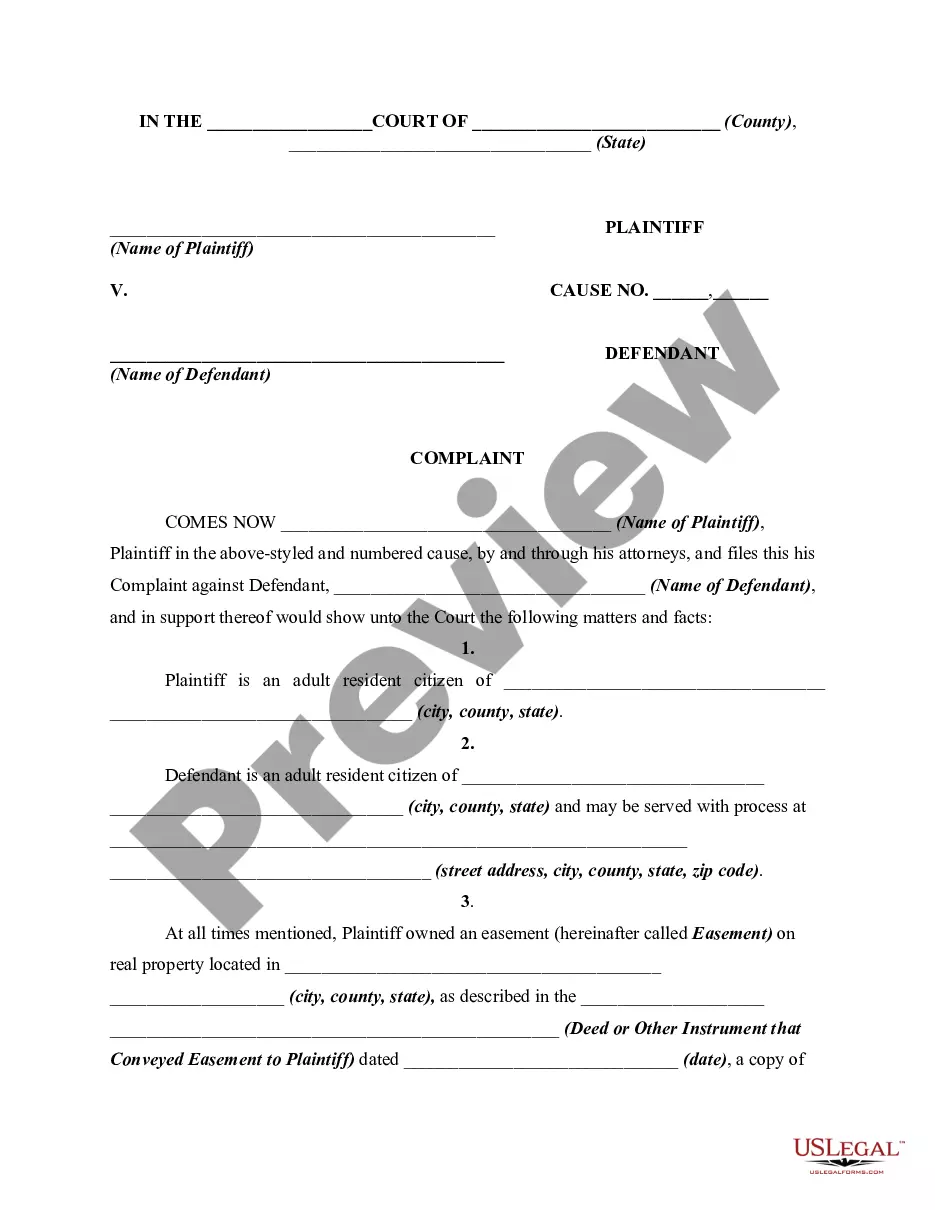
Delaware Complaint or Petition by Purchaser Against Possessor of Real Property After a Foreclosure Sale Pursuant to a Deed of Trust
Category:
State:
Multi-State
Control #:
US-01014BG
Format:
Word;
Rich Text
Instant download
Description
Free preview
Get your form ready online
Our built-in tools help you complete, sign, share, and store your documents in one place.
Built-in online Word editor
Make edits, fill in missing information, and update formatting in US Legal Forms—just like you would in MS Word.
Export easily
Download a copy, print it, send it by email, or mail it via USPS—whatever works best for your next step.
E-sign your document
Sign and collect signatures with our SignNow integration. Send to multiple recipients, set reminders, and more. Go Premium to unlock E-Sign.
Notarize online 24/7
If this form requires notarization, complete it online through a secure video call—no need to meet a notary in person or wait for an appointment.
Store your document securely
We protect your documents and personal data by following strict security and privacy standards.

Make edits, fill in missing information, and update formatting in US Legal Forms—just like you would in MS Word.

Download a copy, print it, send it by email, or mail it via USPS—whatever works best for your next step.

Sign and collect signatures with our SignNow integration. Send to multiple recipients, set reminders, and more. Go Premium to unlock E-Sign.

If this form requires notarization, complete it online through a secure video call—no need to meet a notary in person or wait for an appointment.

We protect your documents and personal data by following strict security and privacy standards.
Looking for another form?

How to fill out Complaint Or Petition By Purchaser Against Possessor Of Real Property After A Foreclosure Sale Pursuant To A Deed Of Trust?
If you require to thorough, obtain, or create legal document templates, utilize US Legal Forms, the largest collection of legal forms, that are accessible online.
Take advantage of the site's straightforward and efficient search to find the documents you require. Numerous templates for business and personal purposes are organized by categories and states, or keywords.
Utilize US Legal Forms to access the Delaware Complaint or Petition by Purchaser Against Possessor of Real Property After a Foreclosure Sale Pursuant to a Deed of Trust with just a few clicks.
Step 5. Complete the payment process. You can use your credit card or PayPal account to finalize the transaction.
Step 6. Choose the format of the legal form and download it onto your device. Step 7. Complete, modify, and print or sign the Delaware Complaint or Petition by Purchaser Against Possessor of Real Property After a Foreclosure Sale Pursuant to a Deed of Trust. Each legal document template you purchase is yours forever. You have access to every form you saved in your account. Click on the My documents section and select a form to print or download again. Stay competitive and obtain, and print the Delaware Complaint or Petition by Purchaser Against Possessor of Real Property After a Foreclosure Sale Pursuant to a Deed of Trust with US Legal Forms. There are numerous professional and state-specific forms you can use for your business or personal requirements.
- If you are currently a US Legal Forms customer, Log In to your account and click the Download option to obtain the Delaware Complaint or Petition by Purchaser Against Possessor of Real Property After a Foreclosure Sale Pursuant to a Deed of Trust.
- You can also access forms you previously saved in the My documents section of your account.
- If you are using US Legal Forms for the first time, follow the steps below.
- Step 1. Ensure you have selected the form for the correct city/state.
- Step 2. Utilize the Review option to browse the form’s details. Don’t forget to check the description.
- Step 3. If you are not satisfied with the form, use the Search field at the top of the screen to find other variations of the legal form template.
- Step 4. Once you have found the form you need, click the Buy now option. Choose the pricing plan you prefer and enter your details to register for an account.
Form popularity
FAQ
Redemption Period After a Foreclosure Sale in Delaware Delaware law, though, doesn't provide a post-sale redemption period. But the borrower has up until the court confirms the foreclosure sale to pay off the full amount of the outstanding debt and keep the home. (Del. Code Ann.
Use a deed in lieu of foreclosure to document an agreement between borrower and lender where the borrower voluntarily gives back a property. A Deed in Lieu of Foreclosure benefits a mortgage borrower because he or she can avoid foreclosure by voluntarily turning the property over to the lender.
Drawbacks Of A Deed In Lieu No guarantee of acceptance: Your lender isn't obligated to accept your deed in lieu of foreclosure. Your credit will still take a hit: While a deed in lieu arrangement won't harm your credit as drastically as a foreclosure, you can still expect your score to drop.
A Deed in Lieu does not clear second (or even third) mortgages, and therefore will not allow the lender to take clear title to the property. (These are sometimes referred to as junior liens.) And if the Deed in Lieu is accepted, the secondary lender may come after you for the deficiency.
A "deed in lieu" is a transaction in which the homeowner voluntarily transfers title to the property to the bank in exchange for releasing the mortgage (or deed of trust) securing the loan. Unlike with a short sale, one benefit to a deed in lieu is that you don't have to take responsibility for selling your house.
There's less negative impact on your credit score. As with any negative event impacting your credit, the higher your score is before the negative impact, the bigger the drop will be. With a deed in lieu of foreclosure, the drop might be anywhere from 50 to 125 points or higher.
Delaware Uniform Common Interest Ownership Act ("DUCIOA"), codified in Chapter 81 of Title 25 of the Delaware Code, governs all common interest communities (planned communities, condominiums, cooperatives, and subdivisions) created after September 30, 2009, unless otherwise exempted.
Any stockholder entitled to appraisal rights may, within 20 days after the date of mailing of such notice, demand in writing from the surviving or resulting corporation the appraisal of such holder's shares.