Delaware Facility Release Agreement - Show Or Clinic - Horse Equine Forms
Understanding this form
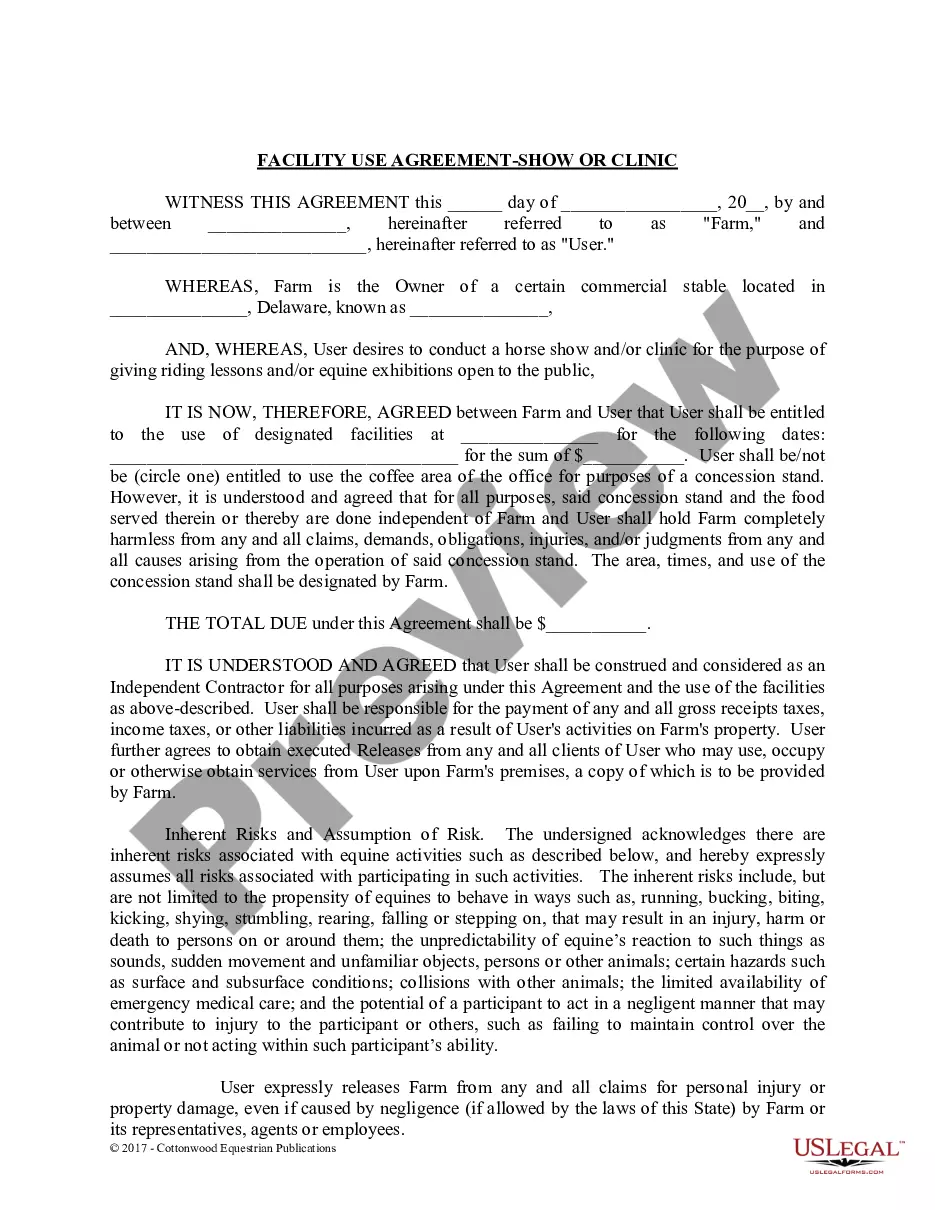
The Facility Release Agreement - Show or Clinic is a specialized legal document designed for equestrians who wish to host a horse show or clinic at a designated facility. This form outlines the terms under which the User can utilize the facility, including provisions for indemnification, acknowledgment of inherent risks, and release of liability. Unlike generic facility use agreements, this form caters specifically to the nuances and risks associated with equine events.
Key parts of this document
- Identification of the parties involved, including the Farm (facility owner) and User (event host).
- Details of the facility, including specific locations at the Farm and the dates of use.
- Provisions for the operation of a concession stand, including liability clauses.
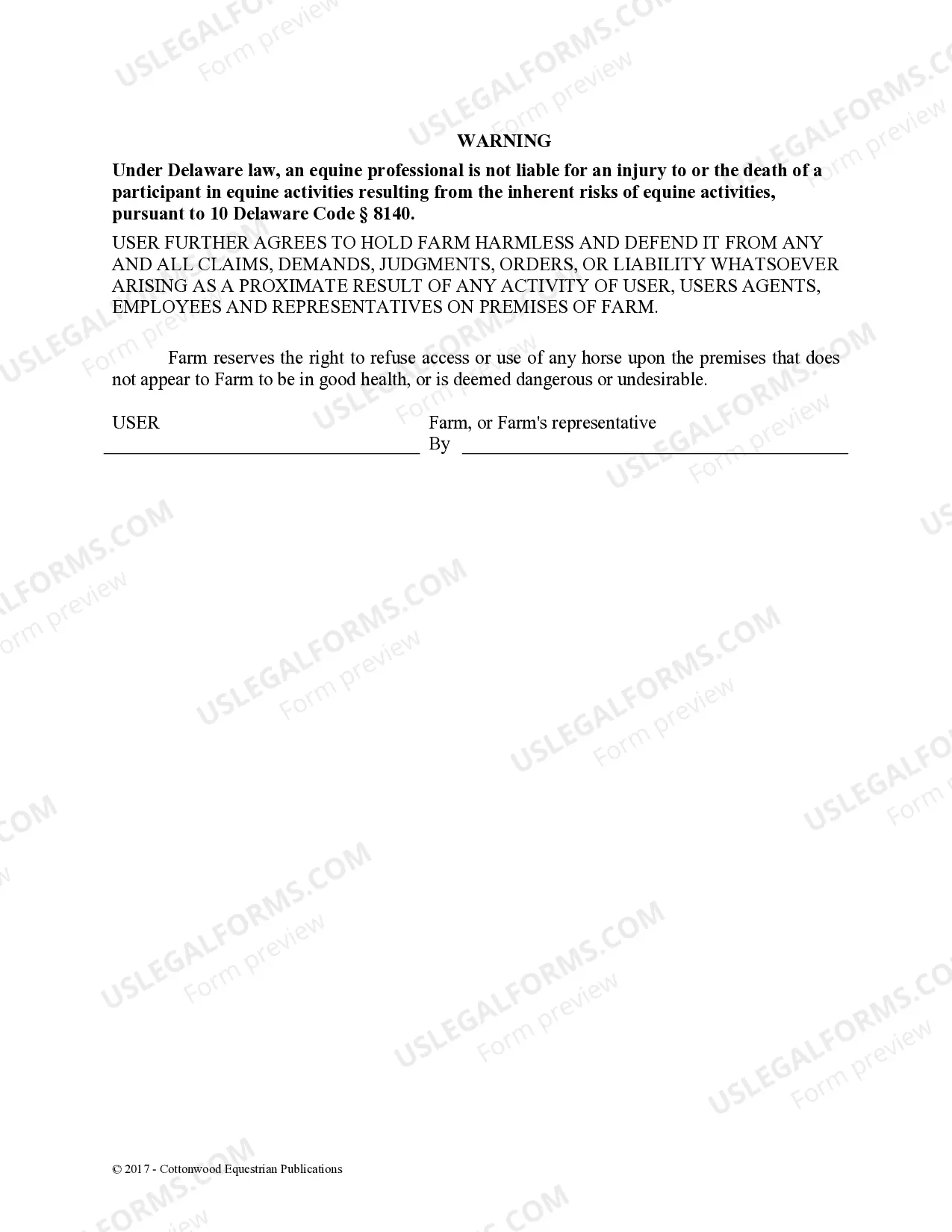
- Acknowledgment of inherent risks associated with equine activities.
- Release of liability for claims related to personal injury or property damage.
- Responsibility clauses regarding taxes and client releases.

When to use this document
This form is essential when an equestrian organization or individual plans to conduct horse-related events such as shows, clinics, or exhibitions at a commercial facility. It protects both the facility owner and the event organizer by clearly defining the terms of use and liability, ensuring that all parties are aware of the risks involved in equestrian activities.
Who can use this document
This agreement is intended for:
- Equestrian organizations hosting events.
- Individuals conducting riding clinics or shows.
- Facility owners who want to protect their interests while allowing the use of their premises.
Completing this form step by step
- Identify the parties: Fill in the names and details of the Farm and User.
- Specify the facility: Clearly indicate the name and location of the stable being used.
- Enter dates and payment: Provide the specific dates of the event and total fees required.
- Include terms for the concession stand: Decide and indicate if the User has rights to use the concession area.
- Acknowledge risks: Ensure all participants are aware of the inherent risks associated with equine activities.
Is notarization required?
This form does not typically require notarization to be legally valid. However, some jurisdictions or document types may still require it. US Legal Forms provides secure online notarization powered by Notarize, available 24/7 for added convenience.
Get your form ready online
Our built-in tools help you complete, sign, share, and store your documents in one place.
Make edits, fill in missing information, and update formatting in US Legal Forms—just like you would in MS Word.
Download a copy, print it, send it by email, or mail it via USPS—whatever works best for your next step.
Sign and collect signatures with our SignNow integration. Send to multiple recipients, set reminders, and more. Go Premium to unlock E-Sign.
If this form requires notarization, complete it online through a secure video call—no need to meet a notary in person or wait for an appointment.
We protect your documents and personal data by following strict security and privacy standards.

Make edits, fill in missing information, and update formatting in US Legal Forms—just like you would in MS Word.

Download a copy, print it, send it by email, or mail it via USPS—whatever works best for your next step.

Sign and collect signatures with our SignNow integration. Send to multiple recipients, set reminders, and more. Go Premium to unlock E-Sign.

If this form requires notarization, complete it online through a secure video call—no need to meet a notary in person or wait for an appointment.

We protect your documents and personal data by following strict security and privacy standards.
Common mistakes to avoid
- Neglecting to have all parties sign the agreement before the event.
- Failing to specify the exact facility areas that will be used.
- Omitting the acknowledgment of risks, which could lead to liability issues.
- Incorrectly documenting the payment terms or amounts.
Why complete this form online
- Convenience: Download and complete the form at your own pace.
- Editability: Easily modify the form fields to match your specific event details.
- Reliability: Access professionally drafted templates created by licensed attorneys.
Looking for another form?

Form popularity
FAQ
Eligibility for APHA registration includes individuals or entities that own a horse with qualifying Paint genetics. Registrants must also provide valid identification documents and completed applications. Additionally, individuals must ensure their horses meet all APHA criteria regarding color and lineage. For a smooth registration experience, consider the Delaware Facility Release Agreement - Show Or Clinic - Horse Equine Forms for organized documentation management.
APHA bloodline requirements stipulate that both parents of the horse must be registered with APHA or other recognized associations. The horse must also exhibit characteristics typical of Paint breeds, including certain color patterns. After verifying bloodlines, you will need to provide pedigree documentation during registration. Using tools like the Delaware Facility Release Agreement - Show Or Clinic - Horse Equine Forms can simplify discussions regarding bloodline verification and registration.
To qualify as an APHA horse, the animal must have Paint bloodlines, which typically means it descends from registered Paint or Quarter Horses. It should display specific coat patterns recognized by APHA, combining solid and white markings. Additionally, both the sire and dam must be registered with APHA or another breed association like AQHA. For related documentation, consider the Delaware Facility Release Agreement - Show Or Clinic - Horse Equine Forms to ensure compliance and proper handling.
In most cases, a horse bill of sale does not require notarization, but it can enhance the document's legal credibility. Notarization serves as a verification of the identities of those involved in the transaction. If you use the Delaware Facility Release Agreement - Show Or Clinic - Horse Equine Forms, you may choose to notarize it to avoid any future disputes.
To obtain a bill of sale for a horse, you can either create one yourself or use trusted templates available online. Many sellers provide their own, but templates like the Delaware Facility Release Agreement - Show Or Clinic - Horse Equine Forms facilitate the process. Make sure to include specific details about the horse and terms of the sale to protect yourself legally.
To sell a horse, you typically need a health certificate, a bill of sale, and any relevant registration paperwork. The bill of sale outlines the terms of the sale and protects both parties involved in the transaction. Utilizing a Delaware Facility Release Agreement - Show Or Clinic - Horse Equine Forms ensures clarity and legal compliance in your sale.
An equine facility liability waiver is a legal document that releases the facility from responsibility for injuries or accidents that may occur while engaging in equine activities. This waiver is crucial for owners and riders to understand their risks and protect themselves legally. By using a Delaware Facility Release Agreement - Show Or Clinic - Horse Equine Forms, both parties can have a clear understanding of expectations and responsibilities, which can enhance safety and transparency during equestrian events.
The 20% rule in horse riding refers to the guideline that suggests riders should not tire their horses beyond 20% of their physical capacity during training. This approach helps to prevent overexertion and promotes gradual improvement in performance. By applying this rule, owners can maintain their horses' health and well-being while training effectively. A Delaware Facility Release Agreement - Show Or Clinic - Horse Equine Forms can provide legal clarity and structure when implementing training practices, ensuring that both horse and rider are protected.