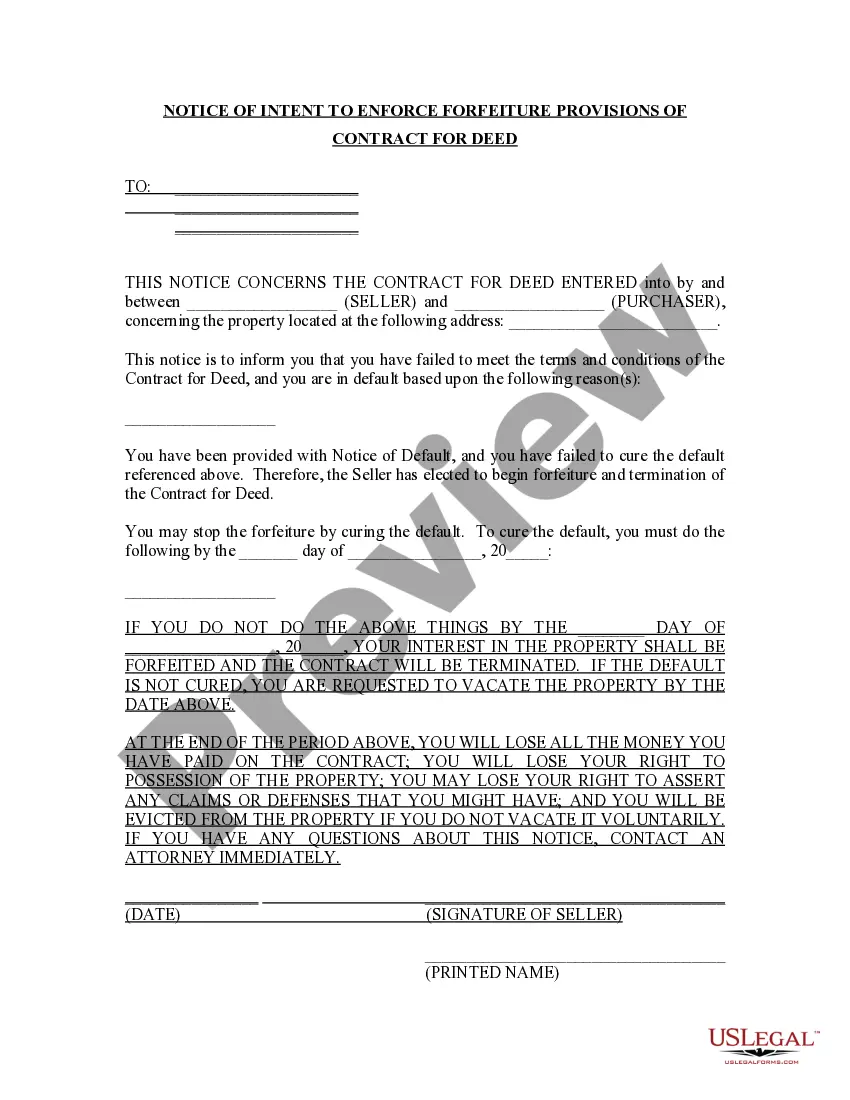
This Notice of Intent to Enforce Forfeiture Provisions of Contract for Deed is an initial notice of Seller's intent to enforce the forfeiture remedy of contract for deed if nonpayment or other breach is not cured. It is used specifically to inform the buyer that he/she has failed to meet the terms and conditions of the Contract for Deed and as a result, are in default based upon the reasons specified.
Delaware Notice of Intent to Enforce Forfeiture Provisions of Contact for Deed
State:
Delaware
Control #:
DE-00470-11
Format:
Word;
Rich Text
Instant download
Description
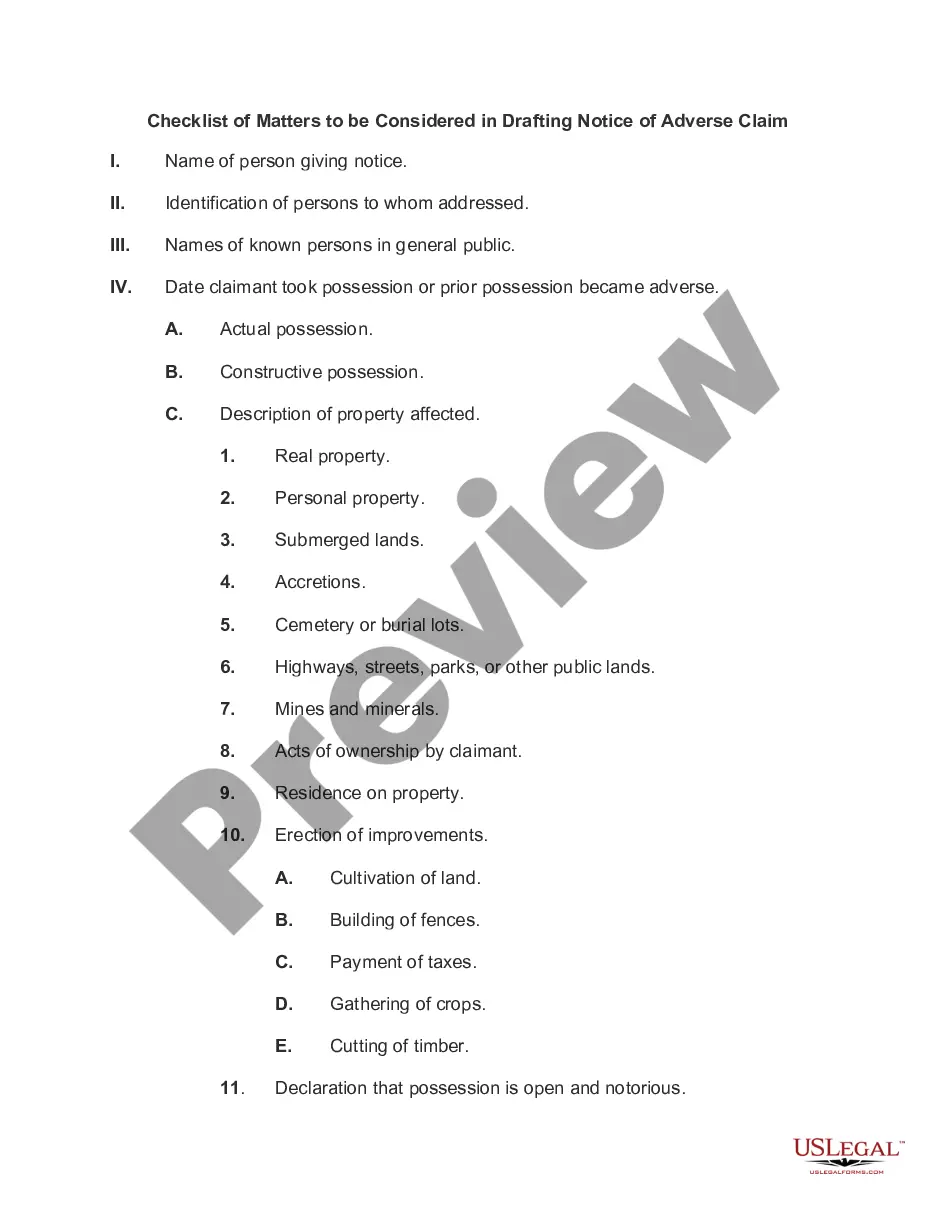
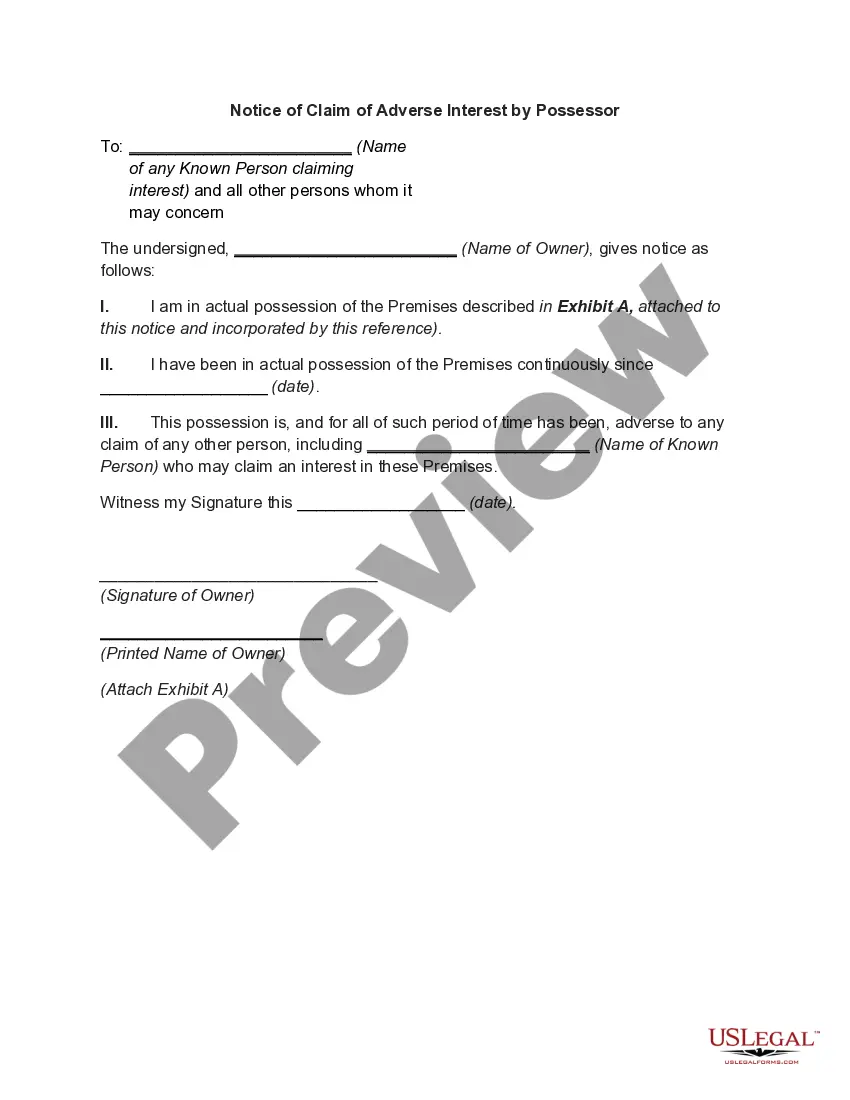


How to fill out Delaware Notice Of Intent To Enforce Forfeiture Provisions Of Contact For Deed?
Utilize US Legal Forms to obtain a printable Delaware Notice of Intent to Enforce Forfeiture Terms of Contract for Deed.
Our court-acceptable forms are created and frequently refreshed by proficient attorneys.
Ours is the most comprehensive Forms collection online and offers reasonably priced and precise examples for consumers, legal professionals, and small to medium-sized businesses.
US Legal Forms provides thousands of legal and tax samples and packages for both business and personal requirements, including the Delaware Notice of Intent to Enforce Forfeiture Terms of Contract for Deed. Over three million users have successfully utilized our platform. Choose your subscription plan and acquire high-quality documents with just a few clicks.
- The documents are organized into state-specific categories and some can be viewed before downloading.
- To acquire templates, users must have a subscription and Log In to their account.
- Click Download next to any form you need and locate it in My documents.
- For individuals without a subscription, follow the guidelines below to easily locate and download the Delaware Notice of Intent to Enforce Forfeiture Terms of Contract for Deed.
- Ensure that you select the correct form pertaining to the required state.
- Examine the document by reviewing the description and using the Preview option.
Form popularity
FAQ
In Delaware, the statute of limitations on debt collection is generally set at three years. This timeframe applies to unsecured debts, like credit cards and personal loans. If someone is attempting to collect on a debt, especially in relation to a Delaware Notice of Intent to Enforce Forfeiture Provisions of Contact for Deed, knowing this limit is crucial for appropriate action.
The statute of limitations on a contract dispute in Delaware is three years. This period commences from the moment the dispute arises. Acting swiftly is critical, particularly if your case involves a Delaware Notice of Intent to Enforce Forfeiture Provisions of Contact for Deed, to ensure your rights remain protected.
To establish a breach of contract in Delaware, you must demonstrate the existence of a valid agreement, a breach of that agreement, and resulting damages. When looking at matters involving a Delaware Notice of Intent to Enforce Forfeiture Provisions of Contact for Deed, gathering evidence that supports these elements is essential. It gives a stronger position in any legal disputes.
In Delaware, some serious crimes, such as murder and certain sexual offenses, have no statute of limitations. This means that a perpetrator can be prosecuted at any time, regardless of how long ago the crime occurred. Understanding these nuances can help you recognize the legal framework in cases related to a Delaware Notice of Intent to Enforce Forfeiture Provisions of Contact for Deed.
Suing for breach of contract can be challenging, as it involves proving that a valid contract existed, a breach occurred, and the breach caused damages. When dealing with a Delaware Notice of Intent to Enforce Forfeiture Provisions of Contact for Deed, clarity in contract terms can significantly influence the case's outcome. Legal support simplifies this process by guiding you through necessary steps and documentation.
The statute of limitations for negligence claims in Delaware is generally two years. This two-year period starts when the injured party becomes aware of the injury. If negligence has impacted your contract dealings, particularly with the Delaware Notice of Intent to Enforce Forfeiture Provisions of Contact for Deed, it’s crucial to address the issue within this timeframe.
In Delaware, the statute of limitations for breach of contract is three years. This time frame begins at the moment of the breach. If you believe you have a valid breach of contract claim, especially concerning a Delaware Notice of Intent to Enforce Forfeiture Provisions of Contact for Deed, you should consider seeking legal advice promptly.
Section 8106 of the Delaware Code outlines the statute of limitations for various civil actions, including breach of contract claims. It specifies that the time frame for initiating suit is generally three years from the date of the breach. Understanding this section can aid you significantly if you are dealing with a Delaware Notice of Intent to Enforce Forfeiture Provisions of Contact for Deed.
The time limit for breach of contract in Delaware typically falls under the statute of limitations, which is generally three years. This period begins when the breach occurs, allowing the harmed party to take appropriate action. If you are facing a breach of contract situation, especially involving a Delaware Notice of Intent to Enforce Forfeiture Provisions of Contact for Deed, it's important to act promptly.
To add someone to a deed in Delaware, you'll need to execute a new deed that names both the current owner and the new co-owner. This deed must be signed, notarized, and recorded with the county recorder. For guidance on drafting these documents, uslegalforms provides resources that can streamline this process and ensure compliance with state regulations.