District of Columbia Revocation of Transfer on Death Deed or TOD - Beneficiary Deed for Two Grantors
Overview of this form
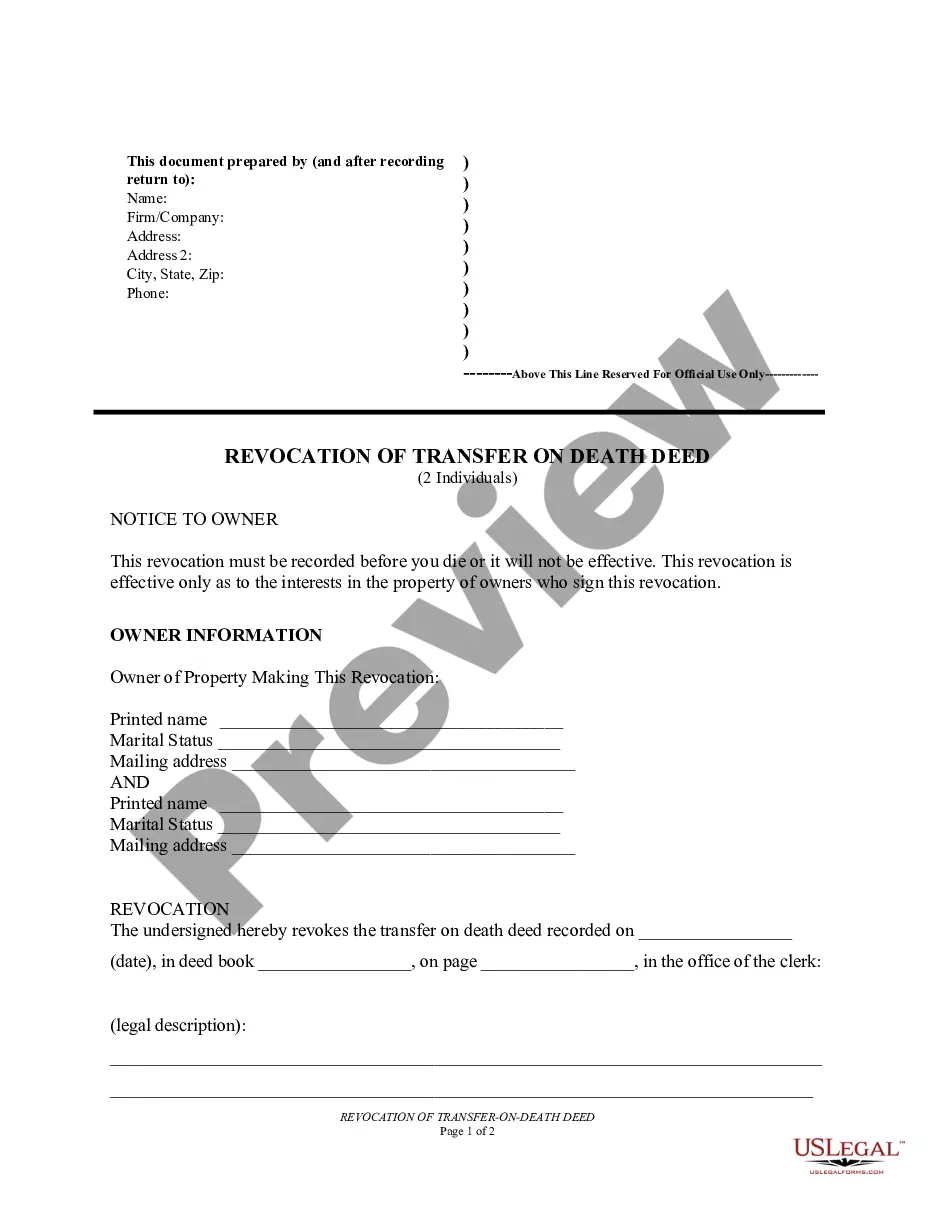
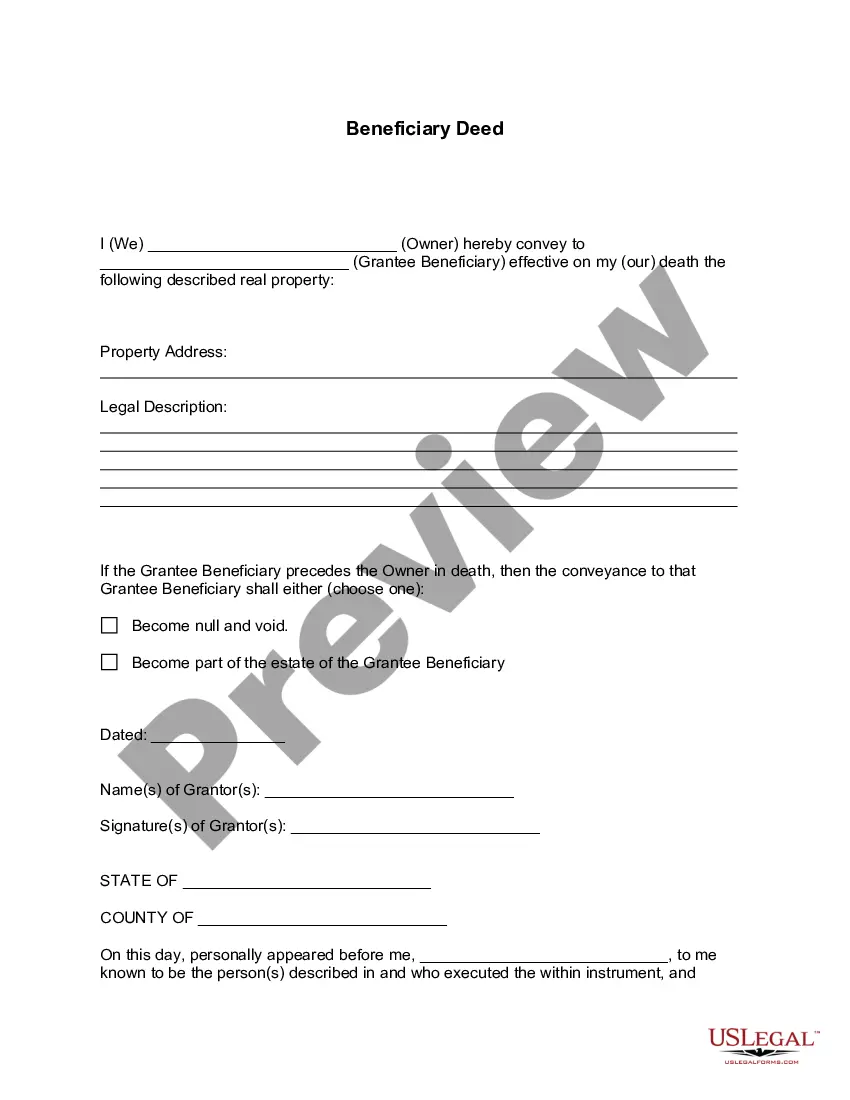
The Revocation of Transfer on Death Deed or TOD - Beneficiary Deed for Two Grantors is a legal document used to invalidate a previously established transfer on death deed. This form ensures that, upon execution, the designated beneficiaries will no longer receive the property upon the owner's death. It must be recorded before the owner's death to be effective, thereby differentiating it from other estate planning documents that may not require immediate action.
What’s included in this form
- Owner information section for both grantors, including names and marital status.
- Details of the original transfer on death deed, including recording date and legal description.
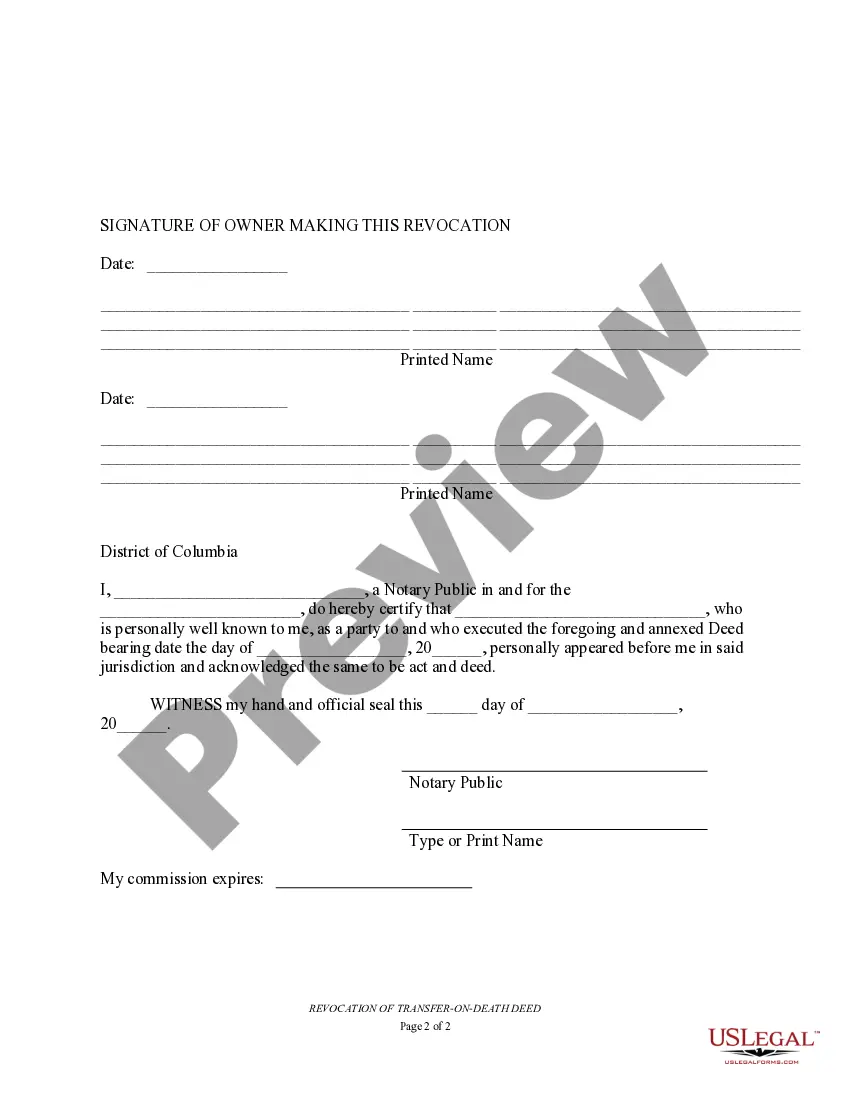
- Signature fields for both property owners revoking the deed.
- Notary acknowledgment section, validating the signatures of both owners.


When this form is needed
This revocation form is used when property owners wish to change their estate planning decisions regarding a transfer on death deed. Common situations include changes in relationships among beneficiaries, changes in ownership, or when the property is no longer intended to pass to the originally named beneficiaries.
Who can use this document
This form is suitable for:
- Property owners who have previously established a transfer on death deed.
- Individuals looking to change beneficiaries associated with their property.
- Couples who jointly hold property and want to revoke a beneficiary deed affecting both parties.
How to prepare this document
- Identify the parties involved, including both property owners who are revoking the deed.
- Provide the date the original transfer on death deed was recorded, along with the deed book and page number.
- Fill in the legal description of the property associated with the transfer on death deed.
- Ensure both owners sign and date the form.
- Have the signed document notarized to confirm the identities of the signers.
- Record the completed and notarized revocation form at the county recorder's office where the property is located.
Notarization requirements for this form
Yes, this form must be notarized to be legally valid. The notarization confirms the identity of the signing parties and their voluntary intent to revoke the transfer on death deed. US Legal Forms offers integrated online notarization services, providing 24/7 availability through secure video calls, ensuring legal compliance without the need for in-person visits.
Get your form ready online
Our built-in tools help you complete, sign, share, and store your documents in one place.
Make edits, fill in missing information, and update formatting in US Legal Forms—just like you would in MS Word.
Download a copy, print it, send it by email, or mail it via USPS—whatever works best for your next step.
Sign and collect signatures with our SignNow integration. Send to multiple recipients, set reminders, and more. Go Premium to unlock E-Sign.
If this form requires notarization, complete it online through a secure video call—no need to meet a notary in person or wait for an appointment.
We protect your documents and personal data by following strict security and privacy standards.

Make edits, fill in missing information, and update formatting in US Legal Forms—just like you would in MS Word.

Download a copy, print it, send it by email, or mail it via USPS—whatever works best for your next step.

Sign and collect signatures with our SignNow integration. Send to multiple recipients, set reminders, and more. Go Premium to unlock E-Sign.

If this form requires notarization, complete it online through a secure video call—no need to meet a notary in person or wait for an appointment.

We protect your documents and personal data by following strict security and privacy standards.
Common mistakes
- Failing to record the revocation before the death of the owner.
- Not having the document notarized when required.
- Omitting necessary information about the original transfer on death deed.
- Neglecting to complete the legal description accurately.
Why use this form online
- Convenience of immediate access to legal forms from any location.
- Editability allows users to fill in the form accurately before printing.
- Reliability of professionally drafted templates that comply with legal standards.
Looking for another form?
Form popularity
FAQ
Yes, the District of Columbia allows transfer on death deeds. These legal instruments enable property owners to transfer ownership to beneficiaries without going through probate. This can expedite the transfer process and allow for a smoother transition of property after death. For those looking to create a transfer on death deed, USLegalForms offers a variety of resources to assist you.
Yes, a survivorship deed can be contested, and this often requires focusing on factors such as capacity, fraud, or undue influence involved in its creation. In the District of Columbia, the courts require valid evidence to support your claim. Understanding the nuances of contesting these deeds is vital, and USLegalForms provides insights and legal documents that may help.
While it is not mandatory to hire a lawyer for a transfer on death deed in the District of Columbia, having legal guidance can simplify the process. A lawyer can ensure that the deed is properly executed and in compliance with local laws. If you want to handle it independently, USLegalForms offers templates and resources that can assist you in creating a valid deed.
Contesting a transfer on a death deed involves filing a legal challenge in the probate court in the District of Columbia. You must provide valid reasons for contesting, such as asserting the grantor lacked capacity when signing the deed. Gather supporting documents and testimonies to strengthen your case. USLegalForms can provide valuable resources for navigating this legal challenge.
To transfer a death deed to two beneficiaries, include both names clearly in the deed document. In the District of Columbia, you must also ensure that the deed is signed by you and recorded with the appropriate government agency. This ensures both beneficiaries receive their share of the property upon your passing. USLegalForms can provide templates to streamline this process.
To contest a transfer on death deed in the District of Columbia, you must file a petition in the probate court. You typically need to show that the deed was invalid due to lack of capacity or undue influence. Gathering evidence and witnesses to support your claim is essential. Using resources like USLegalForms can assist in understanding the contest process.
A power of attorney cannot revoke a transfer on death deed in the District of Columbia. The deed must be revoked by the grantor themselves, who created the transfer on death deed. However, having a power of attorney can help in managing other aspects of the property during the grantor's lifetime. For specific situations, consider consulting USLegalForms for guidance.
While transfer on death deeds can be beneficial, they do come with some disadvantages. One significant drawback involves potential challenges if the property is not appropriately managed during the grantor's life. Additionally, the District of Columbia Revocation of Transfer on Death Deed - Beneficiary Deed for Two Grantors does not provide protection from creditors after death. It’s crucial to discuss your options with a legal professional to navigate these considerations effectively.
Yes, the District of Columbia does permit transfer on death deeds. This means you can designate beneficiaries who will inherit your property directly without the hassle of probate. Utilizing the District of Columbia Revocation of Transfer on Death Deed - Beneficiary Deed for Two Grantors can streamline the inheritance process, making it easier for your loved ones. It's a practical option to consider to ensure your estate is handled according to your wishes.
Currently, many states, including the District of Columbia, recognize transfers on death deeds. This provision simplifies the transfer of property upon death, allowing for a direct transfer to the designated beneficiaries. While the District of Columbia Revocation of Transfer on Death Deed - Beneficiary Deed for Two Grantors is specifically relevant, it’s important to confirm if your state has similar regulations. Always contact a legal expert to understand the impact in your state.