District of Columbia Revocation of Transfer on Death Deed or TOD - Beneficiary Deed for One Grantor
Understanding this form
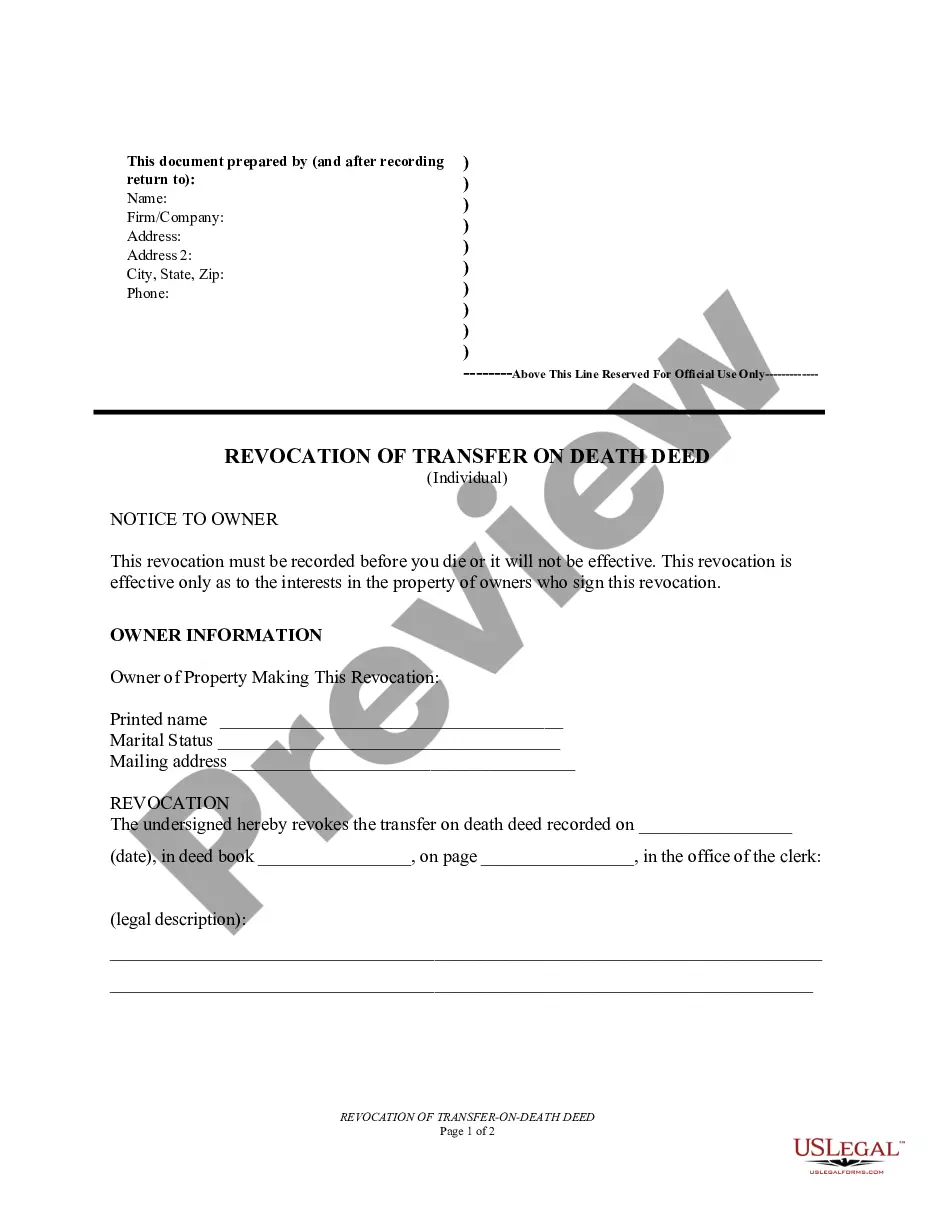
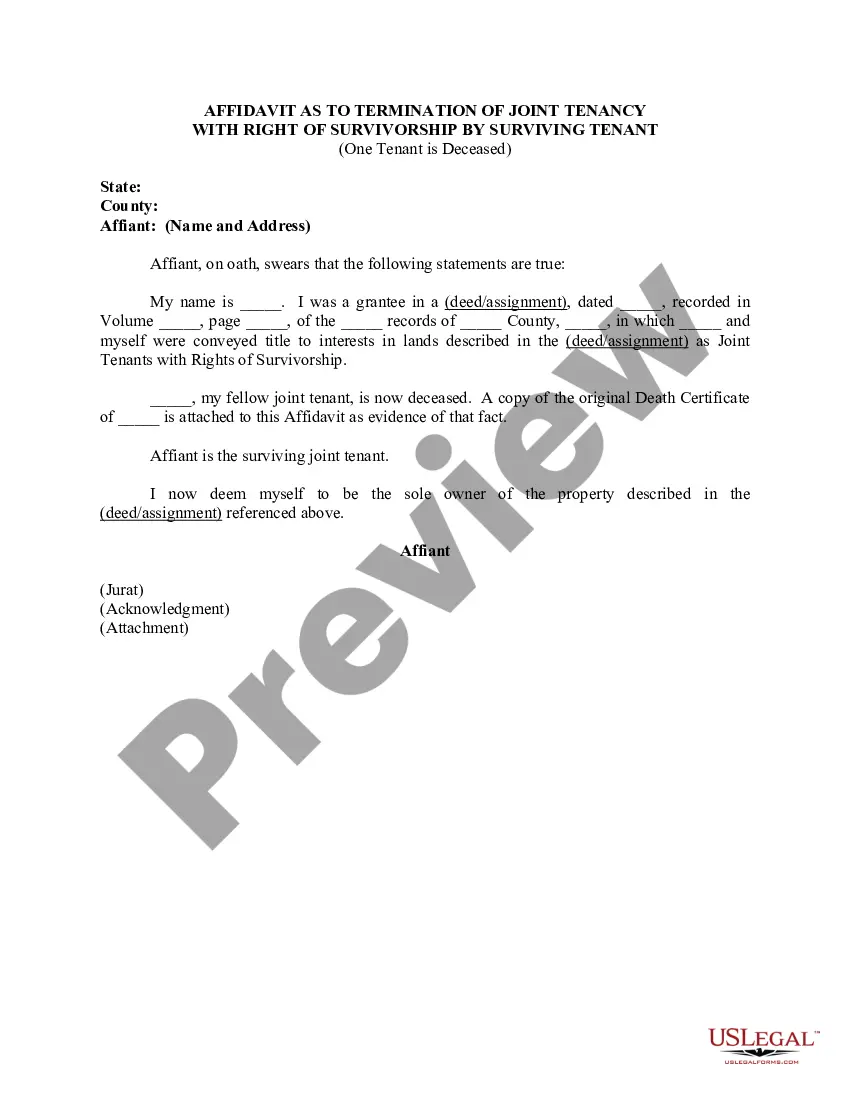
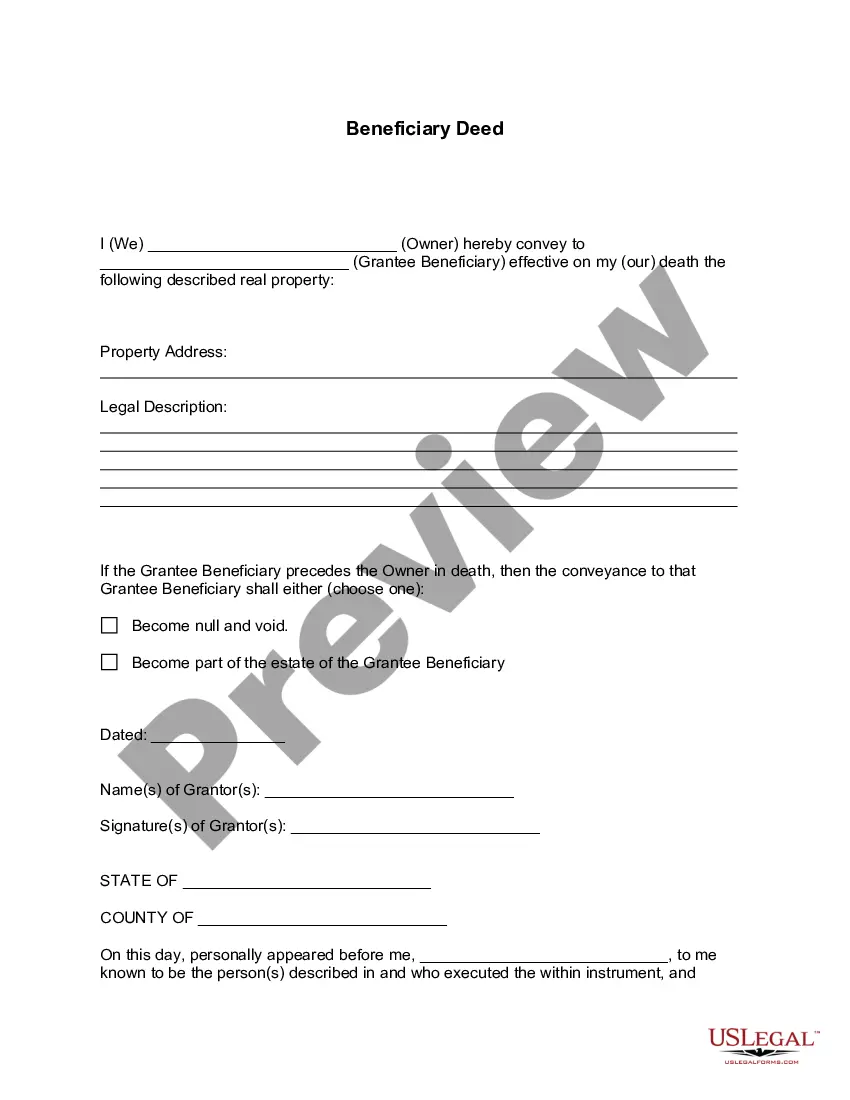
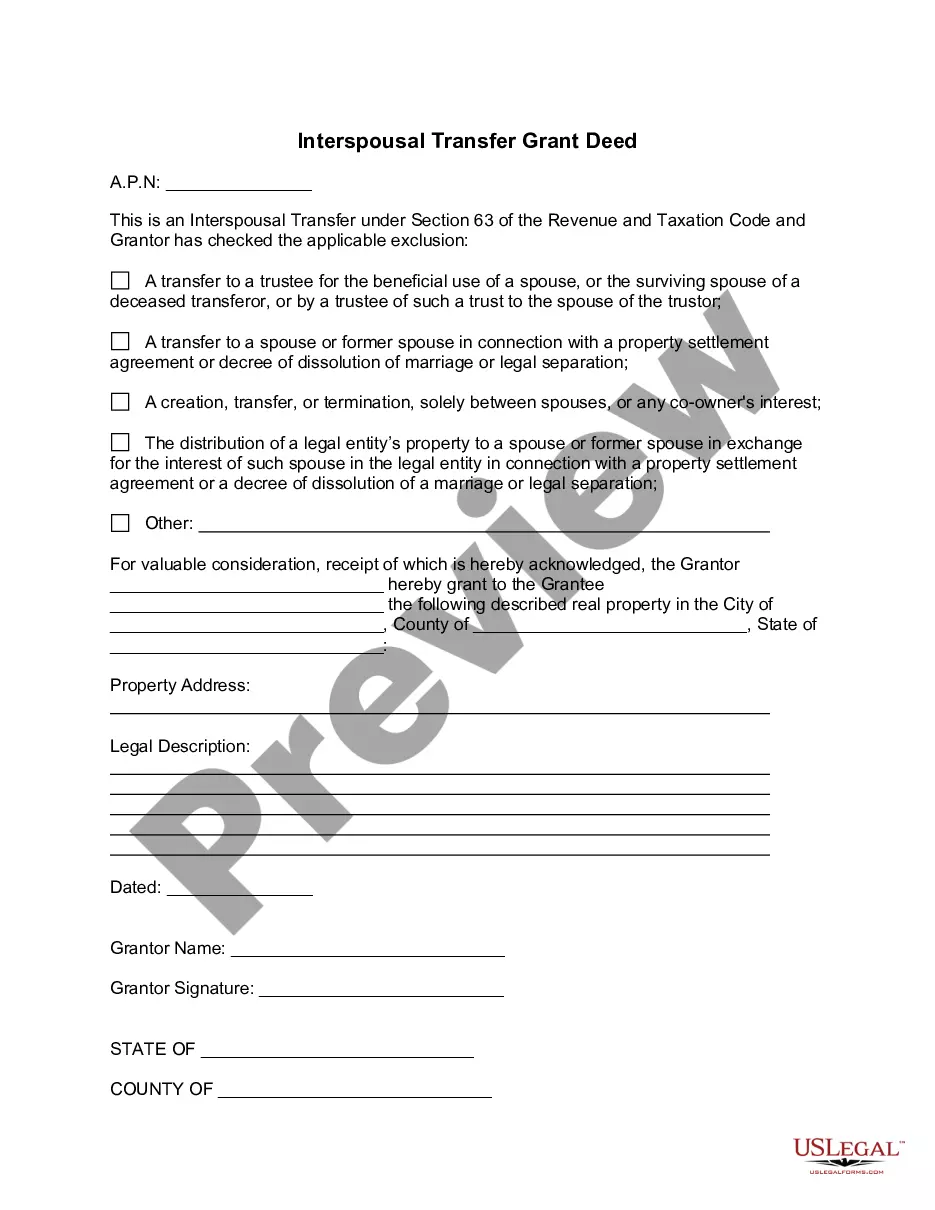
The Revocation of Transfer on Death Deed, or TOD, is a legal document used by an owner to revoke a previously executed transfer on death deed. This form ensures that the property specified in the original TOD deed will not transfer upon the ownerâs death as originally intended. It is vital to execute and record this revocation before the ownerâs death for it to be effective. Unlike standard wills, this specific deed addresses real property and its transfer arrangements directly during the ownerâs lifetime.
Form components explained
- Owner information section: Contains the name, marital status, and mailing address of the property owner revoking the deed.
- Revocation clause: Details the original transfer on death deed's date and deed book information.
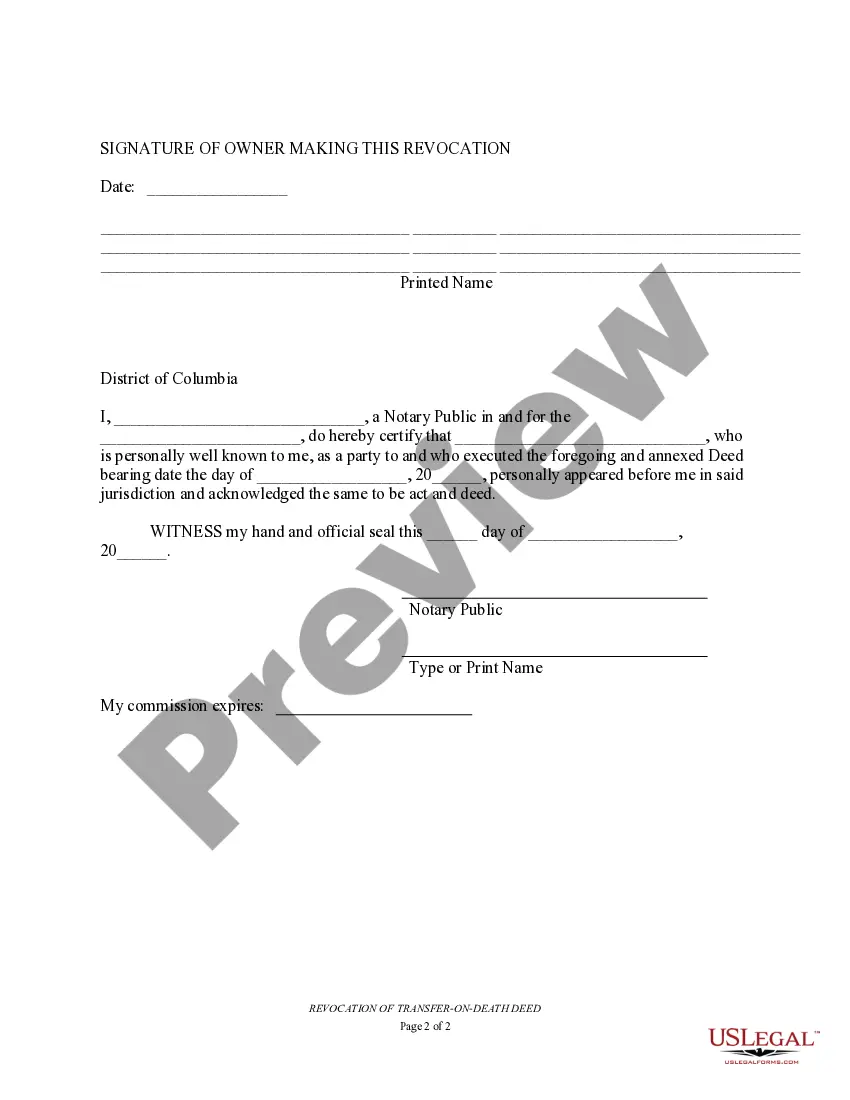
- Signature and acknowledgment: Requires the original owner's signature and date to validate the revocation.
- Notarization section: Includes a space for a notary public to certify the ownerâs identity and the signing of the document.

When to use this form
Use this form if you want to reverse a previous transfer on death or beneficiary deed for your real property. Common scenarios include changes in your estate planning, such as reallocating assets to different beneficiaries or removing someone from your estate plan. It is essential to ensure this revocation is properly executed to avoid conflicts over property inheritance after your death.
Who should use this form
- Homeowners who have previously established a transfer on death deed for their property.
- Individuals seeking to update their estate planning to reflect current wishes.
- Anyone needing to clarify or eliminate prior beneficiary designations for real estate.
Completing this form step by step
- Identify the property owner: Fill in the owner's printed name, marital status, and mailing address.
- Provide details of the original deed: Enter the date of the original transfer on death deed and relevant deed book information.
- Complete the legal description: Insert the proper legal description of the property being revoked.
- Sign and date the revocation: The owner must sign and date the form to validate it.
- Obtain notarization: Have the document notarized to meet legal requirements prior to recording.
Notarization guidance
Yes, this form must be notarized to be legally valid. Notarization confirms the identity of the signer and ensures that the document is executed willingly. US Legal Forms offers integrated online notarization services, providing secure video calls with a notary, available 24/7, ensuring legal equivalence without needing to travel.
Get your form ready online
Our built-in tools help you complete, sign, share, and store your documents in one place.
Make edits, fill in missing information, and update formatting in US Legal Forms—just like you would in MS Word.
Download a copy, print it, send it by email, or mail it via USPS—whatever works best for your next step.
Sign and collect signatures with our SignNow integration. Send to multiple recipients, set reminders, and more. Go Premium to unlock E-Sign.
If this form requires notarization, complete it online through a secure video call—no need to meet a notary in person or wait for an appointment.
We protect your documents and personal data by following strict security and privacy standards.

Make edits, fill in missing information, and update formatting in US Legal Forms—just like you would in MS Word.

Download a copy, print it, send it by email, or mail it via USPS—whatever works best for your next step.

Sign and collect signatures with our SignNow integration. Send to multiple recipients, set reminders, and more. Go Premium to unlock E-Sign.

If this form requires notarization, complete it online through a secure video call—no need to meet a notary in person or wait for an appointment.

We protect your documents and personal data by following strict security and privacy standards.
Avoid these common issues
- Failing to record the revocation before the owner's death, rendering it ineffective.
- Leaving fields incomplete or inaccurately filled, which may invalidate the form.
- Neglecting to obtain notarization where required by state law.
Benefits of using this form online
- Convenience: Download the form anytime, anywhere, on any device.
- Editable: Customize the form to meet specific needs effortlessly.
- Reliable: Ensure legal compliance with forms drafted by licensed attorneys.
Looking for another form?
Form popularity
FAQ
A beneficiary deed generally does not serve as proof of ownership during the grantor's lifetime, but it operates to transfer ownership automatically upon the grantor's death. This means that while the District of Columbia Revocation of Transfer on Death Deed - Beneficiary Deed for One Grantor outlines the intended transfer of property, the property remains under the grantor’s control until their passing. Therefore, it's crucial to understand that the deed does facilitate transfer but does not convey ownership rights until that time. If you're navigating this process, consider using US Legal Forms to find the right resources and documentation for your situation.
While a transfer on death deed offers many advantages, there are notable disadvantages as well. It may limit your control over the property as the beneficiaries become owners after your passing. Additionally, creditors can still make claims against the property, potentially affecting your beneficiaries. It is crucial to weigh these factors and consider how a District of Columbia Revocation of Transfer on Death Deed - Beneficiary Deed for One Grantor fits into your overall estate plan.
In the District of Columbia, a transfer on death deed does not avoid inheritance tax. However, it effectively allows you to transfer property outside of the probate process, which can simplify the overall transfer of assets. While this method streamlines ownership transition, it’s wise to consult a legal expert regarding tax obligations associated with inherited property.
Filling out a transfer on death affidavit requires clear information about the property and the named beneficiaries. You need to provide details such as the property address, the names of the beneficiaries, and your identification information. It's recommended to consult legal resources or use platforms like USLegalForms to find structured templates that guide you through this process.
A transfer on death deed does not directly avoid capital gains tax. When a beneficiary inherits property through a District of Columbia Revocation of Transfer on Death Deed - Beneficiary Deed for One Grantor, they assume the property's basis for tax purposes. This means any capital gains tax will be assessed on the property’s appreciation from the time of inheritance. Therefore, individuals should consult with a tax advisor to better understand any implications.
Yes, the District of Columbia permits the use of transfer on death deeds. This legal tool allows individuals to designate beneficiaries who will receive property upon their passing. You can easily initiate this process by following specific guidelines laid out by the local laws. Utilizing forms from USLegalForms can simplify filling out the necessary documentation.
Yes, a power of attorney can change a deed while the grantor is still alive and competent. The agent can execute a new deed or modify an existing one as outlined in their authority. However, the District of Columbia Revocation of Transfer on Death Deed - Beneficiary Deed for One Grantor requires careful consideration to protect the grantor's intentions.
Deeds may be transferred through a power of attorney when the grantor is alive and capable of making decisions. The designated agent can manage the property as specified in the power of attorney. Ensure that all transactions align with your future plans, especially if you intend to utilize the District of Columbia Revocation of Transfer on Death Deed - Beneficiary Deed for One Grantor.
While it is not legally required to hire a lawyer to create a transfer on death deed, it is highly recommended. A lawyer can ensure that the document is properly drafted and executed, minimizing the risk of future disputes. Consulting with a professional is especially beneficial when dealing with the District of Columbia Revocation of Transfer on Death Deed - Beneficiary Deed for One Grantor.
To contest a transfer on death deed, you must file a legal action in the appropriate court, citing your reasons clearly. Valid grounds include lack of capacity or improper execution of the deed. Understanding the District of Columbia Revocation of Transfer on Death Deed - Beneficiary Deed for One Grantor will guide you in preparing your case effectively.