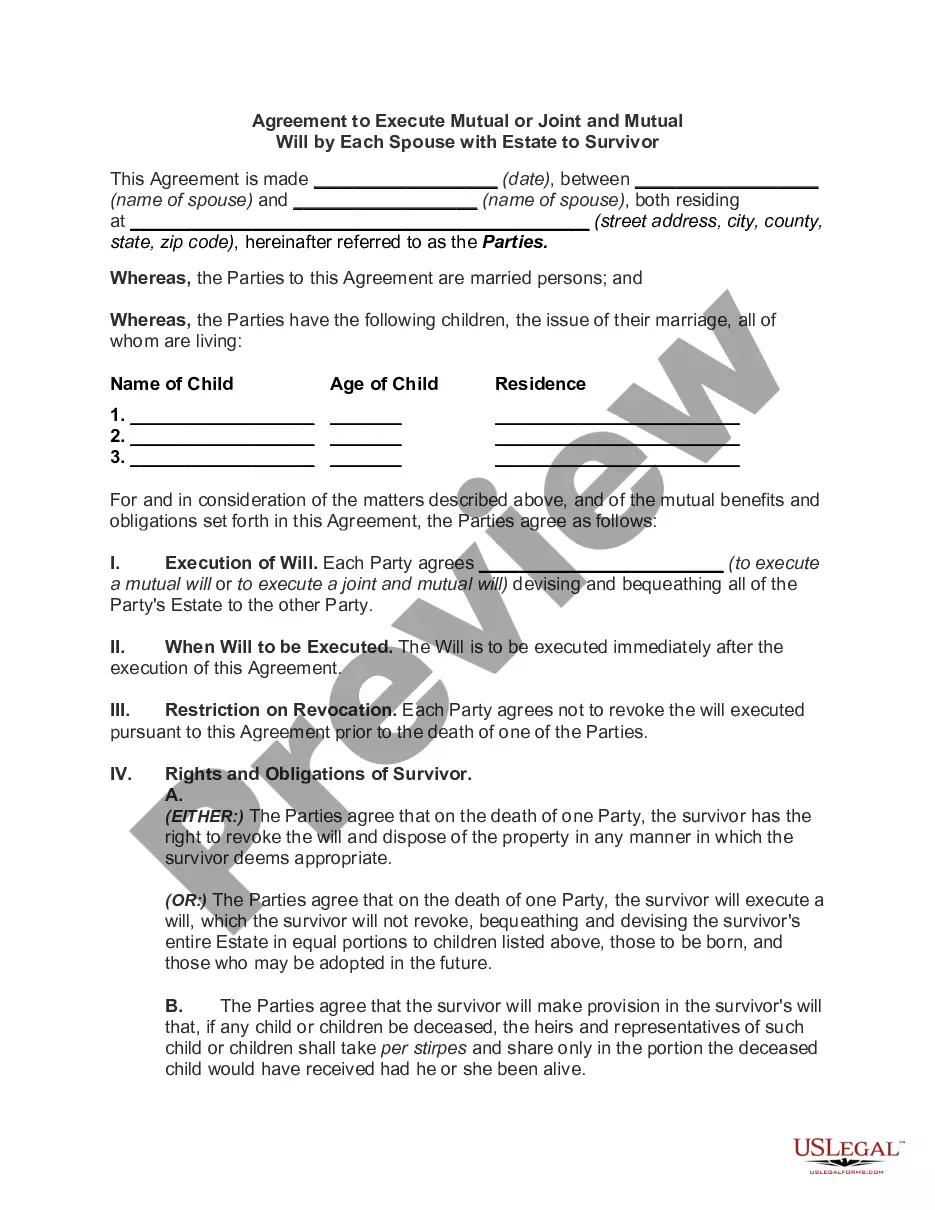
District of Columbia Agreement to Execute Mutual or Joint and Mutual Will by Husband and Wife with Estate to Survivor
Description
Get your form ready online
Our built-in tools help you complete, sign, share, and store your documents in one place.
Make edits, fill in missing information, and update formatting in US Legal Forms—just like you would in MS Word.
Download a copy, print it, send it by email, or mail it via USPS—whatever works best for your next step.
Sign and collect signatures with our SignNow integration. Send to multiple recipients, set reminders, and more. Go Premium to unlock E-Sign.
If this form requires notarization, complete it online through a secure video call—no need to meet a notary in person or wait for an appointment.
We protect your documents and personal data by following strict security and privacy standards.

Make edits, fill in missing information, and update formatting in US Legal Forms—just like you would in MS Word.

Download a copy, print it, send it by email, or mail it via USPS—whatever works best for your next step.

Sign and collect signatures with our SignNow integration. Send to multiple recipients, set reminders, and more. Go Premium to unlock E-Sign.

If this form requires notarization, complete it online through a secure video call—no need to meet a notary in person or wait for an appointment.

We protect your documents and personal data by following strict security and privacy standards.
Looking for another form?








How to fill out Agreement To Execute Mutual Or Joint And Mutual Will By Husband And Wife With Estate To Survivor?
It is feasible to spend hours online trying to locate the legal document template that meets the state and federal criteria you require.
US Legal Forms offers a vast array of legal forms that have been reviewed by experts.
You can conveniently download or print the District of Columbia Agreement to Execute Mutual or Joint and Mutual Will by Spouses with Estate to Survivor from our service.
If available, utilize the Review button to examine the document template as well.
- If you already have a US Legal Forms account, you can Log In and then click the Download button.
- After that, you can complete, edit, print, or sign the District of Columbia Agreement to Execute Mutual or Joint and Mutual Will by Spouses with Estate to Survivor.
- Every legal document template you obtain is yours permanently.
- To retrieve another copy of a purchased form, visit the My documents tab and click the corresponding button.
- Should you use the US Legal Forms site for the first time, follow the simple instructions below.
- First, ensure that you have selected the correct document template for the county/city of your choice.
- Check the form description to confirm you have chosen the correct form.
Form popularity
FAQ
If I have a will, does my spouse need one? The answer is yes everyone should have a will! If you're married, you and your spouse can have separate (or joint) wills that you sign yourselves. This way, if something were to happen to one of you, there's no room for ambiguity or confusion.
Outright distribution. You and your spouse may have one of the most common types of estate plans between married couples, which is a simple will leaving everything to each other. With this type of plan, you leave all of your assets outright to your surviving spouse.
Generally speaking, there are three kinds of Wills: (1) holographicwritten entirely in the handwriting of the person writing the Will; (2) standard, formal typewrittenprinted or typed; and (3) partially handwritten and partially typed. The requirements for a valid Will are different for each type of Will.
If I have a will, does my spouse need one? The answer is yes everyone should have a will! If you're married, you and your spouse can have separate (or joint) wills that you sign yourselves. This way, if something were to happen to one of you, there's no room for ambiguity or confusion.
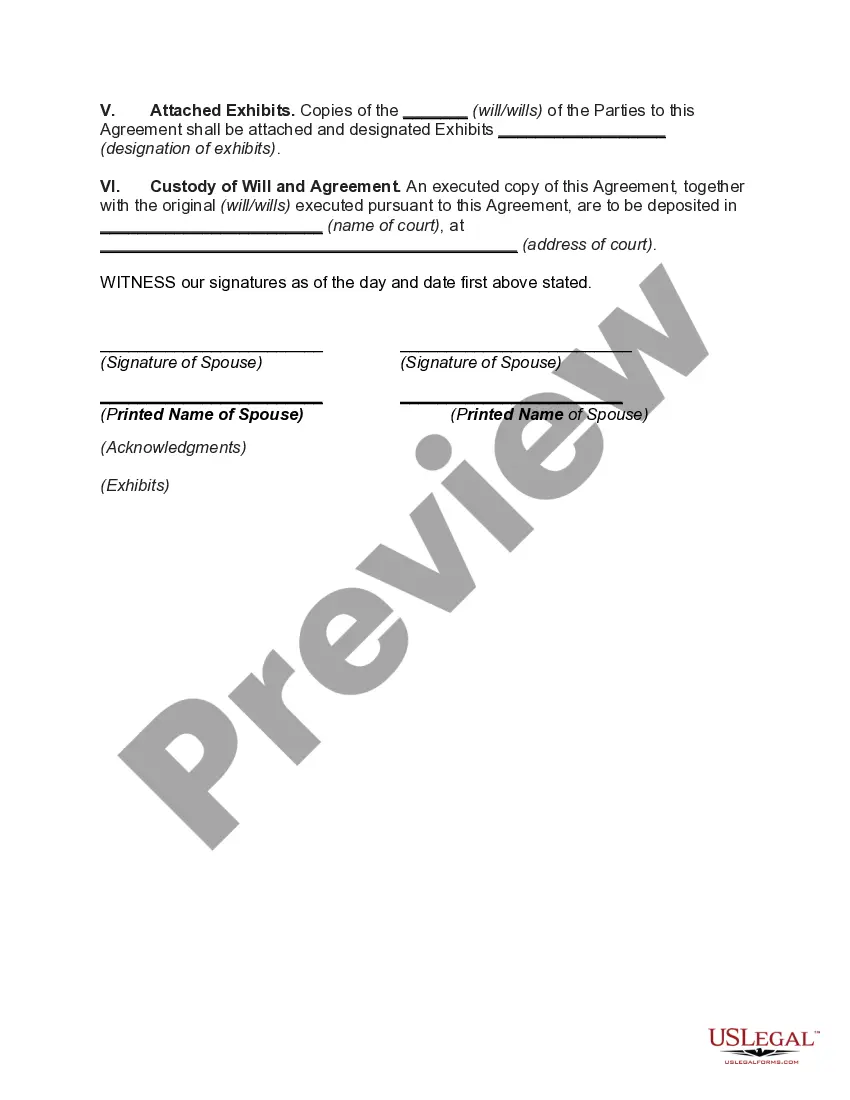
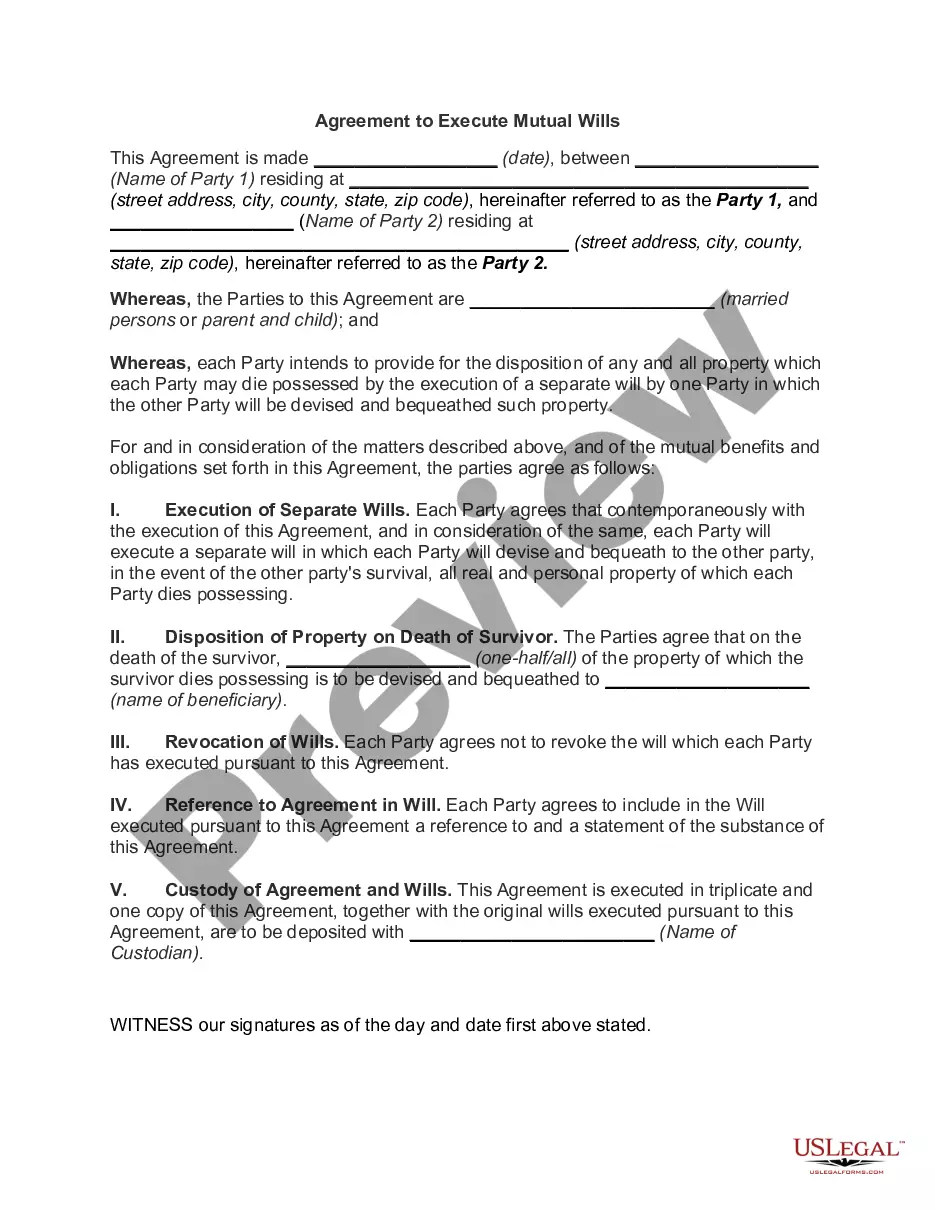
A joint will is one document signed by two people. A mutual will represents two individual wills that are signed separately, but are largely the same in content.
As per the law, the joint assets are owned by both individuals hence both individuals i.e. husband & wife should make a Will either two separate Wills or one single Joint Will.
A joint will can be a good idea if both you and your partner are in total agreement about how you want to distribute your property, your estates aren't complicated, and you only have a few beneficiaries.
Mutual Wills are wills made by spouses or partners at the same time, together with a contract to which they are both parties. In the contract the spouses (or partners) each agree to be legally bound not to change their respective wills without each other's consent.