District of Columbia Satisfaction, Release or Cancellation of Deed of Trust by Individual

What is this form?
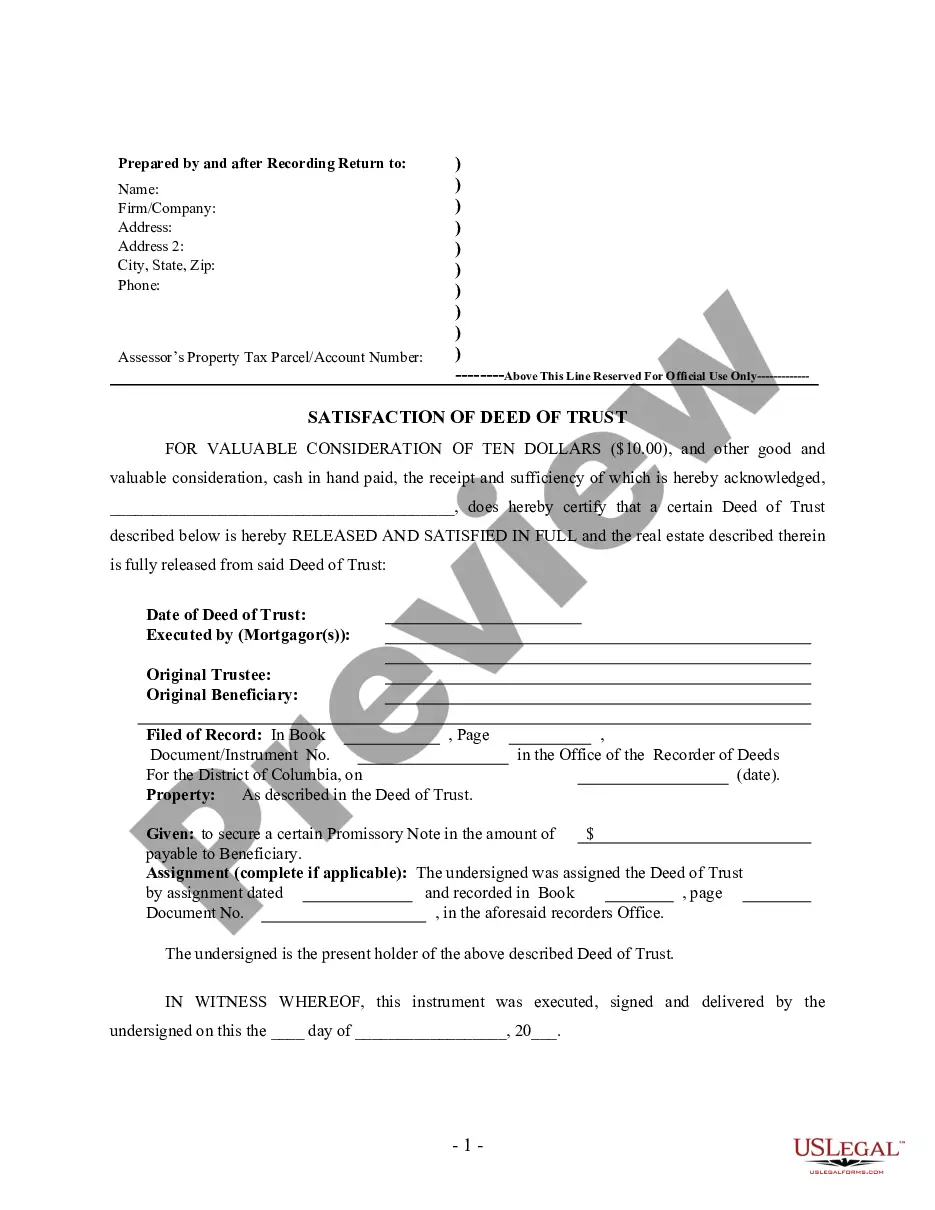
The Satisfaction, Release, or Cancellation of Deed of Trust by Individual is a legal document used to formally release a mortgage lien on a property in the District of Columbia. This form is essential for individuals who have fully paid off their mortgage, signifying that the lender has relinquished its claim on the property. Unlike similar forms, this one specifically addresses the lien's cancellation due to full satisfaction of the mortgage obligation.
Main sections of this form
- Date of the deed of trust
- Names of mortgagor(s), original trustee, and original beneficiary
- Recording information (book and page number, document number)
- Property description as mentioned in the deed of trust
- Promissory note details
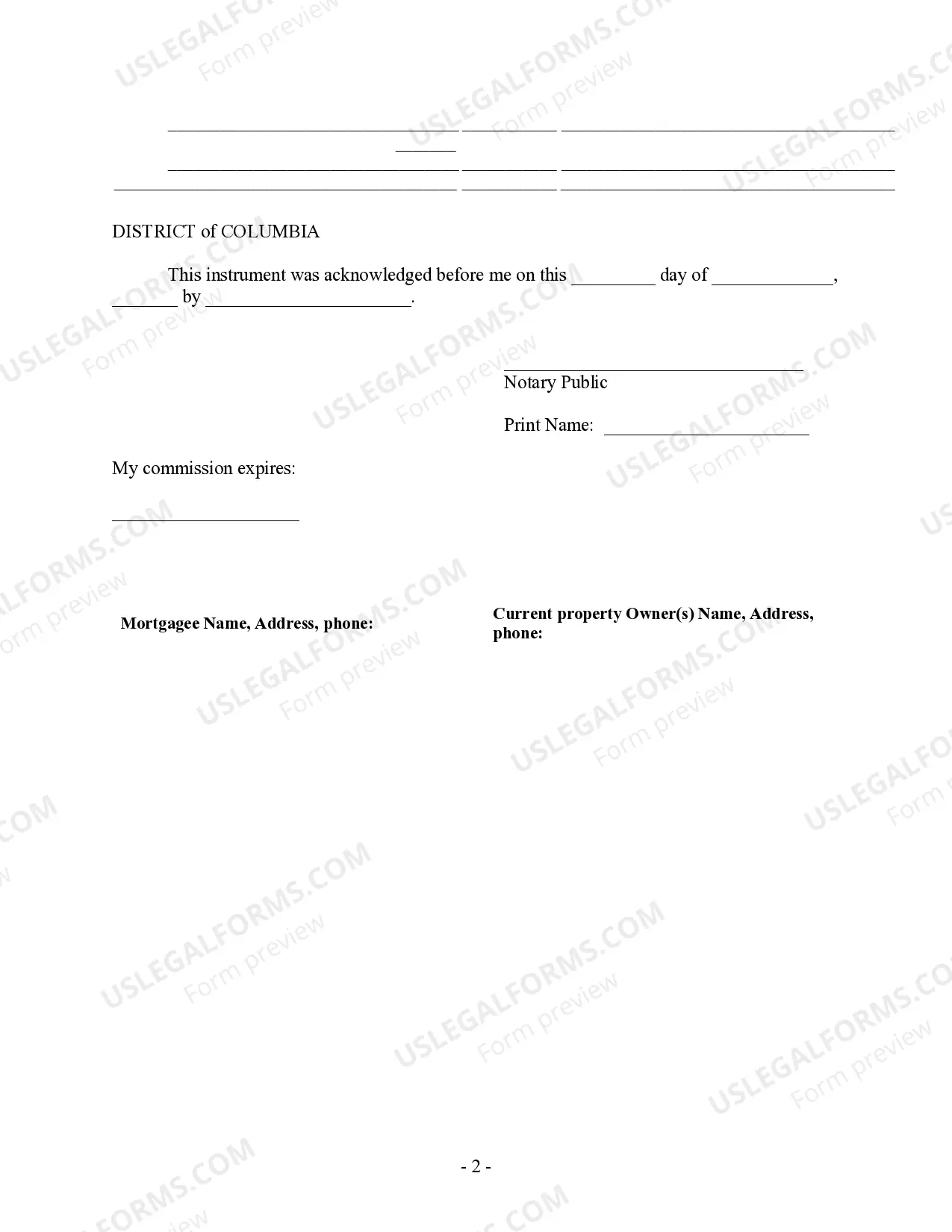
- Signature block for the parties involved, with notary acknowledgment

Common use cases
This form should be used when an individual has finished paying off their mortgage and needs to document the release of the deed of trust. It is especially relevant during the closing stages of a home loan when the borrower's financial obligation to the lender has been fulfilled.
Intended users of this form
- Homeowners who have paid off their mortgage
- Individuals who wish to release a lien on their property
- Brokers or legal representatives assisting clients with property matters
- Real estate professionals managing deeds of trust
Completing this form step by step
- Identify and enter the date of the deed of trust.
- Fill in the names of the mortgagor(s), original trustee, and original beneficiary.
- Provide the recording details including book and page numbers.
- Describe the property as specified in the deed of trust.
- Sign and date the form in the presence of a notary public.
Notarization guidance
To make this form legally binding, it must be notarized. Our online notarization service, powered by Notarize, lets you verify and sign documents remotely through an encrypted video session.
Get your form ready online
Our built-in tools help you complete, sign, share, and store your documents in one place.
Make edits, fill in missing information, and update formatting in US Legal Forms—just like you would in MS Word.
Download a copy, print it, send it by email, or mail it via USPS—whatever works best for your next step.
Sign and collect signatures with our SignNow integration. Send to multiple recipients, set reminders, and more. Go Premium to unlock E-Sign.
If this form requires notarization, complete it online through a secure video call—no need to meet a notary in person or wait for an appointment.
We protect your documents and personal data by following strict security and privacy standards.

Make edits, fill in missing information, and update formatting in US Legal Forms—just like you would in MS Word.

Download a copy, print it, send it by email, or mail it via USPS—whatever works best for your next step.

Sign and collect signatures with our SignNow integration. Send to multiple recipients, set reminders, and more. Go Premium to unlock E-Sign.

If this form requires notarization, complete it online through a secure video call—no need to meet a notary in person or wait for an appointment.

We protect your documents and personal data by following strict security and privacy standards.
Avoid these common issues
- Failing to provide accurate recording information.
- Not having the form notarized as required.
- Incomplete signatures or missing dates.
- Describing property incorrectly or insufficiently.
Quick recap
- This form is essential for releasing a mortgage lien after full payment.
- Notarization is required for validity in the District of Columbia.
- Ensure all fields are completed accurately to avoid legal issues.
Looking for another form?

Form popularity
FAQ
To remove someone from a deed of trust, you must execute a release or cancellation process, which involves formal documentation. Both parties generally need to agree to the change, ensuring all legal requirements are satisfied. Engaging with a professional service that specializes in the District of Columbia Satisfaction, Release or Cancellation of Deed of Trust by Individual can provide clarity and assistance. This approach ensures that all actions are performed correctly, protecting your interests.
Typically, the lender manages the deed of trust process, ensuring that all terms are met. If the borrower satisfies their obligations, the lender is responsible for initiating the release. It's essential to engage in clear communication with involved parties to ensure a straightforward resolution. When dealing with the District of Columbia Satisfaction, Release or Cancellation of Deed of Trust by Individual, having an experienced service like uslegalforms can guide you through each step.
Yes, a release must be documented as a deed to ensure it is legally binding. This formalizes the release, providing proof that the obligations outlined in the original trust deed have been satisfied. By adhering to District of Columbia Satisfaction, Release or Cancellation of Deed of Trust by Individual requirements, you ensure the release is recognized in legal terms. Working with professionals or platforms like uslegalforms can help streamline this process.
The release clause in a trust deed allows the lender to release a borrower from the obligation of the deed under certain conditions. Essentially, it signifies that the borrower has fulfilled their repayment duties, thus enabling them to regain their property's title. This process plays a crucial role in ensuring peace of mind for individuals who have successfully settled their debts. Understanding the District of Columbia Satisfaction, Release or Cancellation of Deed of Trust by Individual will make this transition smoother.
One of the primary disadvantages of a deed of trust is that it can provide less security than a traditional mortgage. If you default, the trustee can sell your property without going through the courts, which can be rapid and overwhelming. Additionally, this process in the District of Columbia may result in unclear title issues if not properly handled. Being mindful of these risks can help you make informed decisions.
A quitclaim deed is a legal document used to transfer interest in a property without guaranteeing that the title is clear. In the District of Columbia, this type of deed is often utilized among family members or when transferring property within a trust. It can provide a simple way to transfer property rights, although it does not offer the same level of protection as other forms, like warranty deeds. Understanding the implications of a quitclaim deed is essential before proceeding.
When the debt secured with a deed of trust is satisfied, the lender must provide a release document, which serves as proof that the obligation is fulfilled. This document can be filed with the appropriate government office in the District of Columbia. By recording this release, you ensure that the property's title is clear of the encumbrance from the deed of trust. This process marks the conclusion of your financial obligation.
A deed of release example would include a document that states the lender releases their claim to the property after debt repayment. It usually includes property details, borrower and lender information, and a statement indicating the deed of trust is no longer in effect. This type of documentation is vital in the District of Columbia to ensure clear property ownership. US Legal can guide you in drafting and filing these important legal documents seamlessly.
A deed of trust satisfaction occurs when the borrower pays off their debt, resulting in the lender formally acknowledging that the debt has been fulfilled. This satisfaction is typically documented through a specific legal form that the lender files with the local government. In the context of the District of Columbia, this step is crucial for clearing property titles. Using US Legal forms can help you create the correct documentation without complications.
Dissolving a trust can vary in difficulty based on the trust's complexity and the agreements in place. Generally, if all beneficiaries agree and the legal obligations are clear, the process can be straightforward. Utilizing resources from US Legal Forms may simplify the dissolution process, especially regarding the District of Columbia satisfaction, release, or cancellation of deed of trust by individual.