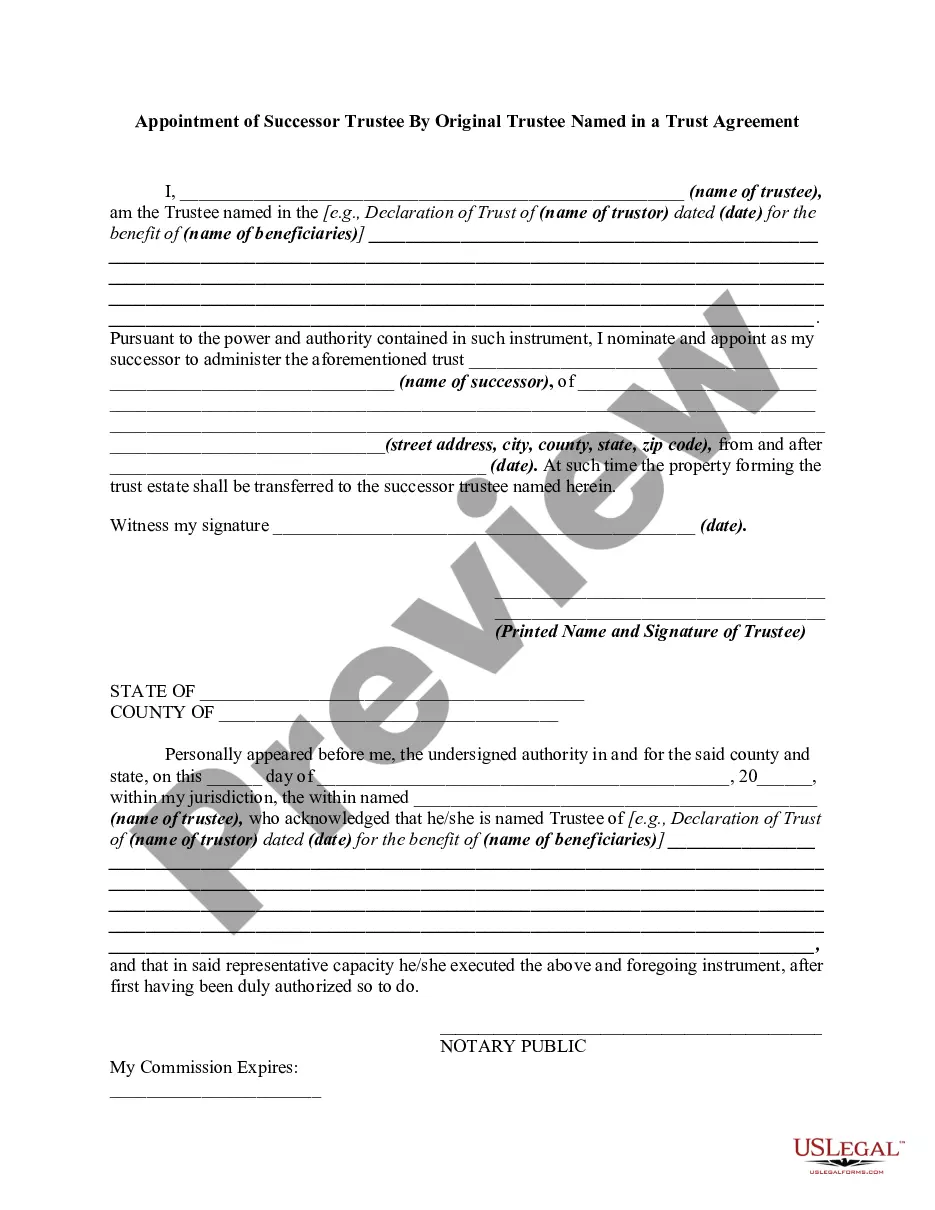
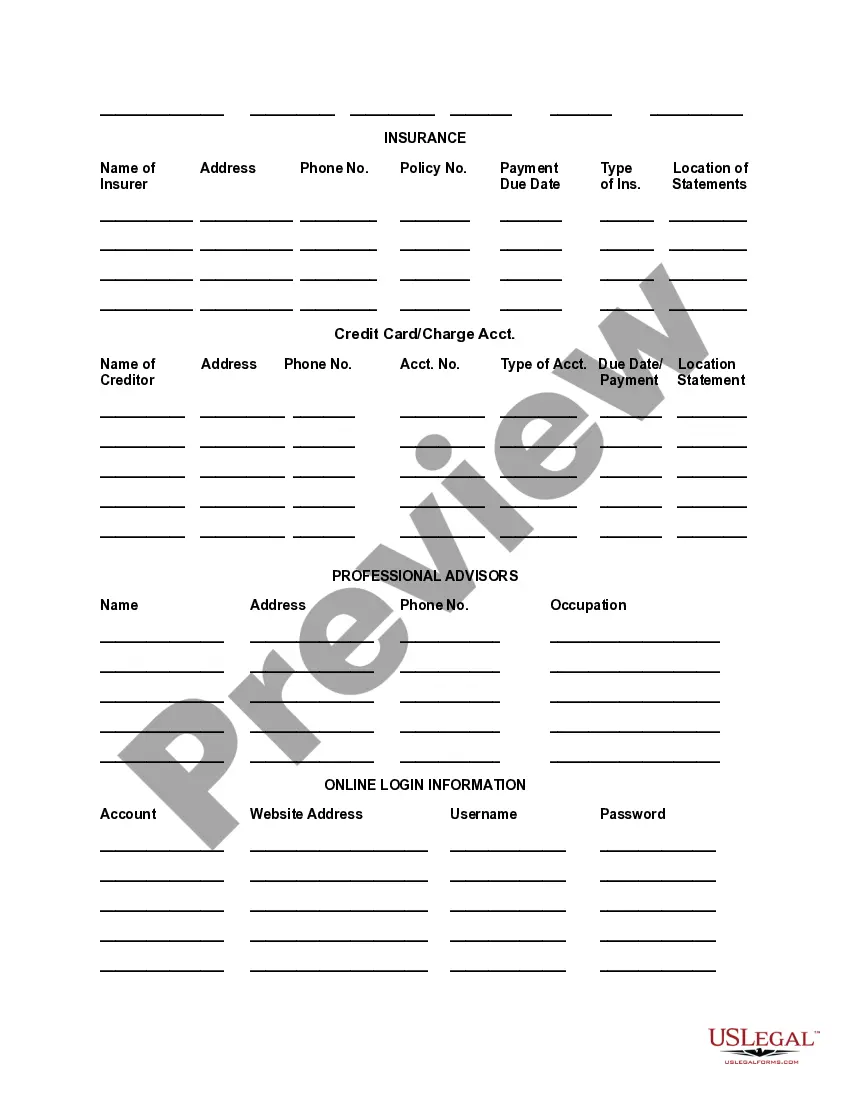
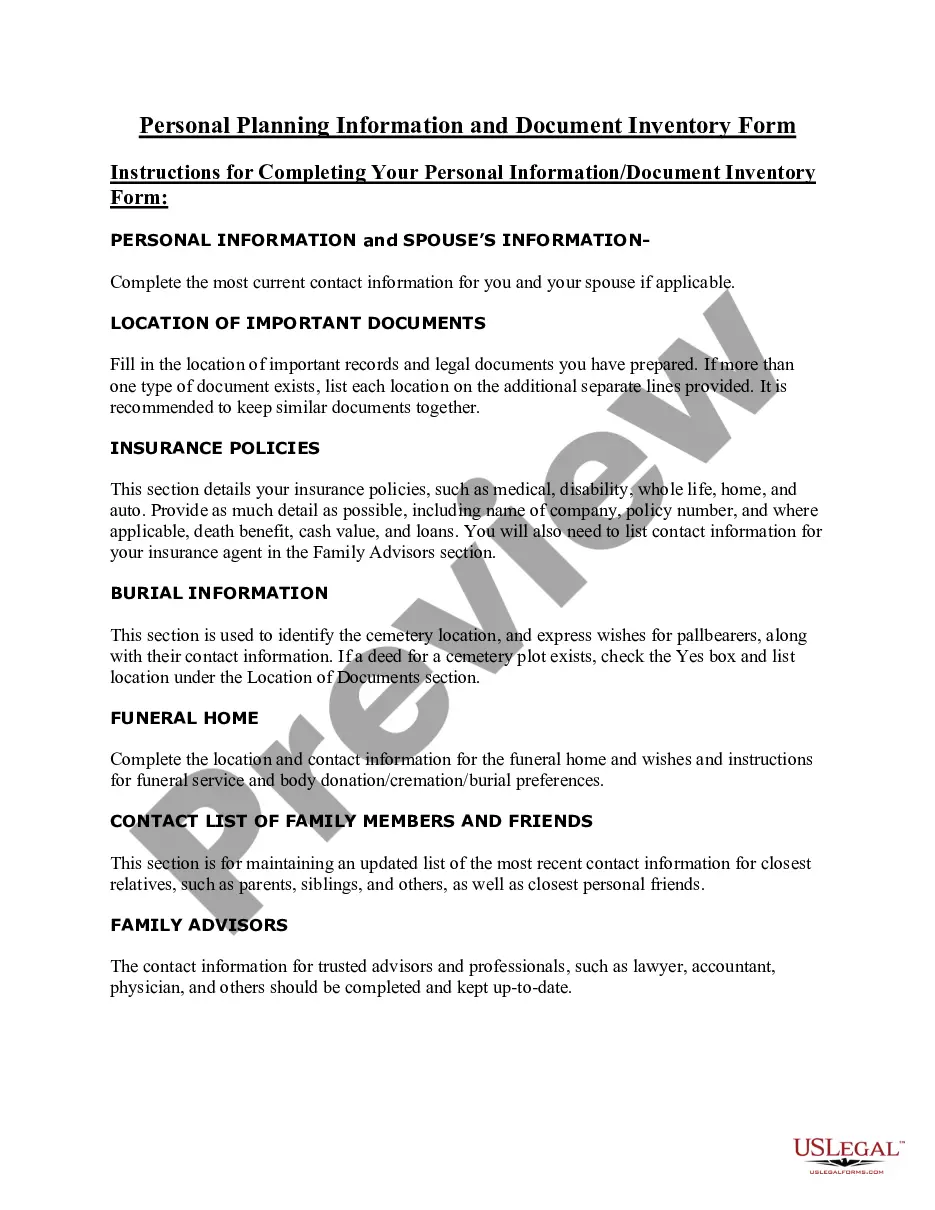
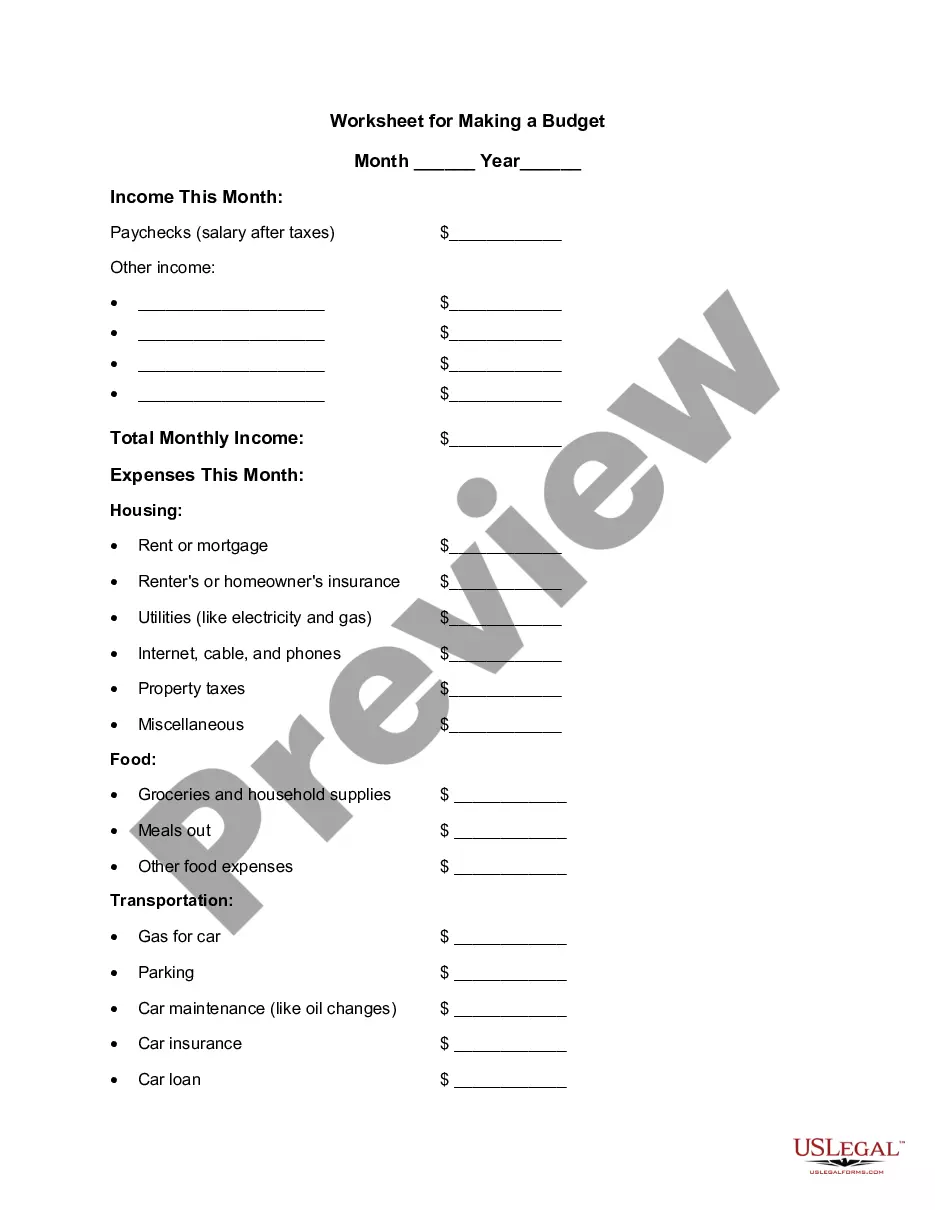
Connecticut Personal Financial Information Organizer
Description


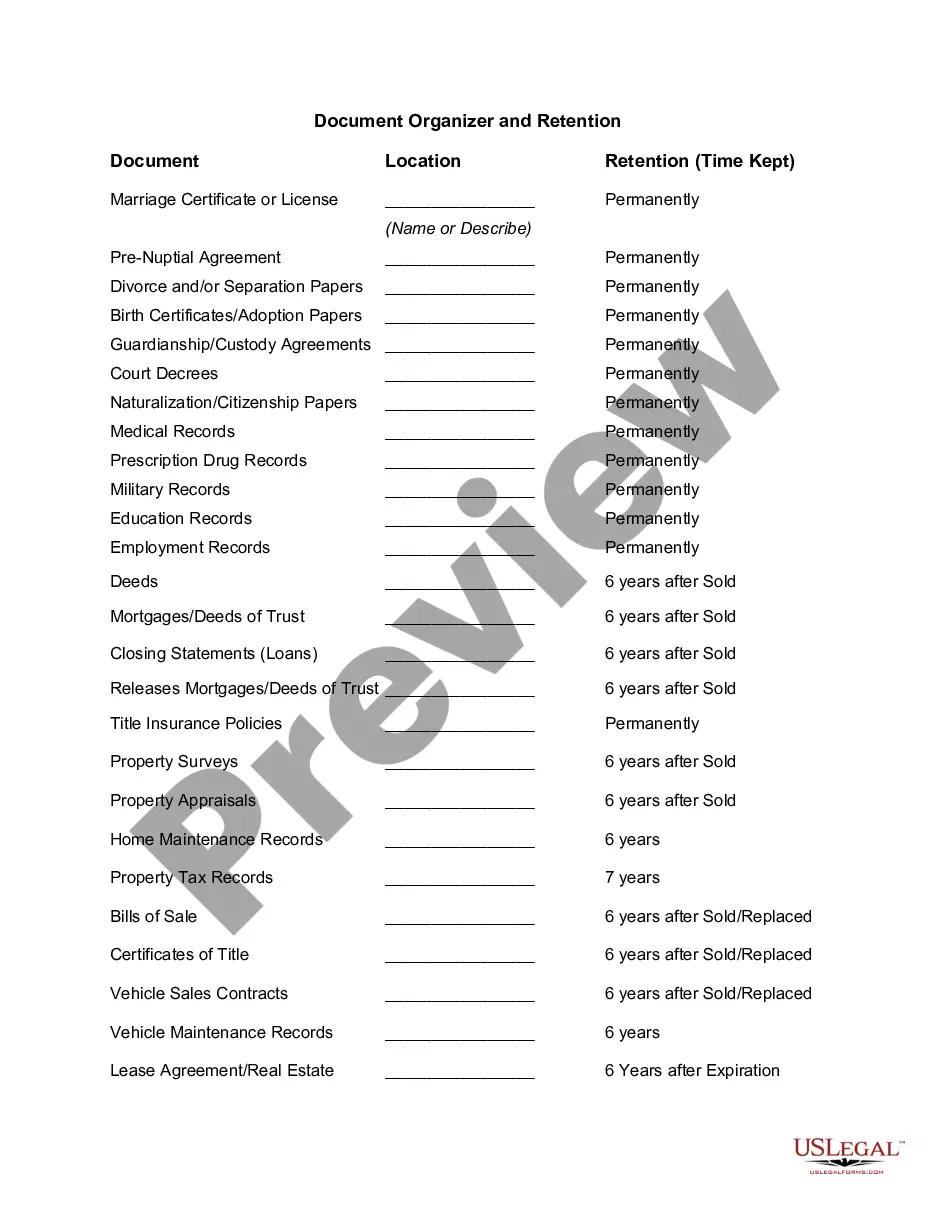
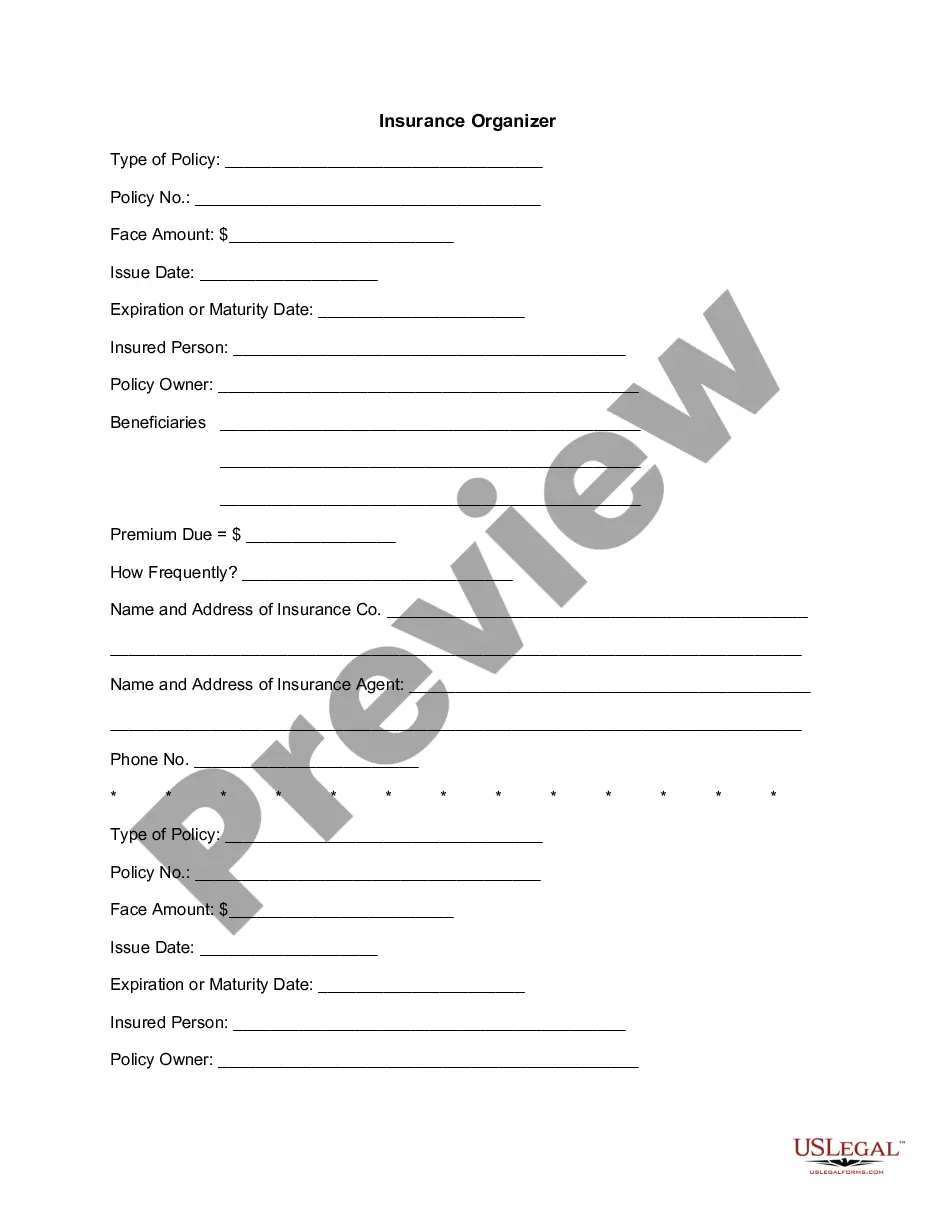
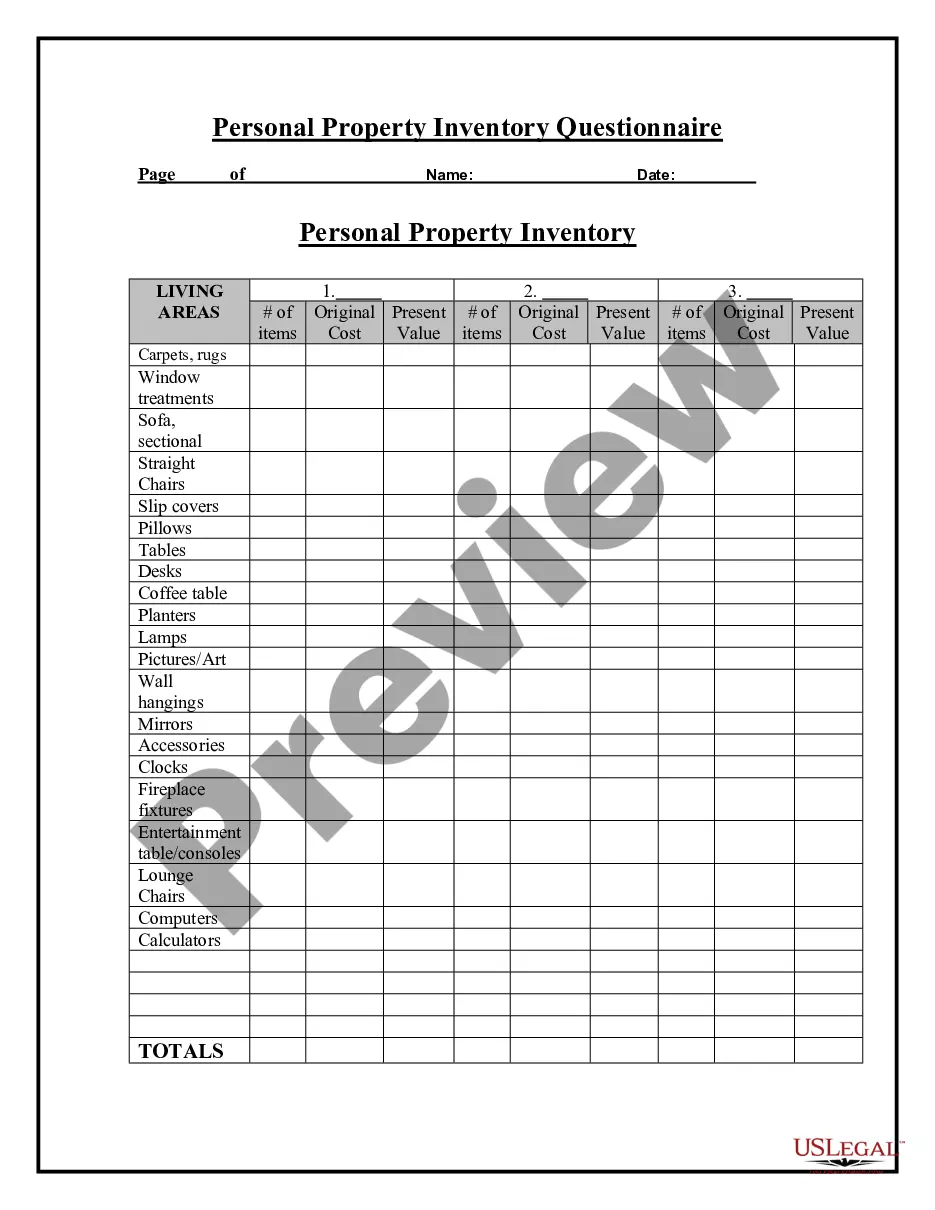
Get your form ready online
Our built-in tools help you complete, sign, share, and store your documents in one place.
Make edits, fill in missing information, and update formatting in US Legal Forms—just like you would in MS Word.
Download a copy, print it, send it by email, or mail it via USPS—whatever works best for your next step.
Sign and collect signatures with our SignNow integration. Send to multiple recipients, set reminders, and more. Go Premium to unlock E-Sign.
If this form requires notarization, complete it online through a secure video call—no need to meet a notary in person or wait for an appointment.
We protect your documents and personal data by following strict security and privacy standards.

Make edits, fill in missing information, and update formatting in US Legal Forms—just like you would in MS Word.

Download a copy, print it, send it by email, or mail it via USPS—whatever works best for your next step.

Sign and collect signatures with our SignNow integration. Send to multiple recipients, set reminders, and more. Go Premium to unlock E-Sign.

If this form requires notarization, complete it online through a secure video call—no need to meet a notary in person or wait for an appointment.

We protect your documents and personal data by following strict security and privacy standards.
Looking for another form?


How to fill out Personal Financial Information Organizer?
Are you currently in a role that requires documentation for either business or personal purposes almost daily.
There are many legal document templates available online, but finding ones you can trust is not easy.
US Legal Forms provides thousands of template forms, including the Connecticut Personal Financial Information Organizer, which can be customized to meet federal and state standards.
Once you find the correct form, click Get now.
Choose a convenient file format and download your copy.
- If you are already familiar with the US Legal Forms website and have an account, simply Log In.
- After that, you can download the Connecticut Personal Financial Information Organizer template.
- If you do not have an account and wish to begin using US Legal Forms, follow these steps.
- Select the form you need and ensure it is for the correct city/region.
- Utilize the Preview button to inspect the form.
- Read the description to confirm you have chosen the right document.
- If the form is not what you are searching for, use the Search field to locate the form that suits your needs.
Form popularity
FAQ
ChFC and CFP are two types of financial planning designations. ChFC is the designation for chartered financial consultants, and CFP is the designation for certified financial planners. These certifications verify a financial professional's knowledge, expertise and commitment to upholding the highest ethical standards.
A Chartered Financial Consultant completes a course that covers financial education and practical experience. The ChFC degree includes topics such as estate planning and employee benefits planning. After earning the designation, earning continuing education credits is required.
Educational Requirements There are no prerequisite courses required before you can begin the ChFC® program, but three years full-time, relevant business experience and a high school diploma or the equivalent ARE required to use the designation.
Becoming a financial planner requires a bachelor's degree, along with courses in investments, taxes, estate planning, and risk management. If you're comfortable with sales, are great with people, have excellent analytical and communication skills, and can work independently, financial planning may be right for you.
Certified Financial Planner (CFP) Hold a bachelor's degree, plus 3 years experience. Personal Financial Specialist (PFS) Have 75 hours personal financial planning education; also, hold a CPA, which requires a degree, plus 2 years experience.
Unlike some certificates that are worth little more than the paper they're printed on, the CFP designation is one of the most prestigious financial certificates around. The CFP designation offered by the CFP board is one that is actually significant because it requires so much preliminary work," said Sotudeh.
The ChFC degree program requires students to complete nine college-level courses or 27 hours of college credit in the field. Students must achieve mastery of more than 100 integrated advanced financial planning topics, including: Estate Planning. Insurance Planning.
The differences lie more in what's required to earn each certification. The ChFC designation requires more coursework, but both CFPs and ChFCs study the same basic topics. A CFP is required to take seven courses, while a ChFC must take nine courses, two of which are application-based courses.
Chartered Financial Consultant: Advanced Financial Planning The Chartered Financial Consultant (ChFC) credential was introduced in 1982 as an alternative to the CFP mark. This designation is also available through the American College.
Educational requirements.A college degree is not necessary to enroll to become a ChFC, Riskin says. But most individuals taking classes to become a ChFC are nontraditional students who may already be working in the field, he says.