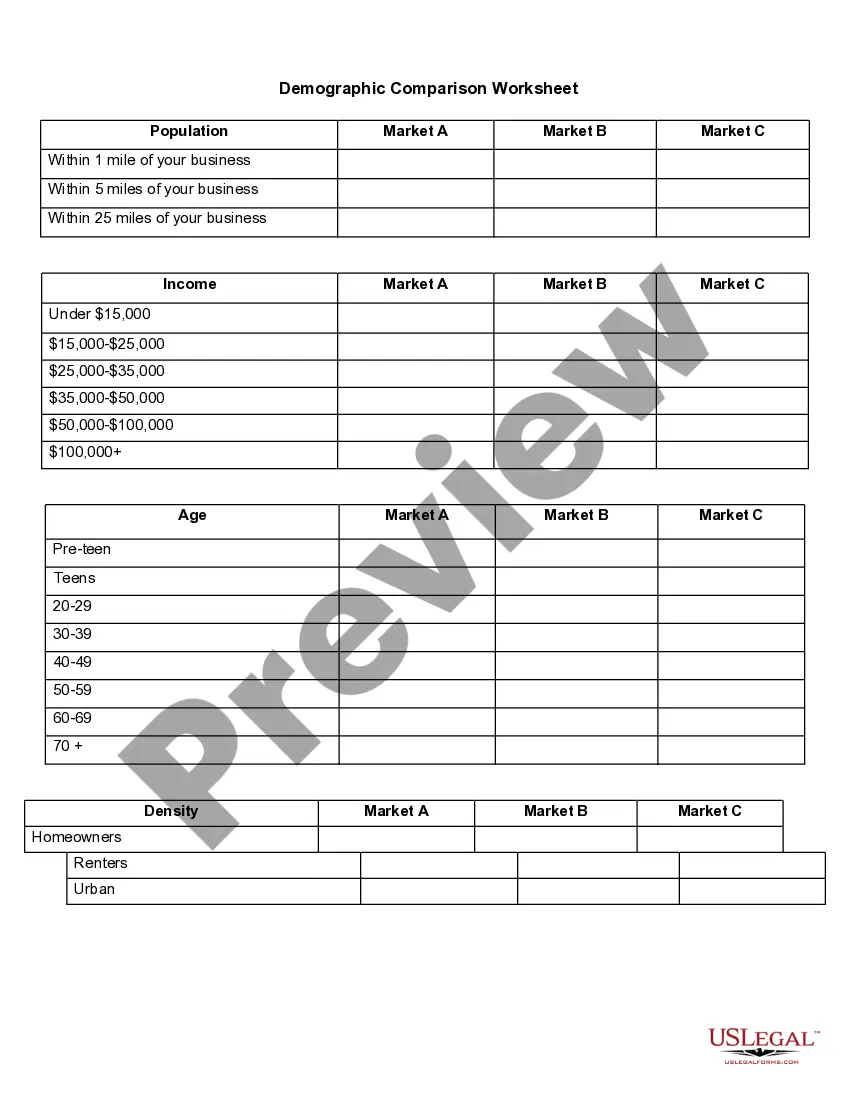
Connecticut Demographic Comparison Worksheet
Description
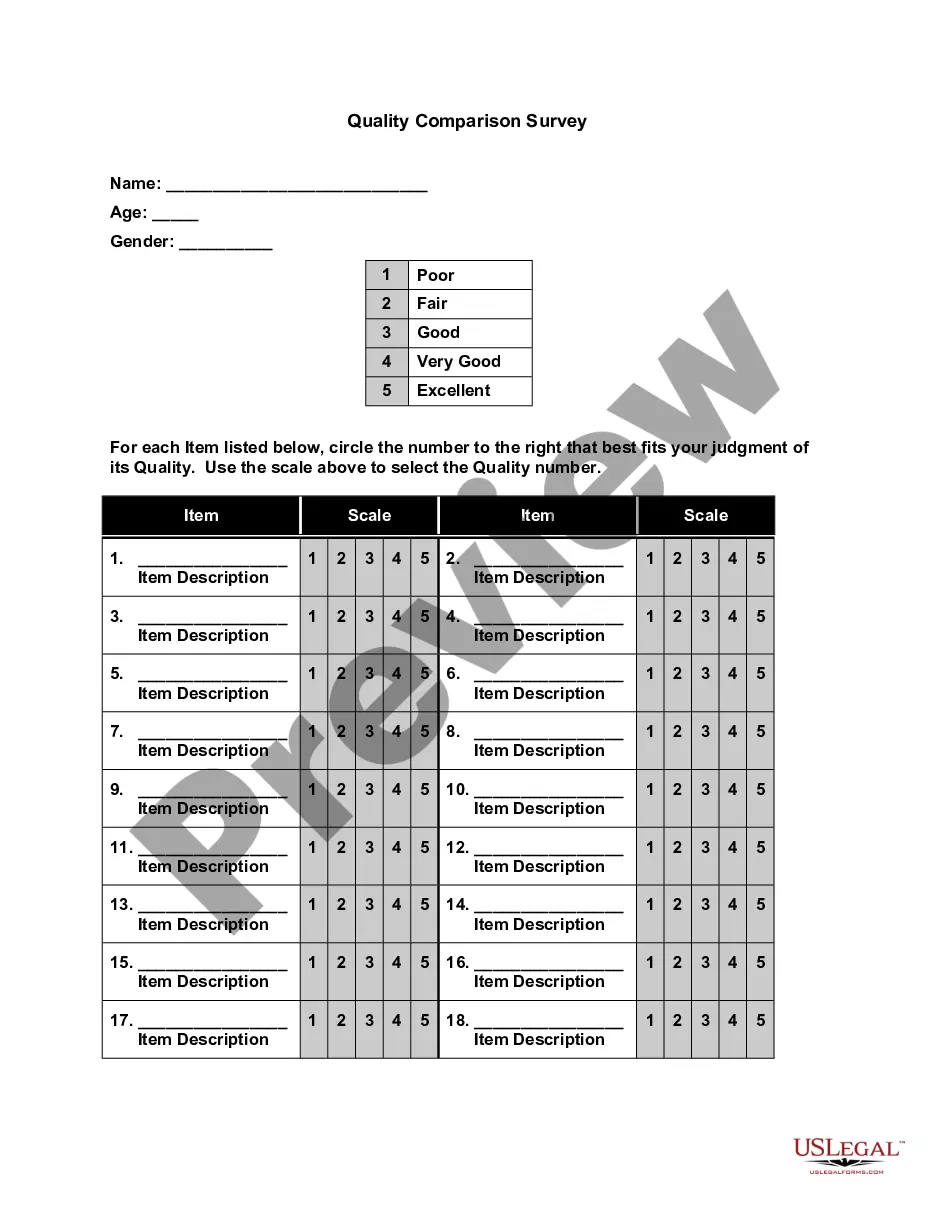
Get your form ready online
Our built-in tools help you complete, sign, share, and store your documents in one place.
Make edits, fill in missing information, and update formatting in US Legal Forms—just like you would in MS Word.
Download a copy, print it, send it by email, or mail it via USPS—whatever works best for your next step.
Sign and collect signatures with our SignNow integration. Send to multiple recipients, set reminders, and more. Go Premium to unlock E-Sign.
If this form requires notarization, complete it online through a secure video call—no need to meet a notary in person or wait for an appointment.
We protect your documents and personal data by following strict security and privacy standards.

Make edits, fill in missing information, and update formatting in US Legal Forms—just like you would in MS Word.

Download a copy, print it, send it by email, or mail it via USPS—whatever works best for your next step.

Sign and collect signatures with our SignNow integration. Send to multiple recipients, set reminders, and more. Go Premium to unlock E-Sign.

If this form requires notarization, complete it online through a secure video call—no need to meet a notary in person or wait for an appointment.

We protect your documents and personal data by following strict security and privacy standards.
Looking for another form?





How to fill out Demographic Comparison Worksheet?
Are you facing a circumstance where you require documents for potentially professional or personal reasons almost every day? There is a range of legal document formats accessible online, but finding trustworthy versions can be challenging.
US Legal Forms offers thousands of template options, including the Connecticut Demographic Comparison Worksheet, designed to comply with both state and federal requirements.
If you are already familiar with the US Legal Forms website and have an account, simply Log In. Afterwards, you can download the Connecticut Demographic Comparison Worksheet template.
Choose a convenient document format and download your copy.
Access all the document templates you have purchased in the My documents section. You can get an additional copy of the Connecticut Demographic Comparison Worksheet at any time if needed. Just navigate through the required form to download or print the document template.
- If you do not have an account and want to start using US Legal Forms, follow these steps.
- Locate the form you need and ensure it is for the correct city/area.
- Use the Review button to evaluate the form.
- Check the description to confirm that you have selected the appropriate form.
- If the form is not what you're looking for, use the Search field to find the form that meets your criteria.
- Once you find the correct form, click Get now.
- Select the payment plan you require, fill in the necessary information to create your account, and complete the transaction using your PayPal or credit card.
Form popularity
FAQ
In Connecticut in 2020, 17.2% of the total population was Hispanic, 65.3% were white, 10.5% were black, 0.2% were American Indian/Alaska Native and 4.9% were Asian/Pacific Islander.
Retrieved April 27, 2022, from . In Connecticut in 2020, 17.2% of the total population was Hispanic, 65.3% were white, 10.5% were black, 0.2% were American Indian/Alaska Native and 4.9% were Asian/Pacific Islander.
According to U.S. 2020 Census Results, CT population in 2020 is 3,605,944. Connecticut population in 2021 is estimated to be 3.6 million.
Retrieved , from . In Connecticut in 2020, 17.2% of the total population was Hispanic, 65.3% were white, 10.5% were black, 0.2% were American Indian/Alaska Native and 4.9% were Asian/Pacific Islander.
Towns with the highest share of Black or African American non-Hispanic population are Bloomfield (53.1; -3.1% from 2010), Hartford (35.5%; +0.1%), Windsor (35.1%, +1.9%), Bridgeport (32.8%; +0.5), and New Haven (30.4%; -3.0%).
Let's begin at home. Connecticut ranks 29th out of 51 (states and D.C.) in racial and ethnic diversity, with 66.4% of people in the Census indicating they are white. Connecticut's share of Black, Indigenous, and People of Color (BIPOC) residents increased from 22.5% in 2000, to 28.8% in 2010, and to 36.8% in 2020.
Connecticut DemographicsWhite: 75.92% Black or African American: 10.72% Other race: 5.21% Asian: 4.51%
In Connecticut in 2020, 17.2% of the total population was Hispanic, 65.3% were white, 10.5% were black, 0.2% were American Indian/Alaska Native and 4.9% were Asian/Pacific Islander.