Connecticut Dissolution of Civil Union Judgment
About this form
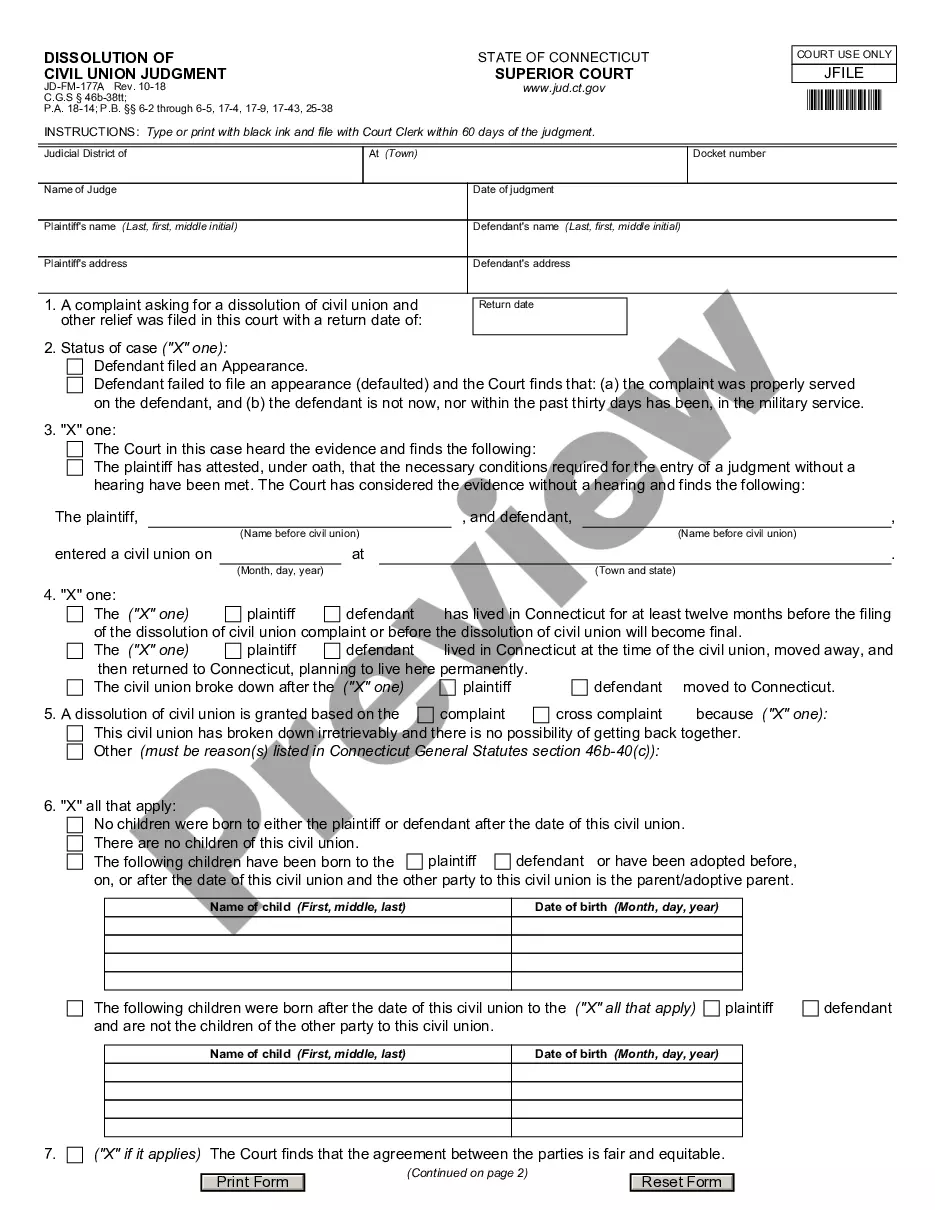
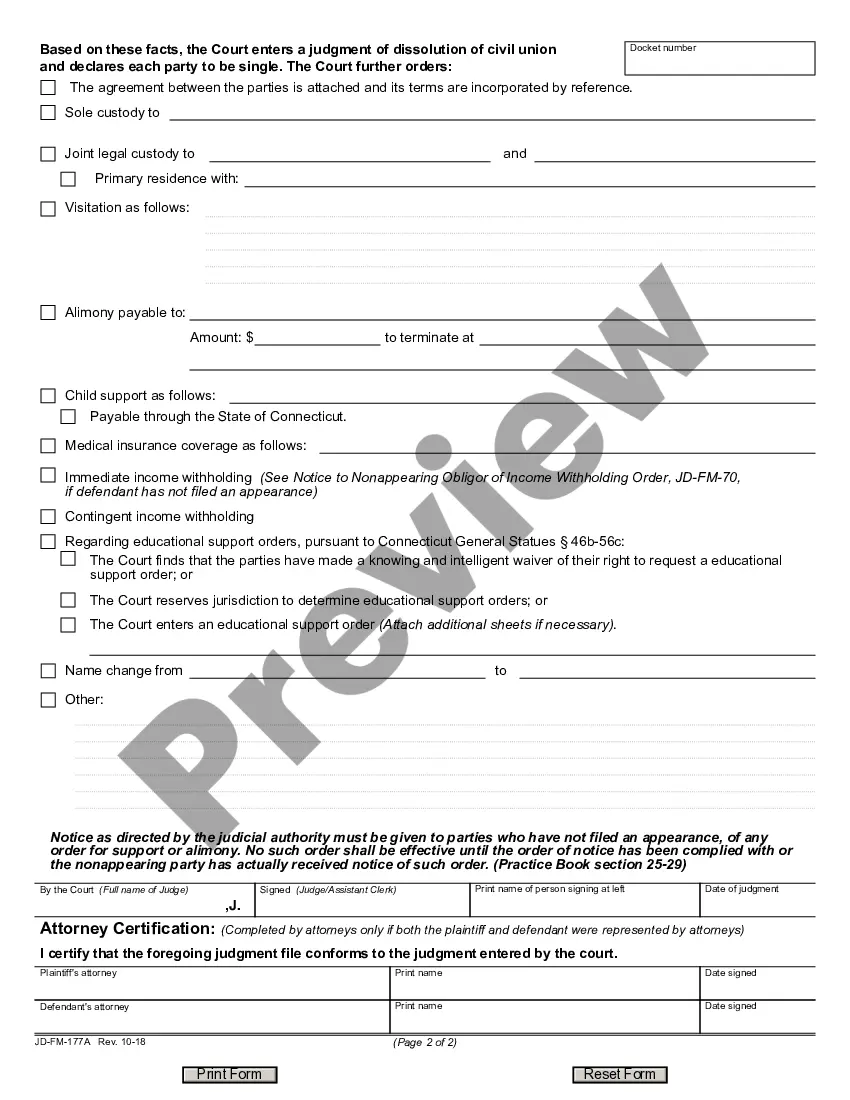
The Dissolution of Civil Union Judgment is a legal document used to formally end a civil union in Connecticut. This form outlines the court's decision to dissolve the union and addresses any related matters such as child custody and alimony. Unlike divorce forms, this judgment specifically pertains to civil unions recognized in the state, ensuring compliance with Connecticut laws and statutes.
Main sections of this form
- Parties involved: Names and addresses of the plaintiff and defendant.
- Judicial findings: Facts supporting the dissolution, including whether the civil union has irretrievably broken down.
- Children: Information about any children pertaining to the civil union, including custody arrangements.
- Judgment details: Declaration of dissolution and provisions for custody, support, and other agreements.
- Signature lines: Space for the judge, plaintiff's attorney, and defendant's attorney to sign.
Common use cases
This form is needed when a couple in a civil union has decided to legally dissolve their relationship. Use it if you have filed a complaint for dissolution and the court has found sufficient grounds to grant this request, ensuring that all conditions are met.
Who can use this document
This form is intended for:
- Individuals currently in a civil union in Connecticut seeking dissolution.
- Couples who have already filed a complaint for dissolution in the court.
- Those who have agreed on issues surrounding custody and support and need court approval.
How to complete this form
- Identify the parties: Enter the full names and addresses of the plaintiff and defendant.
- Specify the case status: Indicate whether the defendant has filed an appearance.
- Provide dates: Fill in the date of the judgment and any relevant dates of birth for children.
- Detail custody and support arrangements: Clearly outline agreements on custody, visitation, alimony, and child support.
- Sign and date the form: Ensure the judge and attorneys sign where indicated.
Does this form need to be notarized?
This form does not typically require notarization unless specified by local law. It is important to check any additional requirements set forth by the court or your attorney.
Get your form ready online
Our built-in tools help you complete, sign, share, and store your documents in one place.
Make edits, fill in missing information, and update formatting in US Legal Forms—just like you would in MS Word.
Download a copy, print it, send it by email, or mail it via USPS—whatever works best for your next step.
Sign and collect signatures with our SignNow integration. Send to multiple recipients, set reminders, and more. Go Premium to unlock E-Sign.
If this form requires notarization, complete it online through a secure video call—no need to meet a notary in person or wait for an appointment.
We protect your documents and personal data by following strict security and privacy standards.

Make edits, fill in missing information, and update formatting in US Legal Forms—just like you would in MS Word.

Download a copy, print it, send it by email, or mail it via USPS—whatever works best for your next step.

Sign and collect signatures with our SignNow integration. Send to multiple recipients, set reminders, and more. Go Premium to unlock E-Sign.

If this form requires notarization, complete it online through a secure video call—no need to meet a notary in person or wait for an appointment.

We protect your documents and personal data by following strict security and privacy standards.
Common mistakes to avoid
- Failing to file within the 60-day deadline after the judgment.
- Omitting necessary details about children or custody arrangements.
- Not obtaining required signatures from all parties involved.
- Filing the form in the wrong court jurisdiction.
Advantages of online completion
- Instant access to legally compliant forms drafted by licensed attorneys.
- Ability to fill out and edit the form at your convenience before submission.
- Reduced risk of errors with guided instructions throughout the process.
Legal use & context
- This form is enforceable in Connecticut as a legally binding order concerning the dissolution of a civil union.
- Proper completion and filing with the court ensure that all rights and obligations are formally recognized.
- It is advised to seek legal counsel to ensure compliance with current laws and individualized circumstances.
What to keep in mind
- The Dissolution of Civil Union Judgment is essential for formally ending a civil union in Connecticut.
- Proper execution and timely filing of the form are critical to its effectiveness.
- Addressing all pertinent details regarding children and support arrangements can help prevent future disputes.
Looking for another form?
Form popularity
FAQ
Connecticut online divorce services can be legitimate and effective for obtaining a Connecticut Dissolution of Civil Union Judgment. You should verify the site's credibility and read user feedback to ensure it meets your needs. Many users find online services to be a practical solution, particularly when paired with platforms like uslegalforms, which offer comprehensive assistance throughout the process.
In Connecticut, it is possible to pursue a divorce without hiring a lawyer, including for a Connecticut Dissolution of Civil Union Judgment. Individuals can represent themselves if they understand the necessary paperwork and procedures. However, legal advice can be beneficial in complex situations. Uslegalforms provides helpful resources and guidance to make self-representation easier.
Yes, Connecticut allows online divorce processes, including the Connecticut Dissolution of Civil Union Judgment. Many couples find convenience in filing online, as it can save time and simplify paperwork. It's essential to confirm that the website you choose complies with state regulations. Uslegalforms can guide you through the process efficiently.
Many online divorce websites operate legitimately and provide valuable resources for those seeking a Connecticut Dissolution of Civil Union Judgment. However, it is crucial to do thorough research before choosing a platform. Look for customer reviews, testimonials, and ensure they have a clear outline of their services. Websites like uslegalforms offer a reliable option tailored for your legal needs.
Civil law encompasses various legal aspects, including family law, which covers divorce. However, civil law is not synonymous with divorce; it refers to the broad category that includes multiple legal issues. For clarity on divorce in Connecticut or the Connecticut Dissolution of Civil Union Judgment, consulting knowledgeable resources is advisable.
To file for divorce in Connecticut, you will need specific forms such as the petition for dissolution of marriage and financial affidavits. These documents outline your assets, income, and other relevant details. For civil union matters, knowing which forms apply to the Connecticut Dissolution of Civil Union Judgment is essential.
Dissolution of a civil union is the legal process that terminates the partnership recognized by civil union status. This process involves resolving issues such as asset distribution and custody if children are involved. When seeking a Connecticut Dissolution of Civil Union Judgment, utilizing comprehensive resources can simplify the journey.
To dissolve a marriage in Connecticut, you must file a petition with the court and meet specific residency requirements. The process involves submitting various forms and possibly attending a hearing. For those facing dissolution of a civil union, understanding the Connecticut Dissolution of Civil Union Judgment is key to navigating your case effectively.
Civil union dissolution is similar to divorce but applies to civil unions rather than marriages. The legal procedures and rights may vary between the two. With a Connecticut Dissolution of Civil Union Judgment, individuals can ensure that their civil union matters are resolved competently and fairly.
Dissolution refers to the legal process of ending a civil union or marriage, while divorce specifically pertains to the termination of a marriage. In Connecticut, both processes involve a court ruling, but they have different legal implications. Understanding the distinction can be beneficial when seeking a Connecticut Dissolution of Civil Union Judgment.