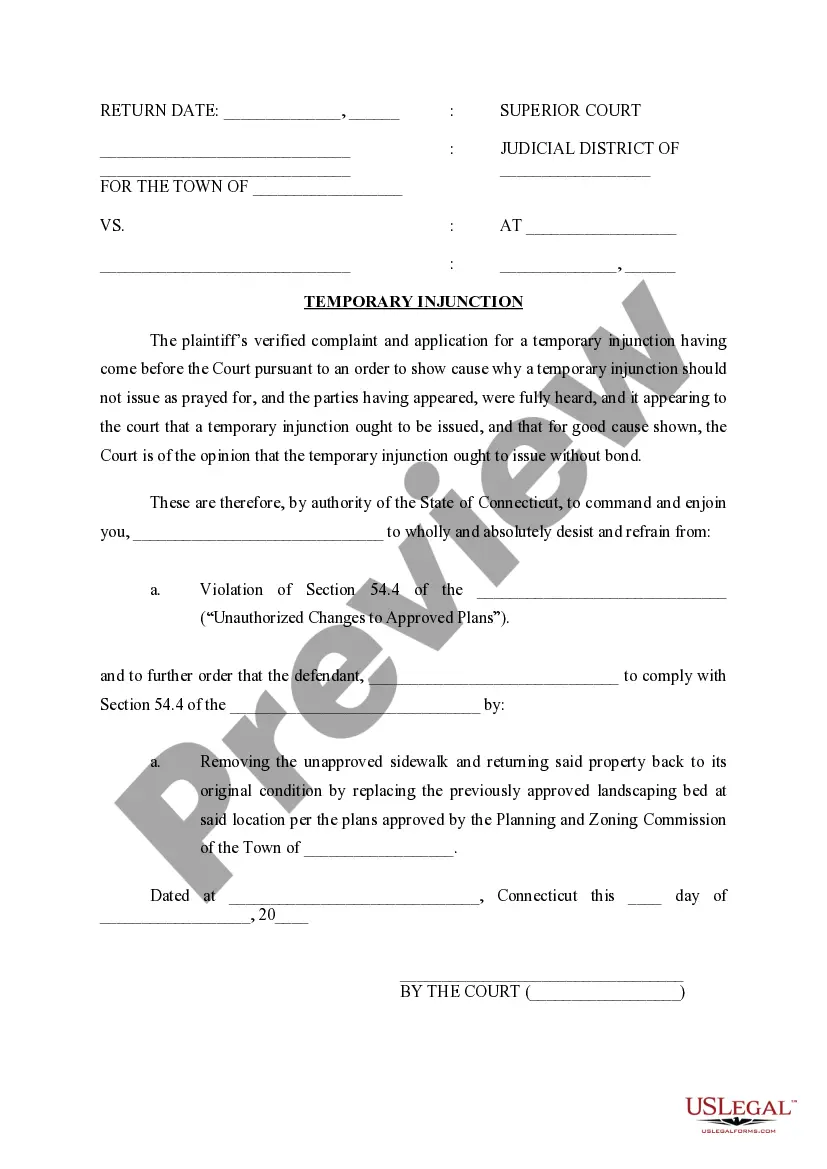
Connecticut Temproary Injunction
What this document covers
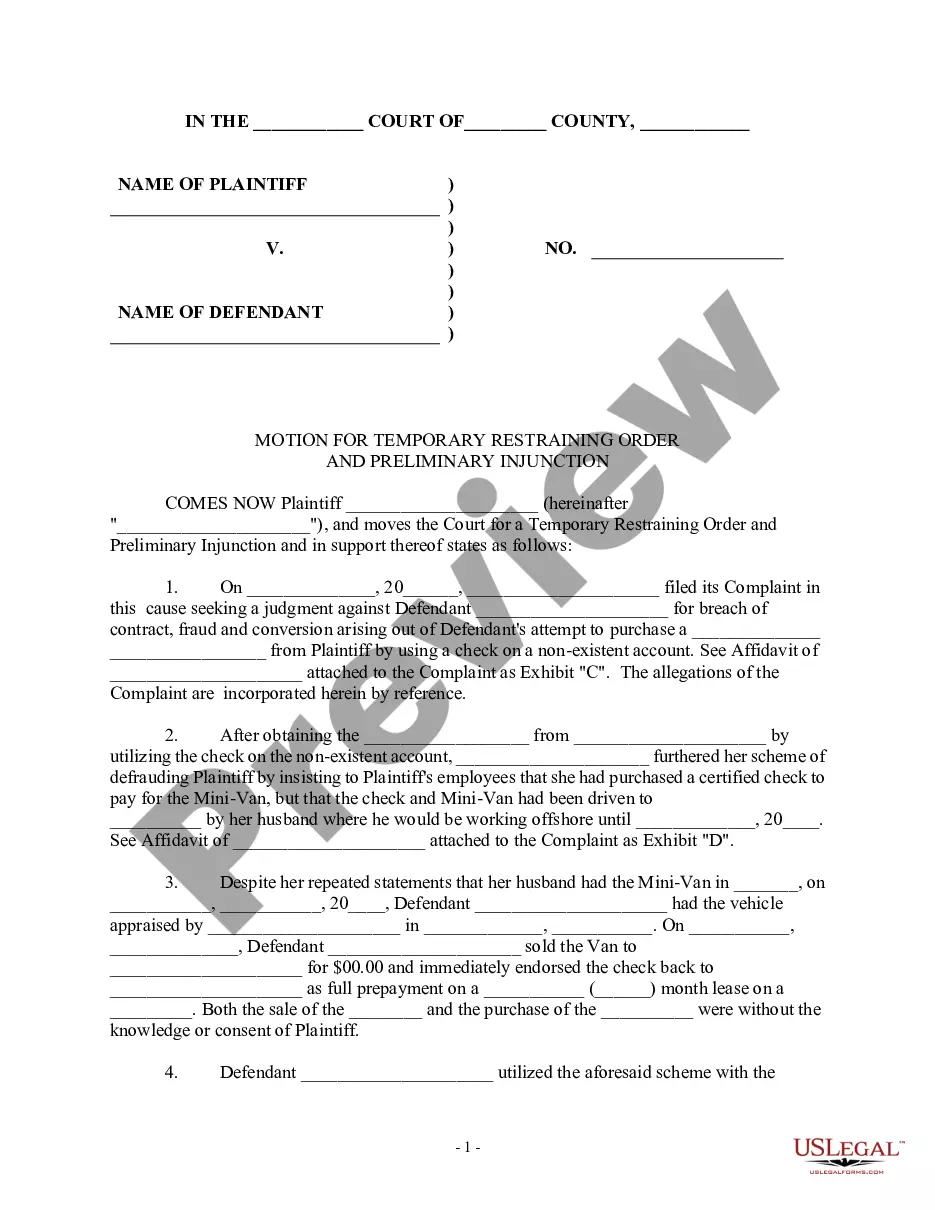
A temporary injunction is a court order that temporarily prohibits a party from taking a specific action while a lawsuit is pending. This legal document is crucial in situations where immediate action is necessary to prevent harm or maintain the status quo before the court renders a final decision. Unlike other types of injunctions, a temporary injunction is issued on a provisional basis, thus allowing the case to proceed towards a trial or further court action.
Key parts of this document
- Return date: To indicate when the court hearing will occur.
- Superior Court designation: Specifies the court where the order is issued.
- Parties involved: Identification of the plaintiff and defendant.
- Order to desist: Clear directives for the defendant on what actions to refrain from.
- Compliance instructions: Details any actions the defendant must take to comply with the injunction.
- Date and signature: Certification by the court on the issuance of the injunction.

When to use this document
This form is necessary when there is an urgent need to prevent a party from acting in a way that could harm another party while a lawsuit is being resolved. For example, if construction work is altering a property without approval, a temporary injunction can stop further changes until the situation is rectified. Use this form when it is critical to enforce rights or to preserve evidence that may be lost if the actions continue.
Who this form is for
- Individuals or entities seeking legal protection before a trial.
- Parties involved in disputes concerning property rights or contractual obligations.
- Anyone needing to halt certain actions that could cause irreparable harm.
How to complete this form
- Identify the parties involved, including the plaintiff and defendant.
- Fill in the return date for the court hearing.
- Clearly state the actions the defendant must cease.
- Outline specific compliance instructions regarding any approved plans.
- Provide the date and the signature of the court official issuing the injunction.
Is notarization required?
This form does not typically require notarization unless specified by local law. However, it is important to check court requirements to ensure compliance.
Get your form ready online
Our built-in tools help you complete, sign, share, and store your documents in one place.
Make edits, fill in missing information, and update formatting in US Legal Forms—just like you would in MS Word.
Download a copy, print it, send it by email, or mail it via USPS—whatever works best for your next step.
Sign and collect signatures with our SignNow integration. Send to multiple recipients, set reminders, and more. Go Premium to unlock E-Sign.
If this form requires notarization, complete it online through a secure video call—no need to meet a notary in person or wait for an appointment.
We protect your documents and personal data by following strict security and privacy standards.

Make edits, fill in missing information, and update formatting in US Legal Forms—just like you would in MS Word.

Download a copy, print it, send it by email, or mail it via USPS—whatever works best for your next step.

Sign and collect signatures with our SignNow integration. Send to multiple recipients, set reminders, and more. Go Premium to unlock E-Sign.

If this form requires notarization, complete it online through a secure video call—no need to meet a notary in person or wait for an appointment.

We protect your documents and personal data by following strict security and privacy standards.
Typical mistakes to avoid
- Failing to include the correct return date for the court appearance.
- Not clearly specifying the actions to be prohibited.
- Omitting necessary signatures or dates, which can invalidate the form.
Why use this form online
- Immediate access to the form at any time, allowing for quick action.
- Editable fields ensure you can customize it for your particular situation.
- Reliability in obtaining templates drafted by licensed attorneys.
Looking for another form?

Form popularity
FAQ
When seeking a Connecticut Temporary Injunction, several factors come into play. Courts typically assess the likelihood of success on the merits of the case, the potential for irreparable harm, and whether the injunction serves the public interest. These elements are crucial, as they help determine if immediate action is necessary to prevent harm before the case is resolved. Consider visiting USLegalForms for guidance on navigating this complex process.
One disadvantage of a Connecticut Temporary Injunction is that it can be time-consuming and costly to pursue. Legal fees and court costs may add up quickly during the process. Additionally, it may not provide a permanent solution to the underlying issue, leaving the concerned parties to seek further legal remedies later. It's important to weigh these factors carefully before filing.
While it is technically possible to file for a Connecticut temporary injunction without an attorney, it is highly recommended to seek legal counsel. An attorney can guide you through the complex legal processes and increase your chances of a successful outcome. They will also help you gather necessary evidence and prepare persuasive documents. Utilizing resources like US Legal Forms can further simplify your efforts while ensuring you cover all the necessary legal bases.
Injunctions can carry several disadvantages, particularly in a Connecticut temporary injunction context. One significant drawback is that obtaining an injunction can be time-consuming and costly, often requiring extensive legal fees. Additionally, if the court denies the motion for an injunction, the unsuccessful party may face additional costs and heightened exposure to legal liabilities. Therefore, it is crucial to weigh these factors carefully when considering pursuing an injunction.
The two most common types of injunctions are preliminary injunctions and permanent injunctions. A Connecticut temporary injunction typically falls under the category of preliminary injunctions, which provide immediate relief to a party while a case is pending. Conversely, a permanent injunction is issued after a trial and provides lasting protection against specific actions. Recognizing these styles can help you navigate the legal landscape more effectively.
An effective example of a Connecticut temporary injunction occurs when a court order mandates a party to cease certain actions to prevent irreparable harm. For instance, if a business infringes on a competitor's trademark, a court may issue a temporary injunction to halt the use of that trademark until a case is resolved. This legal action helps preserve the status quo and protects the rights of the affected party. Understanding such examples can clarify the importance of the Connecticut temporary injunction in legal disputes.
A preliminary injunction is a temporary order intended to maintain the status quo until a case is resolved, while a permanent injunction is issued only after a final judgment. In instances of a Connecticut Temporary Injunction, the focus is on immediate relief. Understanding these differences can help you determine which type of injunction best fits your legal needs.
The three main types of injunctions are temporary, preliminary, and permanent injunctions. A Connecticut Temporary Injunction serves to offer immediate protection of rights during a legal case. Preliminary injunctions may last longer while the case is ongoing, and permanent injunctions are issued after a trial concludes.
A suit for an injunction might be most appropriate in situations involving urgent legal disputes, such as disputes over property use or cases of harassment. When time is of the essence, and harm is likely if action is not taken, a Connecticut Temporary Injunction can provide the needed relief. It's important to assess the circumstances and consult with legal professionals to determine your best course of action.
Yes, you can seek a temporary injunction if you demonstrate that you will suffer irreparable harm without immediate court intervention. In Connecticut, providing evidence of urgency and potential damage is crucial in obtaining a Connecticut Temporary Injunction. Consulting legal experts can enhance your chances of a successful motion.