Colorado Transfer on Death Deed or TOD - Beneficiary Deed - Husband and Wife to Individual
Overview of this form
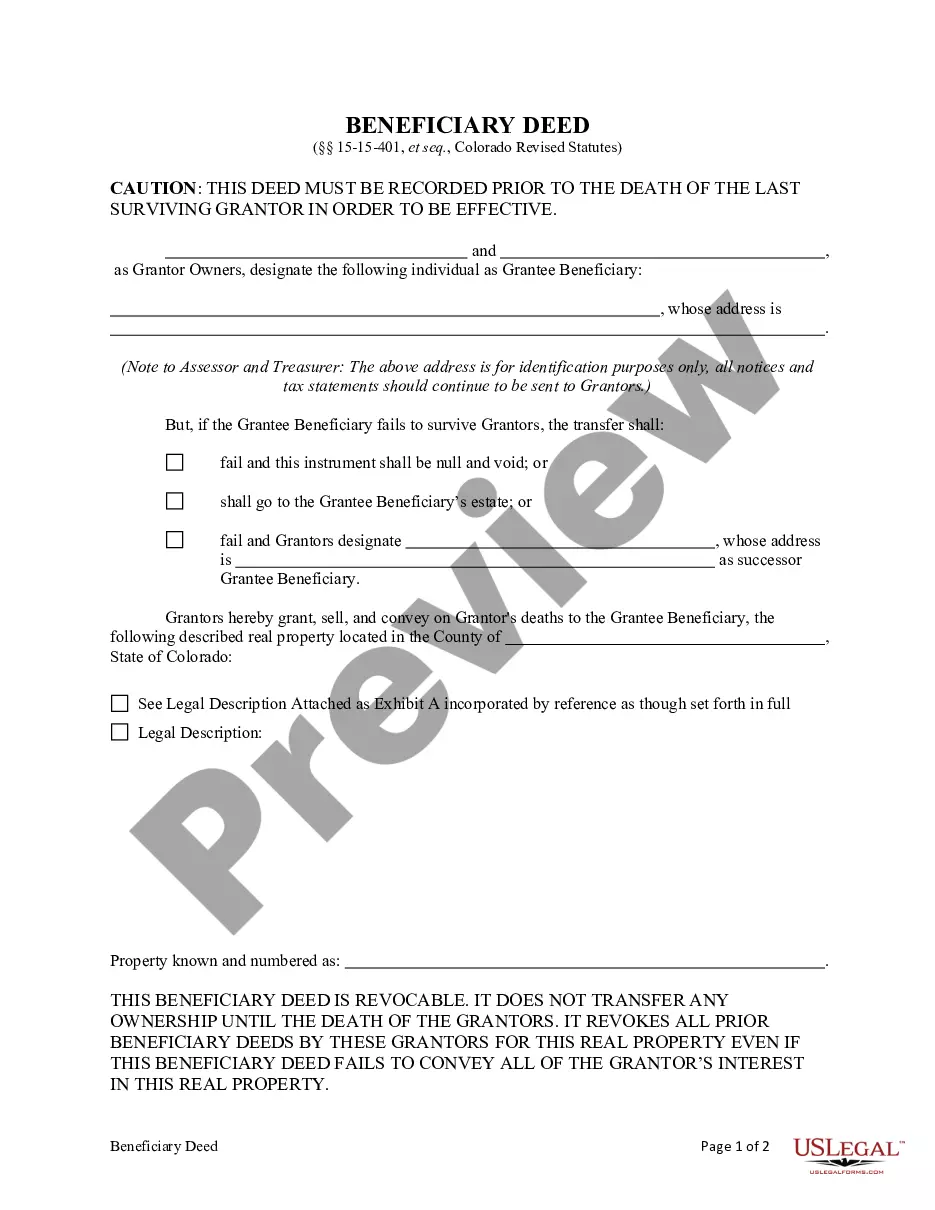
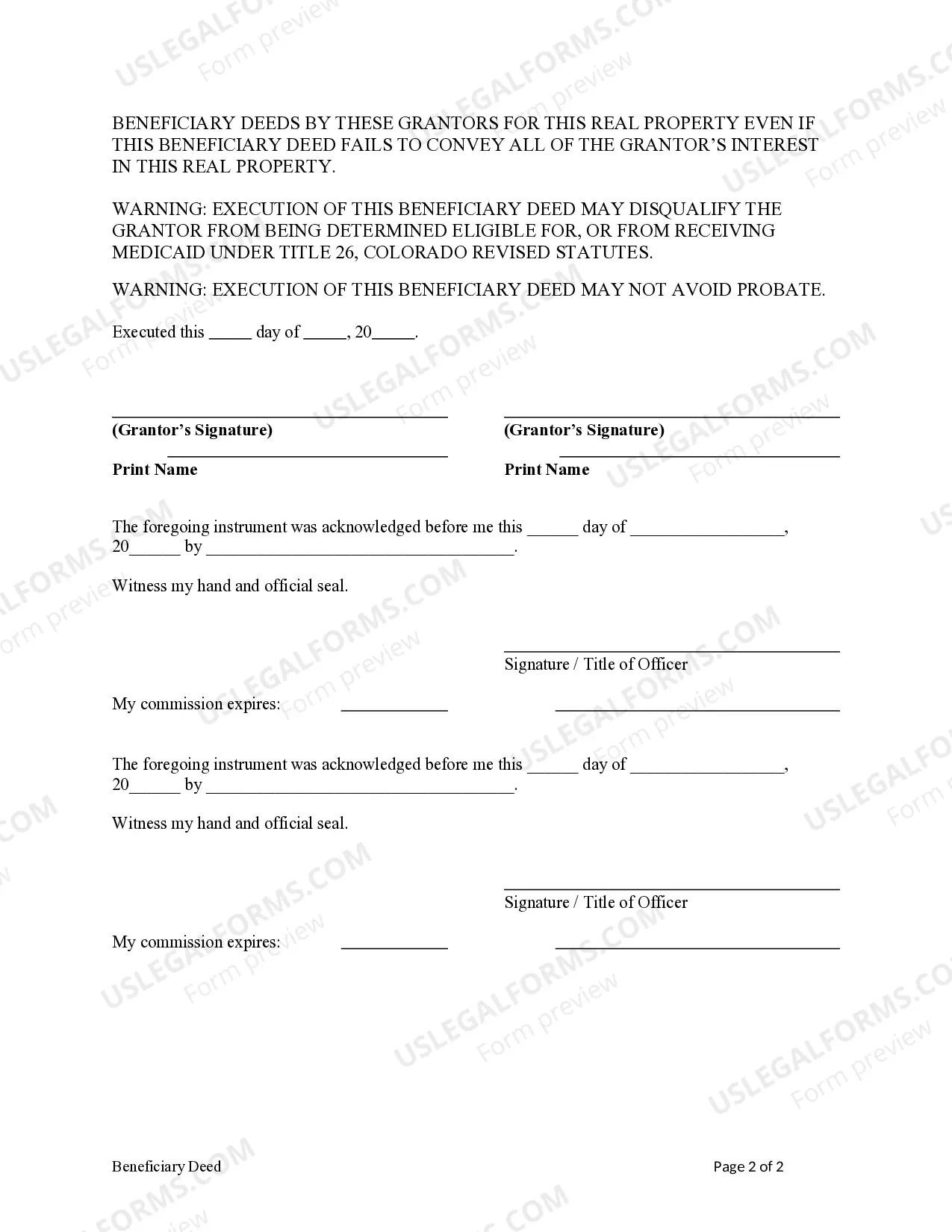
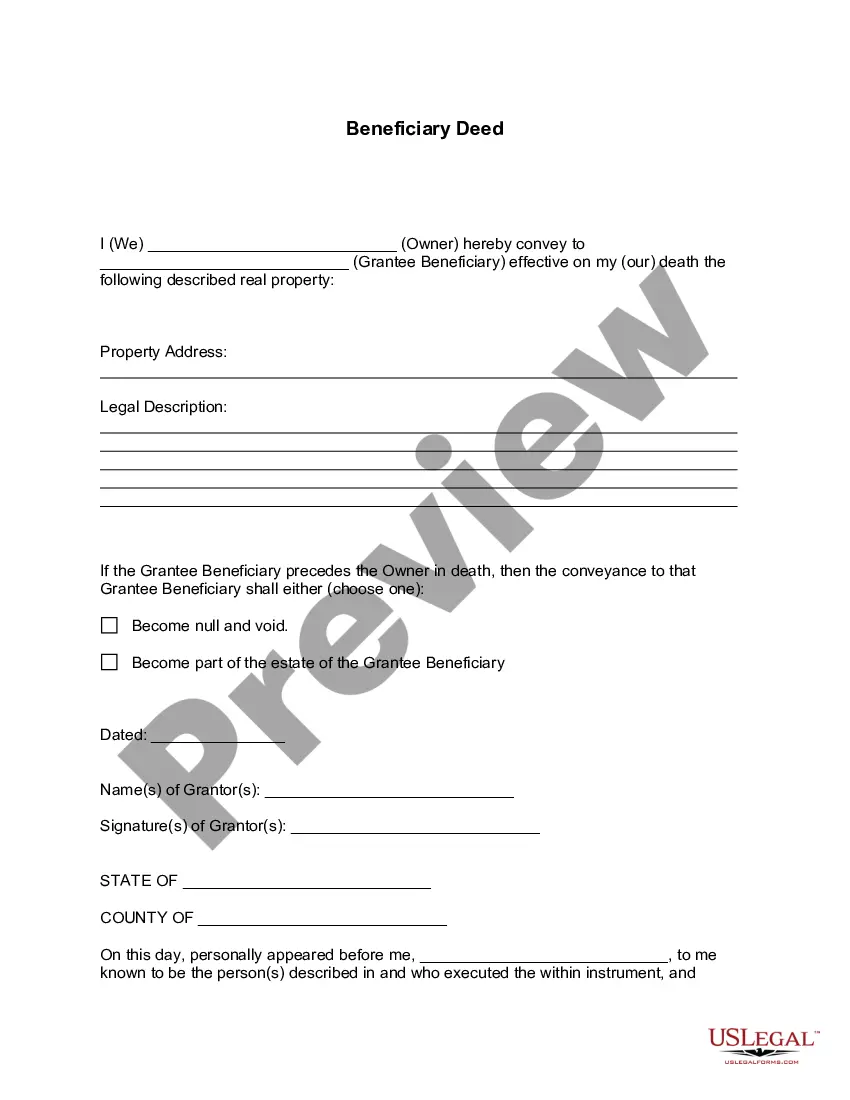
The Transfer on Death Deed, commonly known as a TOD or Beneficiary Deed, is a legal document that enables a husband and wife to transfer ownership of a property to an individual upon the death of the last surviving grantor. Unlike a traditional deed, this form does not convey ownership while the grantors are alive, allowing them to retain full control over the property during their lifetimes. The deed can be revoked at any time, providing flexibility in estate planning.
Main sections of this form
- Identification of the grantors (husband and wife) and the grantee (individual beneficiary).
- Description of the property being transferred, including its legal identification.
- Indication that the transfer is effective only upon the death of the last surviving grantor.
- Revocability clause allowing the grantors to change their mind at any time.
- Provision for what happens if the grantee does not survive the grantors.




Common use cases
This form is beneficial when a husband and wife wish to ensure a seamless transition of property ownership to a chosen individual without going through probate after their passing. It is used primarily in estate planning strategies to simplify the transfer of real estate while retaining control and the ability to revoke the deed during the grantors' lifetimes.
Intended users of this form
- Married couples who own real estate jointly and want to designate a single beneficiary.
- Individuals seeking to streamline the transfer of property to avoid probate complications.
- Couples looking to ensure their property will pass directly to a specific person after their deaths.
Instructions for completing this form
- Identify the grantors by providing their full names and addresses.
- Enter the name and address of the grantee who will receive the property.
- Clearly describe the property in detail, ensuring legal identification is accurate.
- Include the date on which the deed is executed.
- Sign the document in the presence of a notary public, if required.
Does this form need to be notarized?
This form needs to be notarized to ensure legal validity. US Legal Forms provides secure online notarization powered by Notarize, allowing you to complete the process through a verified video call, available anytime.
Get your form ready online
Our built-in tools help you complete, sign, share, and store your documents in one place.
Make edits, fill in missing information, and update formatting in US Legal Forms—just like you would in MS Word.
Download a copy, print it, send it by email, or mail it via USPS—whatever works best for your next step.
Sign and collect signatures with our SignNow integration. Send to multiple recipients, set reminders, and more. Go Premium to unlock E-Sign.
If this form requires notarization, complete it online through a secure video call—no need to meet a notary in person or wait for an appointment.
We protect your documents and personal data by following strict security and privacy standards.

Make edits, fill in missing information, and update formatting in US Legal Forms—just like you would in MS Word.

Download a copy, print it, send it by email, or mail it via USPS—whatever works best for your next step.

Sign and collect signatures with our SignNow integration. Send to multiple recipients, set reminders, and more. Go Premium to unlock E-Sign.

If this form requires notarization, complete it online through a secure video call—no need to meet a notary in person or wait for an appointment.

We protect your documents and personal data by following strict security and privacy standards.
Mistakes to watch out for
- Not adequately describing the property, leading to confusion or disputes later.
- Failing to have the deed notarized if required by state law.
- Omitting the specific language regarding survivorship or revocation.
- Not including a backup beneficiary in case the primary grantee does not survive the grantors.
Why complete this form online
- Convenience of downloading and completing the form at your own pace.
- Editability allows for easy modifications if plans change.
- Access to templates drafted by licensed attorneys ensures legal compliance.
Summary of main points
- The Transfer on Death Deed allows property to pass directly to a named individual upon the death of the grantors.
- It can be revoked or changed at any time while the grantors are alive.
- It is specifically created for use in Colorado, ensuring compliance with state laws.
Looking for another form?

Form popularity
FAQ
Several states allow transfer on death deeds, including Colorado. This option is designed to facilitate the transfer of property directly to a designated beneficiary, bypassing the probate process. Familiarize yourself with your state laws to ensure compliance, as each state may have its specific regulations. Consulting resources like UsLegalForms can provide valuable guidance when navigating this process.
Determining whether a Colorado Transfer on Death Deed or TOD - Beneficiary Deed - Husband and Wife to Individual is better depends on individual circumstances. A TOD deed can simplify the transfer process and avoid probate, making it a favorable option for many. However, a beneficiary deed might offer additional flexibility by allowing for more beneficiaries or changes in the future. Carefully consider your goals and consult with a professional to ensure the best choice for your estate.
A Transfer on Death Deed and a beneficiary deed in Colorado serve similar purposes but have differences in terminology. A TOD deed allows a property owner to name a beneficiary who automatically receives the property upon the owner's death. In contrast, a beneficiary deed is a broader term that can apply to various types of assets. Understanding these distinctions helps individuals create the most effective estate plan tailored to their needs.
Indeed, Colorado recognizes transfer on death deeds as a legitimate way to transfer assets. Such a deed allows property owners to designate beneficiaries who will inherit the property outside of probate. This method streamlines the process, making it easier for loved ones to access their inheritance. Proper execution and recording of the deed are vital to ensure its effectiveness.
The primary disadvantages of a Colorado Transfer on Death Deed or TOD - Beneficiary Deed - Husband and Wife to Individual include the potential for financial risks and lack of legal control. Once the deed is in place, you cannot change your mind easily if your relationship with the beneficiary changes. Additionally, this deed does not shield assets from creditors or legal claims, making it crucial to consider these factors as you plan. An informed decision can help you navigate potential pitfalls.
Yes, Colorado does recognize transfers on death deeds. This method allows property owners to designate a beneficiary who will receive the property upon their death without going through probate. Using a Colorado Transfer on Death Deed or TOD - Beneficiary Deed - Husband and Wife to Individual can simplify the transfer process and provide clear instructions for your estate. It is essential to consult an expert to ensure the deed is drafted and recorded correctly.
One significant disadvantage of a Colorado Transfer on Death Deed or TOD - Beneficiary Deed - Husband and Wife to Individual is that it does not allow you to control the assets after death. If the beneficiary experiences financial difficulties or legal issues, your property might be at risk. Additionally, there is no protection from probate challenges, as beneficiaries can contest the deed. Therefore, careful consideration is essential to determine whether this option aligns with your overall estate plan.
While Colorado Transfer on Death Deeds or TOD - Beneficiary Deeds - Husband and Wife to Individual offer convenience, they do have potential issues. One concern involves how they interact with other estate planning documents, which can create confusion and lead to disputes. Additionally, if not structured correctly, they can complicate the estate's overall tax obligations.
To file a Colorado Transfer on Death Deed or TOD - Beneficiary Deed - Husband and Wife to Individual, you must complete the deed form correctly. After filling out the necessary information, you need to sign it in front of a notary. Finally, record the signed deed with the county clerk and recorder where the property is located to ensure it is legally recognized.
Using a Colorado Transfer on Death Deed or TOD - Beneficiary Deed - Husband and Wife to Individual can be a beneficial choice for many. It simplifies the transfer of property at death without needing to go through probate. Additionally, it allows you to maintain control over the property during your lifetime, making it a flexible option for estate planning decisions.