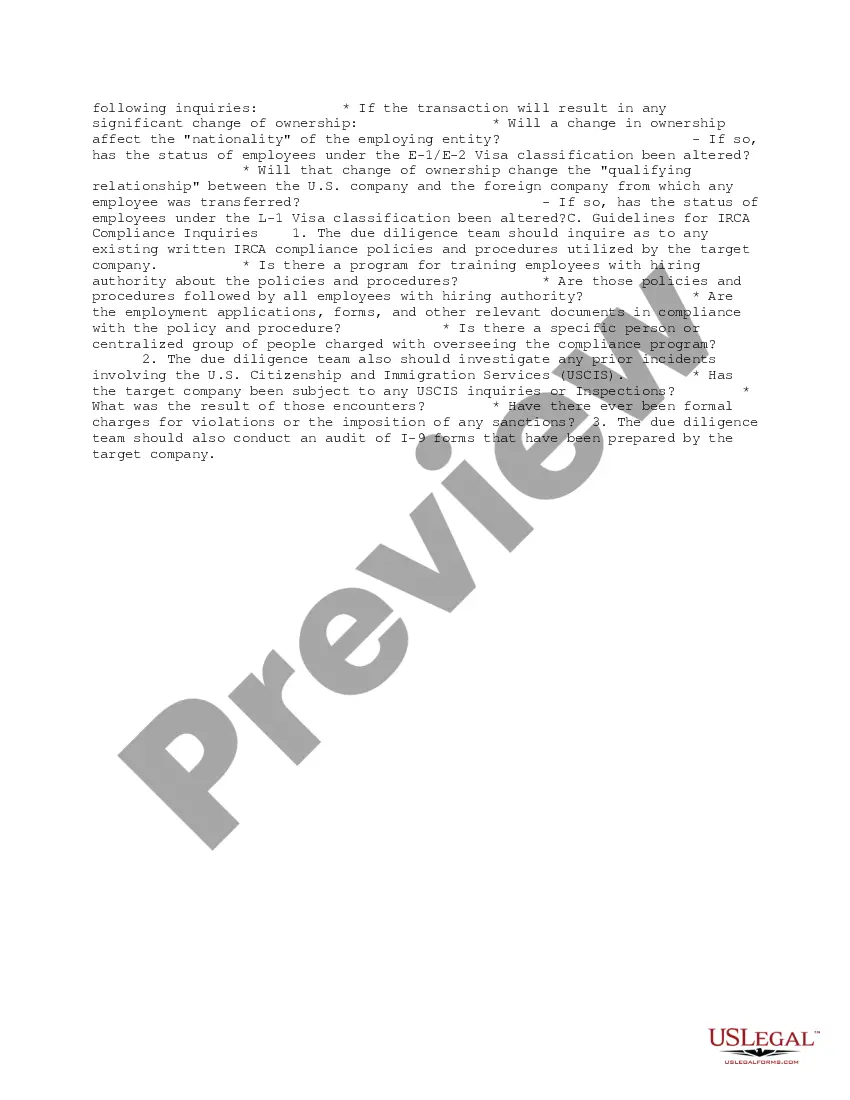
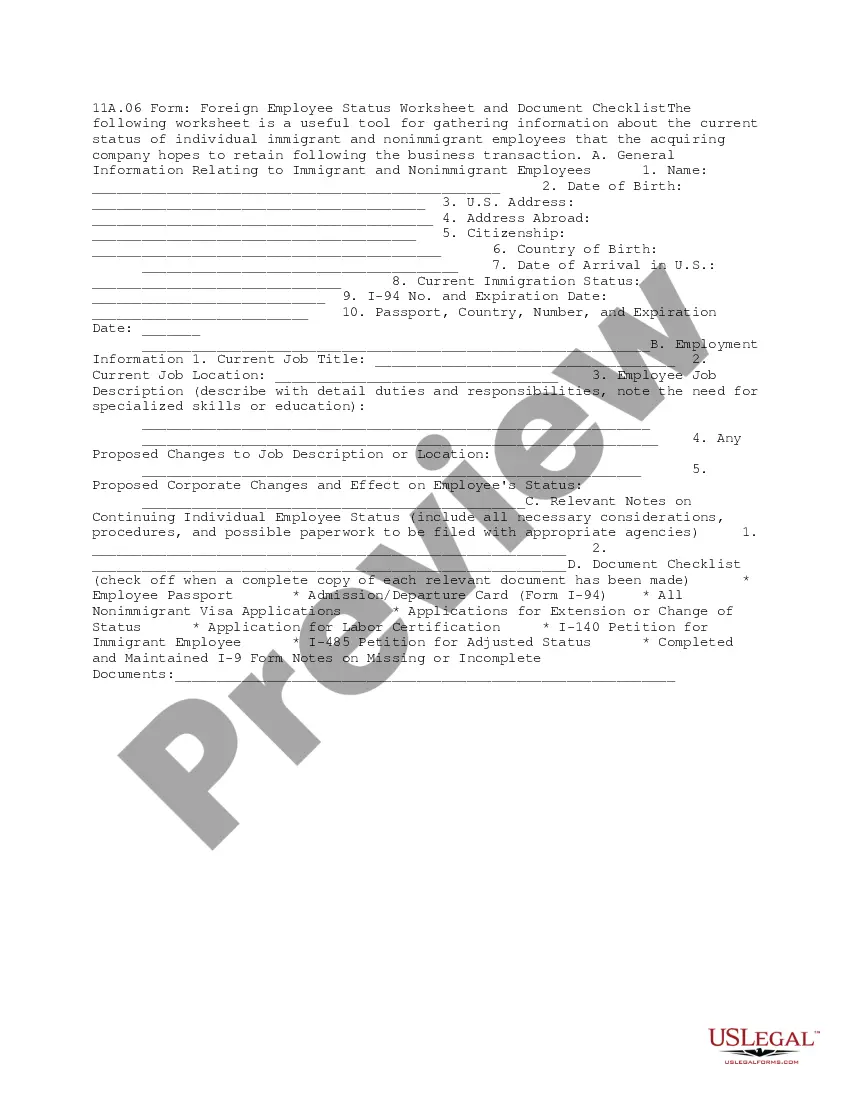
This due diligence form is an overview of suggested inquiries related to foreign nationals with specific considerations for the effect of a corporate transaction upon specific immigrant and nonimmigrant employees.
California Immigration Due Diligence Guidelines and Individual Considerations
Category:
State:
Multi-State
Control #:
US-DD011A05
Format:
Word;
PDF;
Rich Text
Instant download
Description
Free preview
Get your form ready online
Our built-in tools help you complete, sign, share, and store your documents in one place.
Built-in online Word editor
Make edits, fill in missing information, and update formatting in US Legal Forms—just like you would in MS Word.
Export easily
Download a copy, print it, send it by email, or mail it via USPS—whatever works best for your next step.
E-sign your document
Sign and collect signatures with our SignNow integration. Send to multiple recipients, set reminders, and more. Go Premium to unlock E-Sign.
Notarize online 24/7
If this form requires notarization, complete it online through a secure video call—no need to meet a notary in person or wait for an appointment.
Store your document securely
We protect your documents and personal data by following strict security and privacy standards.

Make edits, fill in missing information, and update formatting in US Legal Forms—just like you would in MS Word.

Download a copy, print it, send it by email, or mail it via USPS—whatever works best for your next step.

Sign and collect signatures with our SignNow integration. Send to multiple recipients, set reminders, and more. Go Premium to unlock E-Sign.

If this form requires notarization, complete it online through a secure video call—no need to meet a notary in person or wait for an appointment.

We protect your documents and personal data by following strict security and privacy standards.
Looking for another form?

How to fill out Immigration Due Diligence Guidelines And Individual Considerations?
It is feasible to allocate time online searching for the sanctioned document template that conforms to the state and federal requirements you need.
US Legal Forms offers a vast array of legal forms that can be examined by professionals.
You can easily download or print the California Immigration Due Diligence Guidelines and Individual Considerations from our service.
- If you already have a US Legal Forms account, you can Log In and click the Download button.
- After that, you can complete, modify, print, or sign the California Immigration Due Diligence Guidelines and Individual Considerations.
- Every legal document template you acquire is yours permanently.
- To obtain another copy of a purchased form, go to the My documents section and click the respective option.
- If you visit the US Legal Forms website for the first time, follow the simple instructions below.
- First, ensure you have selected the correct document template for the state/city of your choice.
- Review the form details to confirm you have chosen the right form. If available, use the Preview option to view the document template as well.
Form popularity
FAQ
On July 16, 2021, Judge Hanen issued a ruling finding that DACA is unlawful and blocked DHS from approving any new, first-time DACA applications. He granted a permanent injunction vacating the original 2012 memorandum which created the DACA initiative on the basis that its implementation violated the APA.
To begin with, let's look at the four types of immigration status that exist: citizens, residents, non-immigrants and undocumented.
First Preference: Unmarried adult children (including adopted children) of U.S. citizens over the age of 21. Second Preference: Spouses of permanent residents (green card holders) and their children regardless of their ages. Third Preference: Married children of U.S. citizens, their spouses and their minor children.
There Are Many Different Types Of Immigration Status. As An Immigrant, You Might Be One Of The Following:United States Citizen. If you were born in the United States, you are a U.S. citizen, even if you were raised in another country.Lawful Permanent Resident (LPR)Temporary Visitor.Undocumented Immigrant.
Classification of admission category of immigrant1 - Economic immigrant.2 - Immigrant sponsored by family.3 - Refugee.4 - Other immigrant.
Over the last several years, California has taken significant strides to protect immigrants, passing a broad range of laws to expand and uphold the civil and labor rights of immigrants, to equalize access to higher education, and to define the role local law enforcement agencies may play in the enforcement of federal
Green Card Eligibility CategoriesSpouse of a U.S. citizen.Unmarried child under the age of 21 of a U.S. citizen.Parent of a U.S. citizen who is at least 21 years old.
The four main categories of immigrants to Canada are: the Family Class members (closely related persons of Canadian residents living in Canada), Economic Immigrants (Canadian experience class, skilled workers and business people), Humanitarian and Compassionate applicants (people accepted as immigrants for humanitarian
These Are the Four Types of Immigration Statuses in the US. When immigrating to the US, there are four different immigration status categories that immigrants may fall into: citizens, residents, non-immigrants, and undocumented immigrants.