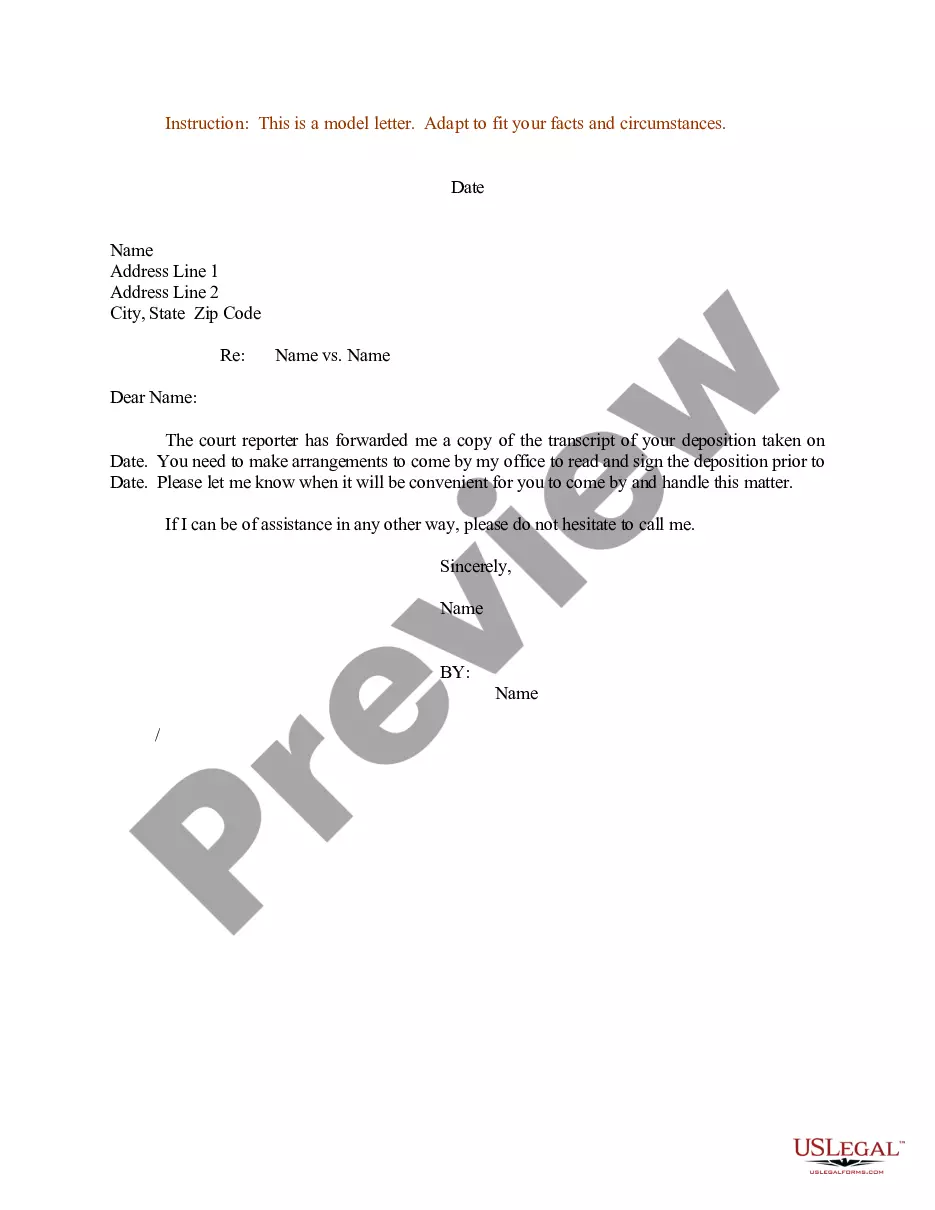
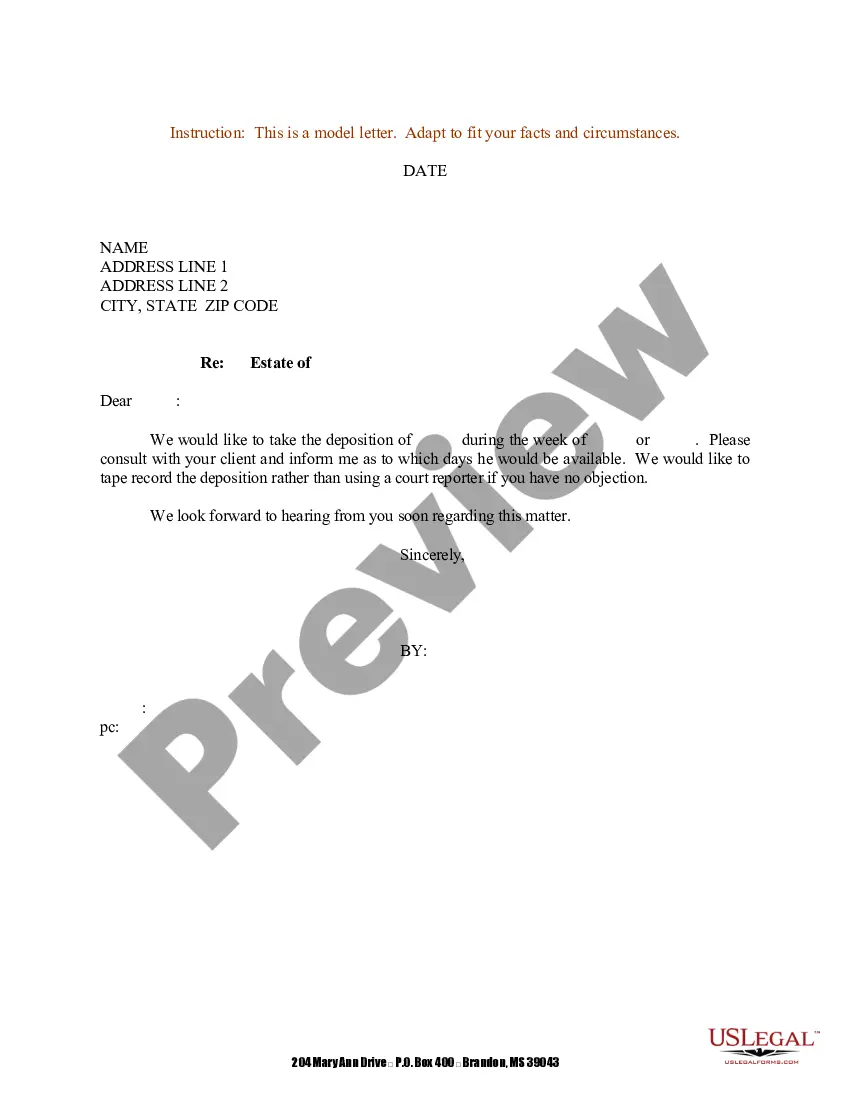
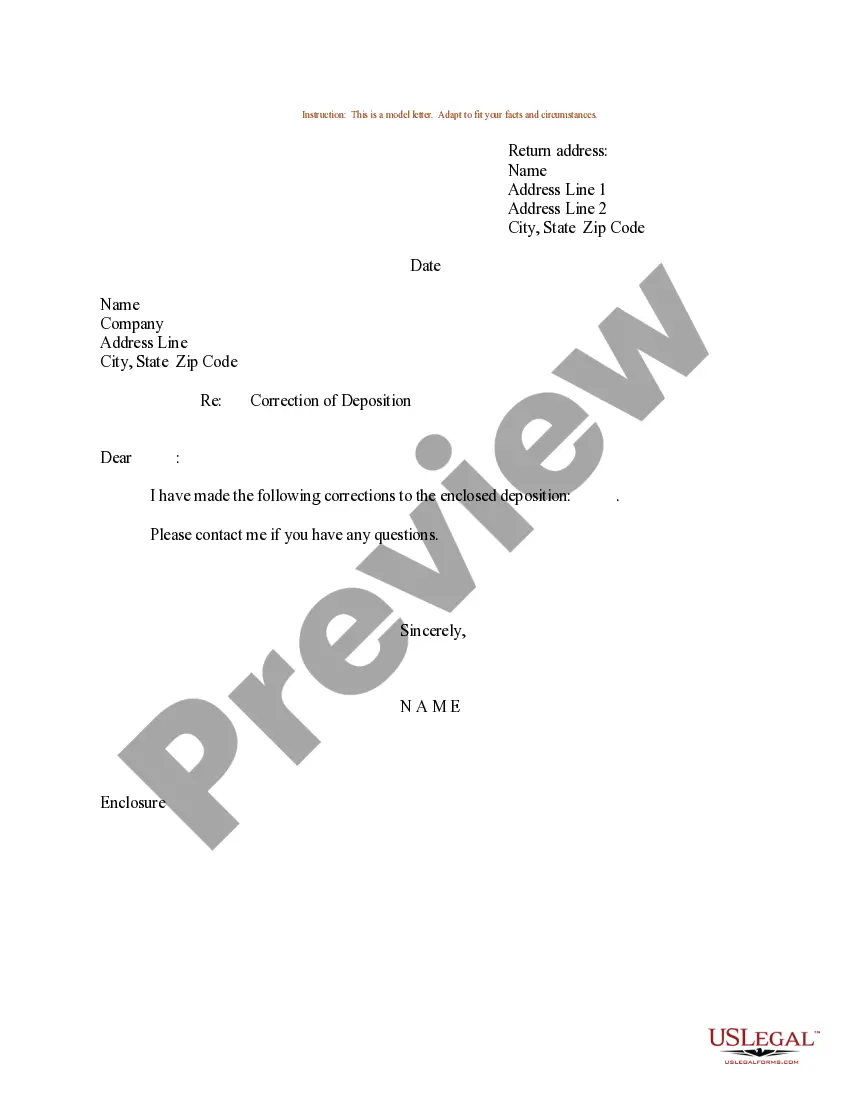
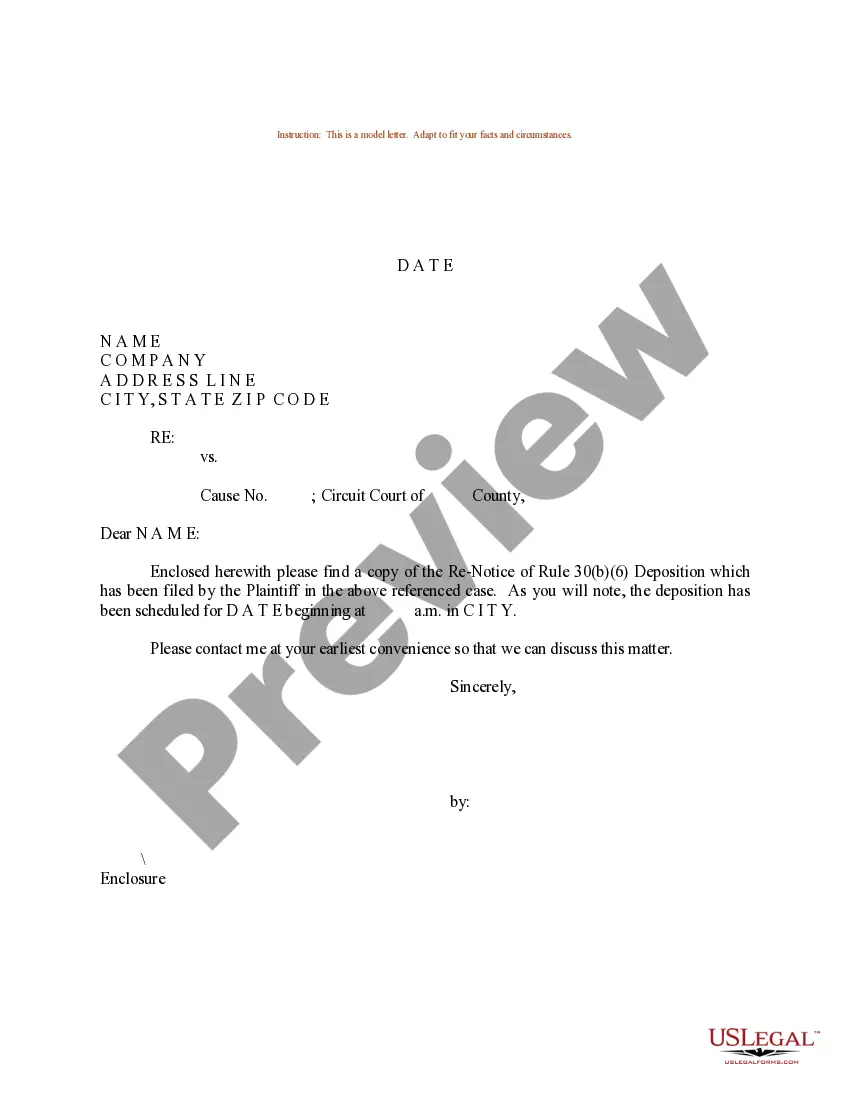
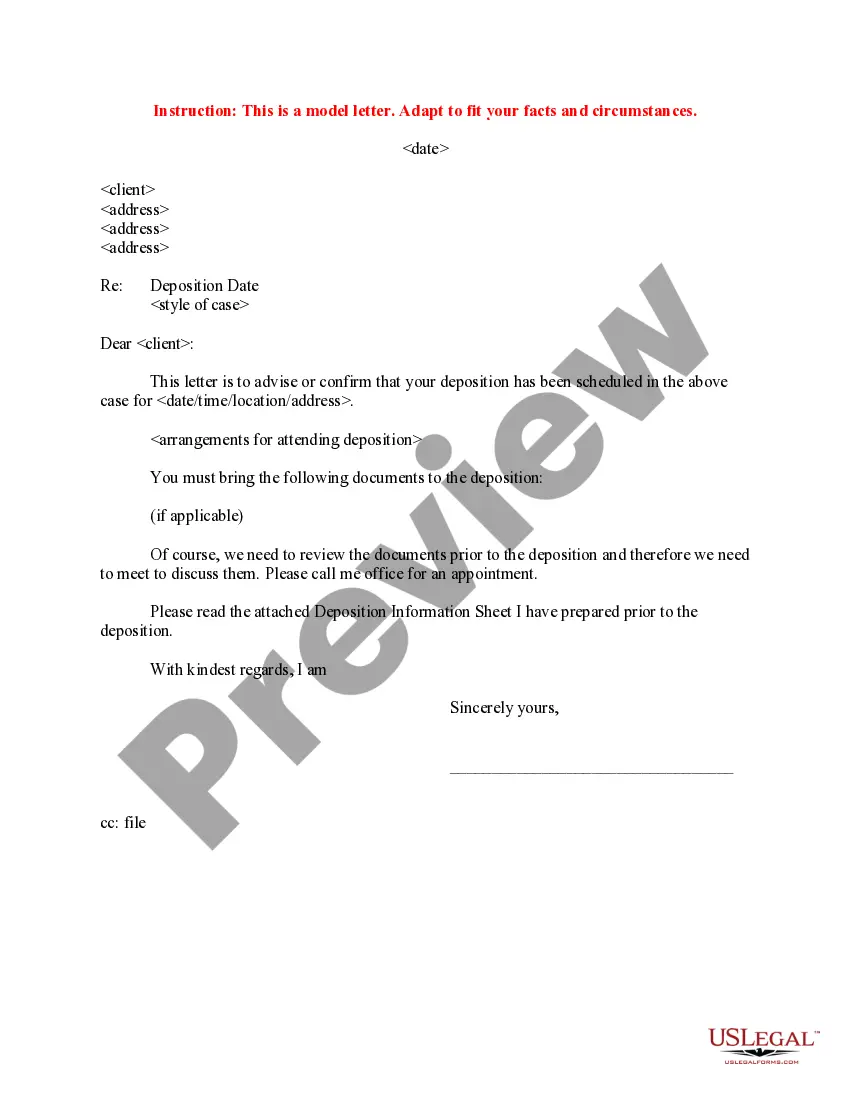
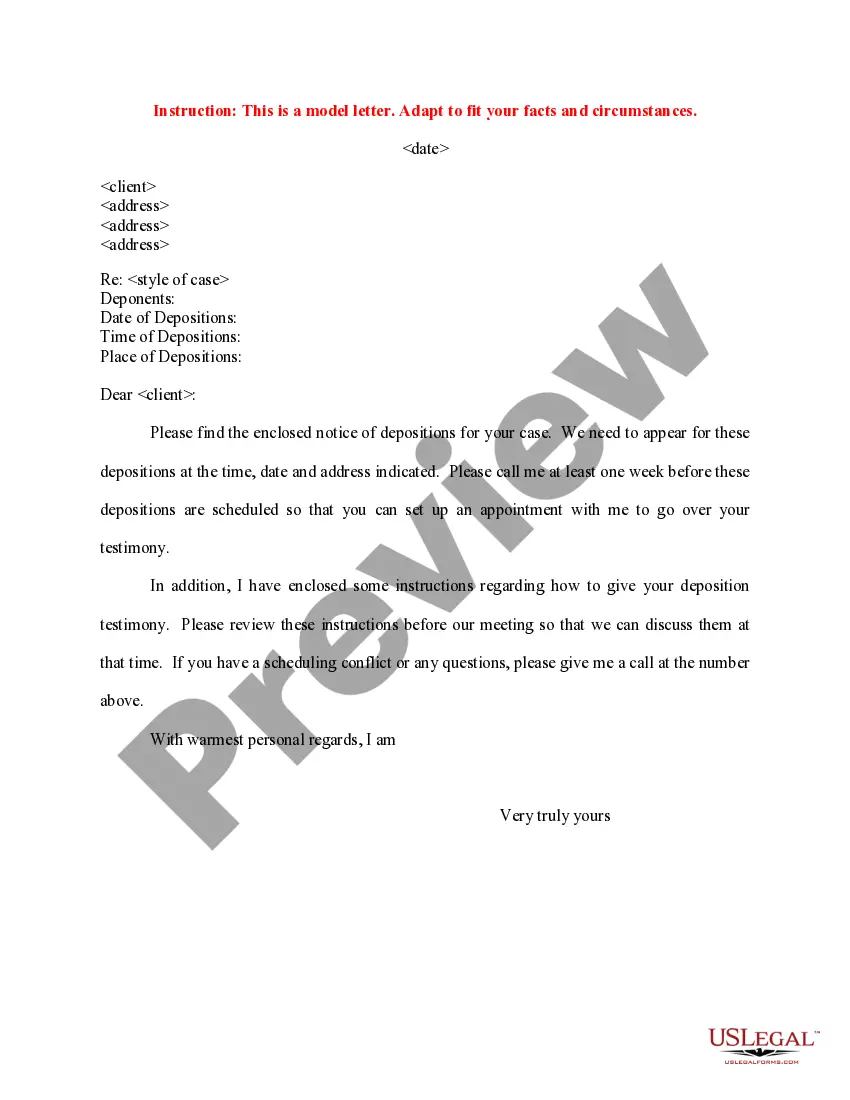
California Sample Letter regarding Deposition
Description

Get your form ready online
Our built-in tools help you complete, sign, share, and store your documents in one place.
Make edits, fill in missing information, and update formatting in US Legal Forms—just like you would in MS Word.
Download a copy, print it, send it by email, or mail it via USPS—whatever works best for your next step.
Sign and collect signatures with our SignNow integration. Send to multiple recipients, set reminders, and more. Go Premium to unlock E-Sign.
If this form requires notarization, complete it online through a secure video call—no need to meet a notary in person or wait for an appointment.
We protect your documents and personal data by following strict security and privacy standards.

Make edits, fill in missing information, and update formatting in US Legal Forms—just like you would in MS Word.

Download a copy, print it, send it by email, or mail it via USPS—whatever works best for your next step.

Sign and collect signatures with our SignNow integration. Send to multiple recipients, set reminders, and more. Go Premium to unlock E-Sign.

If this form requires notarization, complete it online through a secure video call—no need to meet a notary in person or wait for an appointment.

We protect your documents and personal data by following strict security and privacy standards.
Looking for another form?
How to fill out Sample Letter Regarding Deposition?
It is possible to spend several hours online trying to find the authorized papers template that fits the state and federal requirements you need. US Legal Forms provides thousands of authorized types that happen to be reviewed by professionals. You can easily down load or print the California Sample Letter regarding Deposition from the services.
If you already possess a US Legal Forms account, you are able to log in and then click the Obtain key. Following that, you are able to full, change, print, or signal the California Sample Letter regarding Deposition. Every single authorized papers template you get is the one you have eternally. To obtain yet another backup of any obtained type, proceed to the My Forms tab and then click the corresponding key.
Should you use the US Legal Forms website the first time, adhere to the simple guidelines under:
- Initially, ensure that you have selected the best papers template to the area/metropolis of your choice. Browse the type explanation to ensure you have chosen the correct type. If accessible, take advantage of the Review key to check through the papers template also.
- If you would like get yet another model of the type, take advantage of the Lookup industry to find the template that fits your needs and requirements.
- After you have identified the template you would like, click on Purchase now to move forward.
- Choose the prices strategy you would like, type in your references, and register for a merchant account on US Legal Forms.
- Complete the purchase. You can use your Visa or Mastercard or PayPal account to purchase the authorized type.
- Choose the format of the papers and down load it to the system.
- Make adjustments to the papers if necessary. It is possible to full, change and signal and print California Sample Letter regarding Deposition.
Obtain and print thousands of papers layouts utilizing the US Legal Forms site, that provides the biggest selection of authorized types. Use specialist and express-specific layouts to handle your small business or personal requirements.
Form popularity
FAQ
A subpoena is considered a legal request. However, ignoring this request could lead to serious legal consequences and disciplinary actions. If you are uncomfortable responding to a subpoena, speak with an experienced attorney to understand your options.
Luckily for your clients, depositions (whether video or text) are not usually made part of the public record, unless they're entered into testimony during trial. Since most civil cases are settled out of court, there's a good chance that the deposition testimony will never make it past the attorneys and judge.
Deposition DON'Ts: Guess or speculate. ?I don't know? or ?I can't remember? is acceptable. Be anxious or stressed out. It will affect what you say and how you appear. Be defensive or angry. Never argue with the attorney. Offer information not requested. ... Talk too much or ramble. ... Talk too little. ... Be too extreme.
Your notice must include the name of the deponent, as well as the date, time, and location of the deposition. If the deponent is an organization, describe what matters you will be discussing, so that the organization may appoint a representative with the most knowledge of those issues.
In the case of a deposition, since it must be requested through the issuance of a subpoena, choosing to not give testimony when formally requested may result in punishment for contempt of court, under the provision of Rule CR 37.
The Court Reporters Board (CRB) has received questions regarding the role of the court reporter as it relates to the proper implementation of California Code of Civil Procedure section 2025.290, which limits, with stated exceptions, a deposition to seven hours.
In most types of cases, for the deposition of a party to the case, you must provide at least 10 days' notice if personally served, and 15 days' notice if served by mail within California (California Code of Civil Procedure (CCP) § 2025.270(a), § 1013).
The rules for depositions vary by state and in federal court, but generally, the deponent must answer every question presented, regardless of objection, unless the answer is protected by a privilege or a court order. A deposition will usually be taken before a court reporter authorized to administer oaths.