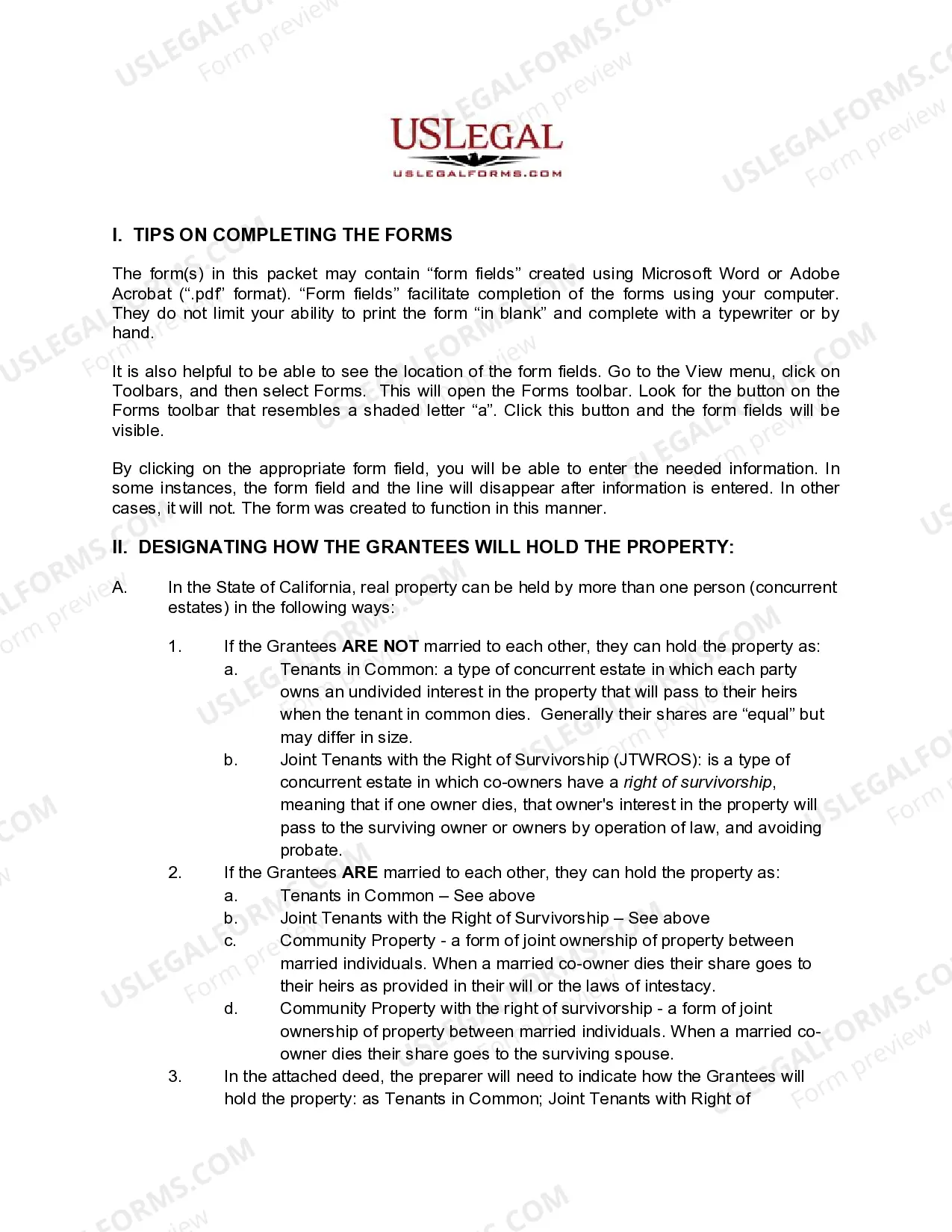
California Quitclaim Deed from Husband, Wife and an Individual to Husband and Wife
What is this form?
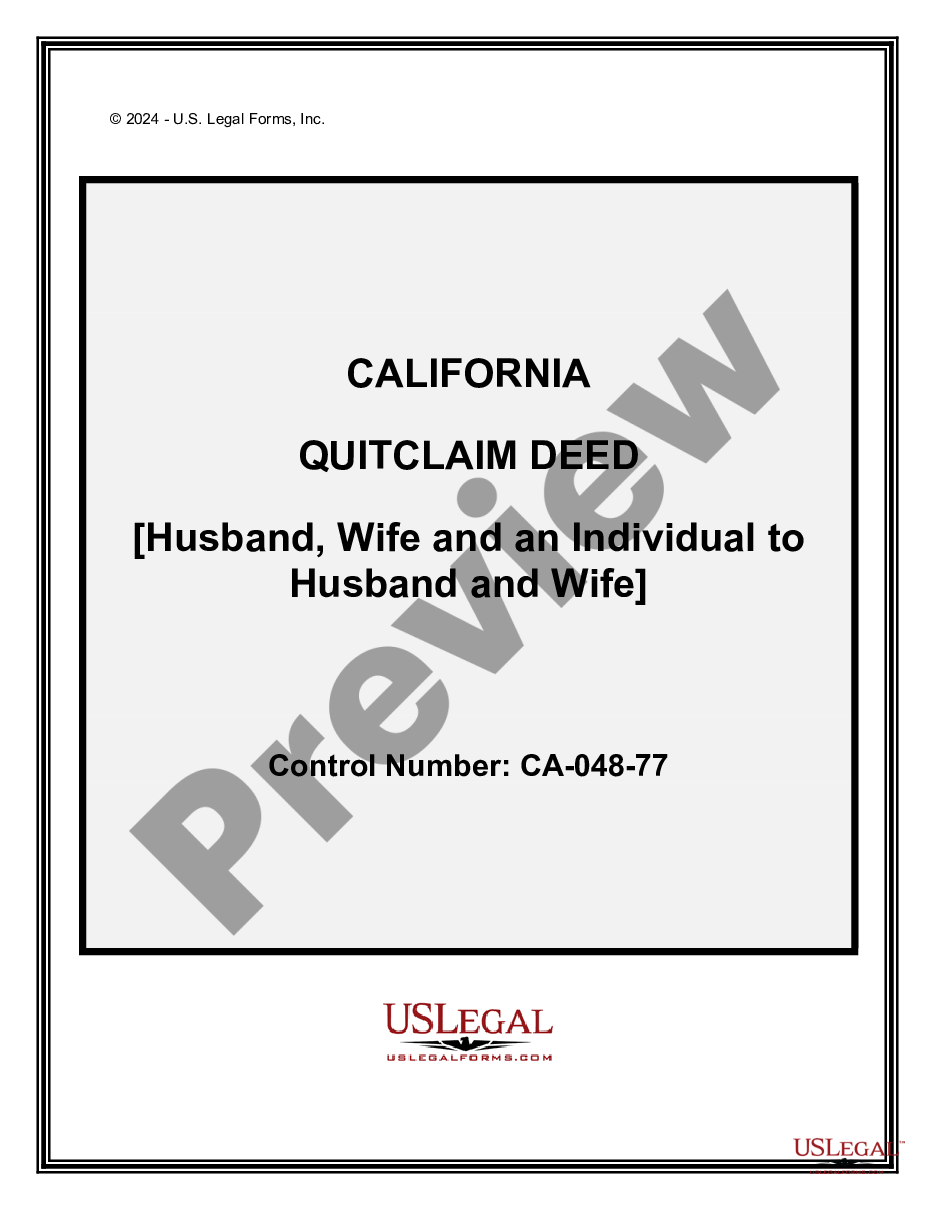
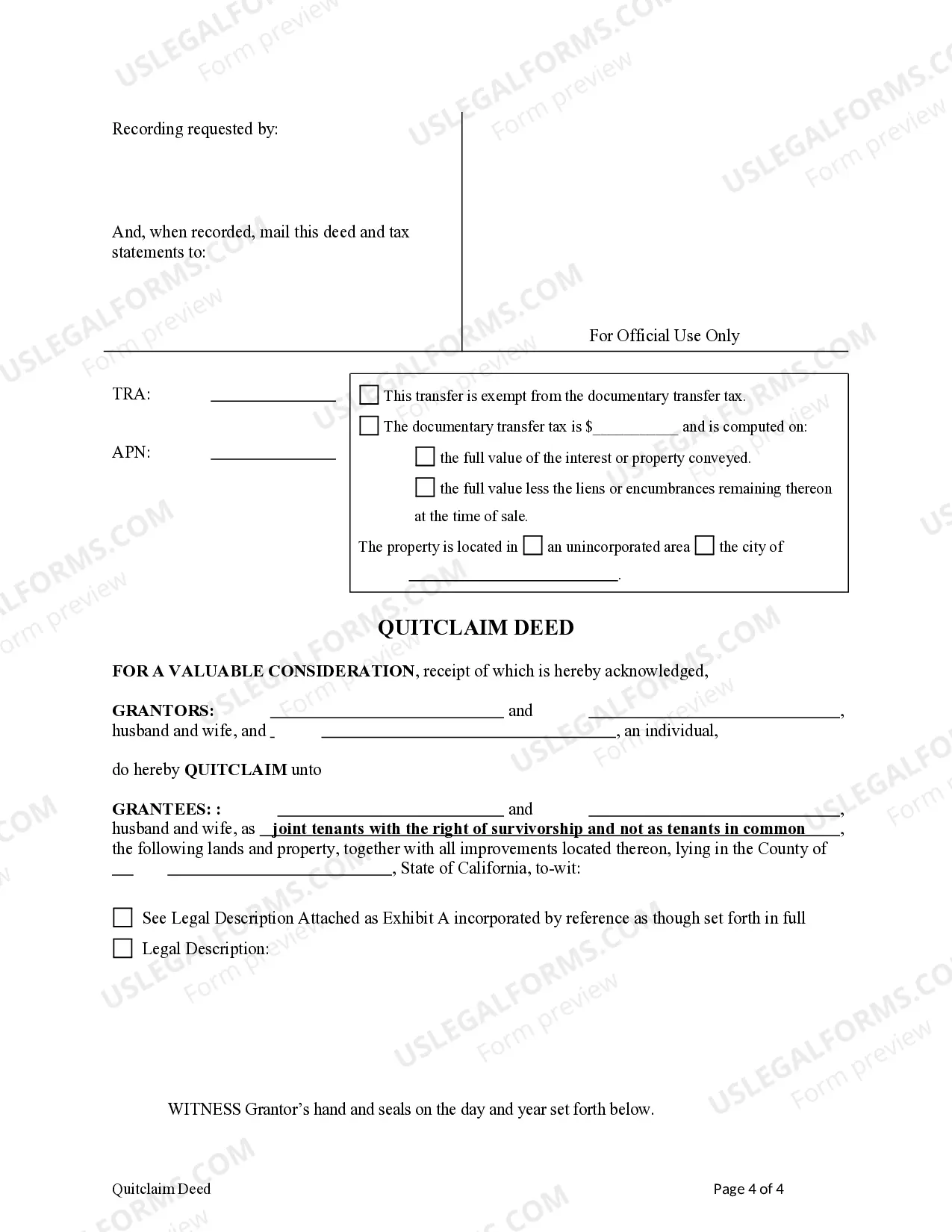
This Quitclaim Deed is a legal document used to transfer property ownership from a husband, wife, and an individual to a husband and wife. Unlike other forms of deed, a quitclaim deed does not guarantee that the grantor holds clear title to the property. Instead, it simply conveys any interest the grantors may have in the property to the grantees. This form is particularly useful in situations like divorce or estate distributions, where formal title transfers are required without the need for a warranty of title.
What’s included in this form
- Identification of grantors and grantees: Specifies who is transferring and receiving the property.
- Description of the property: Details the property being transferred.
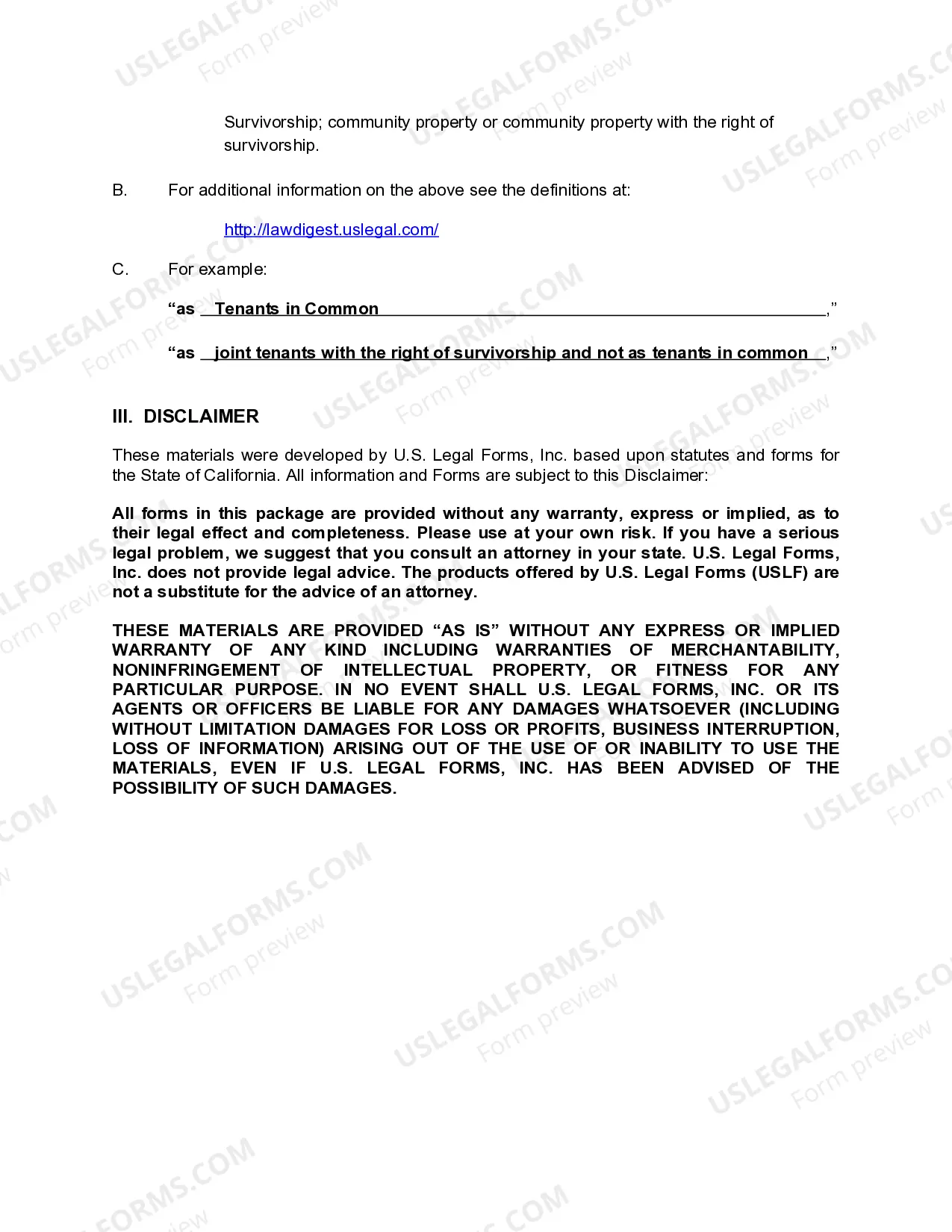
- Type of ownership: Indicates how the grantees will hold the property (e.g., tenants in common, joint tenants).
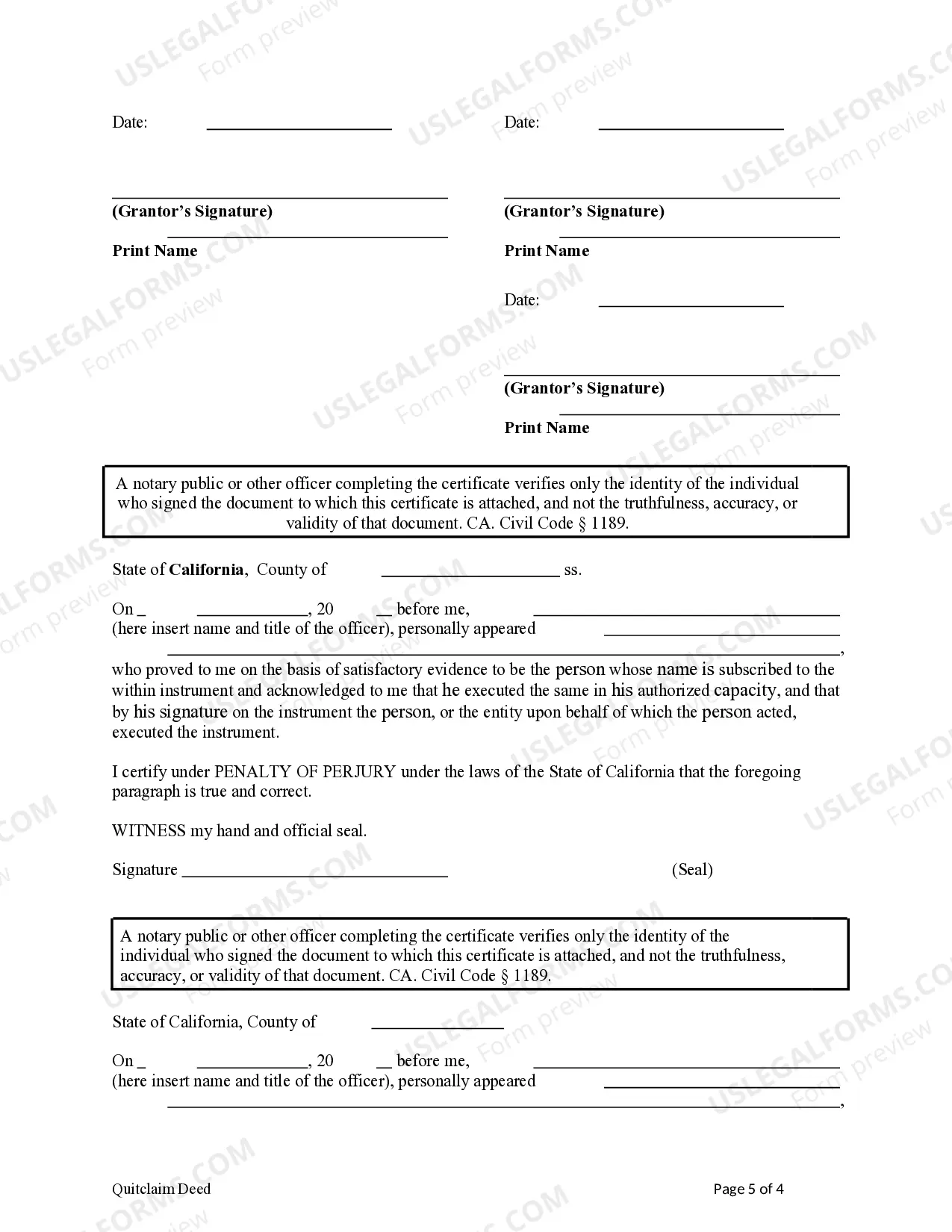
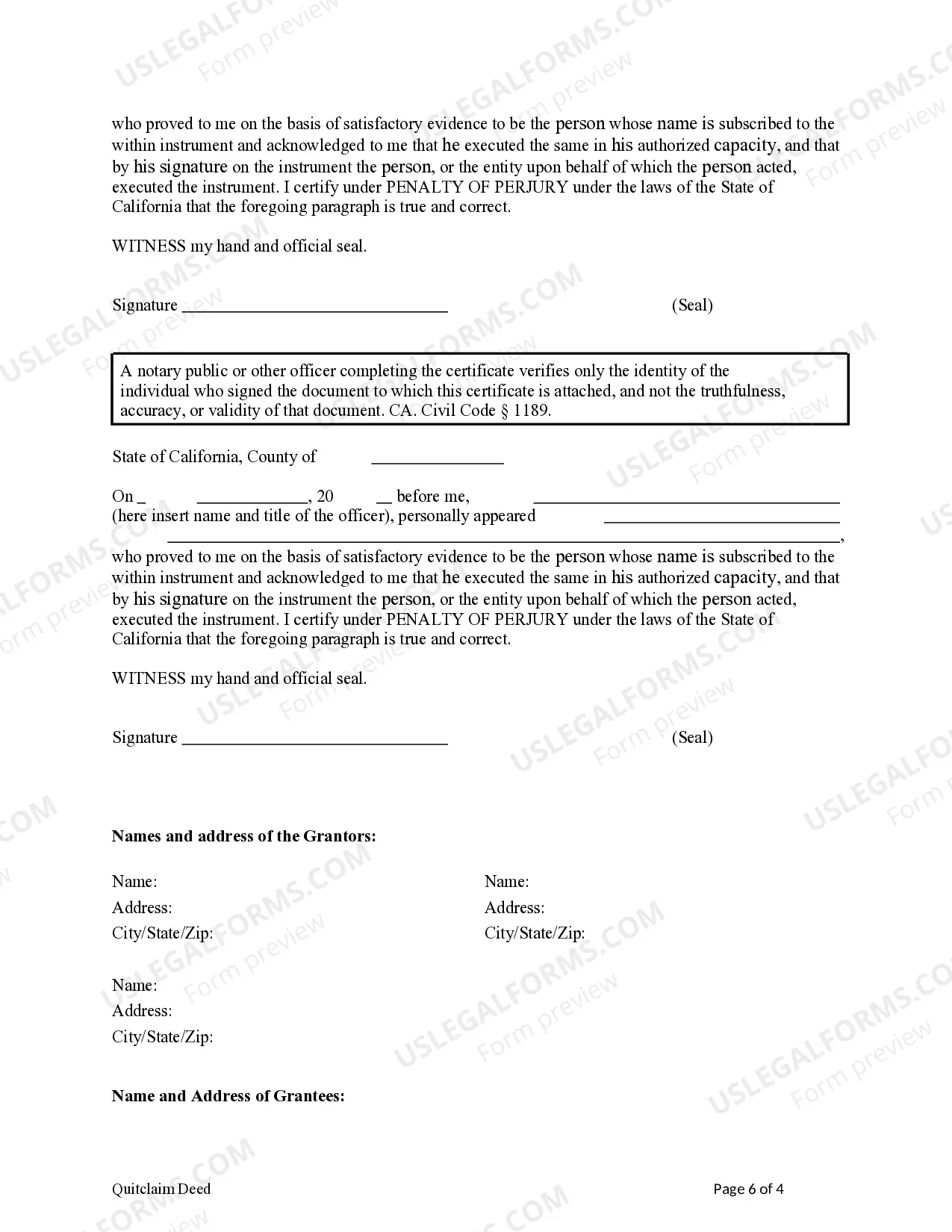
- Witness and notarization sections: Provides spaces for signatures and the notaryâs information to validate the deed.
- Legal compliance: Ensures the deed meets California's statutory requirements for property transfers.






When to use this form
This Quitclaim Deed is typically used in various situations, including:
- Transferring property between family members, such as in divorce or inheritance cases.
- Removing a co-owner's name from a deed.
- Clarifying or transferring ownership interests in a property held jointly.
Who this form is for
This form is intended for:
- Married couples wishing to transfer property ownership between themselves.
- Individuals seeking to add or remove a spouse from the property title.
- Anyone involved in property transfer after divorce or other family matters.
How to prepare this document
- Identify the parties involved: Fill in the names of the grantors (husband, wife, and individual) and the grantees (husband and wife).
- Specify the property: Clearly describe the property being transferred, including its address and legal description.
- Choose the type of ownership: Indicate whether the grantees will hold the property as tenants in common, joint tenants, community property, or community property with right of survivorship.
- Sign and date the form: All grantors must sign the deed in the designated areas.
- Obtain notarization: Have the completed form notarized to validate the signature and the transfer.
Notarization requirements for this form
Yes, this form must be notarized to be legally valid. A notary public will verify the identity of the individuals signing the deed, ensuring the transaction is legitimate. US Legal Forms offers integrated online notarization for your convenience, allowing for 24/7 service through secure video calls.
Get your form ready online
Our built-in tools help you complete, sign, share, and store your documents in one place.
Make edits, fill in missing information, and update formatting in US Legal Forms—just like you would in MS Word.
Download a copy, print it, send it by email, or mail it via USPS—whatever works best for your next step.
Sign and collect signatures with our SignNow integration. Send to multiple recipients, set reminders, and more. Go Premium to unlock E-Sign.
If this form requires notarization, complete it online through a secure video call—no need to meet a notary in person or wait for an appointment.
We protect your documents and personal data by following strict security and privacy standards.

Make edits, fill in missing information, and update formatting in US Legal Forms—just like you would in MS Word.

Download a copy, print it, send it by email, or mail it via USPS—whatever works best for your next step.

Sign and collect signatures with our SignNow integration. Send to multiple recipients, set reminders, and more. Go Premium to unlock E-Sign.

If this form requires notarization, complete it online through a secure video call—no need to meet a notary in person or wait for an appointment.

We protect your documents and personal data by following strict security and privacy standards.
Mistakes to watch out for
- Failing to properly describe the property, which can lead to disputes.
- Not specifying the type of ownership correctly.
- Neglecting to sign the deed or obtain notarization, making the document invalid.
Benefits of completing this form online
- Convenient access from anywhere, allowing users to fill out the form at their own pace
- Editable fields make it easy to input the required information accurately
- Ensures that the form complies with state laws, reducing legal risks
Key takeaways
- A Quitclaim Deed transfers property ownership without warranties.
- This form is especially useful in family situations such as divorce or inheritance.
- It is essential to properly complete, sign, and notarize the deed for it to be valid.
Looking for another form?
Form popularity
FAQ
Essentially, anyone can prepare a quitclaim deed in California, but it's often recommended to seek assistance from a legal expert to ensure accuracy and compliance with state laws. Real estate professionals or legal service providers can assist in drafting this document effectively. Utilizing a service like US Legal Forms offers you access to reliable resources for a California Quitclaim Deed from Husband, Wife and an Individual to Husband and Wife, allowing you to feel confident in your property transfer.
If a quitclaim deed is not recorded in California, the transfer of property may not be legally recognized, potentially leading to challenges in ownership claims. Failing to record the deed puts you at risk of disputes, as it does not provide public notice of the new ownership. To safeguard your rights and effectively execute a California Quitclaim Deed from Husband, Wife and an Individual to Husband and Wife, it is crucial to complete the recording with the county clerk.
Typically, a quitclaim deed in California can be prepared by the parties involved in the property transfer, but it is advisable to seek help from a qualified attorney or a professional service. This ensures that all legal requirements are met, minimizing the risk of future disputes. By using a platform like US Legal Forms, you can access tailored templates for a California Quitclaim Deed from Husband, Wife and an Individual to Husband and Wife, making the process simpler.
In California, a quitclaim deed is usually signed by the individuals involved in the transfer of property. This includes both the granter, who is transferring their interest, and the grantee, who is receiving that interest. For a California Quitclaim Deed from Husband, Wife and an Individual to Husband and Wife, both spouses and the individual must sign the document to validate the transfer.
The key difference between a quitclaim deed and an Interspousal Transfer Deed in California lies in their purpose and context. A quitclaim deed simply conveys any existing interest in a property without warranties, while an interspousal deed is specifically designed for the transfer of property between spouses, often with added legal protections. Both can involve a California Quitclaim Deed from Husband, Wife and an Individual to Husband and Wife, but the interspousal deed has implications specifically in marital relationships. Understanding these distinctions can aid couples in making informed property decisions.
Yes, a quitclaim deed can transfer ownership rights in California, but it transfers only the interest the granter has. It does not guarantee that the title is clear or that the property has no liens. When using the California Quitclaim Deed from Husband, Wife and an Individual to Husband and Wife, it's important to verify the current ownership status to ensure complete understanding of your rights. Properly executing this deed can consolidate ownership and simplify legal transactions.
A quitclaim deed between husband and wife allows one spouse to transfer their interest in a property to the other spouse. This type of deed ensures that the receiving spouse holds full rights to the property, facilitating a clear title. With the California Quitclaim Deed from Husband, Wife and an Individual to Husband and Wife, this process becomes seamless for couples looking to streamline their ownership. It's a useful tool for consolidating ownership when handling marital assets.
An Interspousal Transfer Deed in California is a specific type of deed designed for transfers between spouses. This deed facilitates the transfer of property, allowing spouses to adjust ownership without involving outside parties. The California Quitclaim Deed from Husband, Wife and an Individual to Husband and Wife may serve similar purposes, but the interspousal deed is tailored to ensure asset division in marriage or during divorce proceedings. This can be pivotal for smooth transitions in marital property.
In California, the most common deed used to convey property is the grant deed. However, the California Quitclaim Deed from Husband, Wife and an Individual to Husband and Wife serves its unique purposes for specific situations, particularly in marriage or familial transfers. The grant deed conveys ownership while maintaining certain warranties, whereas the quitclaim deed simply transfers whatever interest the granter has, without guarantees. Understanding when to use each can be important for effective property management.
The primary beneficiaries of a California Quitclaim Deed from Husband, Wife and an Individual to Husband and Wife often include both spouses when transferring property between them. This deed allows for a straightforward way to remove or add an individual's name to the title. It's especially useful in cases of marriage, divorce, or estate planning. Utilizing this tool can simplify complex ownership situations and clarify property rights.