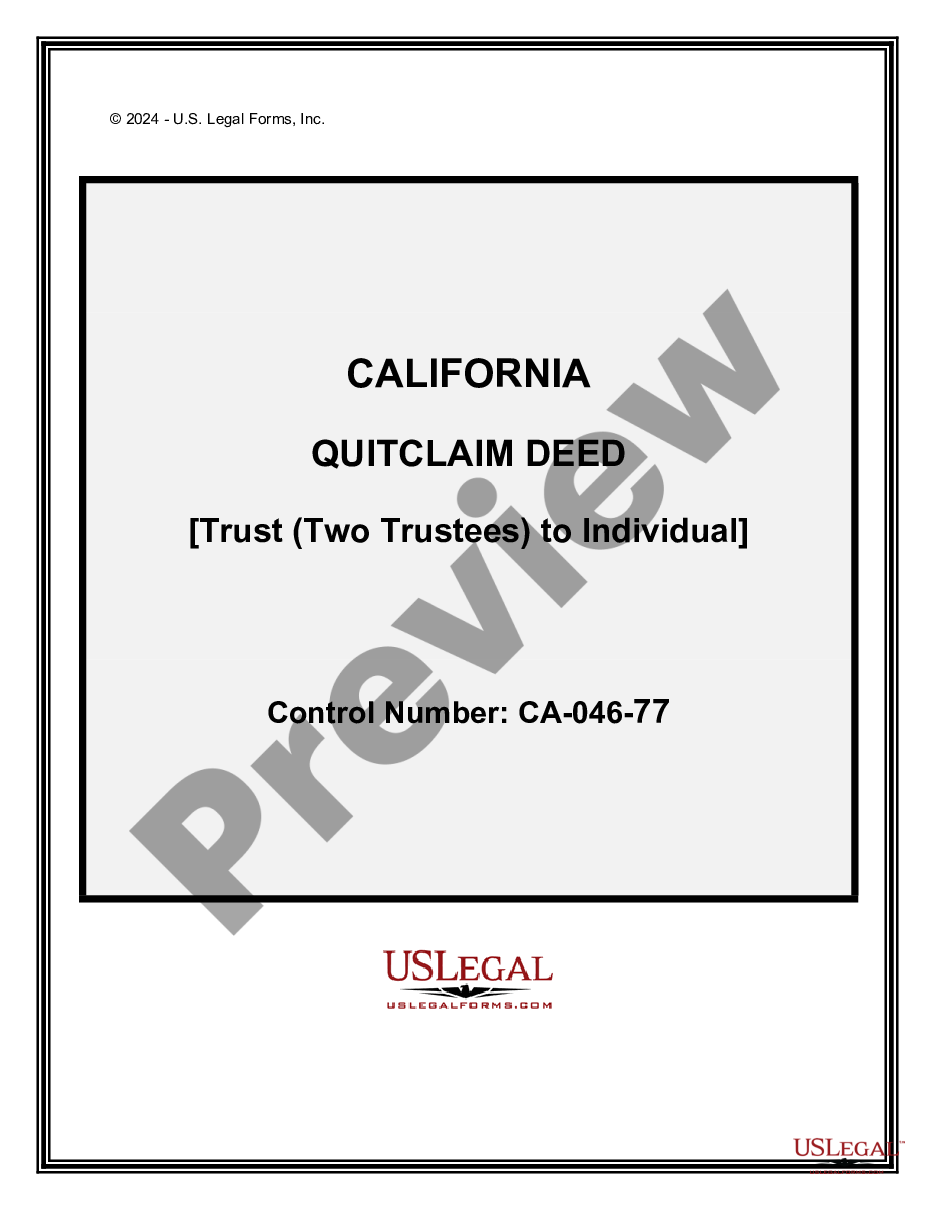
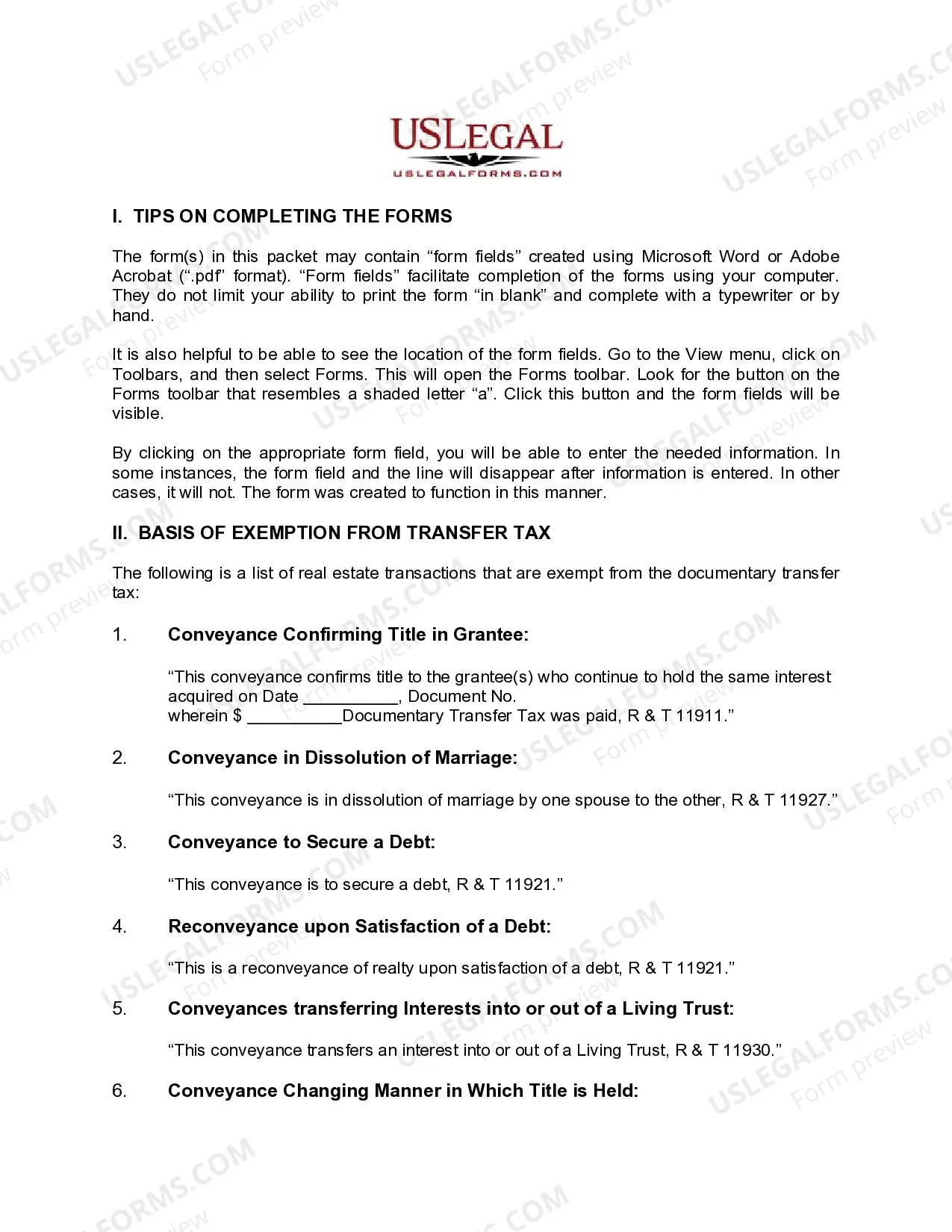
California Quitclaim Deed - Trust (Two Trustees) to an Individual
What is this form?
This Quitclaim Deed - Trust (Two Trustees) to an Individual is a legal document used to transfer property ownership from a trust, represented by two trustees, to an individual. Unlike other deeds, a quitclaim deed conveys whatever interest the trust has in the property without guaranteeing that the title is clear. This means that the grantee receives the property without any warranties against claims or defects.
What’s included in this form
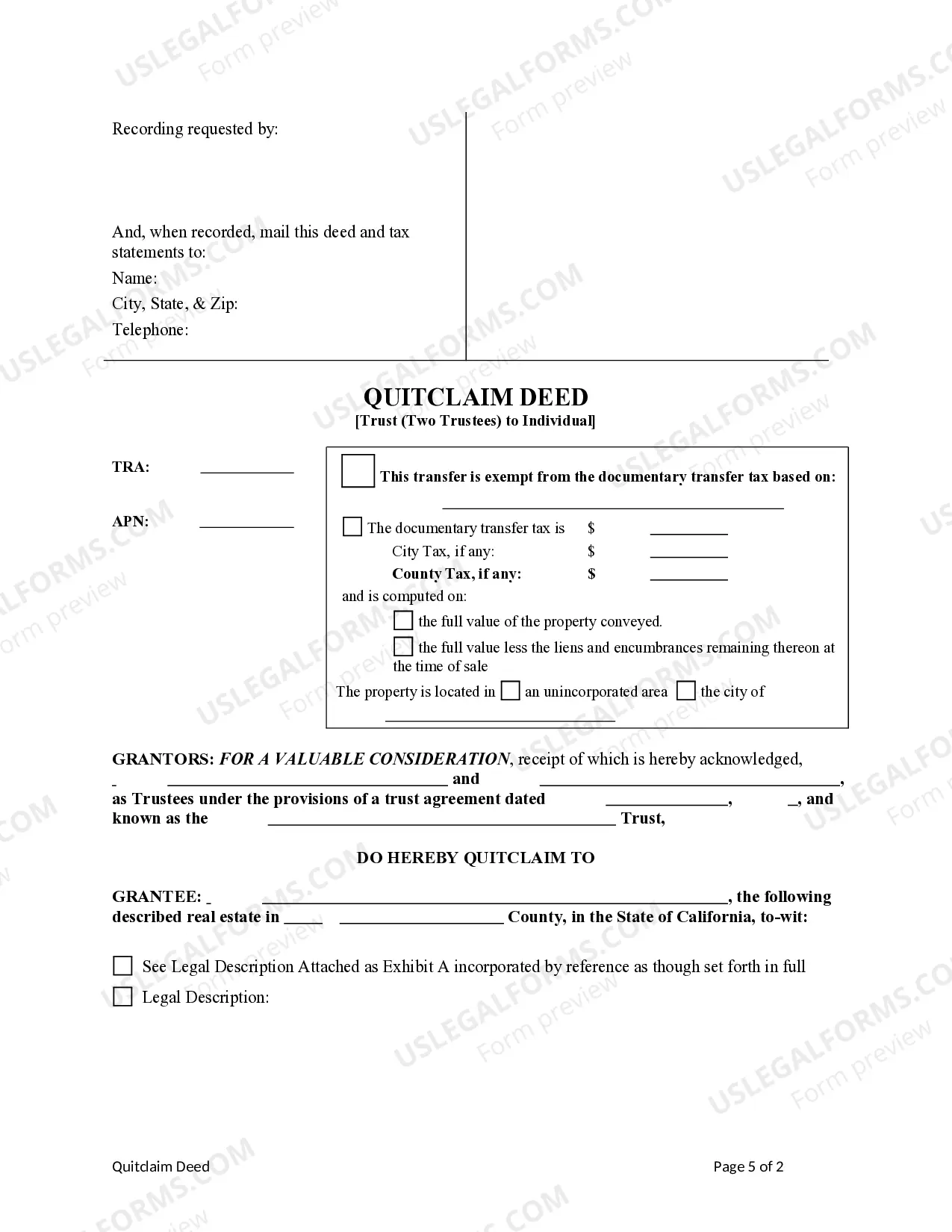
- Identification of the Grantor: The trust and its trustees.
- Identification of the Grantee: The individual receiving the property.
- Description of the Property: A legal description of the real estate being transferred.
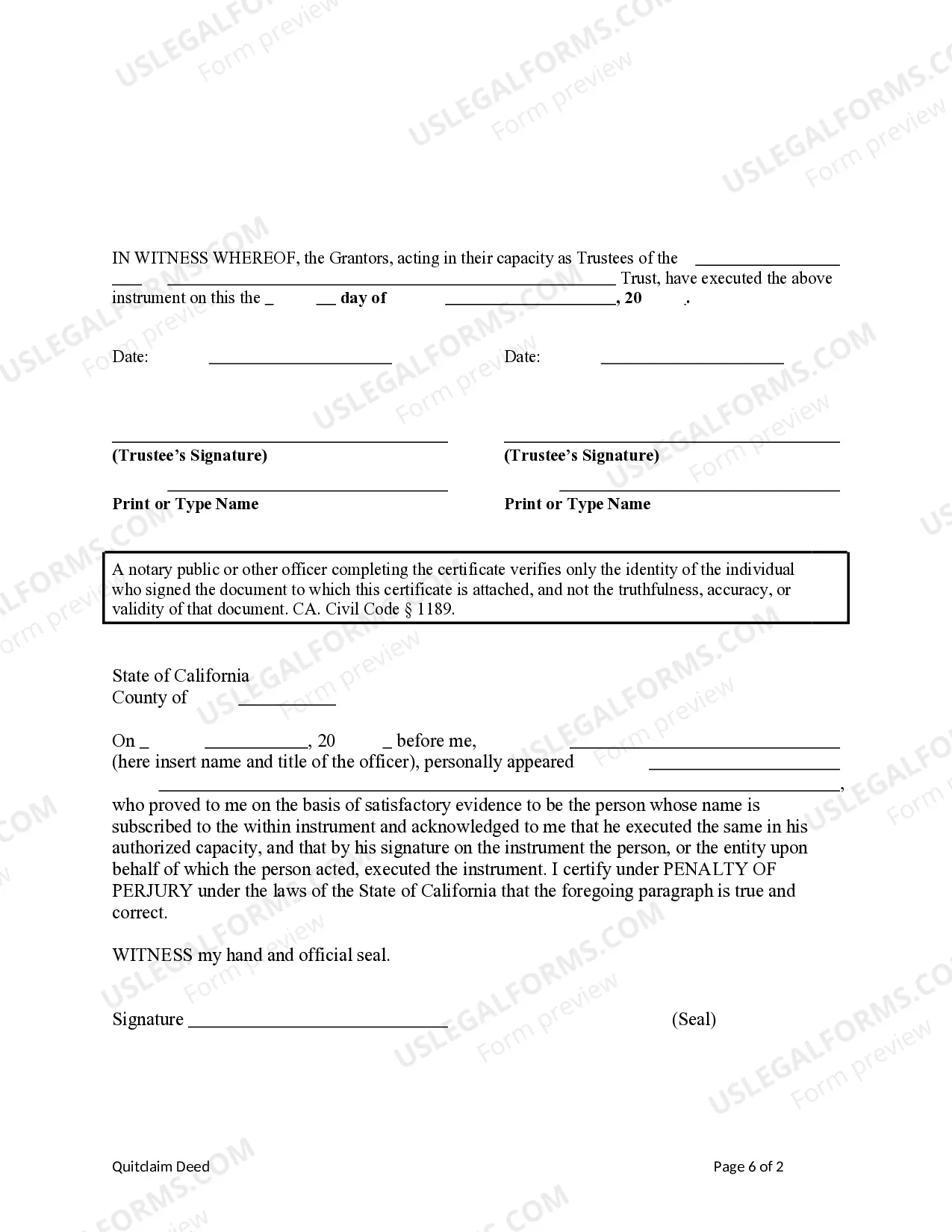
- Signature Lines: Required for the trustees and any witnesses or notary public.
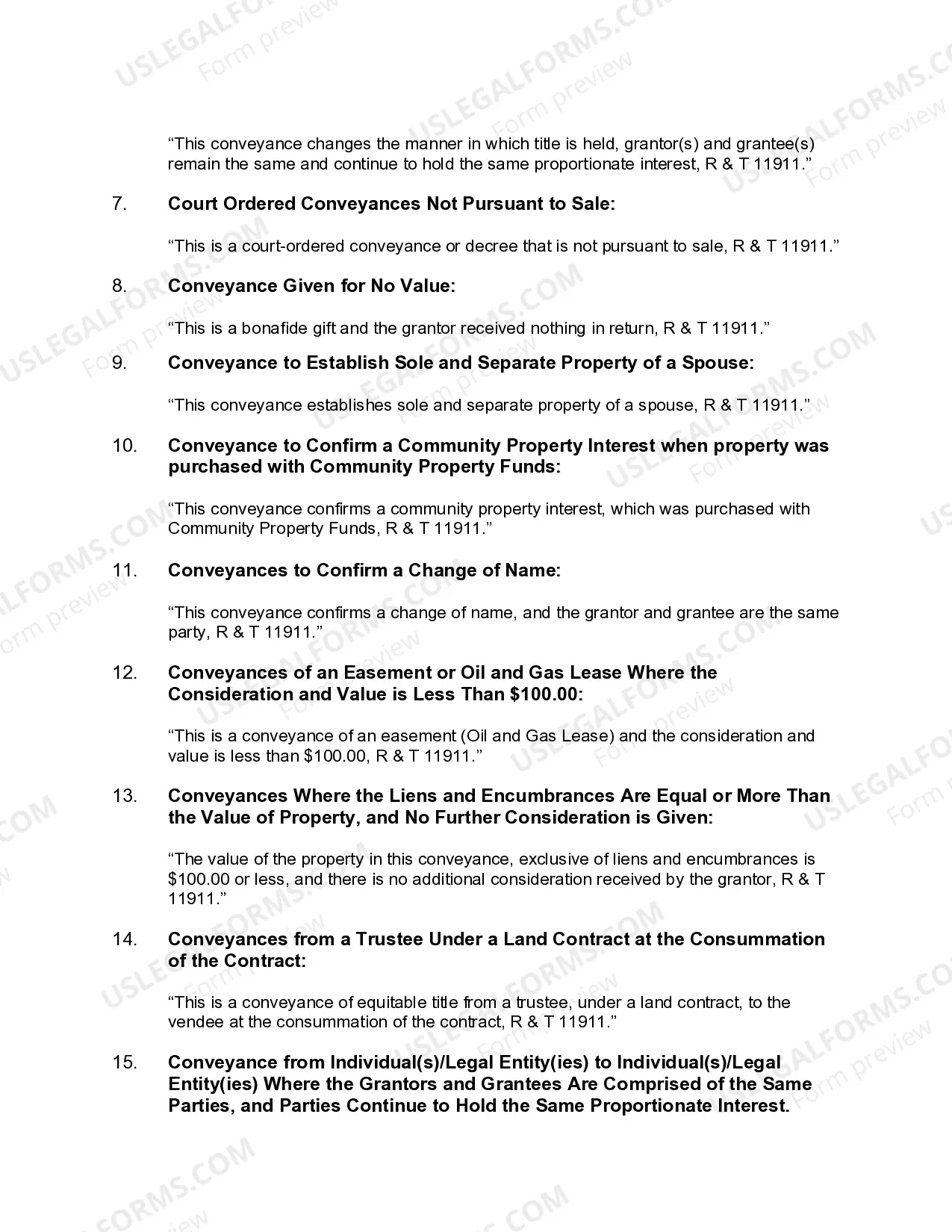
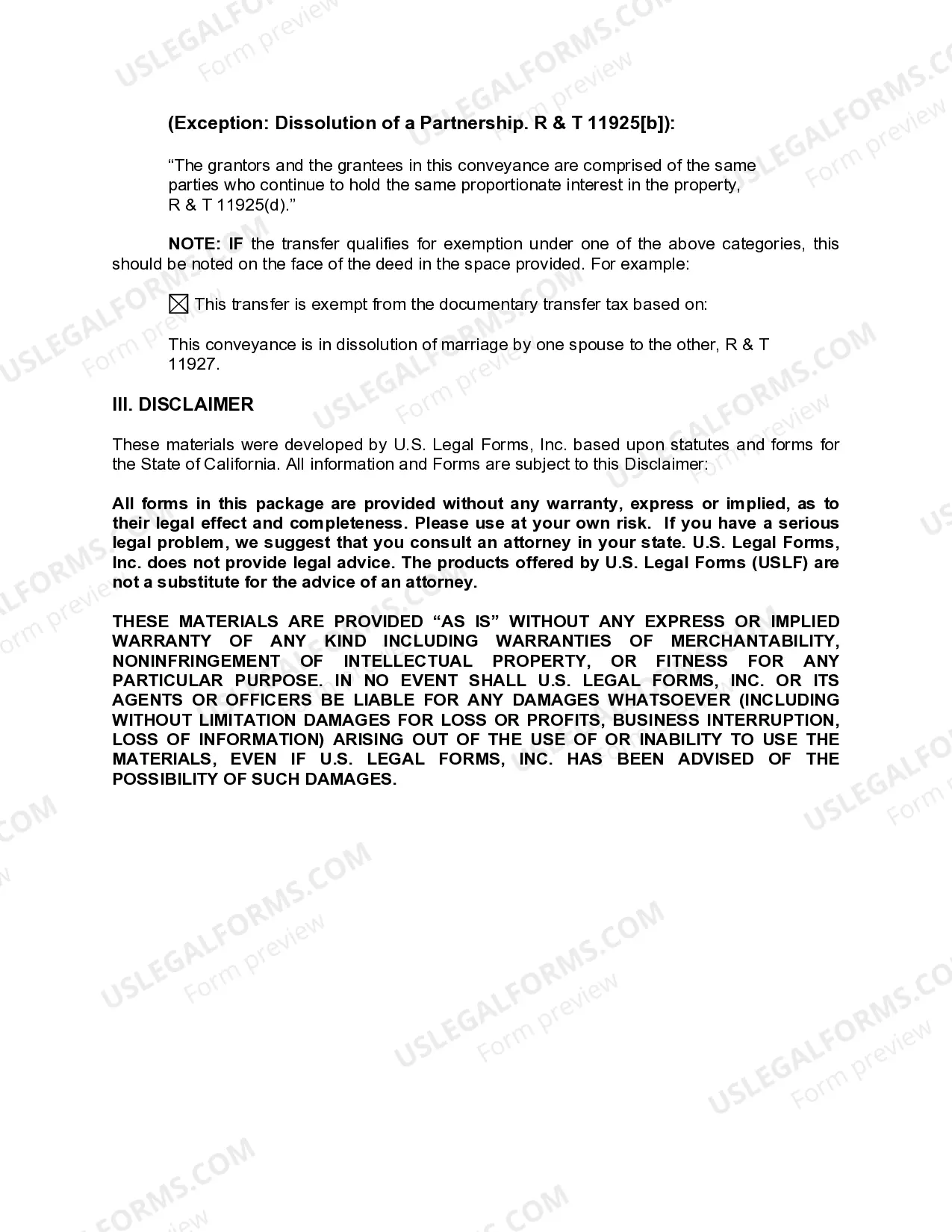
- Exemption Declaration: Option to state exemptions from transfer tax, if applicable.





When to use this document
This form is necessary when a trust wishes to transfer property to an individual. Common scenarios include the completion of a property transfer as part of estate planning, or when trustees are liquidating trust assets. It is particularly applicable in situations where ownership by a trust needs to be formally conveyed to an individual without warranties regarding the title.
Who can use this document
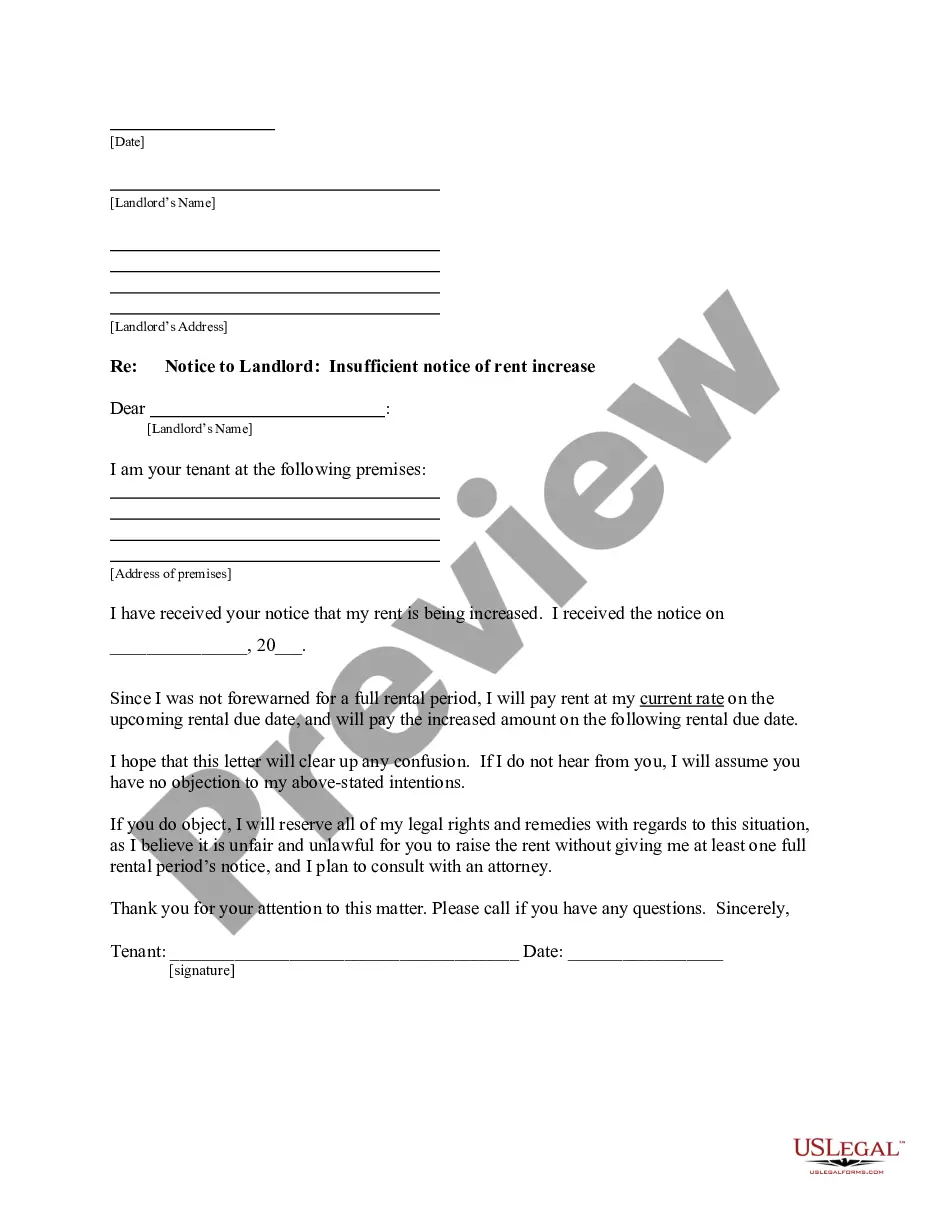
- Trustees acting on behalf of a trust.
- Individuals designated to receive property from a trust.
- Estate planners and legal representatives managing property transfers.
- Any party involved in property transfers with no title guarantees.
Instructions for completing this form
- Identify the parties involved: clearly list the Grantor (the trust) and the Grantee (the individual).
- Provide a complete description of the property being transferred.
- Fill in the date of the transfer.
- Ensure all required signatures are obtained from the trustees.
- Complete the exemption declaration if applicable and necessary.
Notarization requirements for this form
This form does not typically require notarization unless specified by local law. It is important to check any specific requirements that may apply in your jurisdiction.
Get your form ready online
Our built-in tools help you complete, sign, share, and store your documents in one place.
Make edits, fill in missing information, and update formatting in US Legal Forms—just like you would in MS Word.
Download a copy, print it, send it by email, or mail it via USPS—whatever works best for your next step.
Sign and collect signatures with our SignNow integration. Send to multiple recipients, set reminders, and more. Go Premium to unlock E-Sign.
If this form requires notarization, complete it online through a secure video call—no need to meet a notary in person or wait for an appointment.
We protect your documents and personal data by following strict security and privacy standards.

Make edits, fill in missing information, and update formatting in US Legal Forms—just like you would in MS Word.

Download a copy, print it, send it by email, or mail it via USPS—whatever works best for your next step.

Sign and collect signatures with our SignNow integration. Send to multiple recipients, set reminders, and more. Go Premium to unlock E-Sign.

If this form requires notarization, complete it online through a secure video call—no need to meet a notary in person or wait for an appointment.

We protect your documents and personal data by following strict security and privacy standards.
Common mistakes
- Failing to accurately describe the property in legal terms.
- Neglecting to obtain all required signatures.
- Omitting the exemption declaration on the deed.
- Not having the document properly notarized, if required by local law.
Advantages of online completion
- Convenience of completing the form from anywhere at any time.
- Editability allows for easy corrections and updates.
- Access to legally sound templates prepared by licensed attorneys.
- Competitive pricing without compromising on quality or reliability.
Key takeaways
- This Quitclaim Deed is used for transferring property from a trust to an individual.
- Clear identification of all parties and the property is essential.
- Understanding local laws is critical for completing the deed accurately.
Looking for another form?
Form popularity
FAQ
Indeed, a California Quitclaim Deed can transfer property from a trust to an individual. The trustees must authorize this transfer according to the trust's terms. This process facilitates straightforward ownership changes while ensuring compliance with state law. Using US Legal Forms can provide you with the necessary templates and guidance for a smooth transaction.
A California Quitclaim Deed cannot be used to resolve issues of title disputes or to transfer property that is under legal judgment. Additionally, if the property is subject to a mortgage, a quitclaim may not transfer the mortgage liability. It's crucial to understand these limitations before proceeding. Seeking professional advice can help clarify your options.
To add someone to a deed in California, you must prepare a California Quitclaim Deed. This document needs to specify both the current owner and the new individual. You will also need to sign and notarize the deed before filing it with the appropriate county office. For assistance with this, US Legal Forms offers resources to guide you through the requirements.
Yes, a California Quitclaim Deed can transfer property from a trust to another individual. This action involves the trustees executing the deed to transfer ownership. It is essential to ensure that the trust permits such transfers and that you follow all state regulations. Using a reliable platform like US Legal Forms can simplify this process for you.
Certainly, you can have two individual trustees serving on a trust. This option provides the advantage of diverse perspectives and contributions to trust administration. In the context of a California Quitclaim Deed – Trust (Two Trustees) to an Individual, having two individual trustees can strengthen the trust's governance. Just ensure that both trustees communicate effectively and collaborate on making decisions to maintain harmony in the trust's management.
Yes, you can have two trustees on a trust. This arrangement allows for shared responsibility and decision-making, which can benefit the trust's management and oversight. When using a California Quitclaim Deed – Trust (Two Trustees) to an Individual, having two trustees can enhance accountability and provide a support system in managing trust assets. It's essential to clearly define the roles and responsibilities of each trustee to prevent conflicts.
A trustee deed transfers property from a trustee to another party, often following a trust agreement, while a quitclaim deed allows an individual to transfer their interest in a property without guaranteeing the quality of that title. When using a California Quitclaim Deed – Trust (Two Trustees) to an Individual, understanding this distinction can help you choose the right document for your needs. It's crucial to seek guidance to ensure that you're using the appropriate deed for your transaction.
In California, trustees can be individuals, such as family members or friends, or organizations, like banks and trust companies. When you're dealing with a California Quitclaim Deed – Trust (Two Trustees) to an Individual, it is essential to ensure that the trustee you choose is trustworthy and capable of handling the responsibilities involved in the deed's management.
The creator of the deed, often referred to as the trustor, typically selects the trustee. This selection is a critical aspect of establishing a California Quitclaim Deed – Trust (Two Trustees) to an Individual, as it determines who will manage the trust assets. It is advisable to choose someone knowledgeable in trust management to facilitate the process effectively.
While it may seem that a trustee can be anyone, the law requires certain qualifications. The trustee must be of legal age and have the capacity to manage the responsibilities involved. In cases involving a California Quitclaim Deed – Trust (Two Trustees) to an Individual, selecting a qualified trustee ensures proper execution of the trust and protects all parties’ interests.