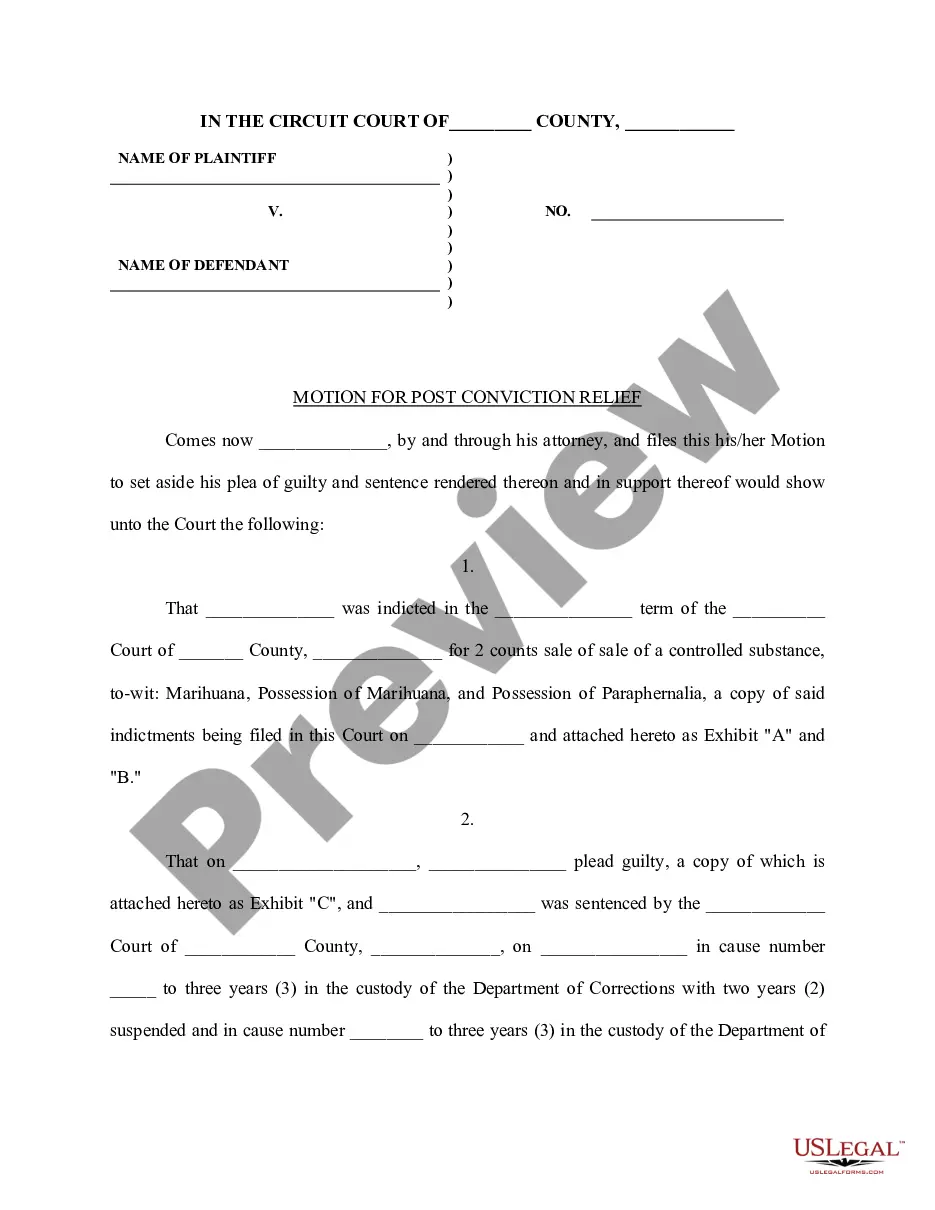
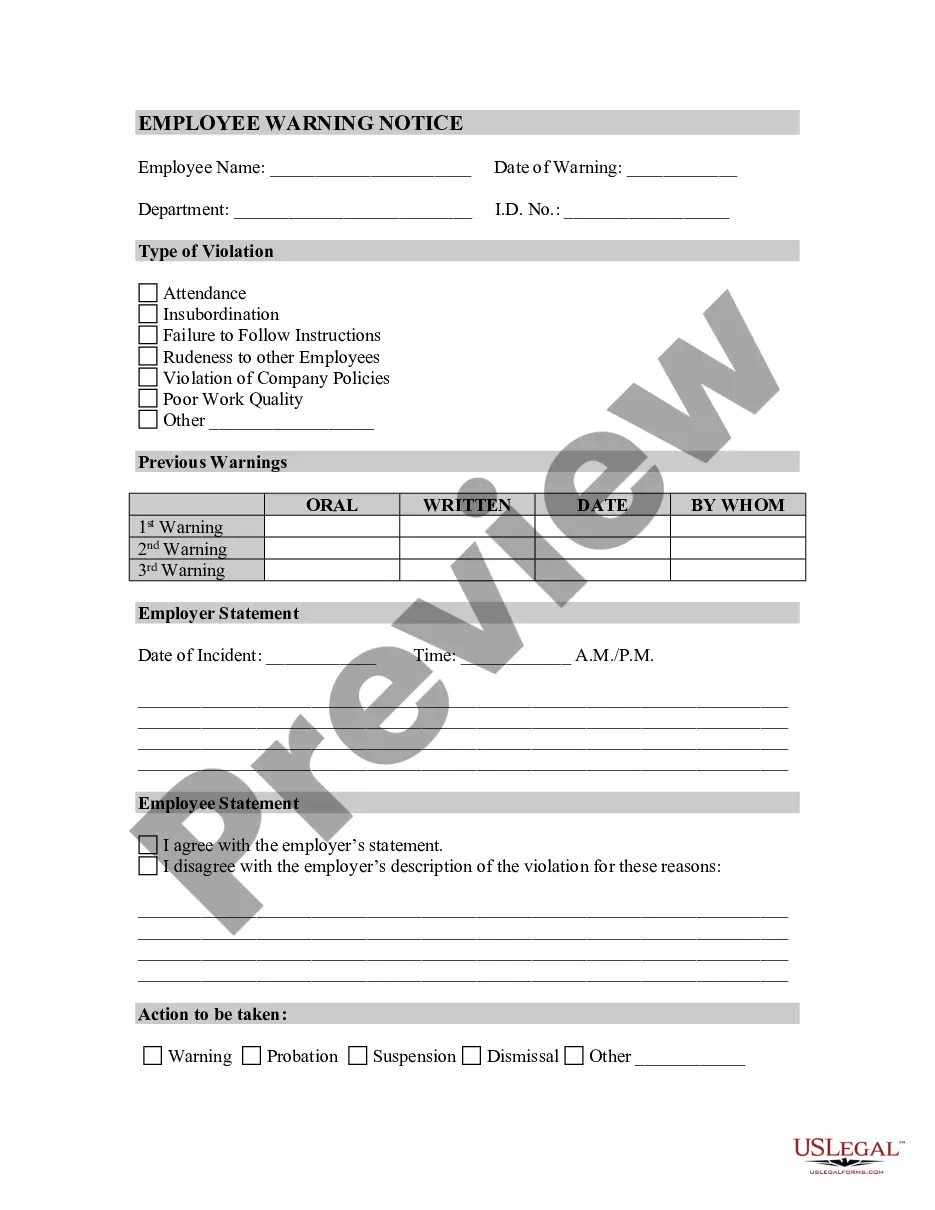
Arizona Employee Warning Notice
Description
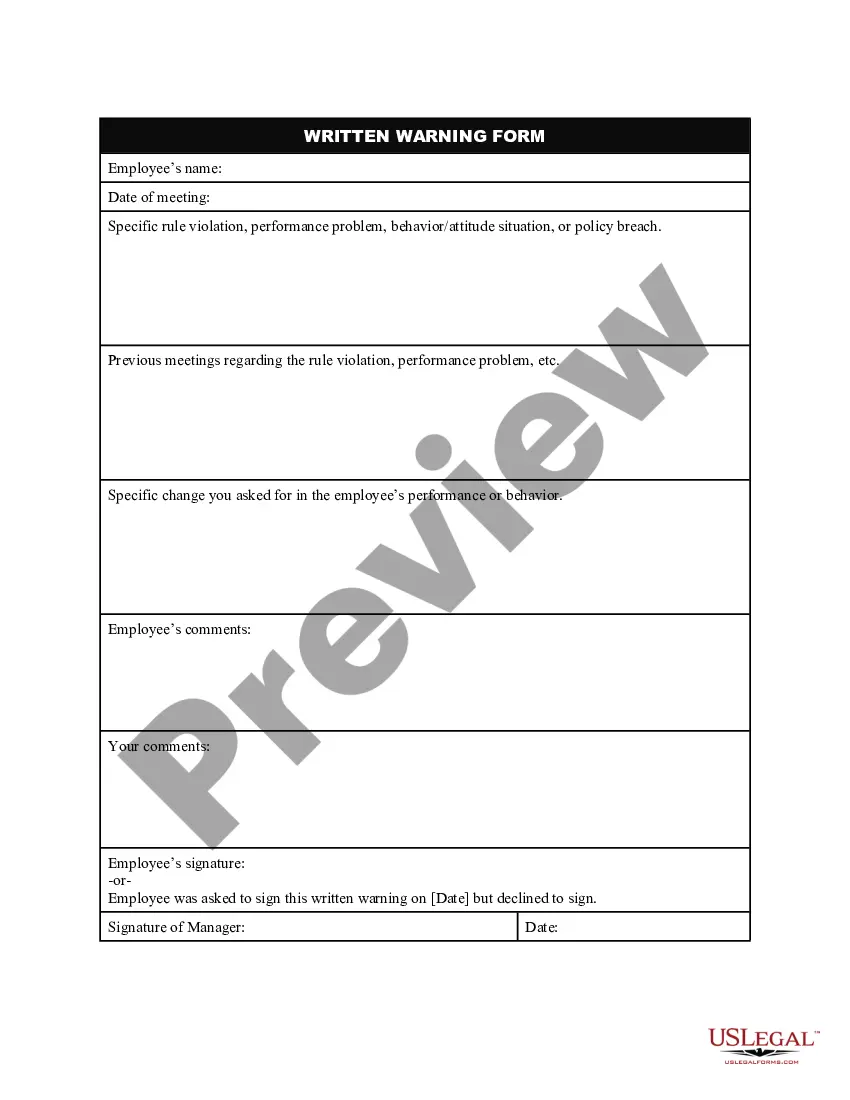
Get your form ready online
Our built-in tools help you complete, sign, share, and store your documents in one place.
Make edits, fill in missing information, and update formatting in US Legal Forms—just like you would in MS Word.
Download a copy, print it, send it by email, or mail it via USPS—whatever works best for your next step.
Sign and collect signatures with our SignNow integration. Send to multiple recipients, set reminders, and more. Go Premium to unlock E-Sign.
If this form requires notarization, complete it online through a secure video call—no need to meet a notary in person or wait for an appointment.
We protect your documents and personal data by following strict security and privacy standards.

Make edits, fill in missing information, and update formatting in US Legal Forms—just like you would in MS Word.

Download a copy, print it, send it by email, or mail it via USPS—whatever works best for your next step.

Sign and collect signatures with our SignNow integration. Send to multiple recipients, set reminders, and more. Go Premium to unlock E-Sign.

If this form requires notarization, complete it online through a secure video call—no need to meet a notary in person or wait for an appointment.

We protect your documents and personal data by following strict security and privacy standards.
Looking for another form?







How to fill out Employee Warning Notice?
US Legal Forms - one of the largest collections of legal documents in the USA - offers a comprehensive selection of legal templates that you can download or print.
By using the site, you can discover thousands of forms for both business and personal needs, categorized by type, state, or keywords. You can find the most current versions of forms like the Arizona Employee Warning Notice in just moments.
If you are already registered, sign in and download the Arizona Employee Warning Notice from the US Legal Forms collection. The Download button will appear on each form you view. You can access all previously downloaded forms from the My documents tab in your account.
Then, choose your payment plan and provide your details to register for an account.
Process the payment. Use your credit card or PayPal account to complete the transaction. Choose the format and download the form to your device. Make edits. Fill out, modify, and print and sign the downloaded Arizona Employee Warning Notice. Each form you save to your account has no expiration date and belongs to you permanently. So, if you need to download or print another copy, just go to the My documents section and click on the form you want. Access the Arizona Employee Warning Notice with US Legal Forms, the most extensive collection of legal document templates. Utilize thousands of professional and state-specific templates that meet your business or personal needs and requirements.
- If you want to use US Legal Forms for the first time, here are a few simple steps to get you started.
- Ensure you have selected the correct form for your city/region.
- Click the Preview button to review the content of the form.
- Check the form description to confirm you have chosen the appropriate form.
- If the form doesn't meet your needs, use the Search box at the top of the screen to find one that does.
- If you are satisfied with the form, confirm your selection by clicking the Purchase now button.
Form popularity
FAQ
Typically, you give one verbal warning and two written warnings (one initial and one final) before dismissing them. However, in cases of severe or gross misconduct, you may dismiss the employee without prior warning.
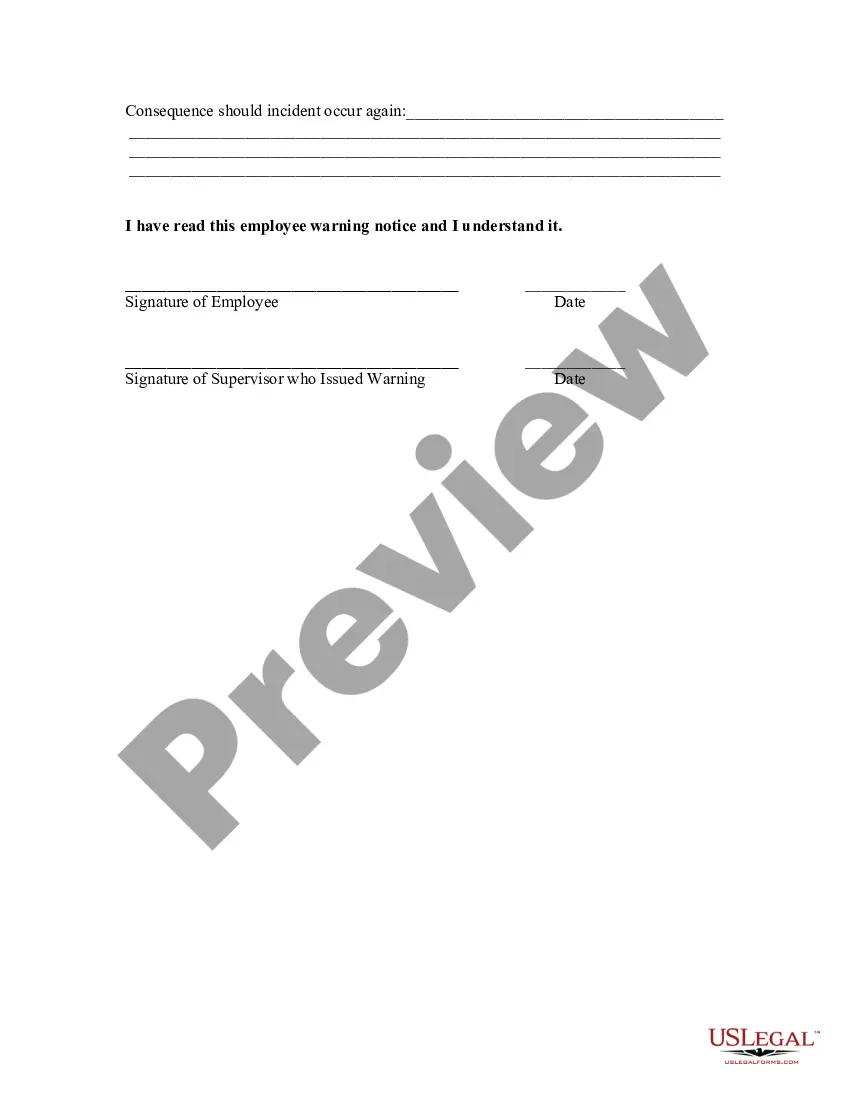
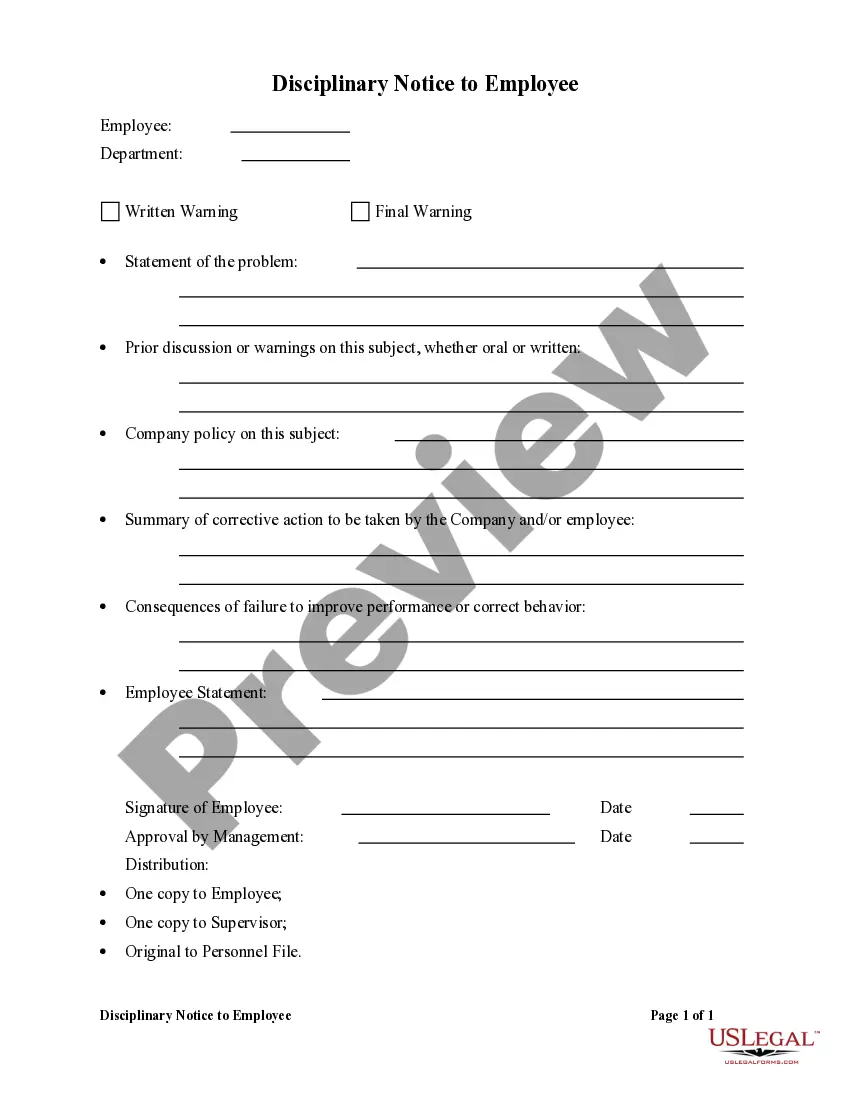
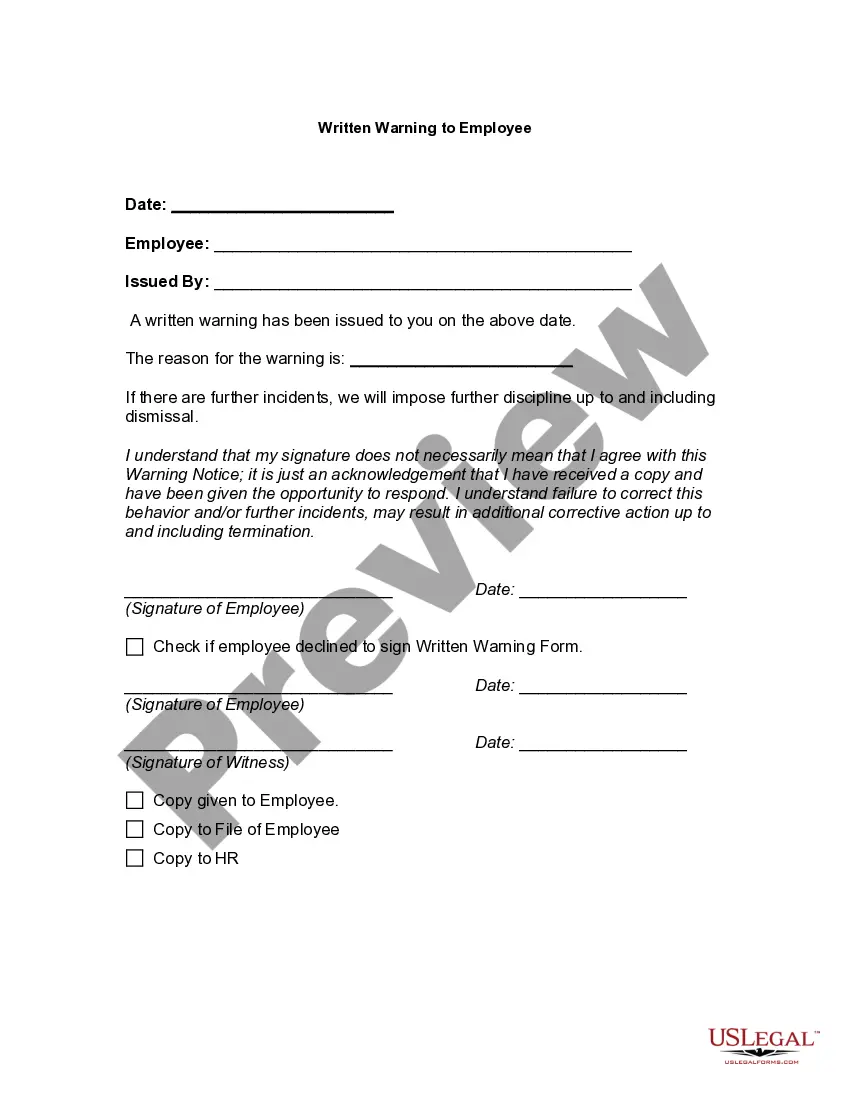
An employee warning letter is a document that an employer issues to an employee to officially notify them of a breach of company protocol and to inform them of any disciplinary consequences. The employee signs the written warning to acknowledge its receipt and a copy is kept in their personnel file.
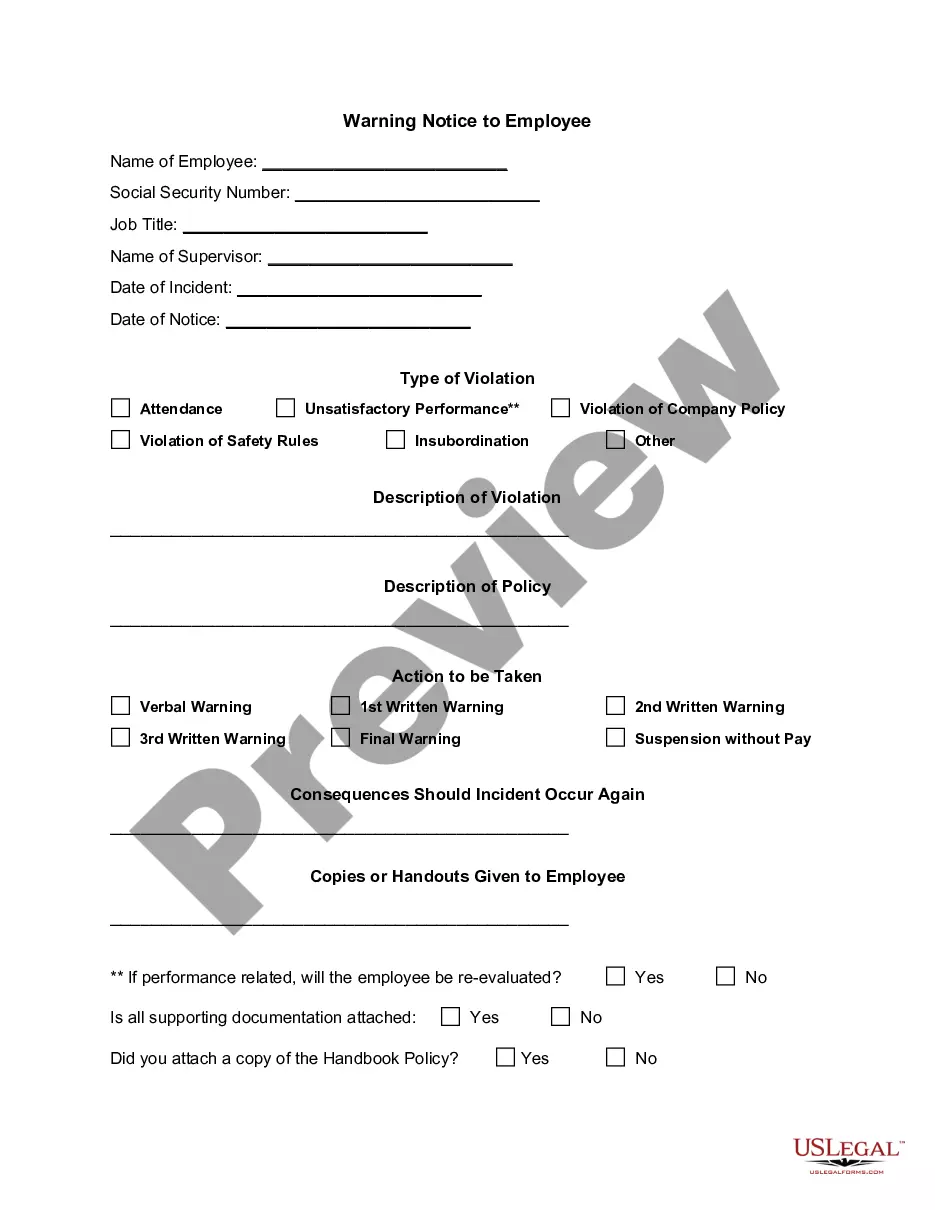
What to include in an employee warning noticeCompany name.Warning number.Name of employee and job title.Name of supervisor.Name of HR representative.Date of issue.Introductory statement.Infractions incurred by the employee.More items...
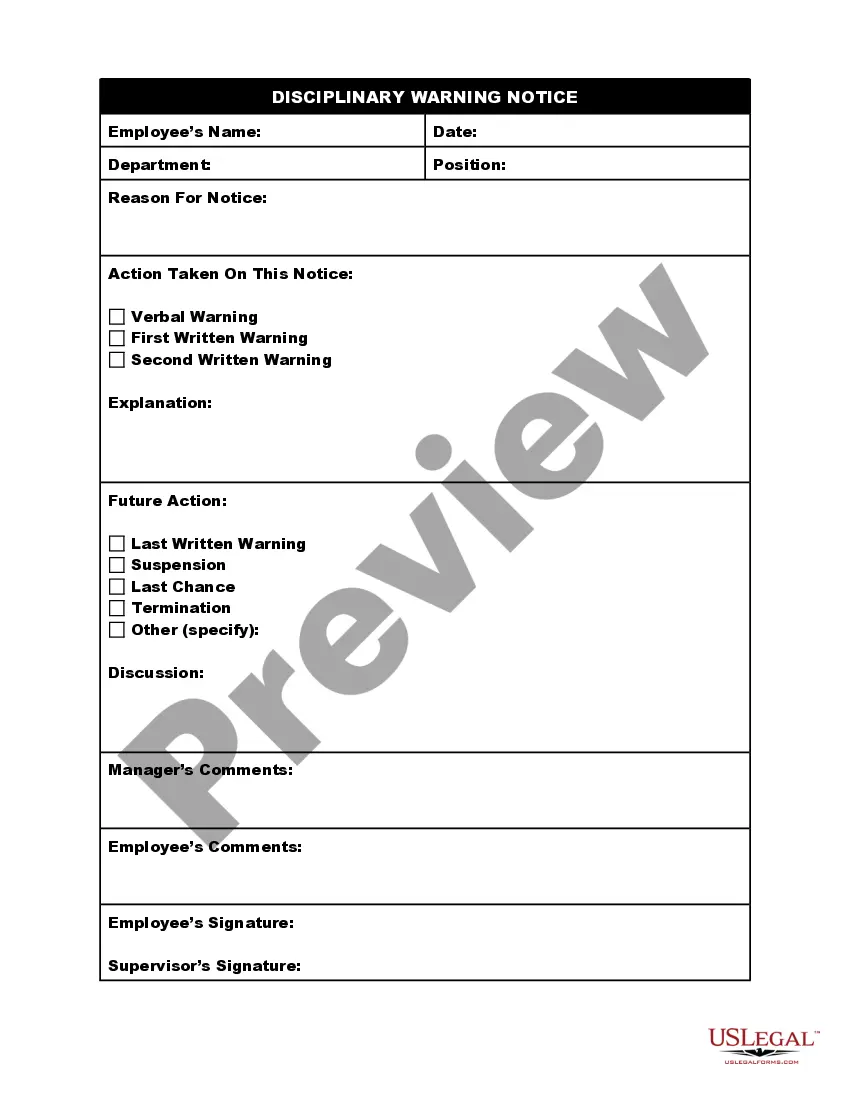
Employee warning notices are used to address and confirm an employee's performance or inappropriate conduct at work. A company usually issues an employee warning form after a meeting with him/her to discuss the issue. This gives the employee an opportunity to correct their behavior moving forward.
The answer lies in the company's disciplinary policy and code. It is recommended that you make provision for a comprehensive final written warning and include a provision in your disciplinary policy that stipulates that any employee who is issued with more than two valid final written warnings may be dismissed.
You usually issue an employee with a warning letter after meeting to discuss the problem. Final warning letters are usually issued to an employee after you have warned him or her about a particular performance or conduct issue and his or her conduct or performance has not improved.
While employers don't legally need to give employees three warnings before dismissing them, it is important to give employees a chance to fix any performance or conduct issues. Therefore, giving employees at least one warning in writing before ending their employment is a good idea.
How many written warnings do I give before dismissal? Typically, you give one verbal warning and two written warnings (one initial and one final) before dismissing them. However, in cases of severe or gross misconduct, you may dismiss the employee without prior warning.
Generally, if an employee maintains an acceptable level of behavior for 12 months or more, many employers agree that older disciplinary warnings normally no longer influence future employment decisions.
The main purpose of a warning letter is to inform an individual of his/her mistakes and what needs to be rectified if there is any room for improvement. A warning letter should clearly describe the problem created by an employee so as to give the employee a fair and reasonable opportunity to amend his/her ways.