Arizona Order for Partial Distribution
What this document covers
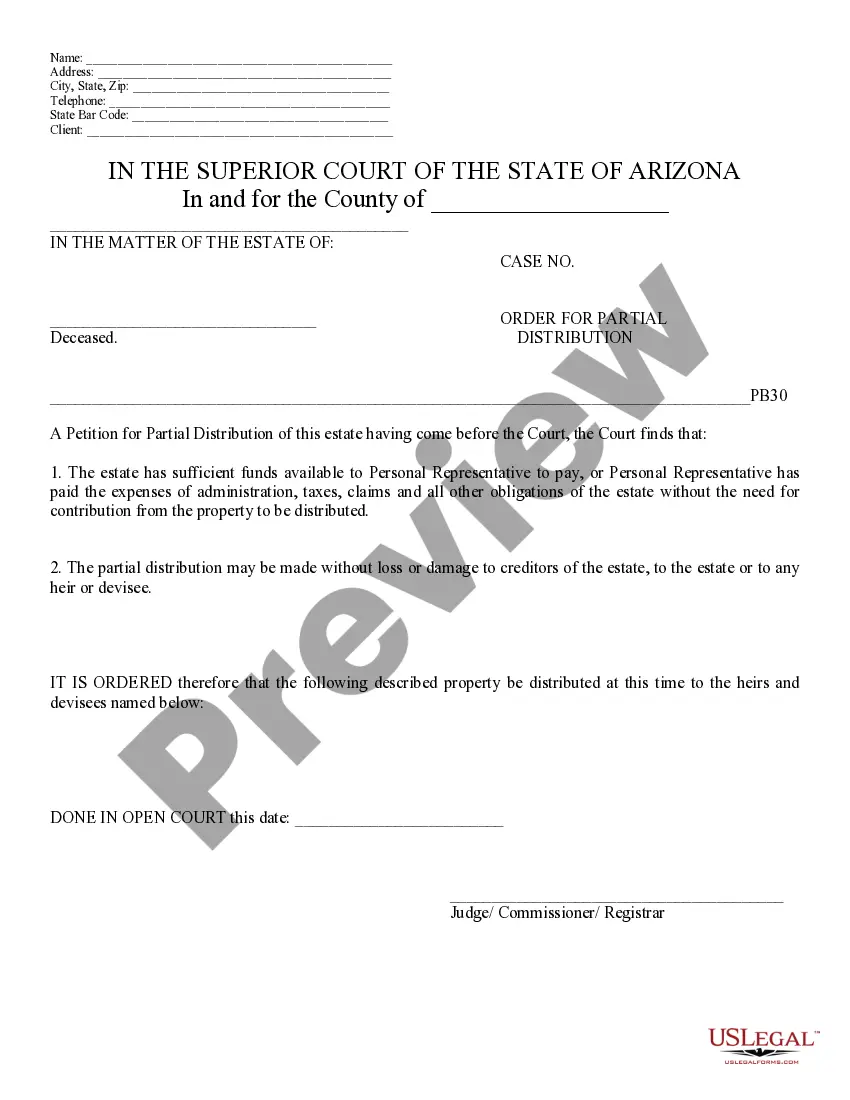
The Order for Partial Distribution is a legal document issued by a court to authorize the distribution of a portion of an estate's assets before the entire estate is settled. This order is distinct from a final distribution order, allowing heirs or beneficiaries to receive their share sooner while ensuring that creditors' claims are safeguarded. It is crucial for parties involved in estate administration to understand and utilize this form appropriately.
Form components explained
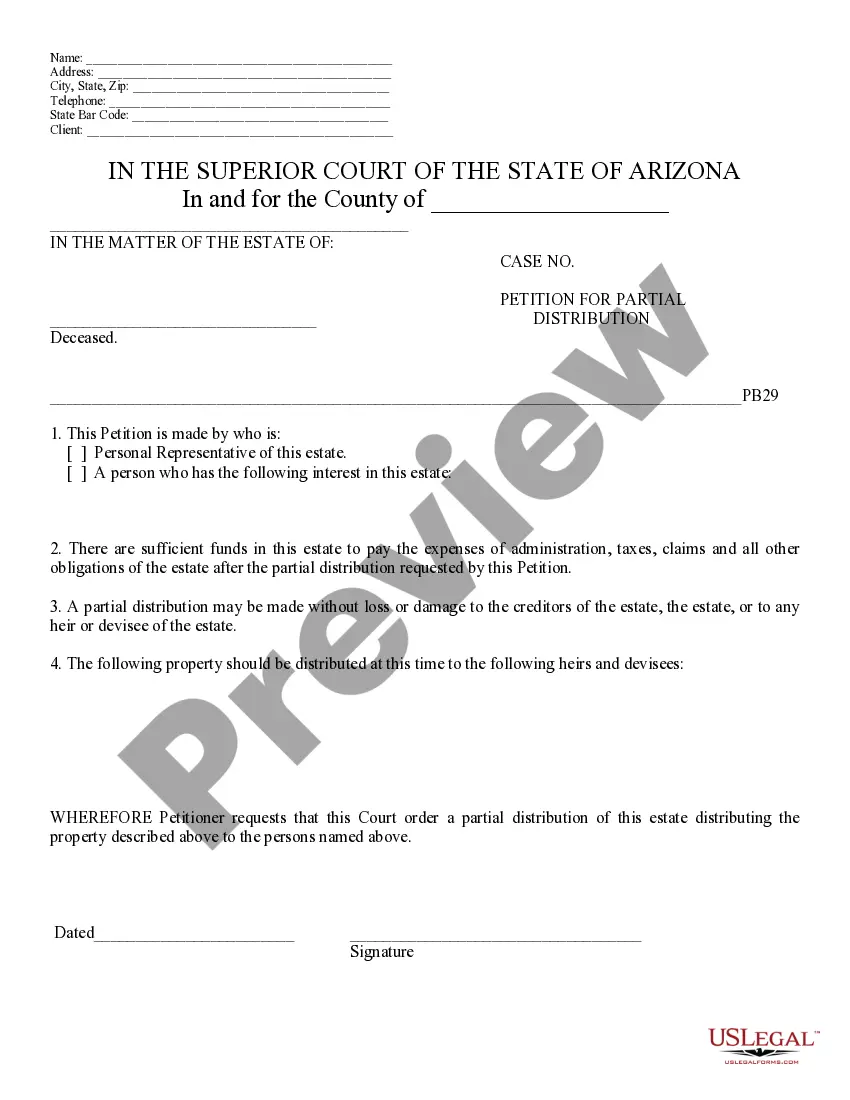
- Petition for Partial Distribution: This section outlines the request made to the court for distributing a portion of the estate.
- Estate Overview: Identifies the estate and confirms that there are enough funds to cover expenses before distribution.
- Distribution Terms: Specifies which assets are to be distributed and to whom they will go.
- Judicial Authority: Signed by a judge, confirming the legally binding nature of the order.
- Documentation Date: Indicates the date the order is completed and signed in court.
When to use this form
This form is typically used when an estate has sufficient funds to pay off debts and expenses, allowing for a partial distribution to beneficiaries. This may occur in scenarios where immediate financial support is needed by heirs, or when the court determines that distributing certain assets will not harm the estate or other beneficiaries.
Who this form is for
- Personal representatives or executors of an estate seeking to distribute assets before final settlement.
- Heirs or beneficiaries in need of their share of the estate funds sooner.
- Legal professionals assisting clients with estate administration.
Instructions for completing this form
- Identify the parties involved: Enter the name and contact information of the personal representative and the estate.
- Fill in the court information: Specify the name of the court and the county where the estate is being administered.
- Complete the petition section: Describe the request for partial distribution and ensure it aligns with the estate's status.
- List the property to be distributed: Clearly define the assets being distributed to heirs or beneficiaries.
- Sign and date the order: The judge will sign and date the document in court, which finalizes the order for distribution.
Does this form need to be notarized?
This form does not typically require notarization unless specified by local law. However, it's always recommended to check with a legal professional or local court for specific requirements in your jurisdiction.
Get your form ready online
Our built-in tools help you complete, sign, share, and store your documents in one place.
Make edits, fill in missing information, and update formatting in US Legal Forms—just like you would in MS Word.
Download a copy, print it, send it by email, or mail it via USPS—whatever works best for your next step.
Sign and collect signatures with our SignNow integration. Send to multiple recipients, set reminders, and more. Go Premium to unlock E-Sign.
If this form requires notarization, complete it online through a secure video call—no need to meet a notary in person or wait for an appointment.
We protect your documents and personal data by following strict security and privacy standards.

Make edits, fill in missing information, and update formatting in US Legal Forms—just like you would in MS Word.

Download a copy, print it, send it by email, or mail it via USPS—whatever works best for your next step.

Sign and collect signatures with our SignNow integration. Send to multiple recipients, set reminders, and more. Go Premium to unlock E-Sign.

If this form requires notarization, complete it online through a secure video call—no need to meet a notary in person or wait for an appointment.

We protect your documents and personal data by following strict security and privacy standards.
Avoid these common issues
- Failing to provide complete information about the estate and beneficiaries.
- Neglecting to verify that all obligations of the estate are met before requesting distribution.
- Using language that does not accurately reflect the circumstances of the case.
Advantages of online completion
- Convenient access from anywhere, allowing users to complete the form at their own pace.
- Editable templates that can be tailored to specific situations without the risk of missing key sections.
- Reliability in using forms created or reviewed by licensed attorneys, ensuring compliance with legal requirements.
Legal use & context
- This order facilitates the legal transfer of property and is enforceable upon court approval.
- It helps to clear estate obligations while allowing for the timely distribution of assets.
- Any distribution made must protect the interests of the estate's creditors.
What to keep in mind
- The Order for Partial Distribution is crucial for managing estate distributions efficiently.
- Proper completion and adherence to legal requirements can expedite the estate administration process.
- Consulting with a legal professional can provide valuable guidance in using this form correctly.
Looking for another form?

Form popularity
FAQ
Certain individuals, such as those with very low income and specific groups like the elderly or disabled, may be exempt from Arizona state income tax. Additionally, you might find some exceptions related to inheritances or distributions like an Arizona Order for Partial Distribution. Always verify eligibility for these exemptions to avoid unnecessary tax liabilities.
Typically, Arizona does not tax foreign income unless it is connected to a trade or business within the state. However, receiving an Arizona Order for Partial Distribution related to foreign assets may have specific impacts. It is wise to seek professional guidance to navigate these waters effectively.
Line 29a on Arizona Form 140 pertains to specific credits available for taxpayers. If you receive a partial distribution from an estate or trust, it may influence your overall tax calculation. Understanding these lines is crucial, especially if you’ve utilized an Arizona Order for Partial Distribution, as they could provide tax benefits.
Yes, Arizona taxes non-resident income that is earned within the state. If you participate in an Arizona Order for Partial Distribution and it generates income, that income may be subject to Arizona taxes. Always track your income sources carefully to ensure you meet tax obligations properly.
Individuals who earn income in Arizona must file a state tax return. This includes residents and non-residents who have Arizona income. If you receive a distribution as part of an Arizona Order for Partial Distribution, you may need to report that on your state return. Always check current guidelines or consult a tax professional to ensure compliance.
Partial distribution refers to the process of allocating a portion of an estate's assets to beneficiaries before the estate is fully settled. This allows beneficiaries to access some of their inheritance sooner, often alleviating immediate financial concerns. In the context of an Arizona Order for Partial Distribution, it serves as a practical solution to support beneficiaries during the ongoing probate process.
Rule 51 in Arizona probate law outlines the procedures for obtaining a court’s approval for a partial distribution of an estate's assets. This rule is essential for ensuring that the distribution aligns with the legal framework governing estates. By following Rule 51, individuals can effectively manage the Arizona Order for Partial Distribution process.
A disbursement typically refers to the payment or release of funds from an account, while distribution relates to the allocation of assets from an estate to beneficiaries. In the case of an Arizona Order for Partial Distribution, the term 'distribution' implies that certain beneficiaries receive their inheritance at a specific stage in the probate process. This distinction is crucial for the management of estate funds.
The 120 hour rule in Arizona dictates that if an individual does not survive for 120 hours after a testator's death, they are treated as if they predeceased the testator. This rule is significant for the distribution of an estate under an Arizona Order for Partial Distribution, as it affects the allocation of assets among beneficiaries. Understanding this rule can help ensure that proper legal protocols are followed.
The term 'partial' in legal contexts typically denotes something that is not complete or whole. In regards to an Arizona Order for Partial Distribution, it indicates that beneficiaries may receive only a portion of their inheritance rather than the entire amount. This ensures that immediate needs are met while the estate is still being settled.