Arizona Application for Order of Continuing Lien
Understanding this form
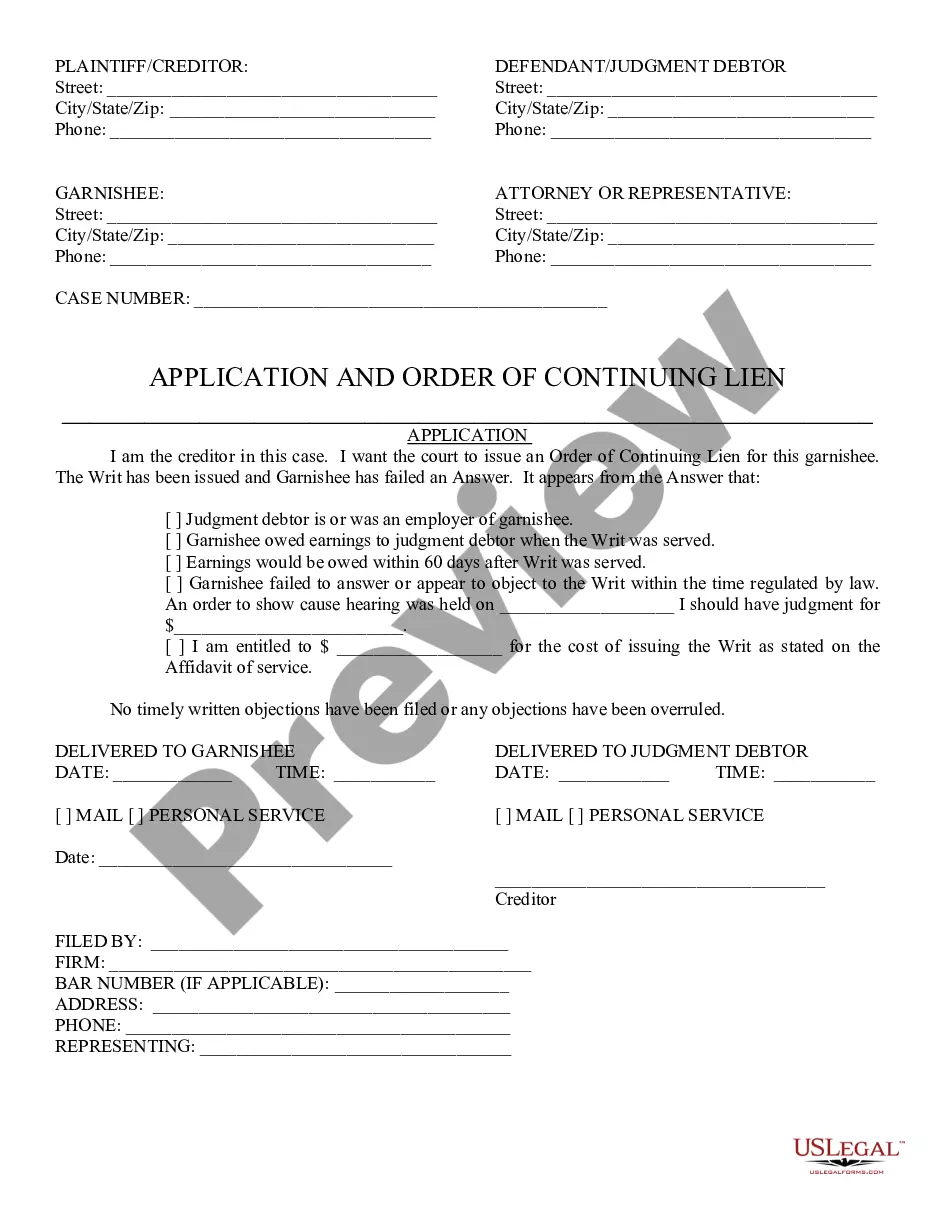
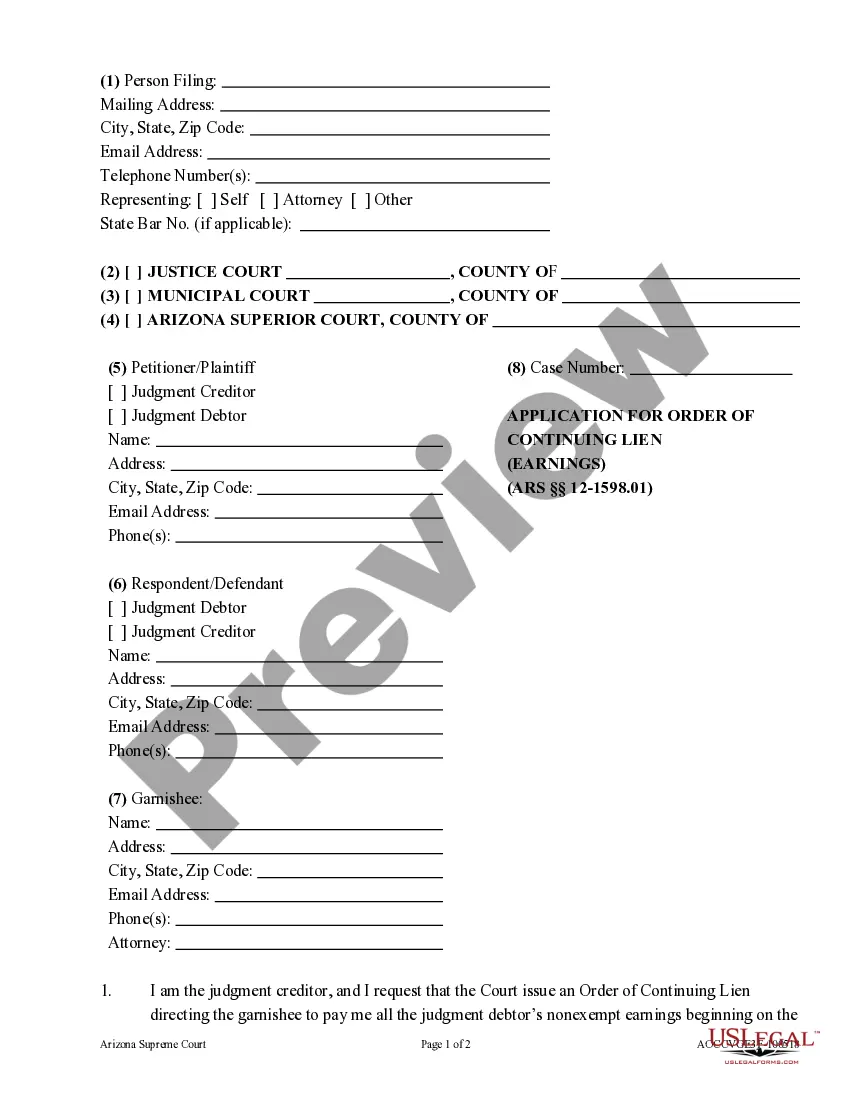
The Application for Order of Continuing Lien is a legal document used by creditors to maintain a lien on a debtor's property when a judgment remains unpaid. This form enables creditors to request the court to extend the lien until the judgment is satisfied, serving as a vital tool for debt recovery.
Main sections of this form
- Party information: Includes details about the creditor, debtor, and garnishee.
- Case number: A unique identifier for the legal case.
- Application declaration: States the creditor's request for a continuing lien.
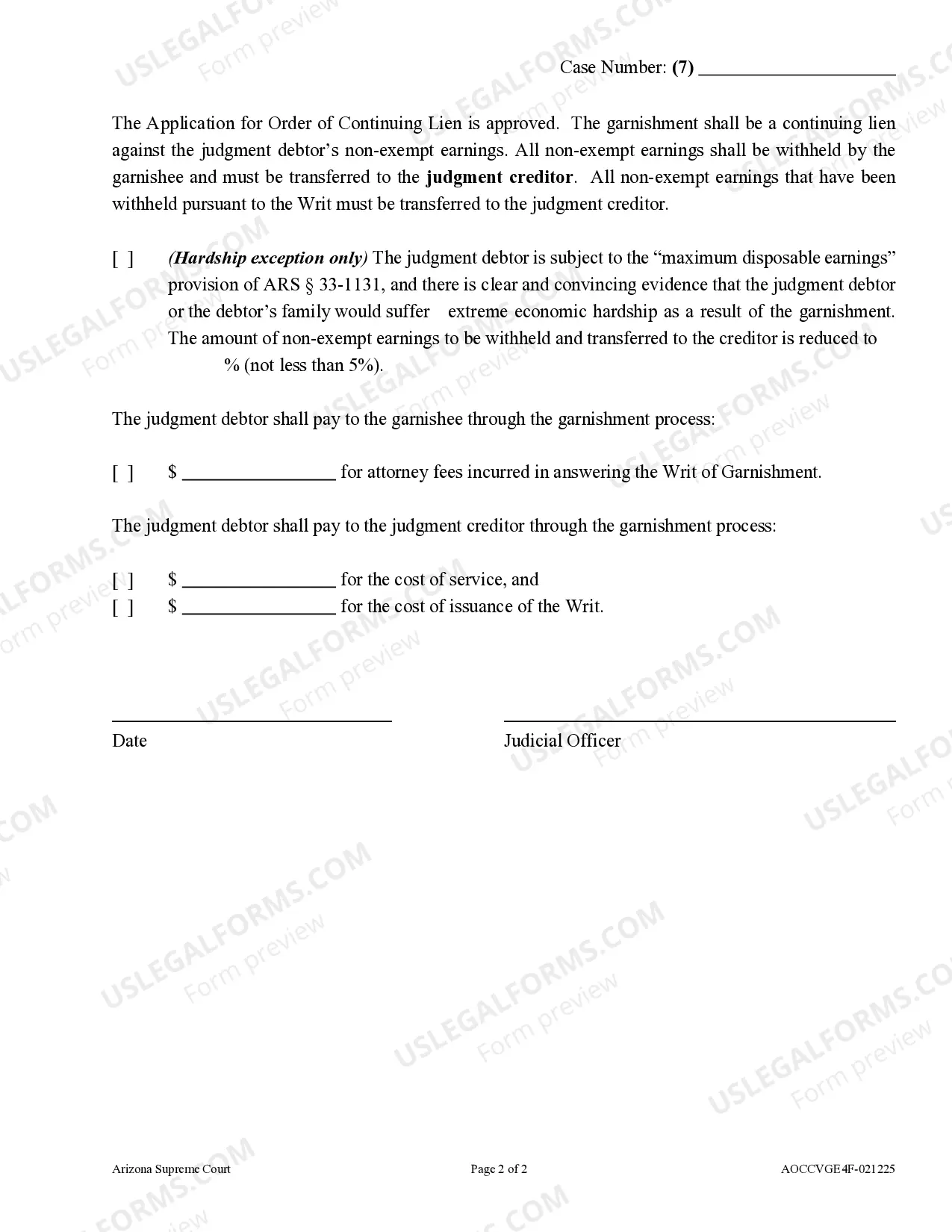
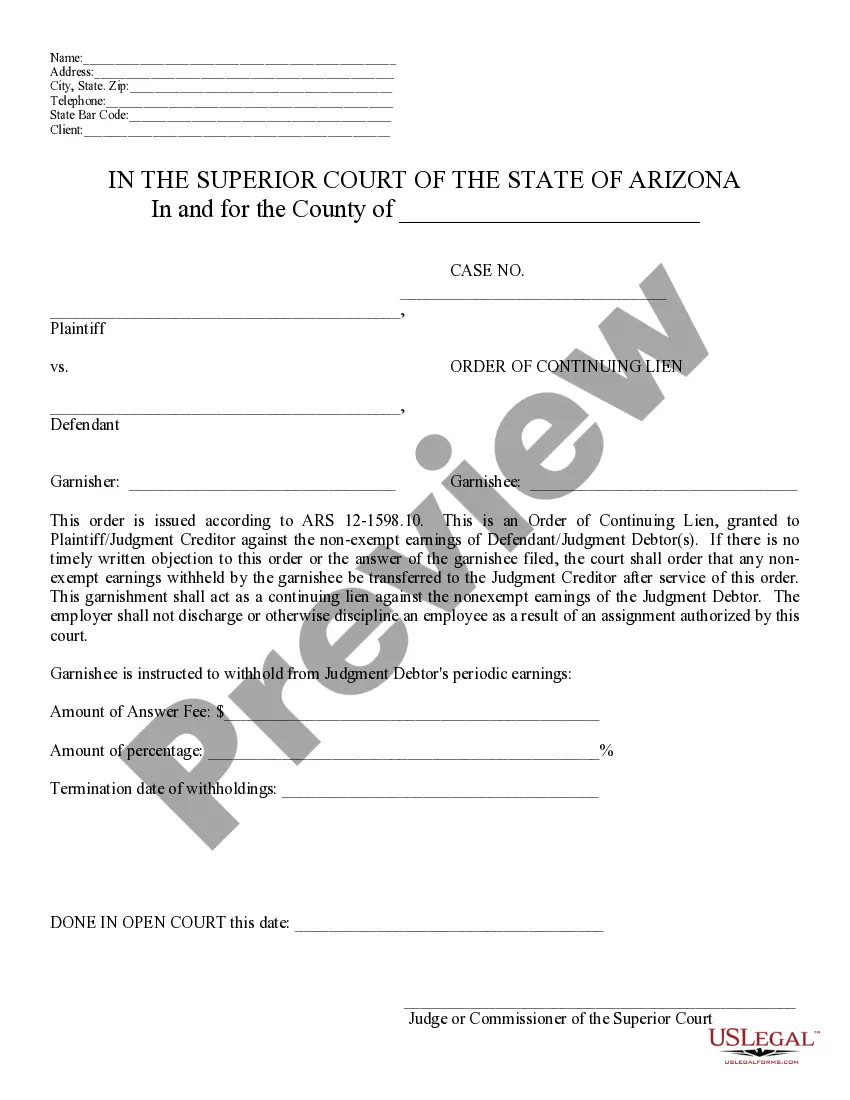
- Order of continuing lien: Specifies the terms under which the lien is approved.
- Judge's signature: Indicates official approval of the application.
Common use cases
This form should be used when a creditor has obtained a judgment against a debtor, but the debtor has not fully paid the debt. If a garnishee fails to respond to a writ of garnishment, the creditor can file this application to secure the lien on the debtor's nonexempt earnings, ensuring that the creditor can recover the owed amount.
Who can use this document
This form is intended for:
- Creditors who have obtained a judgment against a debtor.
- Individuals or businesses seeking to enforce collection through a lien.
- Legal representatives acting on behalf of a creditor in debt recovery matters.
Completing this form step by step
- Identify the creditor: Fill in the name and contact information of the creditor filing the application.
- Provide debtor details: Enter the name and address of the debtor who owes the judgment.
- Include garnishee information: Supply the name and address of the garnishee who is to withhold earnings.
- Specify the case number: Enter the assigned case number for easy tracking.
- Complete the application declaration: Clearly state the request for the court to issue a continuing lien.
- Obtain the judge's signature: Submit the completed form to the court for approval and ensure it is signed by the judge.
Does this form need to be notarized?
Notarization is generally not required for this form. However, certain states or situations might demand it. You can complete notarization online through US Legal Forms, powered by Notarize, using a verified video call available anytime.
Get your form ready online
Our built-in tools help you complete, sign, share, and store your documents in one place.
Make edits, fill in missing information, and update formatting in US Legal Forms—just like you would in MS Word.
Download a copy, print it, send it by email, or mail it via USPS—whatever works best for your next step.
Sign and collect signatures with our SignNow integration. Send to multiple recipients, set reminders, and more. Go Premium to unlock E-Sign.
If this form requires notarization, complete it online through a secure video call—no need to meet a notary in person or wait for an appointment.
We protect your documents and personal data by following strict security and privacy standards.

Make edits, fill in missing information, and update formatting in US Legal Forms—just like you would in MS Word.

Download a copy, print it, send it by email, or mail it via USPS—whatever works best for your next step.

Sign and collect signatures with our SignNow integration. Send to multiple recipients, set reminders, and more. Go Premium to unlock E-Sign.

If this form requires notarization, complete it online through a secure video call—no need to meet a notary in person or wait for an appointment.

We protect your documents and personal data by following strict security and privacy standards.
Common mistakes
- Filling in incorrect party information, which may delay the process.
- Neglecting to provide the case number, making it difficult for the court to file the application.
- Failing to sign the form before submitting it, leading to rejection by the court.
Benefits of using this form online
- Convenience of downloading and filling out the form at your own pace.
- Availability of different formats, such as Word and Rich Text, for ease of use.
- Access to attorney-drafted forms that ensure legal compliance and accuracy.
Legal use & context
- The form is legally binding once filed and approved by the court.
- It secures the creditor's rights regarding the judgment owed.
- Garnishees must comply with the terms outlined in the continuing lien order.
Key takeaways
- The Application for Order of Continuing Lien is essential for securing outstanding debts.
- Accurate and complete information is crucial for the form's validity.
- Consider local laws to understand the requirements for filing this form.
Looking for another form?



Form popularity
FAQ
To renew a judgment in Arizona, you must file a motion with the court where the original judgment was issued, typically within the five-year timeframe. The process may involve completing necessary forms and possibly serving notice to the other party involved. Utilizing the Arizona Application for Order of Continuing Lien can streamline the renewal process and provide ongoing legal enforcement for your judgment.
An Arizona judgment remains valid for a duration of five years from the date it was entered. After this period, it may become dormant unless you take action to renew it. To maintain your collection rights, consider filing an Arizona Application for Order of Continuing Lien, which can help enforce judgments effectively during this timeframe.
In Arizona, a lien typically lasts for a period of five years from the date of its filing. However, if you want to ensure that your lien remains enforceable, you may need to file an Arizona Application for Order of Continuing Lien before the initial period expires. This application allows you to extend the enforcement of your lien, providing additional protection for your interests.
When a judgment is entered against you in Arizona, it can lead to wage garnishment, bank levies, or liens on your property. It is essential to understand your rights and options after a judgment to manage your financial situation effectively. An Arizona Application for Order of Continuing Lien might be useful for you if you are a creditor seeking to secure your interest in the debtor's assets.
To file a judgment lien in Arizona, you need to complete specific forms and submit them to the appropriate county recorder's office. Ensure that you include all required documentation related to the original judgment. For assistance with the process, consider using the Arizona Application for Order of Continuing Lien to facilitate your filing.
Yes, judgments in Arizona do expire, typically after five years from the date of entry. However, creditors can take steps to renew the judgment within that period. Using an Arizona Application for Order of Continuing Lien can be an effective way to keep your claims active.
In Arizona, judgment liens can be renewed to extend their enforceability after the original judgment period expires. To renew a lien, you must file a motion in court and may need to provide supporting documentation. Utilizing the Arizona Application for Order of Continuing Lien helps ensure that you can maintain your financial interests even as time passes.
An order of continuing lien in Arizona is a legal tool that allows a creditor to secure a lien on a debtor's property, ensuring the creditor can collect the debt over time. This order is particularly useful when dealing with ongoing debts or installment payments. By filing an Arizona Application for Order of Continuing Lien, creditors can maintain their rights to the debtor's assets effectively.
In Arizona, a judgment creditor has the right to seize certain personal property if a judgment is entered against you. This includes items such as vehicles, bank accounts, and valuable assets. Knowing what can be seized can help you protect your assets and understand how an Arizona Application for Order of Continuing Lien may impact your situation.
The default judgment rule in Arizona allows a court to issue a judgment against a defendant who fails to respond to a complaint within the specified time. This means if you do not answer the claim made against you, a court can grant the plaintiff's request without your input. Understanding this process is crucial, especially if you're considering using an Arizona Application for Order of Continuing Lien to secure payment.