Arizona Notice 411
About this form
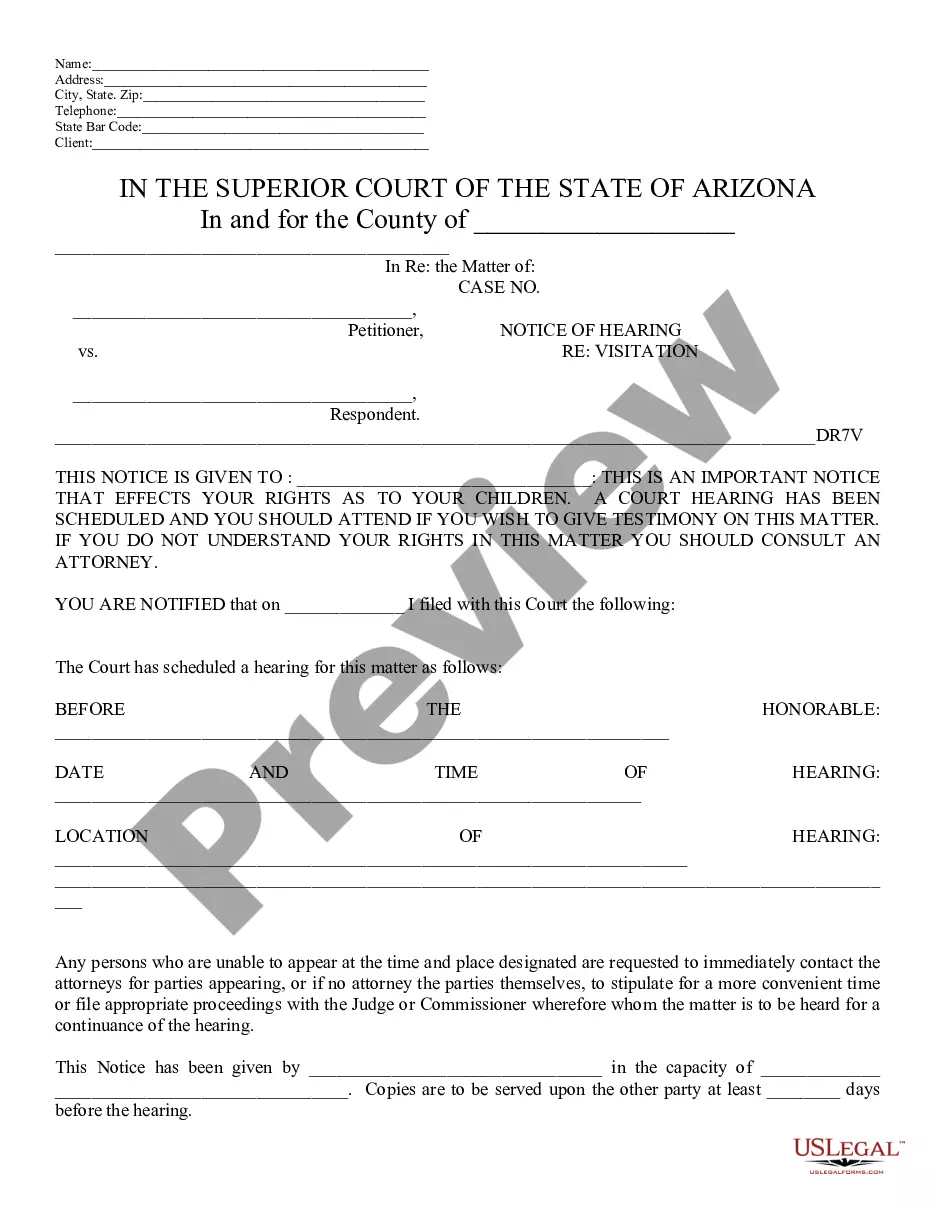
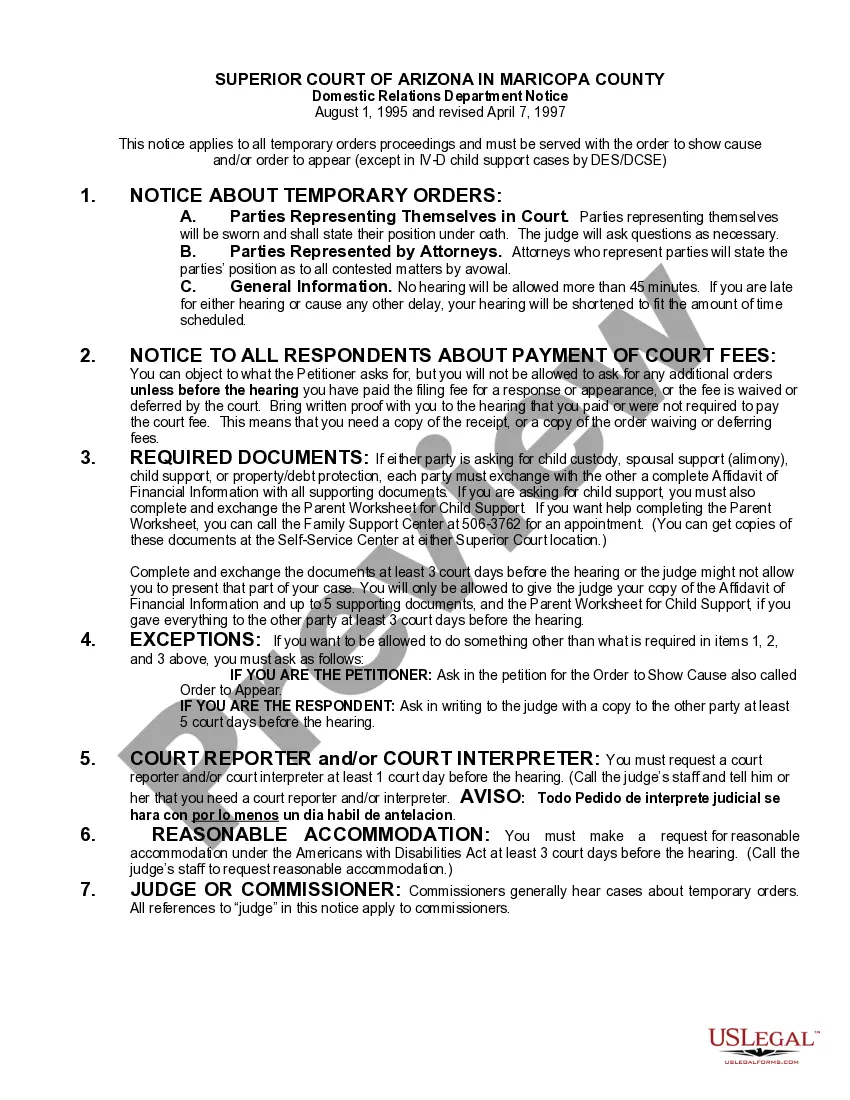
The Notice 411 is a legal document used to provide formal notification to a party about an essential matter concerning their legal rights, particularly concerning visitation issues in child custody cases. Its purpose is to ensure that all involved parties are informed about critical court hearings, allowing them the opportunity to participate and assert their rights. Unlike other notices, the Notice 411 specifically addresses issues related to visitation rights, making it a crucial component in family law proceedings.
What’s included in this form
- Contact Information: Sections for the address, phone number, and state bar code of the notifying party.
- Case Details: Identification of the court and case number related to the visitation matter.
- Hearing Notification: Clear notification of the scheduled hearing, including date, time, and location.
- Instructions: Directions for parties unable to attend the hearing and the requirement to notify attorneys or the court.
- Signature Section: Area for the notifying party's signature and the date.

Common use cases
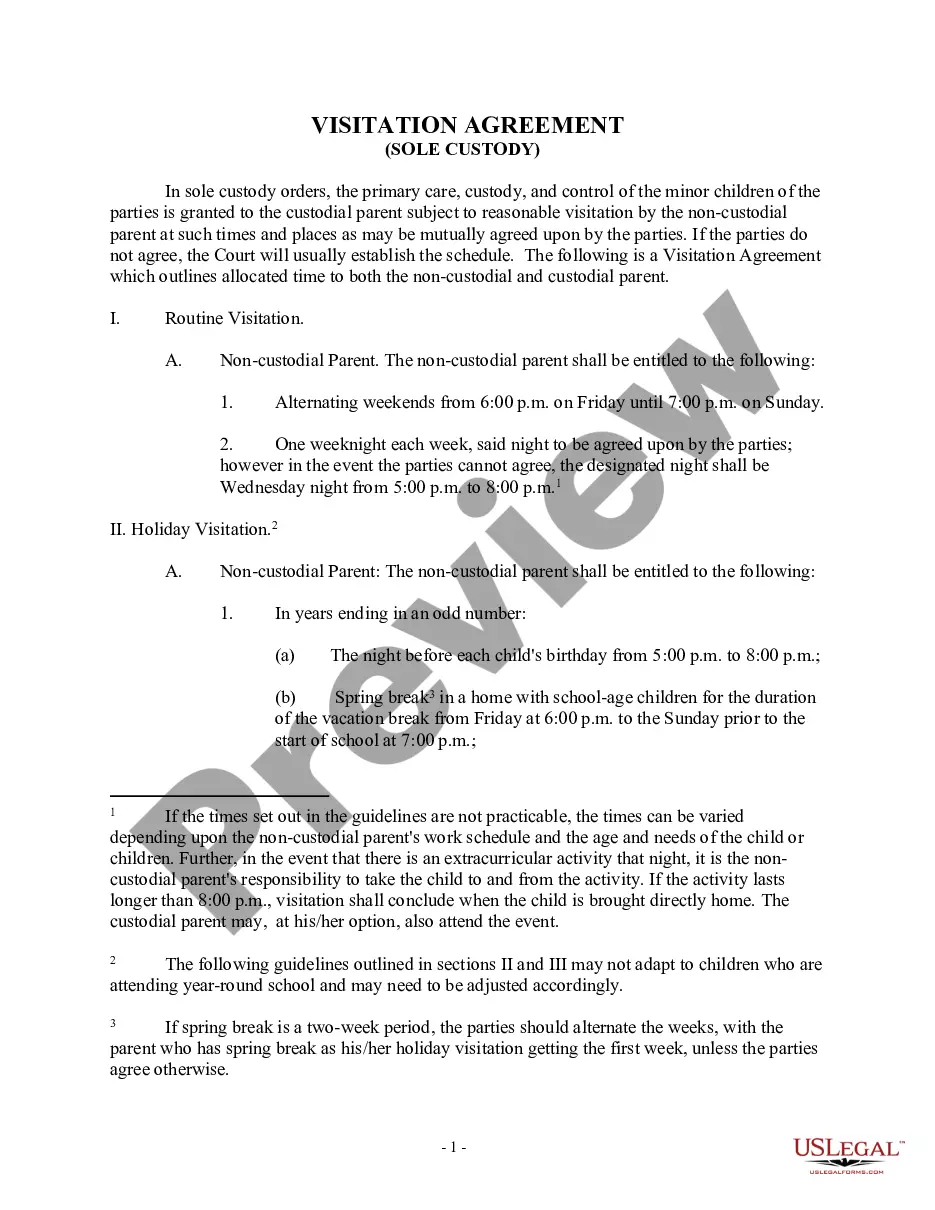
The Notice 411 should be used when a court hearing regarding visitation rights has been scheduled in a family law case. This form ensures that the other party is aware of the hearing details and has the opportunity to provide their testimony. It is essential in scenarios where failure to notify the involved parties could result in delays or legal complications.
Who can use this document
- Petitioners involved in a family law case seeking visitation rights.
- Respondents who need to be informed about upcoming hearings regarding their children's visitation.
- Attorneys representing either party in a visitation dispute.
How to prepare this document
- Step 1: Fill in the contact information, including the address and telephone number.
- Step 2: Enter the relevant details of the case, including the court name and case number.
- Step 3: Complete the section notifying the other party about the hearing, including the date and time.
- Step 4: Indicate any necessary instructions for parties unable to attend the hearing.
- Step 5: Sign and date the notice to validate it prior to serving it to the other party.
Does this document require notarization?
This form does not typically require notarization to be legally valid. However, some jurisdictions or document types may still require it. US Legal Forms provides secure online notarization powered by Notarize, available 24/7 for added convenience.
Get your form ready online
Our built-in tools help you complete, sign, share, and store your documents in one place.
Make edits, fill in missing information, and update formatting in US Legal Forms—just like you would in MS Word.
Download a copy, print it, send it by email, or mail it via USPS—whatever works best for your next step.
Sign and collect signatures with our SignNow integration. Send to multiple recipients, set reminders, and more. Go Premium to unlock E-Sign.
If this form requires notarization, complete it online through a secure video call—no need to meet a notary in person or wait for an appointment.
We protect your documents and personal data by following strict security and privacy standards.

Make edits, fill in missing information, and update formatting in US Legal Forms—just like you would in MS Word.

Download a copy, print it, send it by email, or mail it via USPS—whatever works best for your next step.

Sign and collect signatures with our SignNow integration. Send to multiple recipients, set reminders, and more. Go Premium to unlock E-Sign.

If this form requires notarization, complete it online through a secure video call—no need to meet a notary in person or wait for an appointment.

We protect your documents and personal data by following strict security and privacy standards.
Common mistakes
- Failing to provide complete contact information.
- Not specifying the correct date, time, or location of the hearing.
- Neglecting to serve the notice within the required time frame.
- Missing the signature or date at the end of the notice.
Benefits of using this form online
- Convenience: Easily access and download the form from anywhere.
- Editability: Modify the template to suit your specific situation quickly.
- Reliability: Forms drafted by licensed attorneys ensure compliance with legal standards.
Looking for another form?


Form popularity
FAQ
Yes, it is essential to respond to a traffic violation notice in Arizona. Ignoring the notice can lead to additional penalties, including fines or even license suspension. You have options, such as contesting the ticket or paying the fine, both of which require timely responses. For assistance with navigating traffic laws, consider utilizing tools mentioned in Arizona Notice 411.
In Arizona, either party wishing to terminate a month-to-month lease must provide at least 30 days' written notice. This notice period ensures that both landlords and tenants have adequate time to prepare for the transition. If you are unsure about the legal requirements or need templates for such notices, Arizona Notice 411 can lend helpful support.
The 85% law in Arizona states that individuals convicted of certain crimes must serve at least 85% of their sentence before qualifying for parole. This law applies to serious offenses and highlights the state’s approach to criminal justice. It's critical for convicted individuals and families to comprehend how this impacts sentencing and release. For further insights into your legal rights and obligations, consult Arizona Notice 411.
Rule 85 in Arizona family law pertains to how certain aspects of custody and visitation can be affected by parental involvement. This rule emphasizes the importance of a child's best interests when determining arrangements. It provides guidelines for adjustments based on each parent’s degree of engagement. To navigate these legal waters effectively, you can refer to the Arizona Notice 411 for guidance.
In Arizona, individuals typically must serve a minimum of 85% of their imposed sentence before becoming eligible for parole. This rule, often referred to as the 85% law, aims to ensure that inmates serve substantial time for their offenses. Understanding the nuances of this law can be critical for defendants and their families. For specific details personalized to your situation, resources like Arizona Notice 411 can be invaluable.
Eligibility for parole in Arizona generally applies to inmates who have served a significant part of their sentence, displayed good behavior, and meet specific criteria set by the Arizona Board of Executive Clemency. Additionally, inmates convicted of non-violent offenses may qualify sooner. It's essential for inmates to stay informed about their status and options. Resources such as Arizona Notice 411 offer valuable information related to parole eligibility.
The 65% law in Arizona allows certain offenders to be eligible for parole after serving 65% of their sentence. This law applies to non-violent offenders, and it aims to reduce prison overcrowding while promoting rehabilitation. Understanding the implications of this law can help individuals prepare for their parole hearings. For more information on parole laws, consult Arizona Notice 411.
Common conditions of parole in Arizona include regular meetings with a parole officer, maintaining employment, avoiding criminal activity, completing treatment programs, and complying with curfews. These conditions aim to promote rehabilitation and community safety. Failure to adhere to these conditions can result in revocation of parole. Explore Arizona Notice 411 for more details on parole conditions.
Eligibility for parole in place typically applies to certain individuals who have been living in Arizona without legal status but have no criminal history. This option allows qualified applicants to adjust their immigration status. It provides a way for these individuals to seek legal recognition without leaving the country. To learn more about this, check Arizona Notice 411 for comprehensive insights.
In Arizona, the requirements for parole include the completion of a designated portion of the prison sentence, good behavior while incarcerated, and a parole hearing. Offenders must demonstrate that they pose no threat to society. Additionally, they are required to comply with any specific recommendations made by the sentencing judge. For clarity on legal processes like these, refer to Arizona Notice 411.