Arizona Request for Physical or Mental Examination
Overview of this form
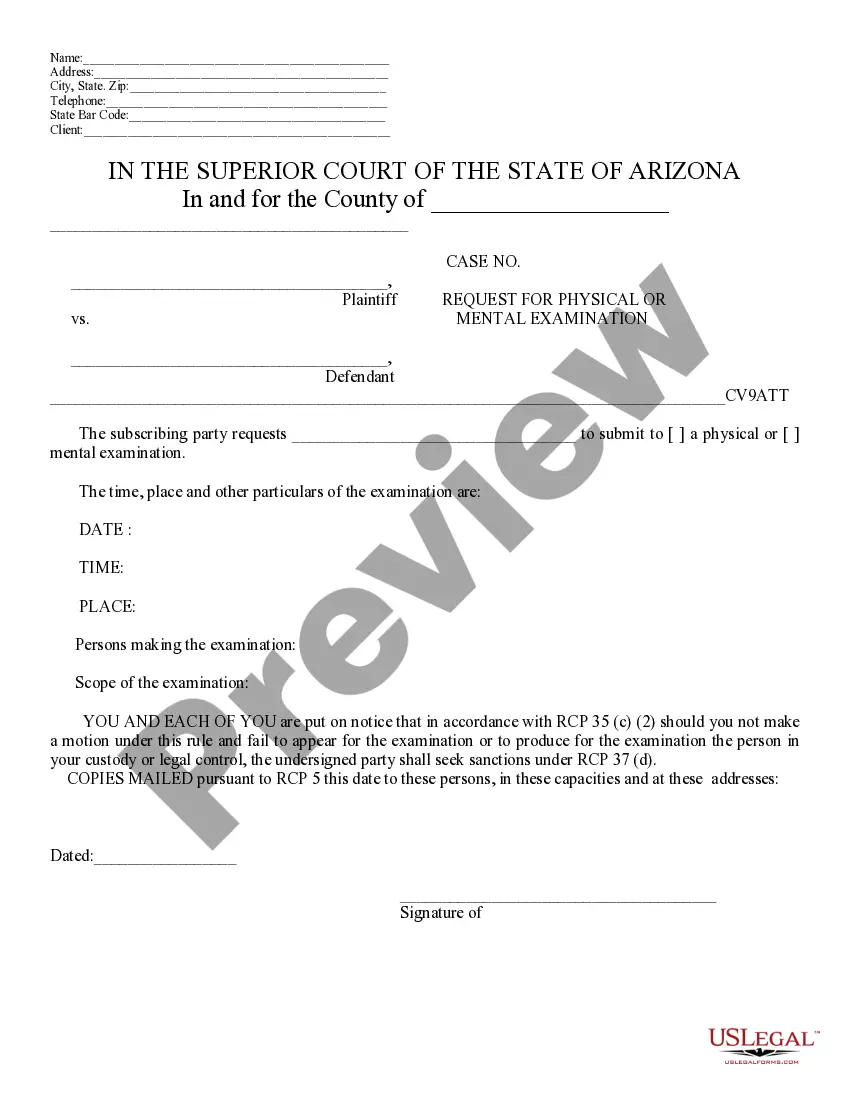
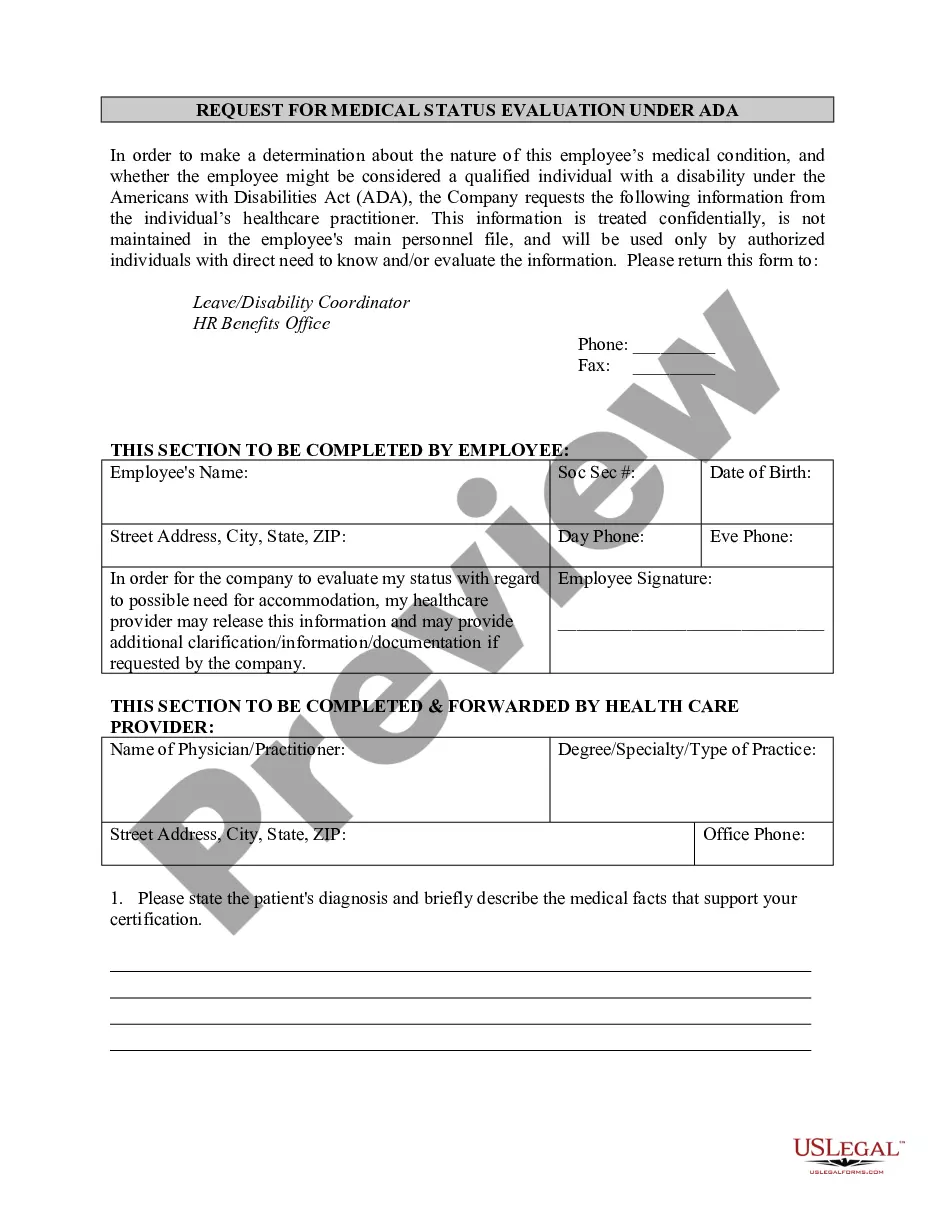
The Request for Physical or Mental Examination is a legal document used in court proceedings when one party believes that the opposing party should undergo a mental or physical examination. This form initiates the request for such an examination, specifying the details including the time and location. It allows the court to determine whether the examination is warranted based on the circumstances of the case. Unlike other legal forms, this specific request is tailored to address concerns regarding mental or physical health evaluations relevant to ongoing legal matters.
What’s included in this form
- Identification of parties involved, including Plaintiff and Defendant.
- Request for the opposing party to submit to a physical or mental examination.
- Details of the examination, including date, time, and place.
- Scope of the examination and the individuals conducting it.
- Notice of consequences for failing to appear for the examination.
When to use this form
This form is typically used in legal contexts where mental or physical health may be a factor in the case. For example, it is relevant in personal injury lawsuits, custody disputes, or cases involving claims of mental health issues. If a Plaintiff or Defendant believes that an examination of the other party is necessary to assess their fitness or condition, this form serves to formally request that evaluation through the court.
Who needs this form
- Plaintiffs or Defendants involved in legal proceedings where mental or physical health is contested.
- Attorneys representing clients who believe an examination is necessary for their case.
- Parties seeking to establish or challenge the mental health claims made in court.
Steps to complete this form
- Identify the parties involved by entering the names of the Plaintiff and Defendant.
- Clearly state your request for the opposing party to submit to a physical or mental examination.
- Fill in the specifics of the examination, including the date, time, and location.
- Describe the scope of the examination and include the names of the individuals who will conduct it.
- Ensure that all required signatures are completed at the bottom of the form.
Does this document require notarization?
Notarization is generally not required for this form. However, certain states or situations might demand it. You can complete notarization online through US Legal Forms, powered by Notarize, using a verified video call available anytime.
Get your form ready online
Our built-in tools help you complete, sign, share, and store your documents in one place.
Make edits, fill in missing information, and update formatting in US Legal Forms—just like you would in MS Word.
Download a copy, print it, send it by email, or mail it via USPS—whatever works best for your next step.
Sign and collect signatures with our SignNow integration. Send to multiple recipients, set reminders, and more. Go Premium to unlock E-Sign.
If this form requires notarization, complete it online through a secure video call—no need to meet a notary in person or wait for an appointment.
We protect your documents and personal data by following strict security and privacy standards.

Make edits, fill in missing information, and update formatting in US Legal Forms—just like you would in MS Word.

Download a copy, print it, send it by email, or mail it via USPS—whatever works best for your next step.

Sign and collect signatures with our SignNow integration. Send to multiple recipients, set reminders, and more. Go Premium to unlock E-Sign.

If this form requires notarization, complete it online through a secure video call—no need to meet a notary in person or wait for an appointment.

We protect your documents and personal data by following strict security and privacy standards.
Common mistakes
- Forgetting to include the exact date, time, and location of the examination.
- Not specifying the scope of the examination clearly.
- Failing to sign the document before submission.
- Not notifying the other party or their attorney adequately.
Why complete this form online
- Convenience of downloading and printing from home.
- Editability ensures you can fill in the details required for your specific case.
- Access to templates drafted by licensed attorneys for reliability and accuracy.
- Easy storage and retrieval for future reference in your legal proceedings.
Looking for another form?

Form popularity
FAQ
Rule 34 governs the production of documents and tangible things, allowing parties access to relevant materials. This access can be pivotal in building a strong case. For those involved with an Arizona Request for Physical or Mental Examination, understanding this rule can aid in gathering necessary documentation for supporting evaluations.
Rule 7.1 relates to writs and other extraordinary relief, providing guidance on how to seek additional judicial relief. This rule ensures that parties know their rights when immediate action is necessary. If your Arizona Request for Physical or Mental Examination leads to urgent legal needs, this rule can be critical in navigating procedural steps.
Rule 40 discusses the setting of cases for trial, determining how and when cases are scheduled. This rule promotes efficiency in the court system by establishing clear timelines and procedures. Familiarizing yourself with this rule can be beneficial when expecting an Arizona Request for Physical or Mental Examination to ensure timely court proceedings.
In Arizona family law, Rule 35 allows for physical or mental examinations of individuals when it pertains to custody and support matters. This ensures that the court has a comprehensive view of the circumstances affecting the parties. Thus, understanding this rule is essential if faced with an Arizona Request for Physical or Mental Examination during family law cases.
Rule 5.1 details requirements regarding service of pleadings and papers to ensure all parties are informed about proceedings. Proper service is vital to maintaining the legal integrity of any case. When dealing with an Arizona Request for Physical or Mental Examination, adhering to these service rules is key for the process.
Arizona Rule 35 specifically addresses requests for physical or mental examinations of parties in a legal case. This rule outlines the procedures and standards required for such examinations to occur. Therefore, if you're involved in an Arizona Request for Physical or Mental Examination, this rule governs the entire process, ensuring that it is conducted properly.
Rule 32 focuses on the use of depositions in court, establishing how depositions can be introduced for evidence. This rule serves to ensure fairness and accuracy in witness testimonies. For an Arizona Request for Physical or Mental Examination, understanding this can help in managing how evaluations are documented and presented.
Rule 17 covers the capacity to sue and be sued, allowing parties to understand who can legally participate in a lawsuit. This rule is important for validating claims and defending against them. If you're navigating an Arizona Request for Physical or Mental Examination, ensuring the proper parties are involved can impact case outcomes.
Rule 26.2 pertains to the disclosure of expert witness information, emphasizing the importance of transparency in legal proceedings. This helps all parties be aware of expert testimony potentially influencing court decisions. It's particularly relevant for an Arizona Request for Physical or Mental Examination, as expert evaluations might be essential.
Rule 7.3 discusses the procedure for motion practice, detailing how motions should be filed and served. This provides clarity on timelines and requirements, which are vital for timely responses. If you're involved in an Arizona Request for Physical or Mental Examination, knowing this rule aids in preparing necessary motions effectively.