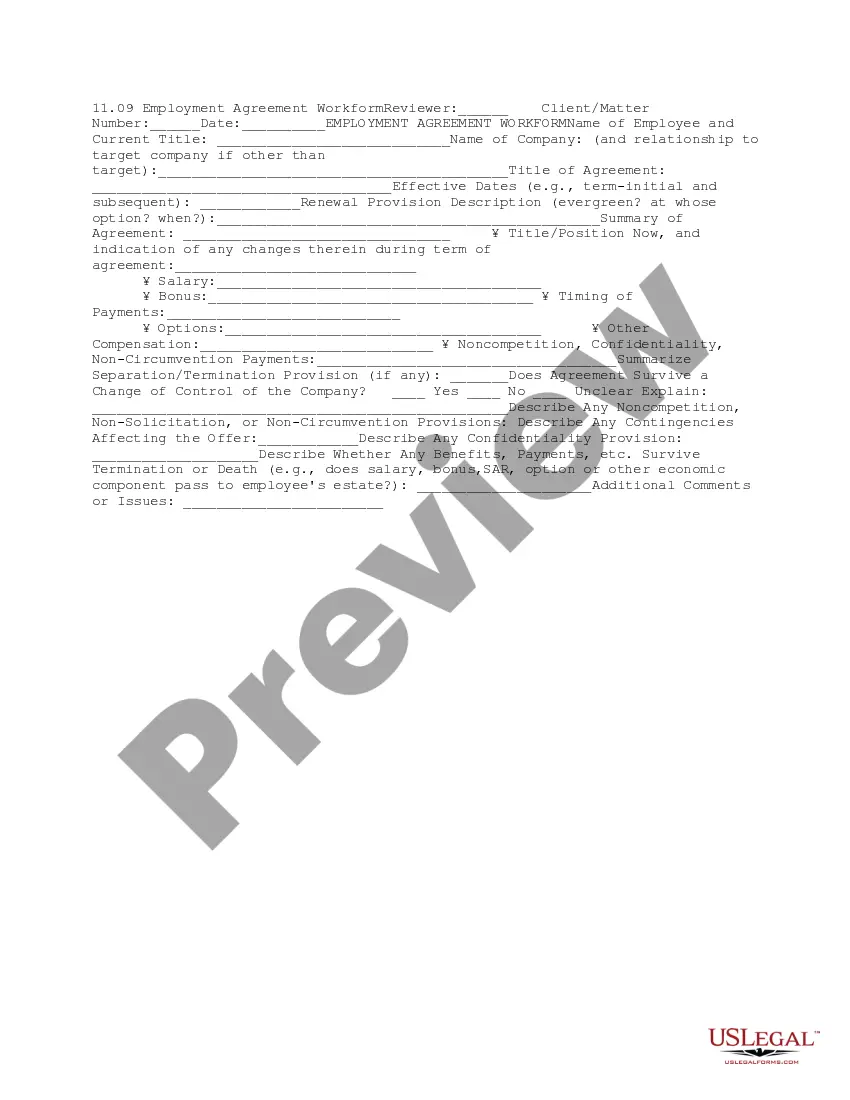
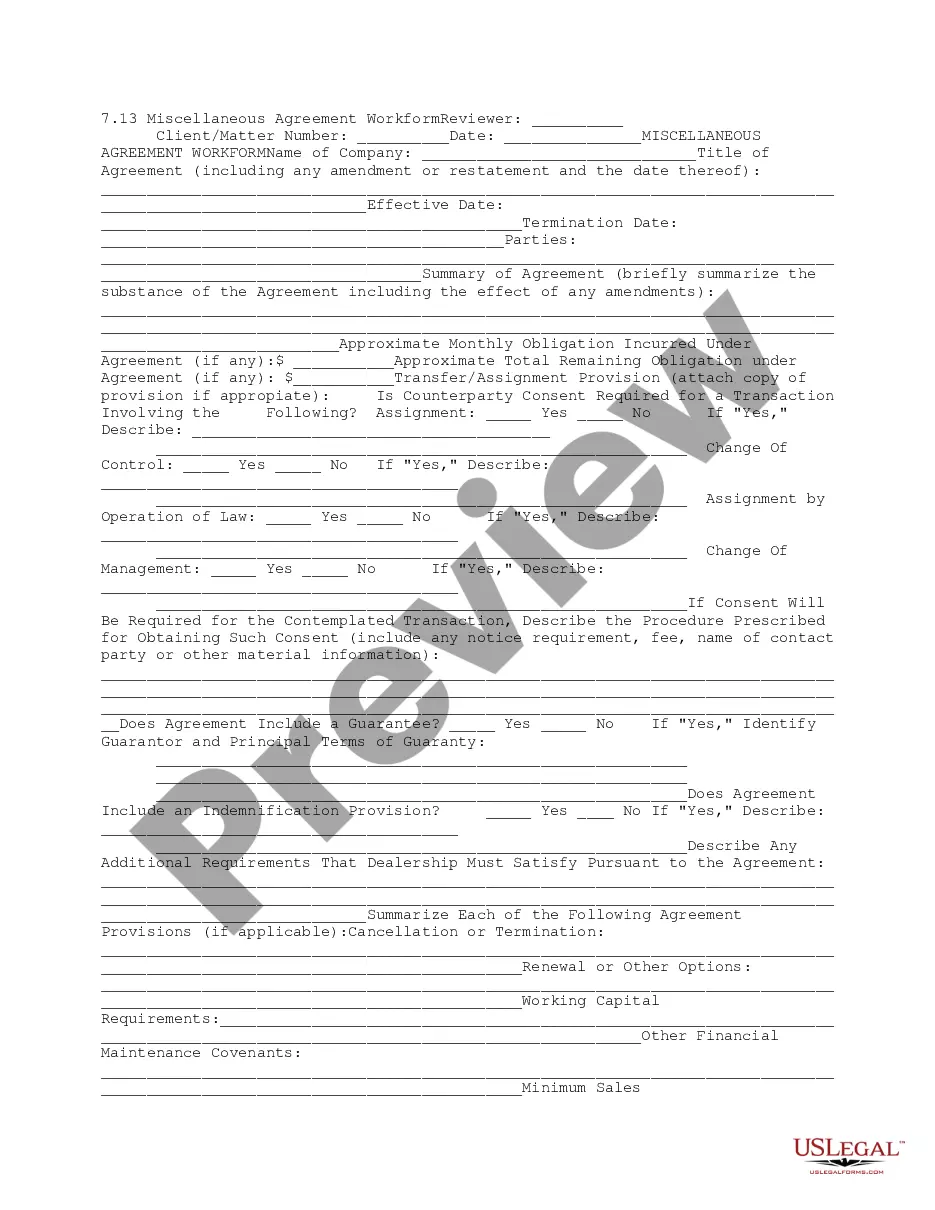
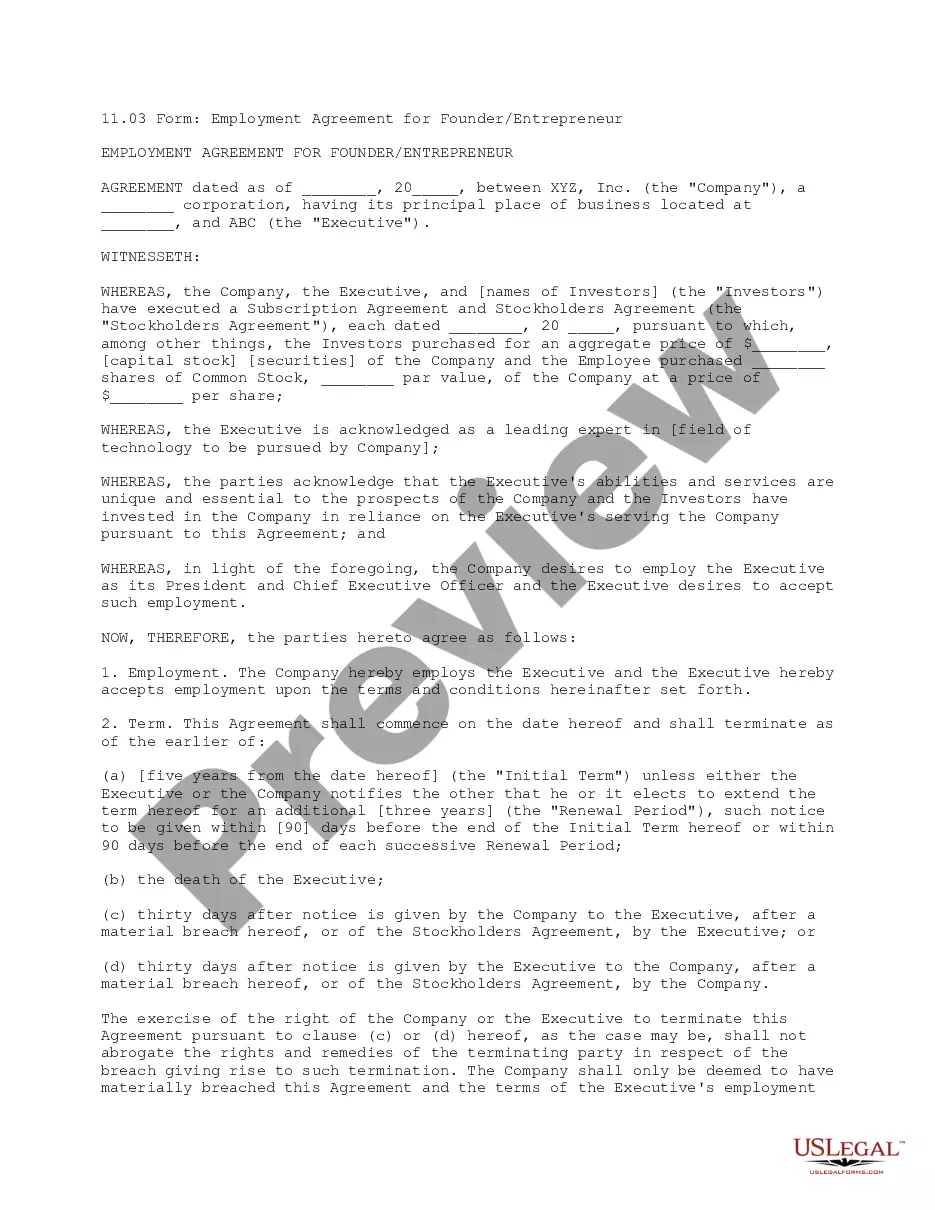
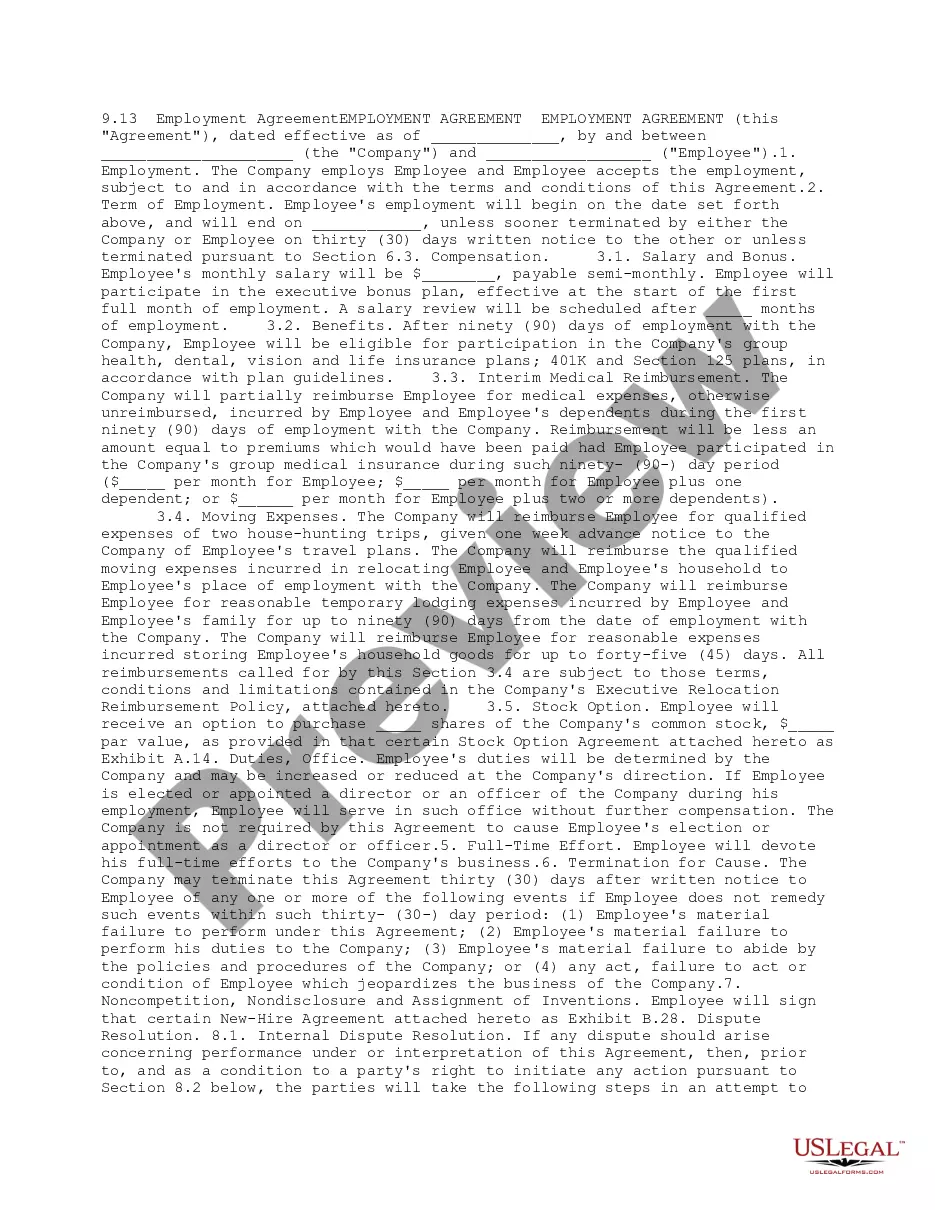
This due diligence workform is used to document new employee information, job title, and employment provisions in business transactions.
Arkansas Employment Agreement Workform
Category:
State:
Multi-State
Control #:
US-DD01109
Format:
Word;
PDF;
Rich Text
Instant download
Description
Get your form ready online
Our built-in tools help you complete, sign, share, and store your documents in one place.
Built-in online Word editor
Make edits, fill in missing information, and update formatting in US Legal Forms—just like you would in MS Word.
Export easily
Download a copy, print it, send it by email, or mail it via USPS—whatever works best for your next step.
E-sign your document
Sign and collect signatures with our SignNow integration. Send to multiple recipients, set reminders, and more. Go Premium to unlock E-Sign.
Notarize online 24/7
If this form requires notarization, complete it online through a secure video call—no need to meet a notary in person or wait for an appointment.
Store your document securely
We protect your documents and personal data by following strict security and privacy standards.

Make edits, fill in missing information, and update formatting in US Legal Forms—just like you would in MS Word.

Download a copy, print it, send it by email, or mail it via USPS—whatever works best for your next step.

Sign and collect signatures with our SignNow integration. Send to multiple recipients, set reminders, and more. Go Premium to unlock E-Sign.

If this form requires notarization, complete it online through a secure video call—no need to meet a notary in person or wait for an appointment.

We protect your documents and personal data by following strict security and privacy standards.
Looking for another form?


How to fill out Employment Agreement Workform?
You have the capacity to dedicate multiple hours online searching for the legal document template that satisfies the federal and state criteria you need.
US Legal Forms offers thousands of legal documents that are assessed by experts.
You can conveniently download or print the Arkansas Employment Agreement Workform from your service.
If available, use the Preview button to inspect the document template as well. If you wish to find another version of your document, utilize the Search field to find the template that meets your needs and specifications.
- If you already have a US Legal Forms account, you can Log In and click on the Obtain button.
- Subsequently, you can complete, modify, print, or sign the Arkansas Employment Agreement Workform.
- Every legal document template you procure is yours indefinitely.
- To acquire an additional copy of the obtained document, go to the My documents tab and click on the corresponding button.
- If you are using the US Legal Forms site for the first time, follow the simple instructions outlined below.
- First, ensure that you have selected the correct document template for the area/town you choose.
- Review the document description to verify that you have made the right selection.
Form popularity
FAQ
According to the Arkansas Child Labor Law, a minor 14 or 15 years of age cannot begin work before 6 a.m., work past 9 p.m., nor more than 8 hours a day, 6 days a week, or more than 48 hours a week when school is not in session.
Arkansas labor laws do not require employers to provide employees with severance pay. If an employer chooses to provide severance benefits, it must comply with the terms of its established policy or employment contract.
A. Arkansas recognizes the doctrine of employment at will. This means that, as a general rule, either the employer or the employee may end the employment relationship at any time for any reason or for no reason at all.
What Is a Separation Notice? A general separation notice is a written communication from an employer or an employee saying that the employment relationship is ending.
Here are a few scenarios that could be considered wrongful termination in Arkansas: You were fired because of your race, gender, or religion. Your employer fired you in retaliation for exercising your rights (such as whistleblowing or participating in an investigation of your employer).
A. If a company or corporation terminates the employee, the employee's wages are due by the next regular payday. If the employer fails to make payment within 7 days of the next regular payday then the employer shall owe the employee double the wages due.
Under Arkansas law employment is protected under multiple circumstances. If a company violates Arkansas employment law the terminated employee can sue for compensation, reinstatement, or both.
To be wrongfully terminated is to be fired for an illegal reason, which may involve violation of federal anti-discrimination laws or a contractual breach. For instance, an employee cannot be fired on the basis of her race, gender, ethnic background, religion, or disability.
30.2 All employers in the State of Arkansas must provide the notice as set out in Attachment A of Rule 30 to an employee upon that employee's separation from employment. 30.3 This rule shall become effective on April 27, 2020 and shall expire on December 31, 2020.
Yes, you can sue your employer if they wrongfully fired you. But you need to know if your employer actually broke the law, and you need to determine how strong your case is. All too often, people want to sue for being fired when the company had a legitimate reason to fire them. Not every firing is illegal.