Alabama Marital Legal Separation and Property Settlement with Adult Children
Understanding this form
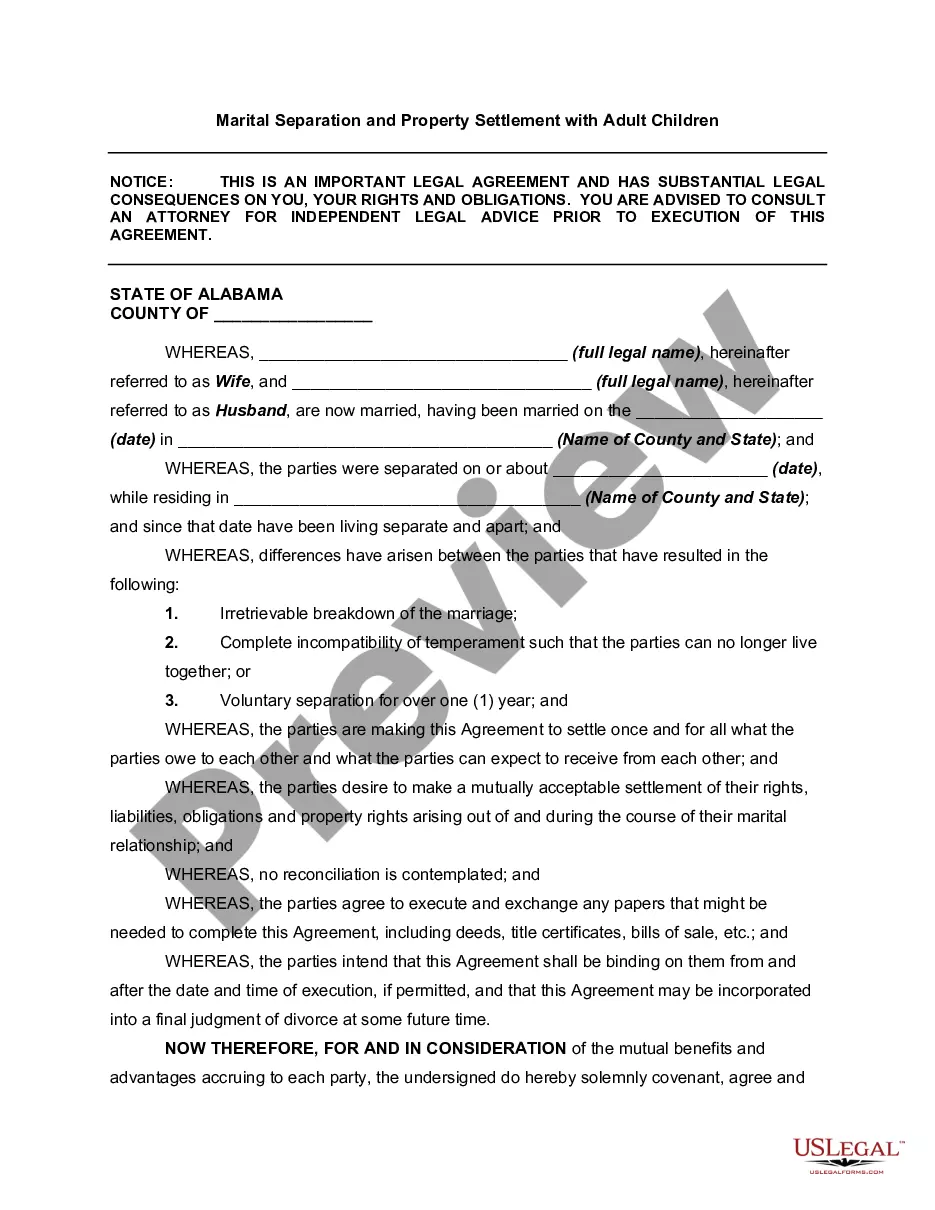
This form, known as the Marital Legal Separation and Property Settlement with Adult Children, serves as a legal agreement between spouses who are separated. It outlines the terms of separation and the division of property and debts, helping couples clarify their obligations and rights during this period. Unlike a divorce, legal separation does not end the marriage yet allows couples to formalize their living arrangements and financial responsibilities.
Form components explained
- Details of the separation and mutual agreements between the parties.
- Financial disclosures to ensure transparency regarding assets and liabilities.
- Division of marital assets and debts, specifying which party receives what.
- Provisions for spousal support, including amounts and payment schedules.
- Mutual indemnity clauses regarding debts and liabilities.
- Legal acknowledgment and provisions for possible future divorce proceedings.


Common use cases
Use this form when you and your spouse have decided to live separately but do not wish to proceed with a divorce at this time. This agreement is helpful in clarifying how to manage your finances, property, and any shared responsibilities. It may also be useful if you have adult children and need to ensure their wellbeing during your separation.
Who should use this form
- Couples in Alabama who are seeking a legal separation instead of immediate divorce.
- Spouses who need to define property division and financial responsibilities.
- Married individuals who have adult children and wish to address their needs during separation.
Completing this form step by step
- Identify the parties involved and provide their full legal names.
- Document the date of marriage and the date of separation.
- Specify the terms for the division of assets and debts in detail.
- Outline any spousal support arrangements, including amount and payment schedule.
- Ensure both parties sign the agreement in the presence of a notary, if required.
Notarization requirements for this form
Notarization is required for this form to take effect. Our online notarization service, powered by Notarize, lets you verify and sign documents remotely through an encrypted video session, available 24/7.
Get your form ready online
Our built-in tools help you complete, sign, share, and store your documents in one place.
Make edits, fill in missing information, and update formatting in US Legal Forms—just like you would in MS Word.
Download a copy, print it, send it by email, or mail it via USPS—whatever works best for your next step.
Sign and collect signatures with our SignNow integration. Send to multiple recipients, set reminders, and more. Go Premium to unlock E-Sign.
If this form requires notarization, complete it online through a secure video call—no need to meet a notary in person or wait for an appointment.
We protect your documents and personal data by following strict security and privacy standards.

Make edits, fill in missing information, and update formatting in US Legal Forms—just like you would in MS Word.

Download a copy, print it, send it by email, or mail it via USPS—whatever works best for your next step.

Sign and collect signatures with our SignNow integration. Send to multiple recipients, set reminders, and more. Go Premium to unlock E-Sign.

If this form requires notarization, complete it online through a secure video call—no need to meet a notary in person or wait for an appointment.

We protect your documents and personal data by following strict security and privacy standards.
Mistakes to watch out for
- Failing to clearly list all assets and debts, leading to disputes later.
- Not including spousal support provisions when necessary.
- Neglecting to have the agreement notarized if required by local law.
- Not consulting with an attorney beforehand, which can result in unfavorable terms.
Why complete this form online
- Convenience of filling out the form at any time.
- Editability allows you to make changes easily before finalizing.
- Access to forms drafted by licensed attorneys ensures legal compliance.
- Quick download and print options facilitate immediate use.
Looking for another form?
Form popularity
FAQ
Alabama, like roughly half of all U.S. states, follows a system called equitable distribution. Under this system, all of the debts and assets that married couples share are divided according to a principle of equity, or fairness.Each spouse's monetary and non-monetary contributions to the marriage.
When married spouses divorce in Alabama, all of their money, property and other assets are divided into two categories: separate property and marital property.Marital property, on the other hand, usually includes any assets that either spouse earned, generated, purchased or otherwise obtained during the marriage.
Marital Settlement Agreements, reached between the parties in writing and signed by the parties, become legally binding when approved by the court at the time of the final court hearing.Once approved by the court, such post judgment stipulations do become legally binding and enforceable between the parties.
While divorce laws vary by state, here are the basic steps: First, you must meet the residency requirements of the state in which you wish to file. Second, you must have grounds (a legally acceptable reason) to end your marriage. Third, you must file divorce papers and have copies sent to your spouse.
There is no set formula in Alabama divorce law for determining the amount of alimony. In simple terms, the amount of alimony is dependent on the needs of the receiving spouse and the ability of the paying spouse to pay alimony.
The spouse who files first in the divorce is the plaintiff. The other spouse is the defendant.The other spouse may only be able to react or respond to the other spouse's strategy moves. A good Alabama attorney can sometimes force the plaintiff into a defensive position and manage to do some things first.
Alabama is an equitable distribution state. This means the divisions of assets and liabilities should be fair and equitable. This does not mean 50/50. The property that each spouse brought into the marriage is considered his/her separate property and is awarded back to the spouse upon divorce.
Alabama law has two categories of assets for divorcing couples: separate property and marital property. With only certain exceptions, anything that either spouse owned before the marriage is considered separate property.Instead, Alabama divides assets under the more nuanced legal doctrine of equitable distribution.
Alabama is considered an equitable distribution state, as opposed to a community property state. What this means is property and debts shared by divorcing parties are divvied up in a way that is most fair and equitable.