Alabama General Release and Settlement Agreement
What this document covers
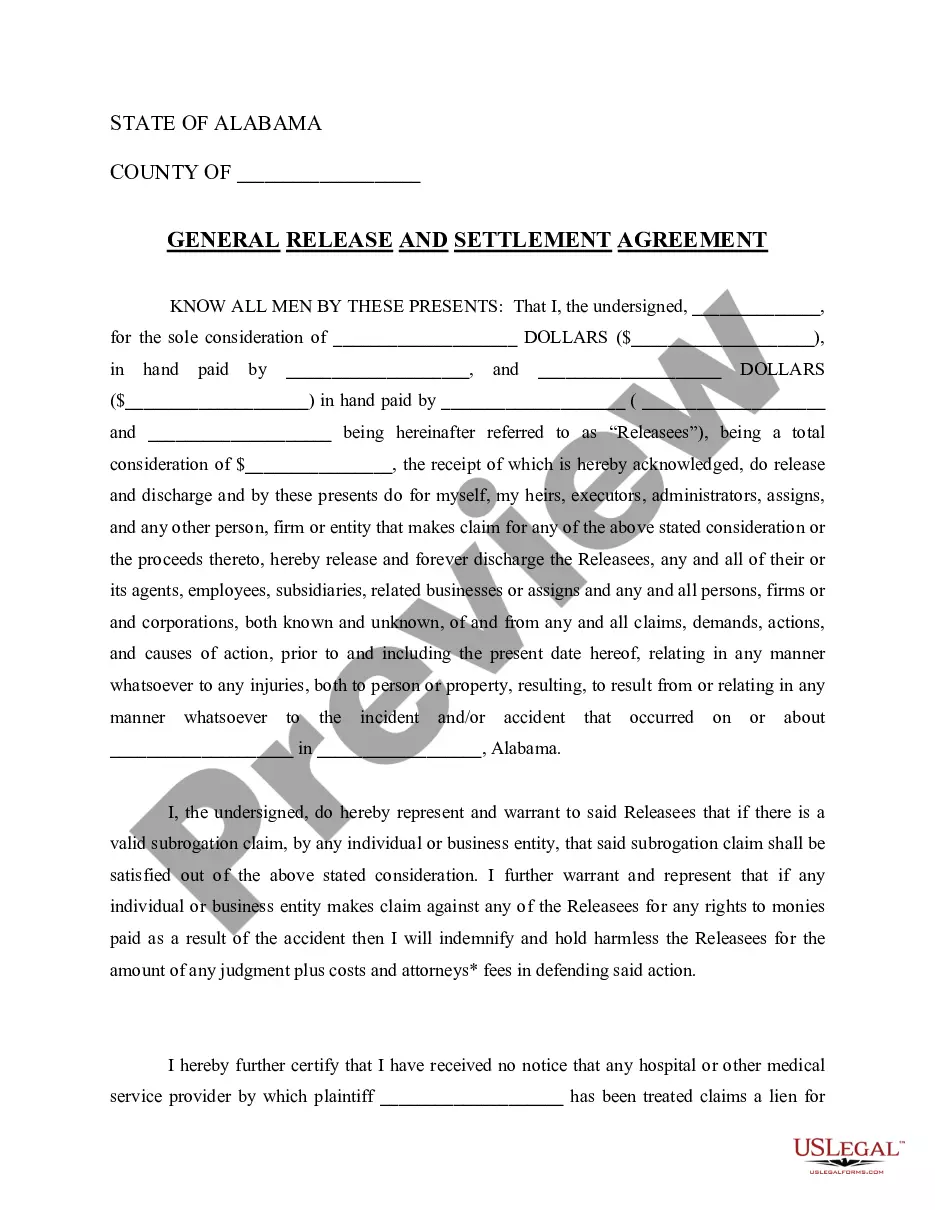
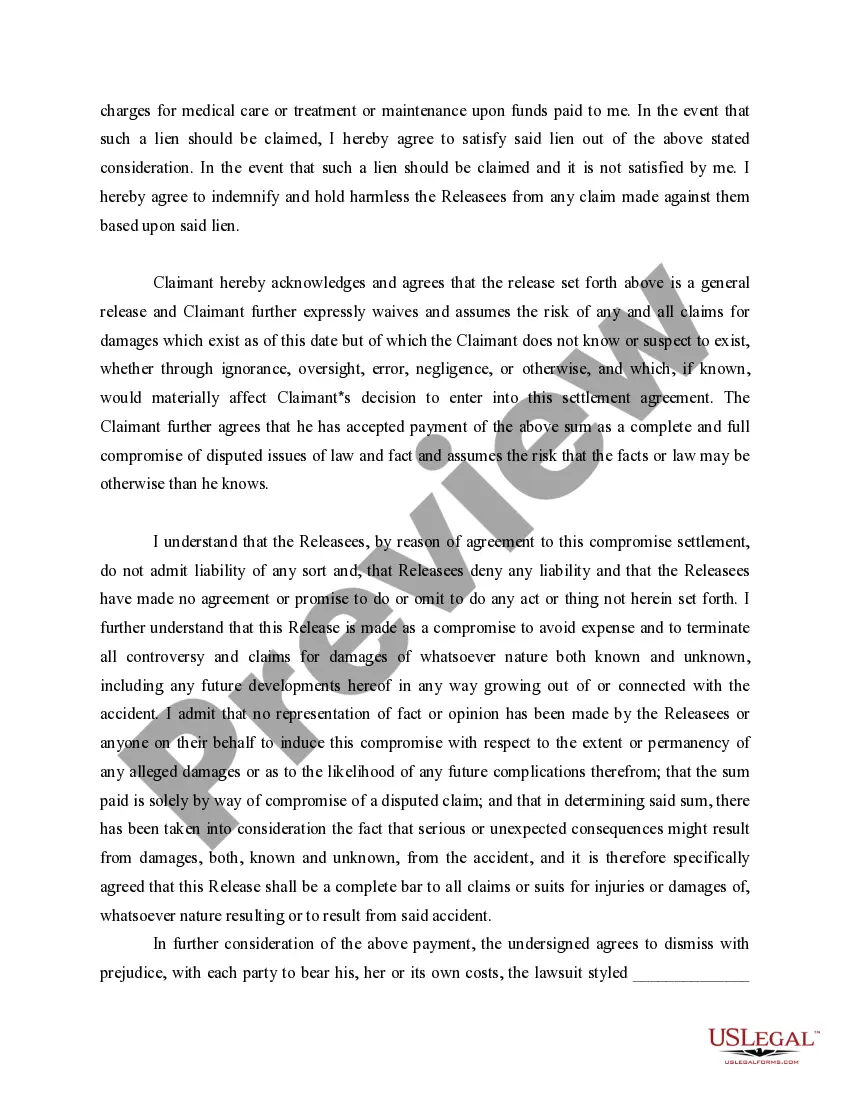
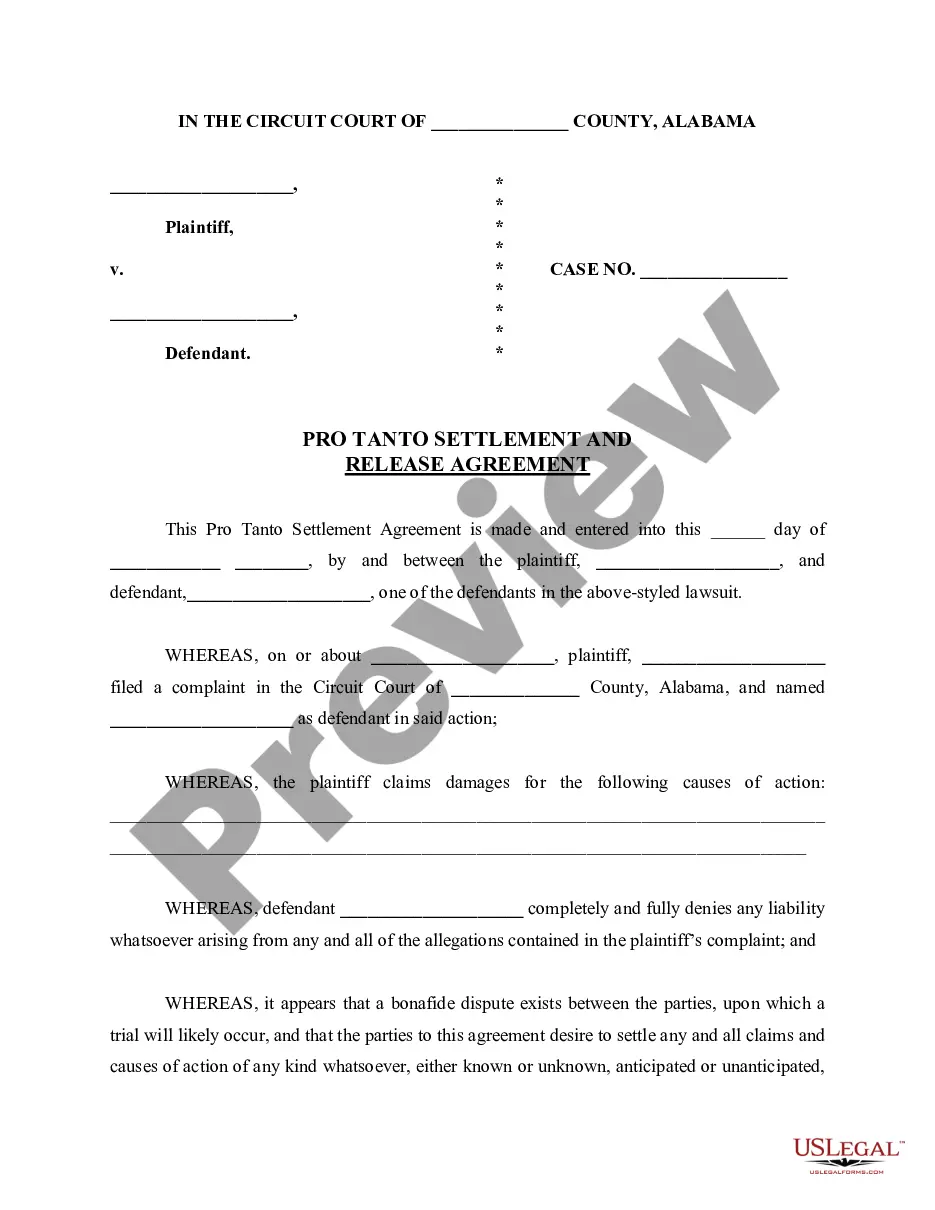
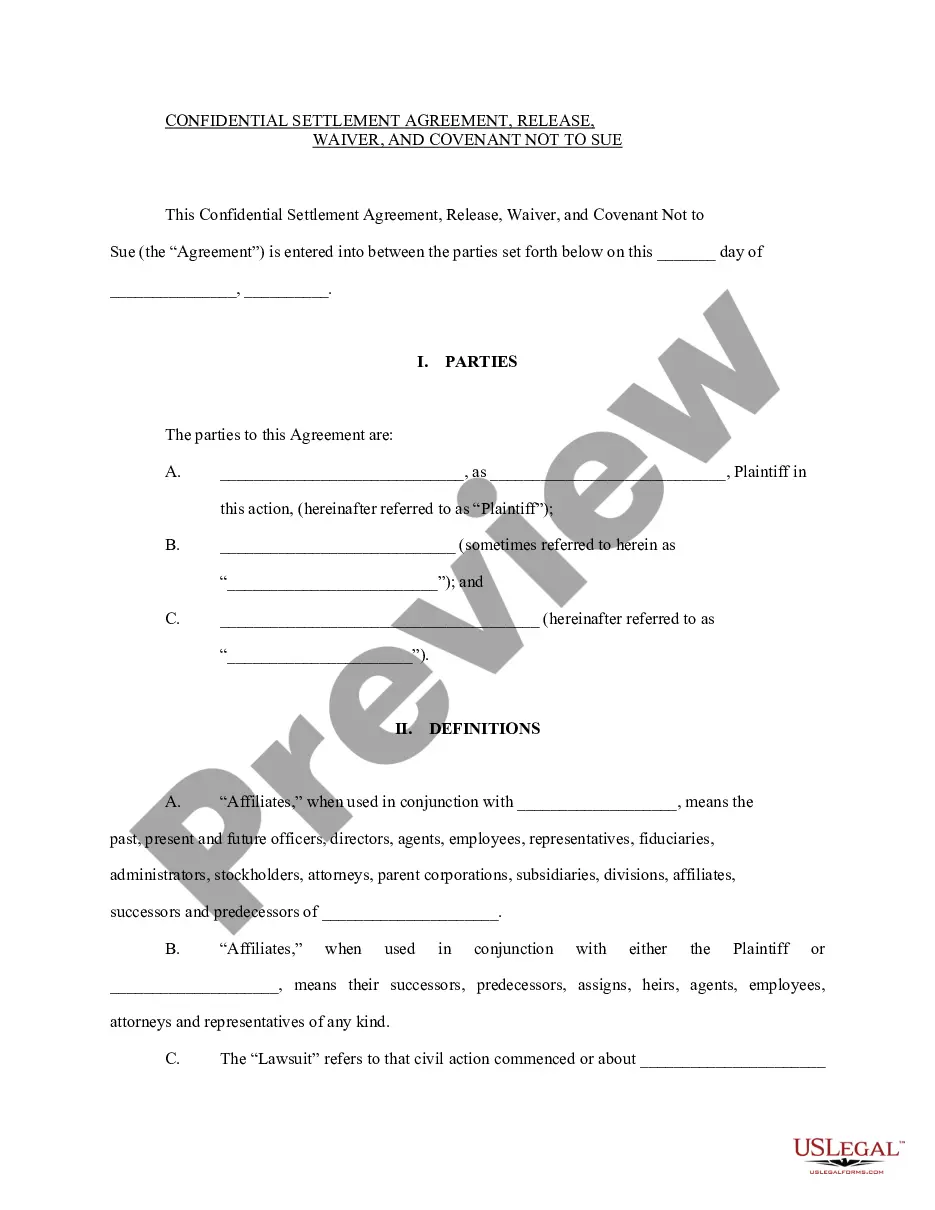
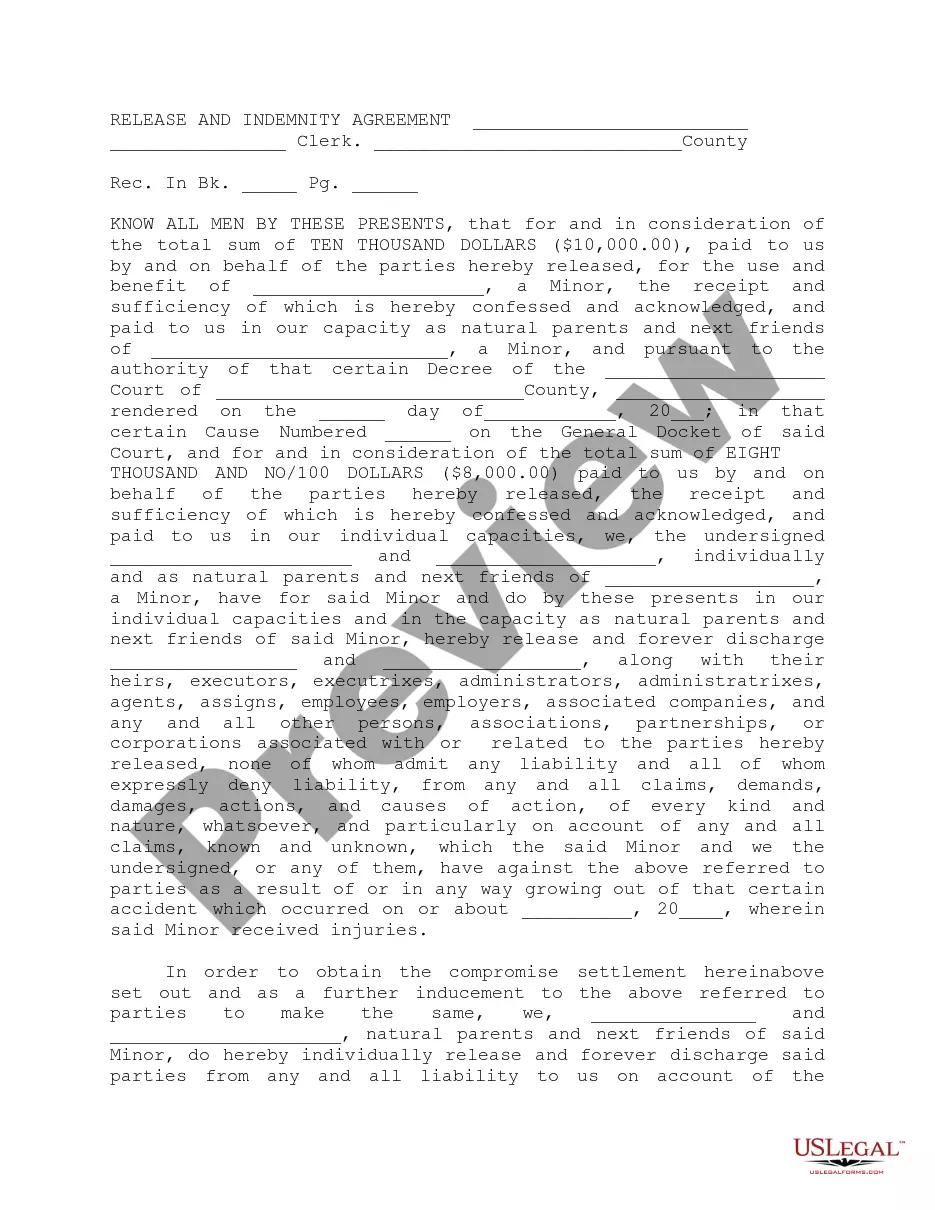
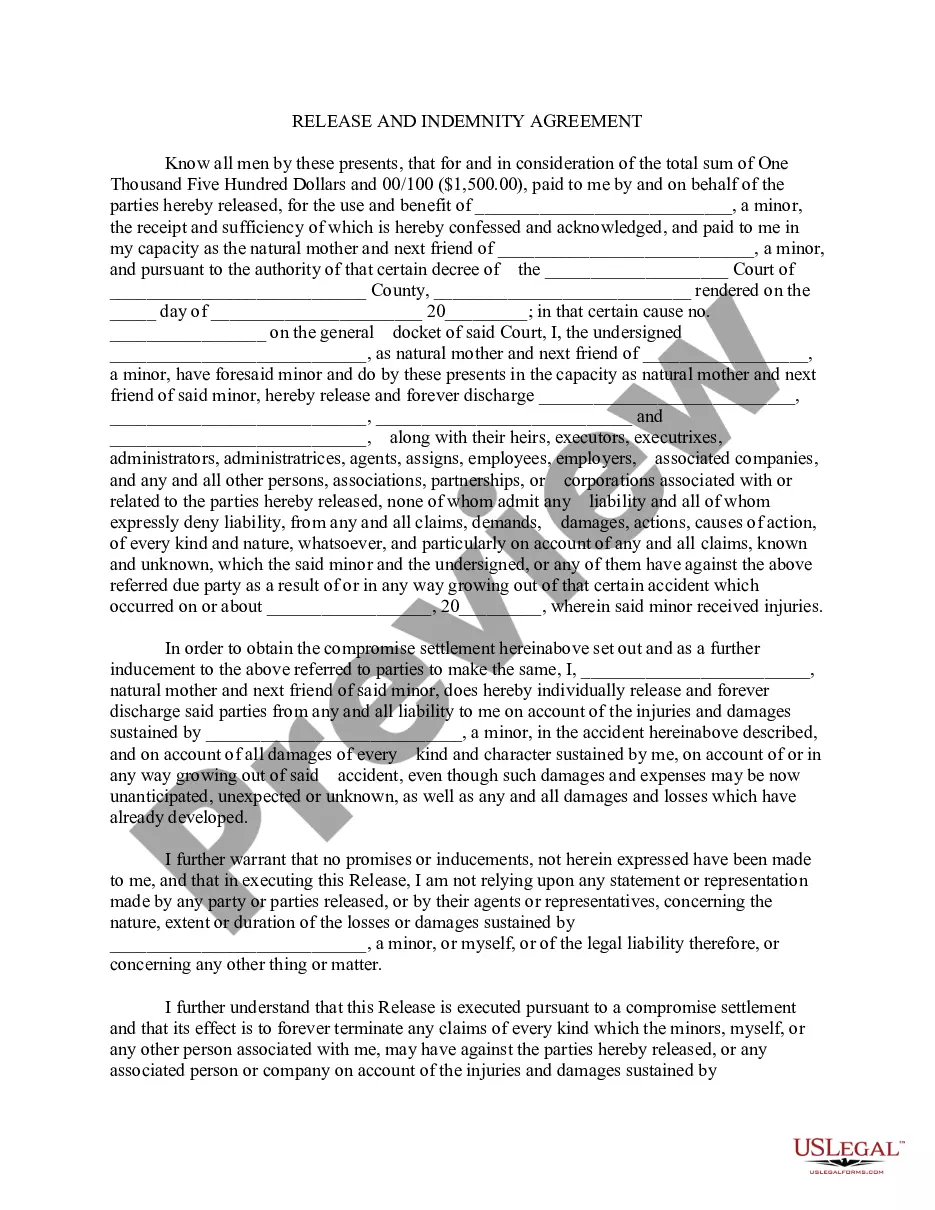
The General Release and Settlement Agreement is a legal document used to settle disputes by releasing parties from future claims related to a specific incident. By using this form, the claimant accepts a defined monetary amount and agrees to discharge the releasee from any future claims, liabilities, or actions connected to the incident. This form differs from other legal agreements by providing a general release that applies to all known and unknown claims at the time of signing.
Form components explained
- Identification of parties: Names and contact information of the claimant and releasee.
- Consideration amount: The specified amount of money being accepted in exchange for the release.
- General release clause: Language that outlines the release of claims against the releasee.
- Indemnification clause: Agreement where the claimant agrees to indemnify the releasee against any future claims or liens.
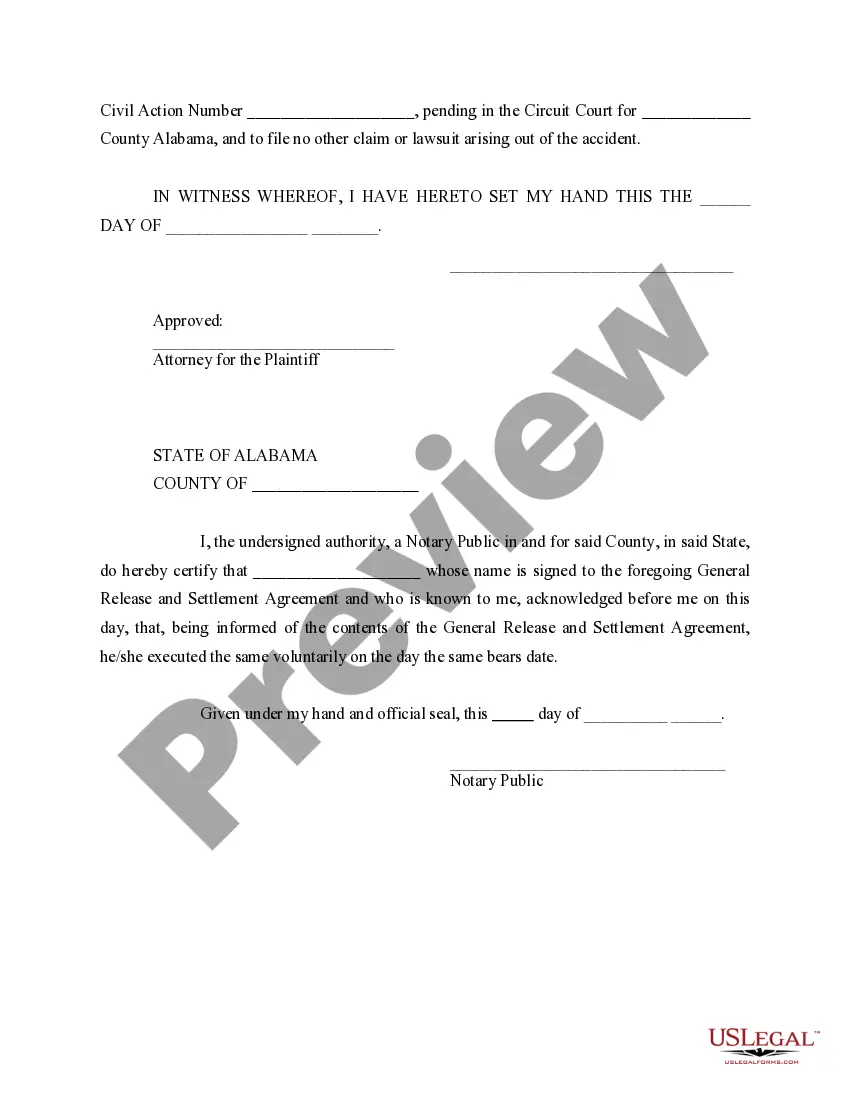
- Signature and notarization fields: Places for all parties to sign, along with notary acknowledgment if required.
When this form is needed
This form is commonly used in situations where one party is seeking a settlement after an accident or injury, particularly in personal injury cases. It can be utilized when a claimant is offered compensation while agreeing not to pursue further legal action against the releasee related to the same incident. It is appropriate in cases where the parties wish to reach a mutual understanding and avoid prolonged litigation.
Who needs this form
- Individuals or organizations involved in a dispute seeking settlement.
- Claimants who have reached an agreement on compensation with the releasee.
- Parties wishing to ensure that all claims are resolved to avoid future disputes.
- Attorneys representing clients in personal injury or settlement cases.
How to complete this form
- Identify the parties: Fill in the names and contact information of the claimant and releasee.
- Specify the compensation amount: Enter the total amount agreed upon for the settlement.
- Complete the incident details: Provide a description of the incident or accident, including dates and locations.
- Sign and date the form: Ensure all parties sign the agreement and provide the date of signing.
- If required, arrange for notarization: Have the document notarized to ensure its legal validity.
Does this document require notarization?
This form typically does not require notarization unless specified by local law. However, notarization can add an extra layer of legal assurance that the agreement has been executed voluntarily by all parties.
Get your form ready online
Our built-in tools help you complete, sign, share, and store your documents in one place.
Make edits, fill in missing information, and update formatting in US Legal Forms—just like you would in MS Word.
Download a copy, print it, send it by email, or mail it via USPS—whatever works best for your next step.
Sign and collect signatures with our SignNow integration. Send to multiple recipients, set reminders, and more. Go Premium to unlock E-Sign.
If this form requires notarization, complete it online through a secure video call—no need to meet a notary in person or wait for an appointment.
We protect your documents and personal data by following strict security and privacy standards.

Make edits, fill in missing information, and update formatting in US Legal Forms—just like you would in MS Word.

Download a copy, print it, send it by email, or mail it via USPS—whatever works best for your next step.

Sign and collect signatures with our SignNow integration. Send to multiple recipients, set reminders, and more. Go Premium to unlock E-Sign.

If this form requires notarization, complete it online through a secure video call—no need to meet a notary in person or wait for an appointment.

We protect your documents and personal data by following strict security and privacy standards.
Mistakes to watch out for
- Not specifying the total amount of compensation clearly.
- Failing to include detailed descriptions of the incident leading to the settlement.
- Overlooking the need for notarization when required by local law.
- Not having all parties sign the agreement before submission.
Benefits of completing this form online
- Convenience of downloading and printing the form from anywhere.
- Editability allows users to tailor the agreement to specific needs easily.
- Reliability of having forms drafted by licensed attorneys ensures adherence to legal standards.
Legal use & context
- The General Release and Settlement Agreement is legally binding upon execution by all parties involved.
- It serves to prevent future claims or lawsuits related to the agreed-upon incident.
- Be aware that local laws may impose specific requirements or limitations on the enforceability of such agreements.
Key takeaways
- The form allows claimants to settle disputes and release the other party from future claims.
- It is vital to include all relevant details to avoid misunderstandings.
- Consider having the form notarized for additional legal protection.
Looking for another form?
Form popularity
FAQ
An offer. This is what one party proposes to do, pay, etc. Acceptance. Valid consideration. Mutual assent. A legal purpose. A settlement agreement must also not be "unconscionable." This means that it cannot be illegal, fraudulent, or criminal.
A release is an agreement not to sue; it waives your right to sue and company and "releases" your employer from legal liability for claims you may have against it. A release may be as broad or as narrow as the parties agree to make it.
2714 Retain relevant documents. 2714 Decide whether (and when) to make offer. 2714 Evaluate the reasons for settling. 2714 Assess motivating factors to settle. 2714 Confirm client's ability to settle. 2714 List all covered parties. 2714 List all legal issues to be settled.
A routine settlement agreement may take up to two hours to prepare. However, how long it takes to complete depends on how much back-and-forth there is between the two sides regarding revisions. Usually, there is not much of that with settlement agreements, but no two cases are the same.
Generally, the insurance company will not authorize the settlement check to be cashed until the Release is executed and returned back to the insurance company and the insurance company will typically require that the Release is signed by you and notarized by a certified Notary Public.
You need to have your written agreement notarized. Make sure, when you sign the agreement, that you understand everything you are agreeing to. This type of agreement is often called a marital settlement agreement or MSA.
Lawyers call an agreement to settle a dispute a "release," because in exchange for some act (often the payment of money), one person gives up (or releases) his or her claim against another.
Both parties involved in the accident should be identified. The letter should state that the payment is full and final, and that the injured party releases the responsible party from all present and future claims. If applicable, terms and conditions for payment should be mentioned.
The agreement should list the rights, claims, obligations, or interests that will be released in the settlement as well as any claims or obligations that are not part of the settlement.