Alabama Last Will and Testament
Overview of this form
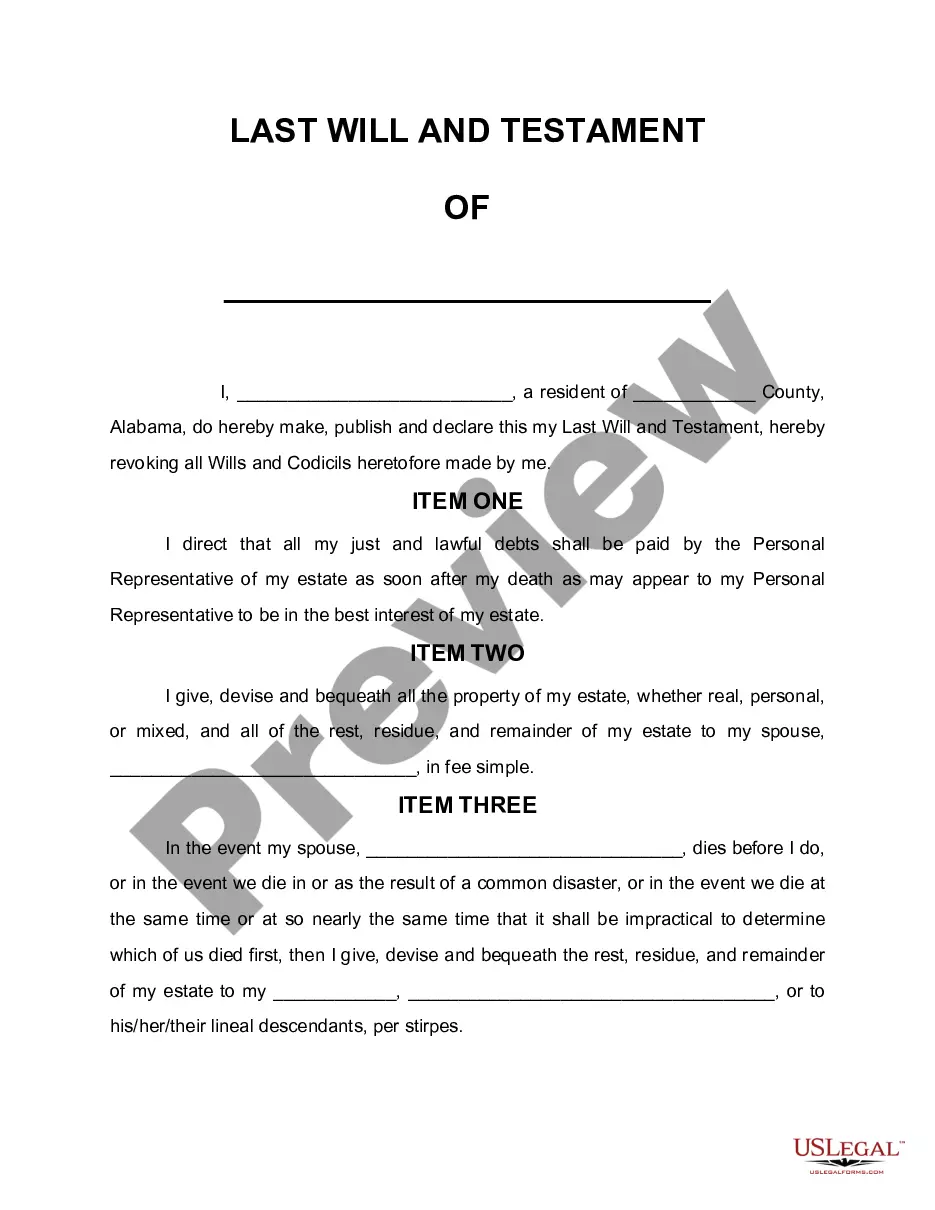
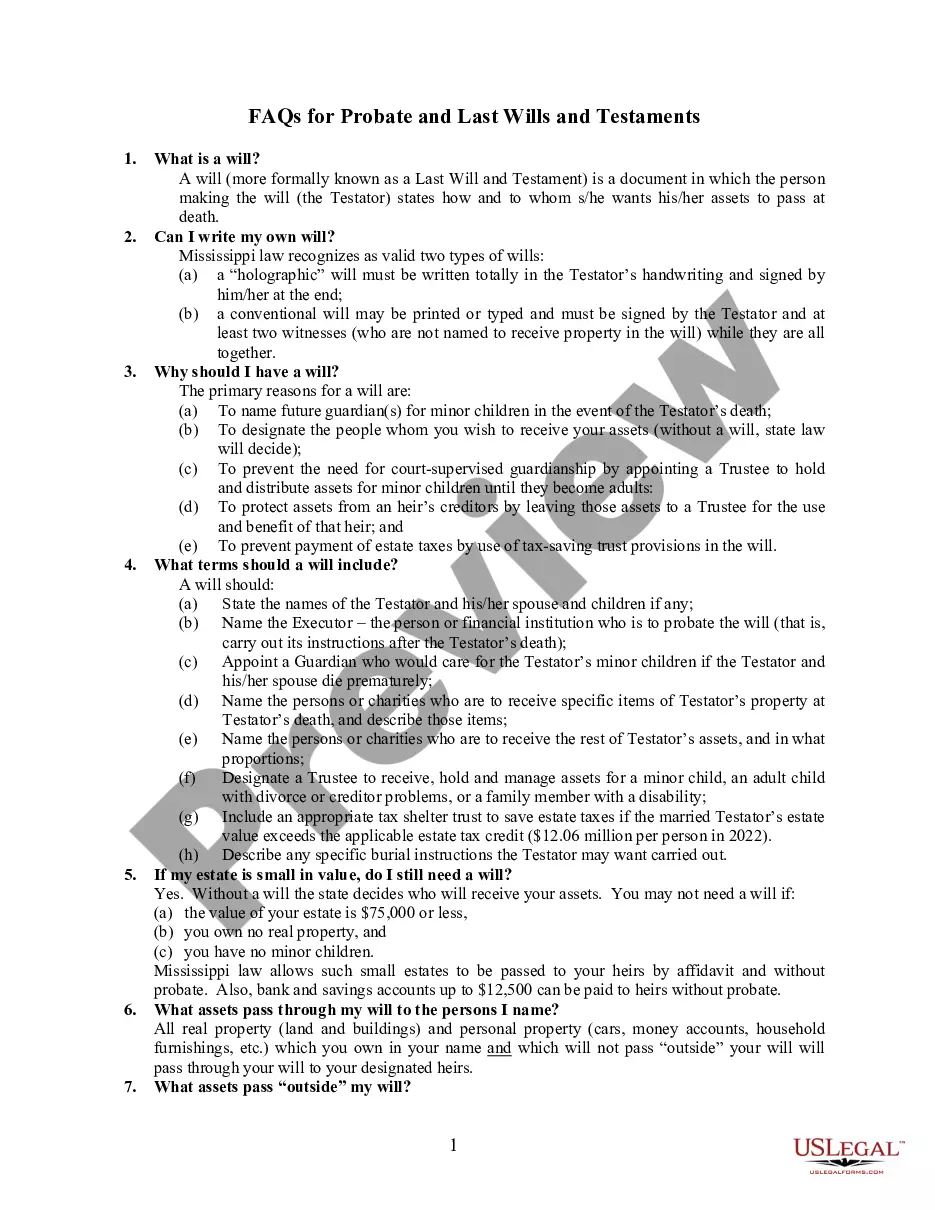
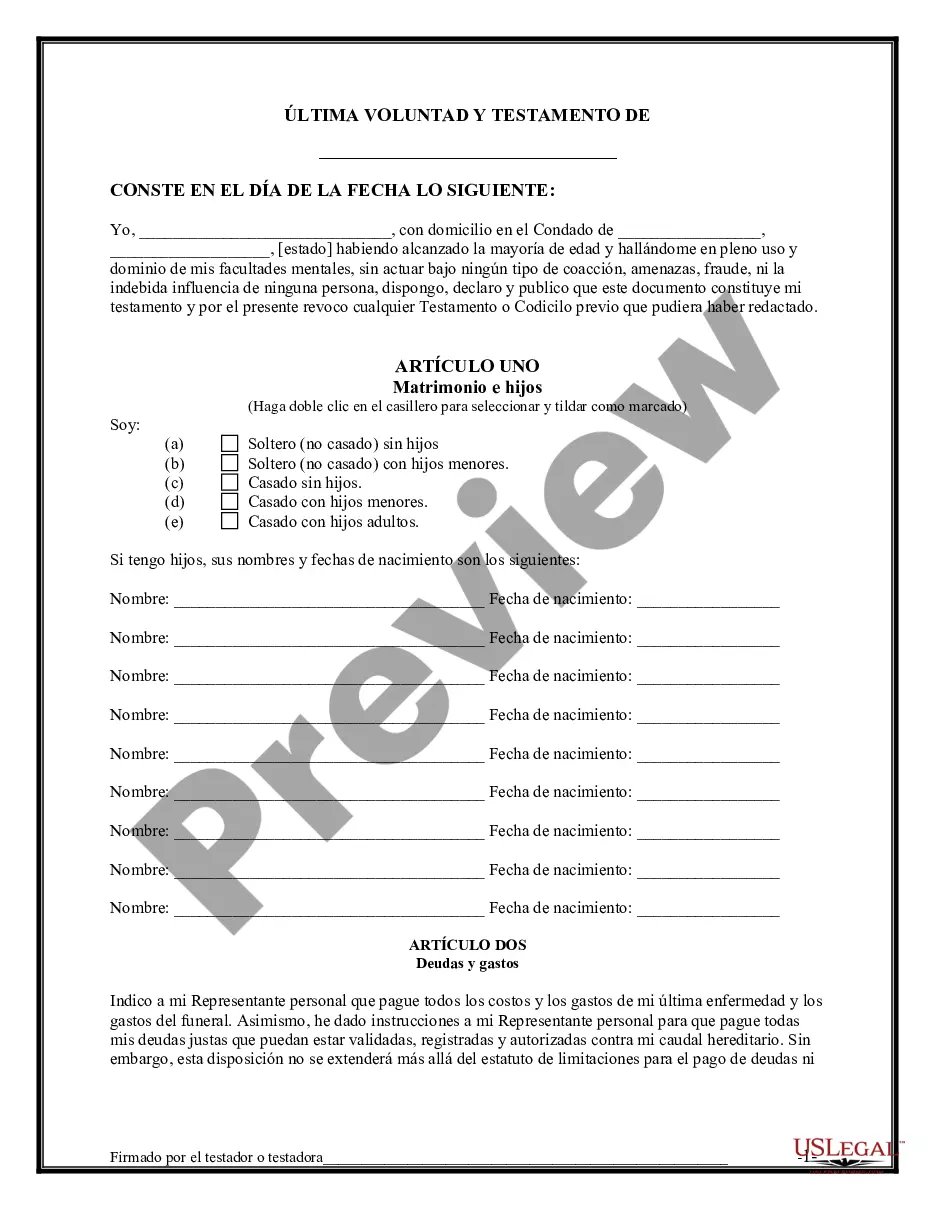
The Last Will and Testament is a legal document that details how a person's assets and property will be distributed after their death. It designates a personal representative or executor to oversee the distribution of the estate and outlines specific bequests to beneficiaries, including provisions for a spouse and minor children. This form is essential for ensuring that your wishes are honored and provides clarity for your loved ones during a difficult time.
What’s included in this form
- Revocation of previous wills and codicils.
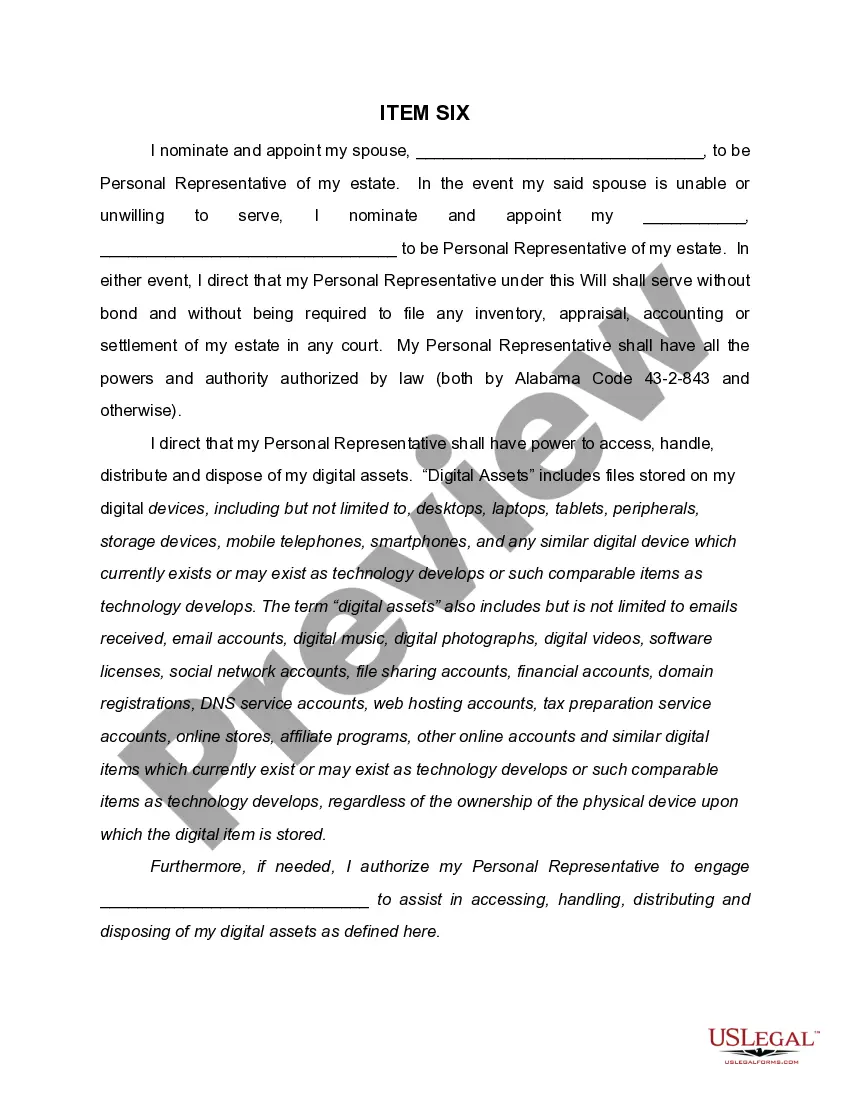
- Appointment of a personal representative to manage the estate.
- Transfer of property to specified beneficiaries, including provisions for a spouse.
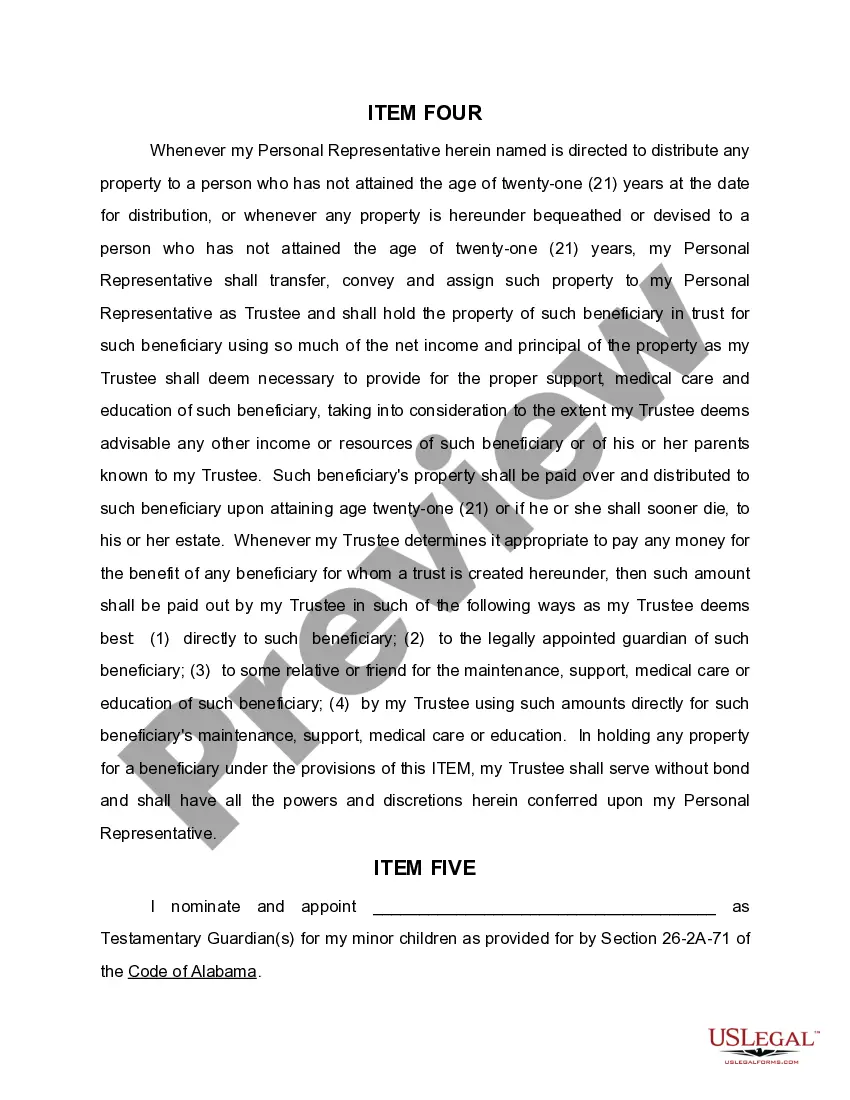
- Establishment of a trust for beneficiaries under the age of twenty-one.
- Designation of testamentary guardians for minor children.
- Provisions for handling digital assets after death.

When this form is needed
This form should be used when an individual wants to dictate how their assets will be distributed upon their death. It is particularly important for those with significant property, children, or specific wishes regarding their estate. Creating a Last Will and Testament can help avoid disputes among family members and ensures that the individual's wishes are followed accurately.
Who can use this document
- Individuals with children or dependents.
- People who own property or substantial assets.
- Those who want to specify guardians for minor children.
- Any adult over the age of eighteen who wants to ensure their wishes are honored after death.
Instructions for completing this form
- Identify yourself as the testator by adding your name and county of residence.
- List all debts to be paid by your personal representative.
- Specify your beneficiaries and how you wish to distribute your estate.
- Designate a personal representative and guardians for any minor children.
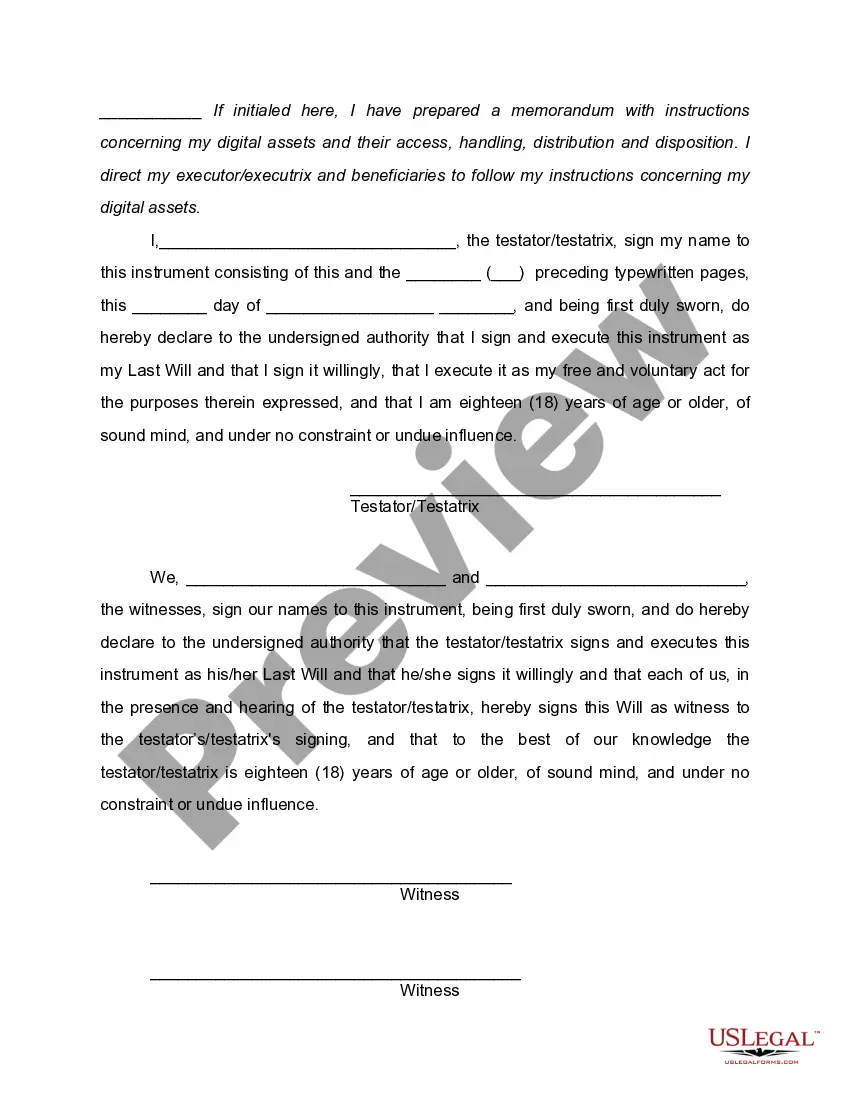
- Sign the document in front of two witnesses and a notary public to validate the will.
Notarization guidance
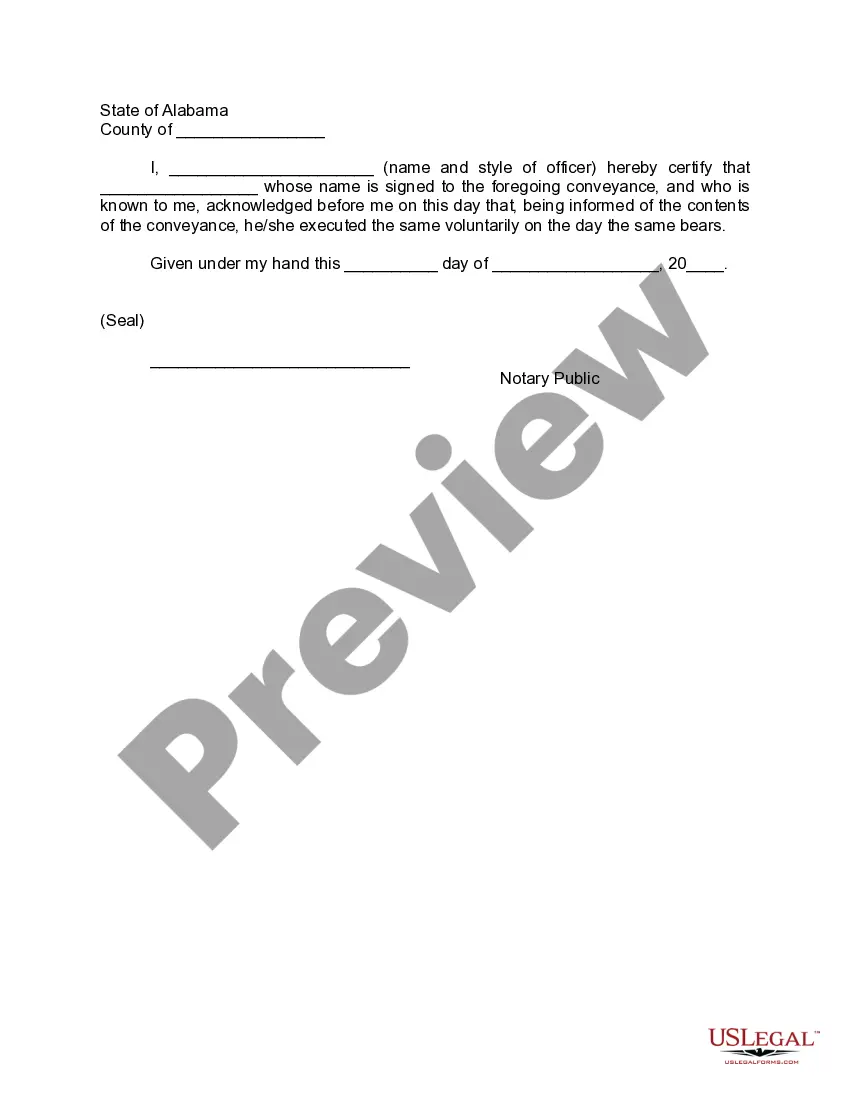
Yes, this form must be notarized to be legally valid. Notarization ensures that the document is authenticated and recognized by the courts. US Legal Forms provides integrated online notarization, allowing you to securely notarize your will via video call at your convenience.
Get your form ready online
Our built-in tools help you complete, sign, share, and store your documents in one place.
Make edits, fill in missing information, and update formatting in US Legal Forms—just like you would in MS Word.
Download a copy, print it, send it by email, or mail it via USPS—whatever works best for your next step.
Sign and collect signatures with our SignNow integration. Send to multiple recipients, set reminders, and more. Go Premium to unlock E-Sign.
If this form requires notarization, complete it online through a secure video call—no need to meet a notary in person or wait for an appointment.
We protect your documents and personal data by following strict security and privacy standards.

Make edits, fill in missing information, and update formatting in US Legal Forms—just like you would in MS Word.

Download a copy, print it, send it by email, or mail it via USPS—whatever works best for your next step.

Sign and collect signatures with our SignNow integration. Send to multiple recipients, set reminders, and more. Go Premium to unlock E-Sign.

If this form requires notarization, complete it online through a secure video call—no need to meet a notary in person or wait for an appointment.

We protect your documents and personal data by following strict security and privacy standards.
Typical mistakes to avoid
- Failing to have the will signed in front of the required witnesses.
- Not clearly identifying beneficiaries, which can lead to disputes.
- Neglecting to update the will after major life events, such as marriage or the birth of children.
- Using outdated language or terms that may not comply with current laws.
Advantages of online completion
- Easy accessibility for downloading and filling out the form at your convenience.
- Editability to customize provisions according to your specific needs.
- Guidance based on current legal standards to ensure compliance and validity.
Key takeaways
- A Last Will and Testament outlines how your assets will be distributed after your death.
- It must be witnessed and notarized according to Alabama law.
- The form enables the appointment of an executor and guardians for minor children.
- Updating your will regularly ensures your wishes are accurately reflected.
Looking for another form?

Form popularity
FAQ
Decide what property to include in your will. Decide who will inherit your property. Choose an executor to handle your estate. Choose a guardian for your children. Choose someone to manage children's property. Make your will. Sign your will in front of witnesses. Store your will safely.
A last will and testament in Alabama must be in writing and signed by the testator (the person writing the will), or at the testator's direction and in his or her presence. The will also has to be witnessed and signed by at least two people.
Filing fees and court costs for probating a will differ based on where the case must be filed. For example, the filing fee to probate a will is about $57.00 in Jefferson County and $47.00 in Madison County, Alabama.
Yes, handwritten or holographic wills are valid in California.
How to probate a will in Alabama depends on the validity of the document, which in turn depends on a set of rules known as testamentary formalities. These rules require the will to be (a) in writing, (b) signed by the person making it (testator) or someone in the testator's presence and under his or direction, and (c
Alabama does not recognize oral (nuncupative) wills. Also, unlike some other states, Alabama does not permit handwritten and unwitnessed (holographic) wills, based on the legal requirement that all wills in Alabama be signed and witnessed by two people to be a valid will.
Create the initial document. Start by titling the document Last Will and Testament" and including your full legal name and address. Designate an executor. Appoint a guardian. Name the beneficiaries. Designate the assets. Ask witnesses to sign your will. Store your will in a safe place.
A last will and testament in Alabama must be in writing and signed by the testator (the person writing the will), or at the testator's direction and in his or her presence. The will also has to be witnessed and signed by at least two people.
A Last Will and Testament is a legal document that provides for the distribution of a person's assets at death. Assuming that probate is necessary and that no alternatives to probate are available, all wills must be admitted to probate before they are considered to be effective.